


The western bay of Naples hides a quieter, moodier twin to the Amalfi Coast: the Phlegraean Fields, a volcanic landscape of crater lakes, fumaroles and Roman ruins. Two of its most atmospheric corners are Lake Averno (Lago d’Averno), long feared by the ancients as a gateway to the underworld, and Lake Fusaro (Lago Fusaro), a brackish lagoon crowned by the elegant Casina Vanvitelliana hunting lodge. Both are within easy reach of central Naples, both feel worlds away from the city, yet they offer very different kinds of escape. Understanding those differences is the key to deciding which one fits your style of trip.
Get the latest updates straight to your inbox!
Understanding the Phlegraean Fields Today
Lake Averno and Lake Fusaro lie inside the wider Campi Flegrei, or Phlegraean Fields, a large volcanic caldera west of Naples. This restless landscape is shaped by past eruptions, geothermal activity and slow ground uplift. Visitors today will notice the low, circular crater rims on the horizon, the smell of sulfur near Pozzuoli and occasional media headlines about earthquake swarms. The reality on the ground is quieter than those headlines suggest, but anyone planning a visit should understand both the appeal and the context.
Italian authorities continuously monitor the area through the National Institute of Geophysics and Volcanology, with a color-coded alert system and detailed civil protection plans. Periodic swarm-like sequences of small tremors have become common in recent years, part of a long phase of unrest that has intensified since around 2005. For travelers, that typically translates into short, localised sensations of shaking rather than ongoing disruption, and daily life in nearby towns like Pozzuoli, Bacoli and Cumae generally continues as usual.
Before you go, it is wise to check the latest advisories from Italian civil protection channels or the municipality websites of Pozzuoli and Bacoli. Hotels and guesthouses in the area are used to fielding questions and can tell you if any trails or craters are temporarily closed. As of mid-2026, there has been no evacuation order and tourism infrastructure continues to operate, but flexibility and situational awareness are essential in a dynamic volcanic region.
Within that framework, both Lake Averno and Lake Fusaro offer very human, very grounded experiences: lakeside walks, small trattorie serving local seafood and wine, and glimpses of ancient history half-hidden in reeds or framed by modern apartment blocks. The question is which atmosphere you want to sink into.
Lake Averno: Brooding Crater Lake for Walkers and Myth Lovers
Lake Averno sits in a near-perfect circular crater just inland from the Tyrrhenian coast, a short drive from Pozzuoli and the archaeological site of Cumae. In antiquity it was known as Avernus and feared for vapors that seemed to kill birds mid-flight, inspiring the Latin name derived from “without birds.” Roman poets placed the entrance to Hades here. Today, the atmosphere is gentler, but the dark waters and encircling slopes still feel dramatic, especially under heavy clouds or in winter light.
For many travelers, the highlight is the flat walking path that loops around the shore, roughly 3 kilometers long. It is manageable for most fitness levels and can be walked in under an hour, though you will want to add time to stop at viewpoints or explore side trails. Parts of the route have a proper paved or compacted surface, while other sections feel more like a country lane with reeds and vineyards on one side and the lake on the other. On weekends you will share the path with local joggers, families pushing strollers and cyclists doing easy laps.
Lake Averno also pairs naturally with nearby archaeological sites. To the west, you can reach the ruins of Cumae, one of the oldest Greek settlements in Italy, where the fabled Cumaean Sibyl delivered prophecies. Some visitors choose to take a morning walk around the lake, then drive or take a taxi 10 to 15 minutes to Cumae for an afternoon among temples, caves and acropolis views. Others link Averno to the Roman port structures at Miseno or the underwater archaeological park at Baia. If you are based in Naples, a common real-world itinerary is a half-day loop by rental car or hired driver: Naples – Cumae – Lake Averno walk – seafood lunch on the coast – return to the city.
Facilities around Lake Averno are modest rather than resort-like. Expect a handful of casual restaurants and bars along the road that skirts the crater, some with lakeside terraces where a coffee costs roughly what you would pay in central Naples, perhaps 1.50 to 2.00 euros for an espresso and 3 to 5 euros for a glass of local Falanghina wine. Parking is a mix of small free lay-bys and informal paid lots run by local businesses, usually just a few euros for the day. There are no large hotels directly on the shore, but agriturismi and B&Bs in the surrounding countryside cater to travelers seeking a quiet, semi-rural base.
Lake Fusaro: Elegant Lagoon for Architecture Fans and Slow Strollers
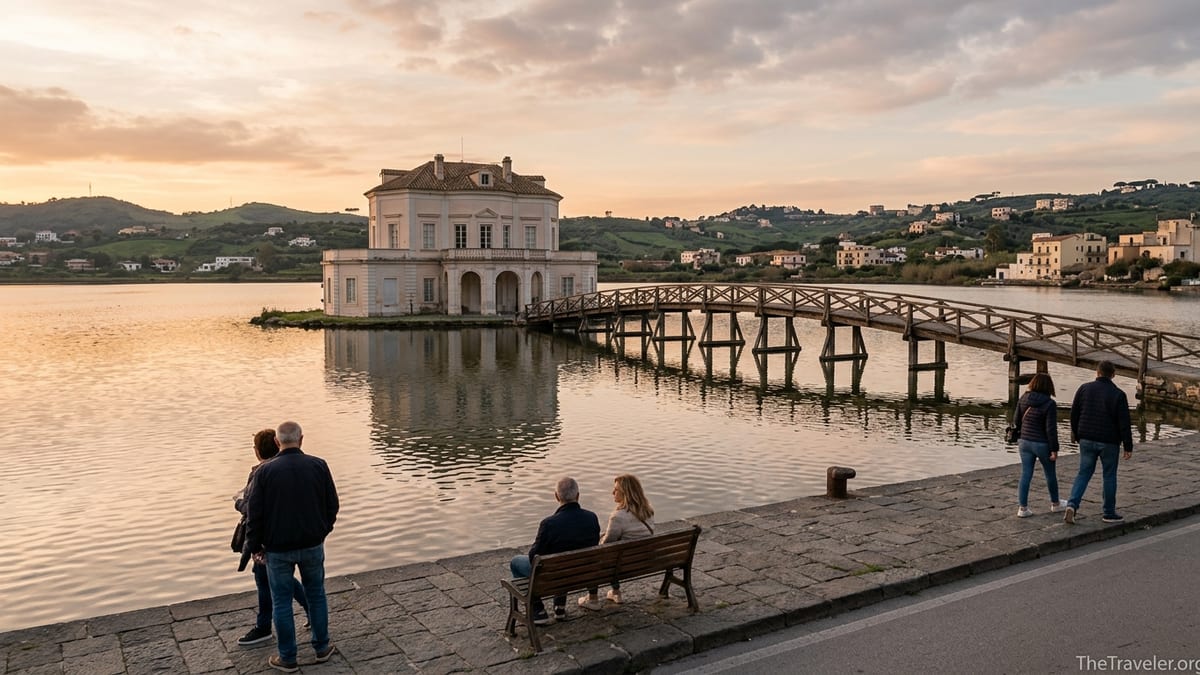
About 10 kilometers to the south, near the town of Bacoli, Lake Fusaro has a completely different personality. This is a shallow coastal lagoon separated from the sea by a strip of land, connected historically to fish farming and shellfish harvesting. The star of the scene is the Casina Vanvitelliana, an 18th-century Bourbon hunting lodge that seems to float on the water, linked to the shore by a curving wooden bridge. Its pale walls and Baroque curves make it one of the most photographed buildings in the region.
If Lake Averno feels like an inward-facing crater, Fusaro feels more open and social. Locals come here in the late afternoon and early evening to stroll the lakeside promenade, sit on benches facing the small island and watch the light change. On a typical summer weekday you might see retirees chatting on the terrace of a café, teenagers taking phone photos from the bridge and couples posing for engagement portraits. On weekends, especially when the weather is mild, the area can fill with wedding parties using the Casina as a backdrop.
The Casina Vanvitelliana itself now operates as part historic house, part small exhibition and event venue. Opening hours have evolved in recent years, but a common pattern has been late-morning to early-evening access with extended hours on weekends, and the municipality of Bacoli has periodically announced daily opening schedules in spring and summer. Entrance tickets are usually modest, often in the low single digits per person, though prices can vary for special events or guided tours. You will find the current schedule posted at the entrance gate and on local noticeboards in town.
Food at Fusaro leans toward simple seaside fare. A typical evening might begin with a walk along the lake, continue with an aperitivo at a bar on Via Miseno or Via Fusaro and end at a trattoria serving spaghetti alle vongole made with clams from the surrounding waters. Expect pasta dishes in the 10 to 15 euro range and carafes of local white wine for around the same. Unlike Averno, which feels almost rural, Fusaro sits within a more urbanised strip of coastal development, so you have quicker access to buses, bakeries, pharmacies and casual street food like fried pizza or cuoppi of mixed fried seafood.
Access, Transport and Practicalities
Most international visitors base themselves in Naples and treat both lakes as half-day or day trips. By car, Lake Averno is roughly a 30 to 40 minute drive from central Naples in light traffic, using the Tangenziale ring road toward Pozzuoli and then local roads toward Cuma. Lake Fusaro, closer to Bacoli, takes a similar amount of time, though congestion can build on summer weekends when Neapolitans head for the beaches of Miseno and Miliscola.
Public transport is possible, though slower and more fragmented than a straight drive. For Lake Averno, travelers typically take the Cumana railway from Naples toward Torregaveta and disembark at stations such as Lucrino or Cuma, then walk or take a short taxi ride inland. The walk from Lucrino station to the lake takes around 25 to 30 minutes along a mixture of sidewalks and roadside verges. For Fusaro, the Torregaveta terminus and regional buses or local trains can get you close, but many visitors opt for a taxi from Pozzuoli or even a rideshare from Naples to simplify the journey, especially in hot weather.
Given the region’s volcanic unrest, it is sensible to think about logistics through a safety lens as well as convenience. Both Averno and Fusaro sit in populated areas with road access in multiple directions, which is reassuring if you are uneasy about being deep in the caldera. At the same time, they are close enough to sites like Solfatara crater and the harbor of Pozzuoli that you will feel very much inside the volcanic landscape rather than merely observing it from a distance. Check that your phone works with Italian networks, download offline maps and note local landmarks such as churches, schools and main squares that would serve as gathering points in the unlikely event of an emergency alert.
In terms of timing, many travelers find late afternoon into sunset to be ideal at both lakes, avoiding midday heat and harsh light. At Lake Averno, that means golden hour rays skimming the crater rim and reflecting off the water. At Fusaro, it means the Casina Vanvitelliana glowing softly against a pastel sky. If you plan to combine lake time with major archaeological sites like Cuma or Baia, arriving mid-morning and moving gently through the day allows room for a long lunch, unhurried walks and photo stops without the sense of rushing before closing time.
Atmosphere and Activities: Which Vibe Fits You?
Choosing between Lake Averno and Lake Fusaro ultimately comes down to the kind of mood and pace you want from your escape. Averno appeals to travelers who like landscapes that feel slightly wild around the edges: reeds rustling in the wind, vineyards clinging to the crater walls, small clusters of houses set back from the path rather than a continuous line of shops and bars. It invites introspection. Solo travelers and couples who enjoy quiet walks, reading on a bench, birdwatching or photography will likely feel at home here.
Fusaro, by contrast, lends itself to a more social, strolling kind of day. The Casina Vanvitelliana offers a clear focal point, and the surrounding neighborhood gives you more obvious places to linger: gelato parlors, snack stands, waterfront pizzerias. It suits small groups of friends or families who enjoy people-watching and like to mix a bit of culture and architecture with relaxed eating and drinking. Young photographers might spend an hour experimenting with reflections of the Casina, while children feed ducks along the shore under a parent’s eye.
Neither lake is a classic swimming destination on the level of Amalfi or Capri’s beaches. Water quality and safety regulations can fluctuate, and both lakes have histories tied to fish farming and, in the case of Averno, occasional fish-kill events linked to overturn and gas release. Locals are more likely to come here to walk, cycle, jog or sit than to lay out towels and dive in. If your priority is a beach day, you are better off continuing to the open seaside at Miseno, Miliscola or Lucrino and treating Averno or Fusaro as scenic side trips.
A practical example helps clarify the difference. Imagine you have one free afternoon in the area. If you choose Averno, you might park near the lakeshore, walk a full loop in about an hour, detour to a viewpoint on the crater rim, then drive to Cuma or Baia for ruins and finish with dinner at a seaside restaurant. If you choose Fusaro, you might start with coffee on the promenade, cross the wooden bridge to tour the Casina Vanvitelliana, sit on a bench for a while, then walk or drive a short distance to Bacoli’s town center for aperitivo and pizza before returning to Naples after dark.
Safety, Seasonality and Current Context
Visitors often ask whether it is safe to visit the Phlegraean Fields at all given recent news about accelerating unrest at Campi Flegrei. The honest answer is nuanced. This is one of Europe’s most closely watched volcanic systems, with scientists tracking deformation, gas emissions and seismic activity in real time. Studies published between 2024 and 2026 point to ongoing uplift and changes in the underground system, and Italian civil protection authorities periodically review emergency plans for the wider Naples area.
For travelers, the relevant question is not whether the caldera is completely quiet, but whether authorities deem everyday activities like commuting, shopping and local tourism acceptable under the current alert level. As of June 2026, residents continue to live and work in Pozzuoli, Bacoli and the neighborhoods around Lake Averno and Lake Fusaro. Businesses open their doors, schools operate in term time and local visitors spend weekends around the crater lakes. If the situation were to escalate to the point where authorities considered evacuation necessary, you would see clear official communication well before the average holiday begins.
Seasonality affects the feel of both lakes. In high summer, particularly July and August, daytime temperatures can be very hot, walking paths have minimal shade and traffic to the coastal strip intensifies. Early morning and late evening become the most comfortable times to visit. In spring and autumn, the lakeside paths are greener, the air clearer and the crowds thinner. Winter can be atmospheric in a different way: mist on Lake Averno, sharp light on the Casina Vanvitelliana, and a quieter, almost melancholy mood that suits travelers who do not mind cool air in exchange for solitude.
Common-sense precautions go a long way. Bring water, sunscreen and a hat in warmer months; check local news or your hotel reception for any updates on volcanic activity; and trust your instincts. If a swarm of small quakes happens while you are in the area, you may feel brief shaking underfoot or see water rippling on the lake surface. Locals will often shrug and carry on, but if you feel anxious, move to an open area away from old masonry and wait a few minutes. Having a pre-planned route back to your accommodation or to a main transport hub can provide extra peace of mind.
Who Should Choose Lake Averno vs Lake Fusaro?
If you are a history enthusiast, hiker or contemplative traveler, Lake Averno is likely your better fit. Its proximity to Cuma, Baia and other Roman and Greek sites makes it easy to weave into a culture-heavy itinerary. You could spend one day exploring Cuma and Averno, another in Baia’s underwater park and museum, and a third in Pozzuoli’s amphitheater and Solfatara surroundings, creating a deep dive into ancient Campania with the crater lake as one of several stops.
Nature-focused travelers also tend to prefer Averno. The circular crater creates a contained micro-landscape where you can walk without constantly crossing roads or passing dense development. Birdlife changes with the seasons, and vineyards on the crater slopes produce local wines you may taste in nearby agriturismi. If your idea of recovery after time in crowded Naples is a quiet loop walk followed by a glass of white wine overlooking still water, Averno delivers that with minimal fuss.
Lake Fusaro, on the other hand, best suits travelers who are drawn to architecture, scenic photography and gentle, sociable strolling. The Casina Vanvitelliana is one of those places where even a casual phone snap looks striking, especially at sunset when the sky reflects on the water. Its role as a venue for exhibitions and weddings means there is often some kind of visual interest: a bride in a white dress crossing the bridge, a small temporary art show inside, or local musicians playing nearby.
Families with children or multigenerational groups may also find Fusaro easier. The promenade offers places to sit, snacks are never far away and short attention spans are less of a problem when there is a clear architectural landmark to focus on. Combining Fusaro with a beach afternoon at Miseno or a panoramic drive to the cape of Capo Miseno creates a varied day without long stretches of walking that might tire younger or older travelers.
The Takeaway
Lake Averno and Lake Fusaro are two facets of the same volcanic story, yet they feel markedly different when you stand on their shores. Averno is the introspective, myth-laden crater: a place for quiet circuits on foot, reflections on history and a sense of being cradled inside the caldera. Fusaro is the open, sociable lagoon: a stage for the Casina Vanvitelliana, for evening passeggiate and for snapshots that look lifted from a glossy travel feature.
If you only have time for one and value solitude, nature and proximity to major archaeological sites, lean toward Lake Averno. If you prefer elegant architecture, gentle social energy and easy access to cafés and coastal drives, choose Lake Fusaro. With more time, visiting both in different lights and on different days reveals how diverse the Phlegraean Fields can be within a short radius.
Above all, remember that you are visiting an extraordinary living landscape. The same forces that created these lakes continue, deep below your feet, to shape the Campi Flegrei. Staying informed, flexible and respectful of local guidance will allow you to enjoy the beauty of Lake Averno or Lake Fusaro while acknowledging, rather than ignoring, the restless earth that made them.
FAQ
Q1. Is it safe to visit Lake Averno and Lake Fusaro given the Campi Flegrei unrest?
Authorities continuously monitor the area, and as of June 2026 everyday life and tourism continue around both lakes. That said, this is an active volcanic region in a phase of unrest, so it is essential to check official Italian civil protection updates before your trip, follow any local instructions and be prepared to adjust your plans if alert levels change.
Q2. Which lake is better if I only have half a day?
If you have a single half-day and enjoy walking and history, Lake Averno is usually more rewarding because you can combine a loop around the crater with a quick visit to Cuma or Baia. If you prefer an easy stroll, cafés and a striking architectural landmark for photos, Lake Fusaro with the Casina Vanvitelliana is the better choice.
Q3. Can I swim in Lake Averno or Lake Fusaro?
Neither lake is a mainstream swimming spot. Water quality, local regulations and the lakes’ roles in fish farming mean that swimming is not generally promoted or set up with facilities. If you want to swim, head instead to nearby seaside areas such as Miseno, Miliscola or Lucrino and treat Averno or Fusaro as walking and sightseeing destinations.
Q4. Do I need a car to visit these lakes from Naples?
A car gives you the most flexibility and is the easiest way to link the lakes with archaeological sites in a single day. However, it is possible to reach both areas using the Cumana railway from Naples plus local buses or taxis. Public transport will add time and some walking, so if you have limited mobility or are traveling with small children, hiring a car or arranging a driver is often more comfortable.
Q5. How much time should I plan at each lake?
At Lake Averno, plan around two to three hours for a relaxed lap, photo stops and a drink or snack, longer if you also visit nearby ruins. At Lake Fusaro, one to two hours is enough for a stroll along the shore, a visit to the Casina Vanvitelliana when open and a coffee or aperitivo, though you may linger longer if combining it with a beach or town visit.
Q6. Are there good places to eat near Lake Averno and Lake Fusaro?
Yes. Around Lake Averno you will find a small number of trattorie and agriturismi serving local wines and Campanian cuisine, often with views of the crater. Near Lake Fusaro, and especially in nearby Bacoli and along the coast toward Miseno, there is a wider choice of pizzerias, seafood restaurants and casual bars ideal for aperitivo with a view of the lagoon or sea.
Q7. Which lake is more suitable for families with children?
Lake Fusaro is often more practical for families because of its promenade, benches, easy access to snacks and the visual appeal of the Casina Vanvitelliana. Lake Averno can be enjoyable too, especially for older children who like walking and hearing about myths, but the full circuit may be long for very young kids and there are fewer immediate distractions.
Q8. Can I visit both lakes in one day?
Yes, visiting both in a single day is realistic if you have a car. A common pattern is to start with a late-morning walk at Lake Averno, have lunch near Cuma or on the coast, then drive to Lake Fusaro for a late-afternoon visit and sunset at the Casina Vanvitelliana. Using only public transport, combining both in one day is possible but more tiring.
Q9. What should I wear and bring when visiting?
Wear comfortable walking shoes suitable for mixed surfaces, bring water, sunscreen and a hat in warm months, and a light jacket in cooler seasons. Because this is a volcanic area, it is wise to carry a fully charged phone, offline maps and a small daypack with basic necessities so you can move comfortably and safely if conditions change.
Q10. Which lake offers better views and photography opportunities?
Lake Averno offers moody crater views, reflections and a sense of immersion in the landscape, especially at sunrise or on overcast days. Lake Fusaro provides more iconic single-frame shots thanks to the Casina Vanvitelliana, particularly at golden hour and sunset. Serious photographers often enjoy capturing both: Averno for atmosphere, Fusaro for architecture and reflections.