


Most visitors treat Nice’s Musiciens district as a practical place to sleep: quiet, central, and full of mid-range apartments. That is true, but it also undersells one of the city’s most characterful neighborhoods. With Belle Epoque facades, leafy streets named after great composers, and an easy walk or tram ride to almost everywhere you want to be, Musiciens is worth experiencing in its own right. Here is how to turn this elegant quarter into a highlight of your stay instead of just a convenient address on the booking site.
Get the latest updates straight to your inbox!
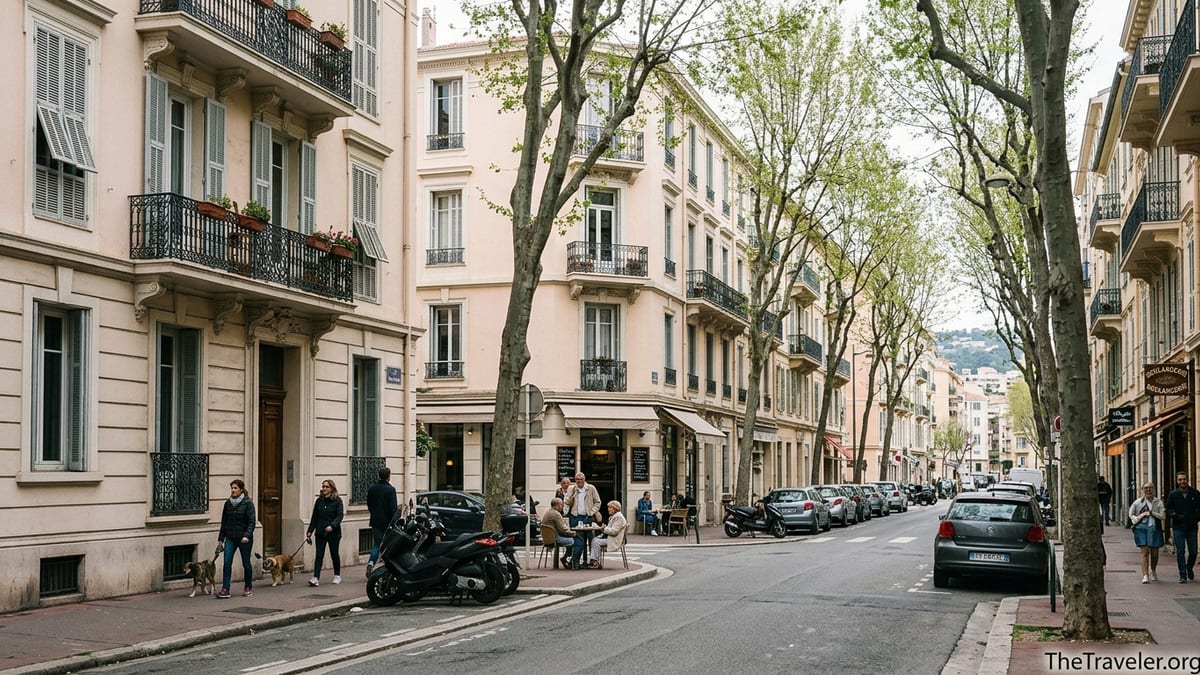
Get Your Bearings in an Elegant, Quiet Quarter
Musiciens, sometimes labelled Thiers–Musiciens on local maps and estate agents’ windows, sits just north of the Promenade des Anglais and west of Avenue Jean Médecin. It is a compact, mostly residential grid where streets like rue Verdi, rue Rossini, rue Gounod and rue Berlioz honor the composers who give the area its name. For travelers, this means you are within a 10 to 15 minute walk of the beach and Nice-Ville train station, yet the streets feel calmer and more local than the Old Town or seafront.
The personality of the district comes from its late 19th and early 20th century architecture. Many buildings are Belle Epoque or early Art Deco apartment palaces with wrought-iron balconies, ornate stonework and high-ceilinged stairwells. Walking along rue Rossini or around Place Mozart you will pass pastel facades with carved masks, floral motifs and curved corner turrets. Even if you are not staying in one of them, a slow evening stroll lets you peek into marble-floored lobbies and internal courtyards that recall the days when wintering European aristocrats flocked to Nice.
Because Musiciens is primarily residential, visitors often assume there is “nothing to do.” In reality, the lack of big sights is an advantage. You are free from coach tours and souvenir shops, and you get a snapshot of everyday city life: parents walking children home from school, dogs trotting beside their owners, neighbors chatting outside boulangeries. It is an excellent base if you value sleep, safety and a calm atmosphere but still want to be able to walk to a morning swim or a glass of rosé on the seafront.
Musiciens is also well connected. Tram line 2, which runs between Nice Airport and the eastern port district, stops at Alsace-Lorraine and Jean Médecin, both a short stroll from most Musiciens addresses. That makes it easy to land at the airport, ride the tram for about 20 minutes, and walk a few blocks to your rental without needing a taxi. From Nice-Ville station on avenue Thiers, regional trains will take you to Cannes, Antibes, Menton or Monaco in 20 to 40 minutes, ideal for day trips.
Stroll the Architecture: Rue Rossini, Place Mozart and Belle Epoque Details
The simplest and most rewarding thing to do in Musiciens is to treat it as an open-air architecture museum. Start late afternoon on rue Rossini, one of the district’s emblematic streets. Here you will see a succession of facades that show off the neighborhood’s evolution: Belle Epoque buildings with curved balconies and ceramic name plaques, later Art Deco blocks with geometric ironwork, and postwar infill that reveals how demand in central Nice has grown.
Pause at corners where rue Rossini meets streets like rue Gounod or rue Verdi to look up at rooflines. Many corner buildings have small domes, mansard roofs or sculpted caryatids that are easy to miss if you hurry past. The interplay between the decorative older facades and the more sober 1930s and 1950s buildings tells the story of Nice’s shift from elite winter resort to a year-round city where the middle class also needed homes.
Continue towards Place Mozart, a small, tree-shaded square that functions as one of the quarter’s living rooms. The architecture around the square is a mix of bourgeois apartment blocks with balconies that catch the afternoon sun. In the early evening, you may see residents having an aperitif on their balconies or children playing under the plane trees. It is a lovely spot to sit on a bench with a takeaway coffee or a pastry and soak up the feeling of being in a lived-in city rather than a pure resort.
If you are interested in architectural history, it is worth planning a self-guided loop along rue Berlioz, rue Gounod and avenue Georges Clemenceau. Look for details like wrought-iron elevator cages visible through front doors, original ceramic floor tiles in entryways, and preserved name plaques that give the building’s original romantic name rather than a street number. You will notice how the Belle Epoque love of ornament gradually gave way to the cleaner lines of Art Deco, while still keeping the generous balconies and tall windows that make these apartments so desirable today.
Live Like a Local: Cafes, Bakeries and Everyday Food Stops
One of the joys of basing yourself in Musiciens is the everyday food scene. You may not find high-profile destination restaurants within the grid of composer streets, but you will find what you actually need: good boulangeries, neighborhood cafes and small supermarkets where locals do their daily shopping. Prices are often gentler than on the seafront or in the Old Town, and there is little of the hard sell that can make heavily touristed areas tiring.
Start your day at a corner cafe on rue Verdi or rue Gounod, where a croissant and espresso at the counter will typically run to around 3 to 4 euros. Many places still offer a simple formule petit déjeuner that includes a hot drink, orange juice and tartine for roughly 6 to 8 euros. Standing at the zinc bar, listening to regulars order by name and watching the barista chat with people on their way to work, you immediately get a sense of local rhythm.
For picnic supplies, small supermarkets and fruit-and-vegetable shops dotted along streets like rue de France and boulevard Gambetta sell everything from olives to fresh tomatoes, cheeses and cured meats. It is easy to assemble a beach picnic for two for under 15 euros: a baguette, a tub of tapenade, a wedge of cheese, some sliced saucisson and a couple of peaches in season. As a bonus, you avoid the inflated prices at many seafront kiosks.
In the evening, Musiciens is more subdued than Old Town, but that suits many travelers. Instead of loud bars, you get wine shops and casual bistros. A local brasserie along rue de France or near boulevard Victor Hugo will often offer a two- or three-course menu of Niçoise staples such as daube (beef stew), stuffed vegetables and panisses (chickpea fritters) for about 22 to 30 euros. Make a habit of reserving for 8 p.m., then enjoy the gentle walk back through quiet streets under the orange glow of streetlamps.
Slow Travel from a Strategic Base: Beach, Promenade and Day Trips
Using Musiciens as a base is not about staying put, it is about giving yourself a calm, strategic home point. From most Musiciens addresses, you can reach the Promenade des Anglais in roughly 10 to 15 minutes on foot. A common routine for visitors staying here is to head down for a morning swim before breakfast. The central section of the beach near Magnan and the western end of the Promenade is easily reached by walking along rue de France, which runs just south of the district and parallel to the seafront.
The pebbly public beaches along the Promenade cost nothing to enter, and you can rent a lounger and umbrella at a private beach club if you want more comfort. Expect to pay around 25 to 40 euros per person for a half- or full-day lounger in high season, depending on the location and services, though simple public areas are always free. After a swim, you can walk home via a different route to explore new streets and cafes.
For day trips, Nice-Ville station on avenue Thiers is a major asset of staying in Musiciens. From the station, regional TER trains serve almost the entire Riviera coast. You can reach Antibes in about 20 minutes, Cannes in roughly 30 to 40 minutes, Villefranche-sur-Mer in under 10 minutes and Menton in around 40 minutes, often for under 10 euros one way if you book standard second-class tickets. This makes it perfectly feasible to spend the day wandering Antibes’ old ramparts or Cannes’ market, then be back in your calm neighborhood by early evening.
The tram network supplements those train links. Tram line 2 runs from the airport to Port Lympia via underground stops such as Alsace-Lorraine and Jean Médecin. A single tram ticket costs around 1.70 euros, with day passes available. For example, you could ride the tram east in the evening to the port area for dinner by the water, then return to Musiciens in under 15 minutes door to door. Having that connectivity while still being able to sleep in a quiet street is a major advantage over staying directly on the Promenade or in the nightlife-heavy Old Town.
Cultural Detours: From Classical Names to Contemporary Nice
Even if Musiciens does not contain blockbuster museums, its personality is deeply shaped by culture. Many of the streets are named after composers who either stayed in Nice or were admired by the city’s 19th-century elites. Giuseppe Verdi, Hector Berlioz, Gounod, Auber, Beethoven, Paganini and others are all honored on street signs. Knowing this makes a simple walk feel like a themed promenade through European music history.
To connect those composer names to actual music, plan time at Nice’s wider cultural institutions, easily reachable from Musiciens. The Opéra de Nice, in the Old Town near the seafront, programs opera, ballet and symphonic concerts throughout the year. Tickets for less sought-after performances or upper-balcony seats can sometimes be found for roughly 15 to 30 euros, which is an accessible way to spend an evening if you are curious but not a dedicated aficionado.
For visual art, the city’s major museums such as the Musée Matisse in Cimiez and the Museum of Modern and Contemporary Art (MAMAC) near Place Garibaldi are straightforward to reach by bus or tram in 20 to 30 minutes from Musiciens. Admission fees for municipal museums are generally modest compared with other European cities, and the combination of a morning at a museum and an afternoon at the beach works particularly well in spring or autumn.
Closer to home, pay attention to the smaller-scale cultural life in the neighborhood: a piano recital advertised on a flyer in a local church, a photography exhibition in a small gallery just off boulevard Victor Hugo, or a jazz duo playing at a hotel bar on the edge of Carré d’Or. While Nice is not as saturated with live music as some larger cities, informal cultural offerings often appear in these central districts during festival periods such as Nice Jazz Festival in July or around Christmas.
Practical Tips: Safety, Budgets and Choosing the Right Street
For many travelers, the main reason to consider Musiciens is peace of mind. The district is widely regarded as one of central Nice’s safer and quieter areas, especially compared with late-night hotspots closer to Place Masséna or the Old Town. Streets here typically empty out earlier, and most ground floors are residential or small local businesses rather than bars. This makes it a particularly good choice for families, light sleepers and solo travelers who want to walk home at night along calm, well-lit avenues.
That said, not every street feels identical. The closer you get to the busier ends of rue de France or towards the station on avenue Thiers, the more traffic and footfall you will notice. When choosing accommodation, pay attention to how far your address is from major axes and night-time gathering points. A side street off rue Gounod or midway down rue Verdi will generally be quieter than a corner flat directly overlooking a big junction. If noise is a concern, consider asking hosts about double glazing and courtyard-facing bedrooms.
In terms of budget, Musiciens sits in the comfortable middle of Nice’s price spectrum. Holiday rentals and mid-range hotels in Belle Epoque buildings are usually a little cheaper than equivalent options right on the Promenade des Anglais or in the most fashionable part of Carré d’Or, but more expensive than outer districts further from the sea. For a clean, well-located studio or one-bedroom apartment in high season, nightly rates in this area often fall somewhere between 90 and 160 euros, with prices dropping in shoulder seasons like April or October.
Everyday costs are manageable if you embrace the neighborhood’s strengths. Shop at local supermarkets and markets rather than relying on seafront kiosks, use the flat terrain to walk instead of taking taxis, and mix the occasional dinner out with simple meals assembled from bakery goods and market produce. Because you are close to both urban amenities and the seafront, you can design days that feel indulgent without constant spending: a morning swim, an afternoon exploring side streets, then a picnic on your balcony watching the light fade on pastel facades.
The Takeaway
Musiciens will rarely appear at the top of a “must-see in Nice” list, and that is exactly why it works so well as a base. It is central without being chaotic, architectural without being a museum piece, and elegant without being exclusive. Treating it as more than “just somewhere to sleep” opens up a different kind of Riviera experience, one that privileges daily rhythms over checklist tourism.
From morning croissants at a corner cafe to evening walks past Belle Epoque balconies, the neighborhood offers a low-key, authentic backdrop to your time in Nice. With the beach, tram and train station all within easy reach, you can spend your days roaming the coast and your nights in a quiet residential grid that feels like home after only a couple of days.
If you value calm streets, walkability and the chance to see how locals actually live in one of France’s most visited cities, Musiciens is hard to beat. Give yourself at least a few unstructured hours there. Look up at the ornate facades, listen to the muted city sounds from a shaded bench on Place Mozart, and you may find that the best thing about your trip is not a single spectacular sight, but the feeling of belonging, however briefly, to this elegant corner of Nice.
FAQ
Q1: Is the Musiciens district in Nice a good area to stay for first-time visitors?
Yes. Musiciens is central, safe and well connected by tram and train, while remaining quieter than Old Town or the seafront. It is an excellent base if you want easy access to the beach and major sights without staying in the most touristy streets.
Q2: How long does it take to walk from Musiciens to the Promenade des Anglais and the beach?
From most streets named after composers, it takes roughly 10 to 15 minutes on foot to reach the Promenade des Anglais. The walk is flat and straightforward, often following rue de France or nearby parallel streets towards the sea.
Q3: Is Musiciens safe to walk around at night?
Overall, Musiciens is considered one of central Nice’s calmer and safer quarters. Streets are residential and tend to quieten down by late evening. As in any city, normal precautions apply, but most visitors report feeling comfortable walking home at night.
Q4: Does Musiciens have good public transport connections?
Yes. The area sits between the Alsace-Lorraine and Jean Médecin stops on tram line 2, which links directly to Nice Airport and the eastern port. Nice-Ville train station on avenue Thiers is also a short walk away, giving easy access to regional trains for day trips.
Q5: Are there restaurants and cafes in the Musiciens area, or will I need to go elsewhere?
There are plenty of everyday options: local cafes, bakeries, small bistros and supermarkets. For a wider choice of restaurants or nightlife, you can walk 10 to 15 minutes to Old Town, the port or the busier parts of Carré d’Or and the seafront.
Q6: What kind of accommodation can I expect in Musiciens?
Accommodation is mostly apartments in Belle Epoque, Art Deco or mid-century buildings, along with a few small hotels. You will find everything from compact studios to larger family flats, often with balconies and high ceilings characteristic of the neighborhood’s architecture.
Q7: Is Musiciens noisy because it is close to the station?
Noise levels vary by street. Avenues right next to Nice-Ville station and major roads carry more traffic, while mid-block streets like sections of rue Verdi or rue Gounod are generally much quieter. When booking, check if bedrooms face a courtyard and whether windows are double glazed.
Q8: What is the best time of year to stay in Musiciens?
Spring and autumn are ideal, with milder temperatures, fewer crowds and lower accommodation prices than midsummer. Winter can be pleasant too, especially if you enjoy city walks and cultural visits more than long days on the beach.
Q9: Is the area suitable for families with children?
Yes. The district’s calm streets, proximity to parks, beach access and relatively low late-night noise make it appealing for families. Having supermarkets and bakeries nearby also simplifies everyday routines like breakfast and simple dinners.
Q10: If I stay in Musiciens, will I miss out on the “atmosphere” of Nice?
No. You will actually gain a different kind of atmosphere: that of a lived-in central neighborhood. Because Old Town, the port and the Promenade are within an easy walk or short tram ride, you can dip into busier areas whenever you like and retreat to Musiciens when you want peace and quiet.