


For many travelers, Pisa is a quick detour for a single photo of the Leaning Tower before racing back to Florence. Yet the square that surrounds it, Piazza dei Miracoli, is one of the most complete medieval religious complexes in Europe, a UNESCO World Heritage site where every building tells part of a larger story. If you are wondering whether it is worth visiting for more than that famous tilt, the answer depends on how you use your time once you get there.
Get the latest updates straight to your inbox!
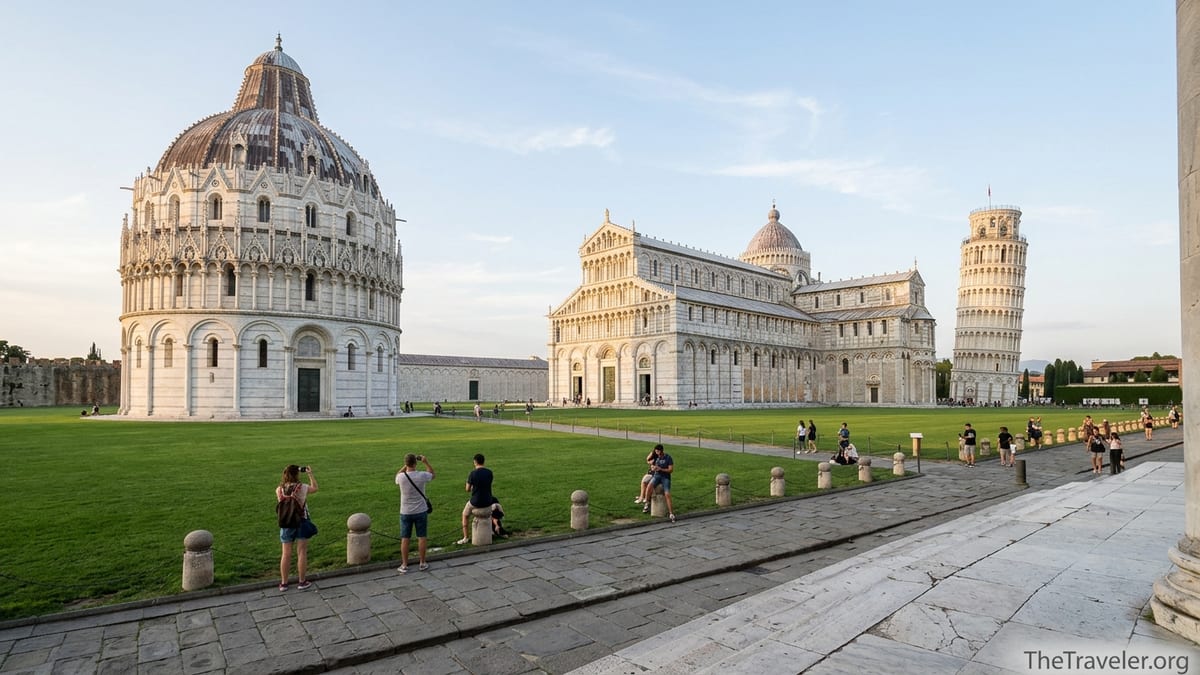
What Piazza dei Miracoli Actually Is, Beyond the Iconic Tilt
Piazza dei Miracoli, officially Piazza del Duomo, is not just a backdrop for souvenir photos. It is a walled green space on the northern edge of central Pisa that gathers four major monuments: the Cathedral of Santa Maria Assunta, the Baptistery, the Camposanto Monumentale cemetery, and the freestanding bell tower better known as the Leaning Tower. There are also two small but worthwhile museums, the Opera del Duomo Museum and the Sinopie Museum, which display original sculptures, fresco drawings, and liturgical objects removed from the monuments for conservation.
The entire complex is managed as a single monumental site, with coordinated ticketing and timed entries for some elements. Travelers often assume that you must climb the tower to “see Pisa,” but in practice the tower is only one of several ticketed spaces, and you can choose how deep to go. Walking onto the lawn to admire the architecture is free, while a complete ticket that includes all monuments typically costs in the range of a modest restaurant meal, making it a strategic decision rather than an automatic splurge.
Understanding the piazza as a unified ensemble changes the question from “Is the Leaning Tower worth it?” to “Is a half-day in one of Italy’s most harmonious medieval spaces worth it?” For travelers interested in art, architecture, photography, or simply a slower pace than Italy’s big cities, the answer is usually yes, provided you explore more than the classic tower pose.
The Cathedral Interior: The Masterpiece Most Visitors Skip
The Cathedral of Santa Maria Assunta, begun in the 11th century, is the true heart of the piazza and arguably its most impressive interior. Behind the striped marble facade are towering granite columns, a gilded coffered ceiling, and a massive apse mosaic of Christ that glows even on cloudy days. Many day trippers never set foot inside, rushing from tower to train, which leaves the nave noticeably calmer than the lawn outside.
From a value perspective, the cathedral is also one of the best reasons to visit beyond the tower. Access to the cathedral is typically included either as a free timed entry when you hold any other monument ticket, or with a low-cost ticket purchased on-site when the tower is sold out. For roughly the price of a cappuccino in central Florence, you can spend 30 to 45 minutes walking through a space that rivals better known churches in Rome and Venice in scale and decoration.
A practical example: a couple arriving on a late-morning regional train can easily walk to the piazza, collect their pre-booked monument tickets, tour the cathedral interior for half an hour, and still have time for lunch at one of the simple trattorias just outside the walls before an afternoon visit to the Baptistery or Camposanto. If your only goal were to see the tower from the outside, you would miss the cathedral’s carved pulpit, glittering ceiling, and quiet side chapels that tell the story of Pisa’s medieval power.
The Baptistery and Its Acoustics: A Short Performance Worth Planning Around
Standing directly in front of the cathedral, the round Baptistery is the largest in Italy and shows a transition from Romanesque to Gothic style. Its upper levels bristle with carved figures, while the interior is surprisingly spare, with pale stone and a central font. At first glance it can seem like a quick in-and-out visit, yet travelers who time their entry around the acoustics demonstration often name it as their favorite moment in the piazza.
Several times a day, an attendant steps into the center of the Baptistery and sings short sustained notes that echo and overlap in the domed space. The demonstration itself lasts only a few minutes, but the effect is striking enough that visitors usually fall silent. If you arrive, for example, on a hot summer afternoon when crowds around the tower feel overwhelming, paying a modest fee, roughly the cost of a gelato, to step into this cool stone interior and listen for 10 or 15 minutes can completely change the tone of your visit.
Because the Baptistery is included in many “all monuments” or tower combo tickets, you do not necessarily pay extra beyond what you have already spent to climb the tower. Travelers on a budget who choose not to climb can instead buy a ticket that bundles the Baptistery with the Camposanto and museums at a mid-range price, turning what might have been a quick photo stop into a structured two- to three-hour cultural visit.
Camposanto Monumentale: Frescoes, Quiet, and a Different Pace
On the far side of the piazza, often ignored by hurried tour groups, the Camposanto Monumentale is a cloistered cemetery built along a long rectangular courtyard. The inner walls once carried vast fresco cycles; after wartime damage, many were painstakingly restored. Today, walking the cool corridors lined with sarcophagi and fragmentary frescoes feels worlds away from the busy lawn outside, even though you are only a few steps from the Leaning Tower.
For travelers who value atmosphere over checklists, Camposanto may be the single strongest argument for visiting Piazza dei Miracoli beyond the tower. It is one of the few places where you can pause on a bench, look out over the green courtyard toward the cathedral dome, and feel the weight of centuries without constant camera shutters. Independent travelers often report spending 45 minutes here simply looking at the sculpted tombs or watching the play of light on the stone.
In concrete terms, the cemetery is usually part of the “all monuments except tower” ticket, which is typically priced around the cost of a simple trattoria lunch. If you are deciding whether to invest in that ticket, ask yourself whether you want at least two quieter indoor experiences to balance the hectic feel of the tower area. If the answer is yes, Camposanto alone can justify the upgrade from a basic exterior-only visit.
Museums, Night Views, and Photography: Hidden Bonuses of the Square
Two small museums, the Opera del Duomo Museum and the Sinopie Museum, are easy to overlook when planning a short visit, but they offer practical advantages. Sculptures and bronze doors that once stood exposed to weather on the cathedral and Baptistery facades are now exhibited indoors, often at eye level. This allows you to appreciate details you would never see from the lawn, such as the delicate carving on Nicola Pisano’s pulpit figures. On hot summer days, these climate-controlled spaces also provide a break from the sun for the same cost already covered in a combo ticket.
Photographers and content creators will find that the piazza rewards time spent exploring different vantage points beyond the standard “holding up the tower” shot. For example, a wide-angle view from the far corner near Camposanto can frame the cathedral, tower, and Baptistery in one image with fewer people in the foreground, especially in the first hour after opening. In late afternoon, when many organized tours have already left for Florence, soft side light picks up the texture of the white marble and the green lawn, making it easier to capture natural-looking photos without harsh shadows.
Another underused strategy is visiting the piazza twice in the same day: once early or mid-morning for timed entries to the tower or Baptistery, and once again after dinner simply to walk the grounds. While the monuments close in the evening, the square itself remains accessible, and basic lighting on the exteriors creates a calmer, almost contemplative atmosphere. Travelers staying overnight in Pisa can easily stroll over from a nearby guesthouse around 10 pm to see the tower and cathedral with only a handful of other people present, an experience quite different from the midday crush.
Costs, Tickets, and Time: When Is It Worth Going Beyond the Tower?
By 2026, standard adult tickets to climb the Leaning Tower are around 20 euros, with combined “complete visit” options that include the tower plus other monuments typically priced a few euros higher. There is also an “all monuments except tower” ticket that gives access to the Baptistery, Camposanto, and museums for roughly half the cost of a typical guided tour in Florence. Walking on the lawn and admiring the exteriors, however, remains free at any hour, which is why many bus tours treat Pisa as a quick photo stop.
To decide whether a more in-depth visit is worth it, start with how much time you have. With less than two hours in Pisa, climbing the tower plus one additional interior is ambitious but possible if you book a mid-morning or early afternoon time slot and accept that you will see the rest of the piazza from the outside. With three to four hours, you can climb the tower, visit the cathedral and Baptistery, and spend at least 30 minutes in Camposanto, which is where many visitors report that they finally slow down enough to appreciate the site.
Your budget also matters. A couple purchasing two complete combo tickets that include the tower might spend slightly less than the cost of an average dinner for two in central Florence, yet receive several hours of structured cultural experiences in return. A family of four on a tight budget might decide to skip the tower, purchase “all monuments except tower” tickets for the adults, and let younger children play on the edge of the lawn while adults alternate visits to the Baptistery and Camposanto. In both cases, the value comes from balancing paid interiors with free time on the square rather than treating Pisa as a one-shot photo opportunity.
Practical Tips: Avoiding Crowds and Making the Most of Your Visit
Piazza dei Miracoli attracts millions of visitors a year, so timing and preparation can determine whether you remember it as magical or stressful. Tower tickets are sold in timed slots, typically every 30 minutes, and often sell out weeks ahead in high season. Booking directly through official channels as soon as your travel dates are fixed greatly increases your chances of getting a morning slot, which avoids midday heat and the heaviest tour groups.
Arriving by train from Florence or Lucca, you should factor in roughly 20 to 25 minutes on foot or a short city bus ride from Pisa Centrale station to the square. Many travelers underestimate this transfer and end up rushing. A realistic plan for a half-day visit might be to take a regional train that arrives between 9 and 10 am, walk directly to the piazza, tour the interiors on timed entries before lunch, then either wander the historic center or return to your base city in the afternoon.
Accessibility is improving, though the historic nature of the buildings means there are limits. Official visitor information notes that people with significantly reduced mobility generally cannot climb the tower due to its narrow spiral staircase, but support services and dedicated contacts exist to help plan accessible visits to the cathedral, Baptistery, and Camposanto. If you or someone in your group uses a wheelchair or has mobility challenges, it is worth contacting the monument authorities several days in advance to confirm current arrangements and entrances.
The Takeaway
So, is Piazza dei Miracoli worth visiting beyond the famous Leaning Tower? If your sole aim is to check a landmark off your list with a quick photo, you can technically do that in under an hour, and many travelers do. Yet that approach leaves most of what makes this square special unseen: the quiet grandeur of the cathedral interior, the unexpected beauty of the Baptistery’s acoustics, the reflective calm of Camposanto, and the sculptural details preserved in the museums.
For travelers willing to devote at least half a day and the cost of a modest meal, the piazza becomes far more than a tilted campanile. It turns into a layered experience of medieval art and architecture that contrasts sharply with the pace of nearby cities. Whether you are a first-time visitor to Italy or returning for a deeper look, planning your visit around the full ensemble rather than the tower alone is what transforms Pisa from a rushed detour into a place that lingers in memory.
FAQ
Q1. Is it worth visiting Piazza dei Miracoli if I do not climb the Leaning Tower?
Yes. Even without climbing, you can walk the piazza for free and, for a modest ticket price, visit the cathedral, Baptistery, Camposanto, and museums. Many travelers find that these interiors, especially the cathedral and Camposanto, are the most memorable parts of the visit.
Q2. How much time should I plan at Piazza dei Miracoli to see more than just the tower?
Plan at least three hours if you want to climb the tower and visit two or three additional monuments. Without climbing, two to three hours is usually enough for the cathedral, Baptistery, Camposanto, and a short museum stop, plus time for photos on the lawn.
Q3. Are combo tickets for the monuments good value compared with buying separate entries?
In most cases yes. Combined tickets that cover the tower and other monuments, or all monuments except the tower, usually cost noticeably less than buying individual entries. For roughly the price of a simple restaurant meal, you can secure a full half-day of visits.
Q4. When is the best time of day to visit to avoid the worst crowds?
Early morning and late afternoon are usually the calmest. Timed tower entries soon after opening often feel less crowded, while late afternoon or early evening is ideal for walking the lawn and taking photos with softer light and fewer tour groups.
Q5. Can I see the cathedral interior without a tower ticket?
Yes. While many visitors access the cathedral with a tower or combo ticket, you can usually obtain a low-cost cathedral ticket on-site, or free timed entry tied to another monument ticket such as the Baptistery or Camposanto, subject to availability and current policies.
Q6. Is Piazza dei Miracoli suitable for children and families?
Generally yes. The lawn and open spaces give children room to move, and older kids often enjoy the climb up the tower or the echo demonstration in the Baptistery. Families on a budget can mix free time outside with a limited number of paid interiors.
Q7. How does Piazza dei Miracoli compare to other Italian cathedral complexes like Florence or Siena?
Pisa’s complex is smaller but more self-contained, with all major monuments facing a single green square. It feels less urban than Florence and less hilltop dramatic than Siena, but offers a uniquely harmonious ensemble where the cathedral, tower, Baptistery, and Camposanto form a coherent whole.
Q8. Do I need a guided tour to appreciate the piazza, or can I explore on my own?
You can see the essentials independently using simple brochures or audio guides. However, first-time visitors with a strong interest in history or architecture may benefit from a small-group tour that connects what you see in the cathedral, Baptistery, and Camposanto into a single narrative.
Q9. Is it better to visit Pisa as a day trip or stay overnight near the piazza?
Most travelers visit as a half-day trip from Florence, Lucca, or the coast. Staying overnight, however, lets you enjoy the piazza early in the morning and late at night when it is quieter, which many people find transforms the experience.
Q10. Are there any dress code or behavior rules I should know before entering the monuments?
Yes. As active or historic religious sites, the cathedral and Baptistery expect modest dress, with shoulders and knees reasonably covered. Loud behavior, eating, and phone calls are discouraged inside, and flash photography may be restricted in some areas, so checking posted signs on arrival is important.