


San Miniato al Monte is best known for its postcard panorama over Florence, but the view is only the beginning. Perched above Piazzale Michelangelo, this Romanesque basilica rewards anyone who steps inside and wanders around the complex. From luminous mosaics and Renaissance chapels to monastic chant and a cemetery rich with stories, there is far more to experience here than a quick photo stop at sunset.
Get the latest updates straight to your inbox!
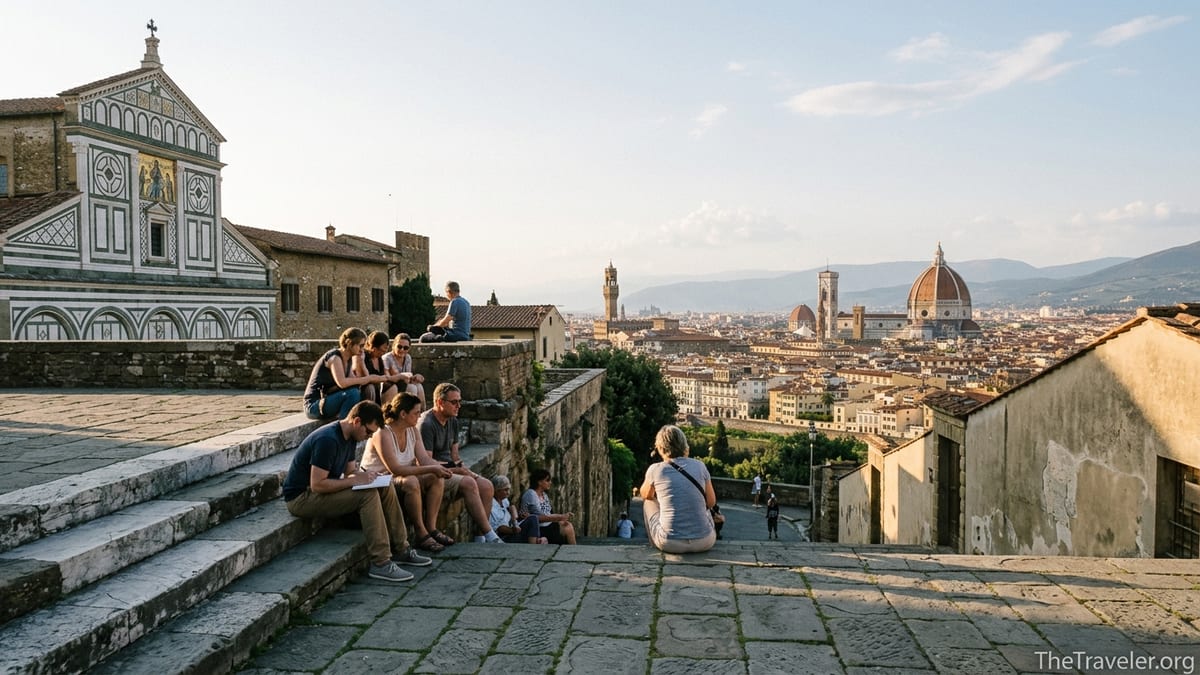
The Romanesque Facade and First Impressions
Most visitors arrive at San Miniato al Monte slightly out of breath after the climb from Piazzale Michelangelo or the bus stop on via del Monte alle Croci. The reward is immediate: a façade of white and dark green marble that glows in late afternoon light. Built between the 11th and 13th centuries, it is one of the purest examples of Florentine Romanesque architecture, with geometric patterns that echo other Tuscan monuments but feel more intimate at this hilltop scale.
Stand at the base of the steps and look carefully at the upper part of the façade. You will see a golden mosaic of Christ between the Virgin and Saint Minias dating from the late 13th century. In strong sun it can appear almost backlit, while on overcast days it reads as a softer, antique shimmer against the marble. This is the same subject that appears again inside in the apse, a visual thread tying exterior and interior together.
As you turn away from the view of Florence and face the church, notice the slight irregularities that reveal its age: faint chips in the marble, softened edges on the stairs from centuries of feet, iron handrails added for safety on the steep central staircase. These details are reminders that this is a working monastery and parish, not a frozen museum set.
Practical detail: the church is generally open from morning into early evening, but the façade terrace is fully exposed to sun and wind. In summer, many travelers time their arrival for about 5:30 pm to avoid the harshest heat and to roll the visit into vespers later in the evening if they wish to stay.
Inside the Basilica: Light, Shadow, and the Chapel of the Crucifix
Stepping inside San Miniato al Monte is a shock after the bright terrace. The nave is deliberately dim, with a timber roof and a patterned marble floor that leads your eye upward toward the raised choir and apse. The interior has changed remarkably little since the Middle Ages, which makes it one of the most atmospheric churches in Florence to simply sit and absorb.
At the center of the nave stands the Cappella del Crocefisso, or Chapel of the Crucifix, designed by Michelozzo in the mid 15th century. This freestanding structure, with its delicately carved columns and painted panels, feels like a small temple within the larger basilica. Today, visitors often circle it slowly, noticing details like the worn stone at its base where worshippers once knelt and the faint, aged colors on the decorative panels.
On either side of the nave, flickering votive candles illuminate side chapels and altars. You may see locals stopping for a quick prayer on their way home from work, or a guide quietly pointing out the 13th century pavement patterns to a small group. Unlike better-known churches in the city center, there are usually no ticket checks or loud audio guides here, so the atmosphere remains comparatively hushed.
For photographers, the basilica’s interior is challenging but rewarding. A fast lens is useful, since tripods are not appropriate during services and the low light can be difficult for smartphones. Shooting from the back of the nave toward the raised choir captures the unique composition of floor, chapel, and apse in a single frame, especially when a shaft of late afternoon sun hits the mosaic above.
The Glittering Apse Mosaic and Raised Choir
Climb the few steps up to the raised presbytery to appreciate one of San Miniato’s most striking features: the apse mosaic of Christ between the Virgin and Saint Minias, dated 1297. Seen up close, the mosaic’s gold ground, stylized robes, and solemn faces show the transition from Byzantine influence to the more naturalistic Tuscan style that would soon flourish in nearby churches.
The raised choir itself, set above the crypt, is an unusual feature compared with many other Florentine churches. Marble choir stalls flank the space, their carved details softened by time. If you visit earlier in the day, you may find a monk quietly arranging books or candles here, a reminder that this is still an active liturgical space rather than a decorative platform.
To the side stands an early 13th century marble pulpit, dated to 1207, with intricate reliefs. Even if you are not an architecture enthusiast, it is worth pausing here to imagine medieval sermons delivered from this very spot to a congregation lit only by oil lamps and small, high windows. Modern visitors often lean over the low barrier to inspect the carvings of animals and biblical scenes carved into its panels.
Because there is no separate museum ticket, you can linger as long as you like in front of the apse without feeling rushed. Many travelers report spending 15 or 20 minutes simply sitting in one of the front pews, watching how the mosaic shifts in tone as clouds move across the sun outside and the interior light subtly changes.
The Crypt and the Quiet Life of Saint Minias
Beneath the raised choir lies the crypt, one of the oldest and most atmospheric corners of the complex. Supported by dozens of columns, some re-used from earlier Roman buildings, the space is low, cool, and surprisingly extensive. It is here that the relics of Saint Minias, the early Christian martyr for whom the basilica is named, are traditionally believed to rest.
The story of Minias is part history, part legend. He is said to have been an Armenian prince who became a hermit near Florence and was martyred during persecutions in the 3rd century. For many modern visitors, the specifics matter less than the sense of continuity the crypt offers: walking among the columns, you become aware that pilgrims have been coming here for a thousand years with their own private worries and hopes.
Practically, the crypt is cooler than the nave, which can be a welcome relief in summer. The low ceiling and minimal lighting mean that it can feel crowded quickly if a tour group arrives, so independent travelers often have a better experience early in the morning or later in the afternoon outside the peak bus arrival times.
Some travelers choose to leave a small coin in one of the donation boxes before or after visiting the crypt, especially if they have taken photos or spent time sheltering from the heat. While there is no entry fee, donations help the Olivetan community maintain the complex, from lighting in the crypt to restoration of the frescoes elsewhere.
The Sacristy and the Cardinal of Portugal Chapel
One of the most rewarding detours inside San Miniato al Monte lies through an unassuming door off the left aisle: the sacristy. This room, often overlooked by hurried visitors, is covered in a cycle of late 14th century frescoes by Spinello Aretino depicting episodes from the life of Saint Benedict. Monks once used these scenes as a visual guide to Benedictine values, and today they provide a richly colored counterpoint to the more austere main nave.
The sacristy is not always open, and access can occasionally be restricted during liturgical use or conservation work. When it is accessible, step inside and allow your eyes a moment to adjust. You will see walls alive with small narrative scenes: Benedict receiving the habit, performing miracles, instructing monks. Many visitors find themselves unexpectedly drawn in, tracing the stories visually even if they cannot identify every episode.
Back in the left aisle of the church itself, do not miss the Chapel of the Cardinal of Portugal, added in the mid 15th century as the burial place of the young Portuguese cardinal James of Lusitania. Designed and decorated by artists including Antonio Rossellino and Luca della Robbia, the chapel feels like a perfectly preserved Renaissance jewel box. White and colored marbles, glazed terracotta roundels, and delicate sculpted details combine in a harmonious whole.
For a particularly good view, stand just outside the entrance and look diagonally across the chapel. This perspective reveals the way the tomb, altar, and decorative program were conceived as a single composition, something that is easy to miss if you only glance in from directly in front. Because the space is small, step aside quickly after you have taken your photographs so others can enter; this simple courtesy keeps the chapel from feeling cramped even when several visitors are present.
Gregorian Chant and Daily Monastic Life
Beyond its art and architecture, San Miniato al Monte offers something that many travelers remember more vividly than any mosaic: the sound of Gregorian chant filling the nave at vespers. The Olivetan Benedictine community, which has been here since the 14th century, still follows a rhythm of daily prayer that visitors are welcome to attend respectfully.
Service times can vary slightly by season, but vespers with chant are typically held in the early evening, often around 6:30 pm. Independent travelers often arrive 10 or 15 minutes early, find a seat halfway down the nave, and sit in silence as the church gradually fills with locals and a handful of visitors. The lights are lowered, a few candles are lit, and the chant begins from the choir above the crypt.
There is no ticket and no reserved seating, but visitors are expected to behave as they would in any religious setting. That means no flash photography, phones switched off, and minimal movement once the service starts. Many people choose not to film at all, preferring to experience the sound directly; the simple, unaccompanied voices have a meditative quality that does not translate well to shaky smartphone videos.
For a concrete example, consider planning a summer visit where you reach the basilica at about 5:45 pm, explore the nave, crypt, and chapels until just after 6:15 pm, then settle into a pew for vespers. Afterwards, you can step back outside into the cool of the evening and watch the lights come on over Florence, having experienced the church not only as a monument but as a living spiritual center.
The Fortifications, Cloister, and Monastery Complex
Look beyond the basilica itself and you will notice that San Miniato al Monte sits inside a ring of defensive walls and bastions. These fortifications were reinforced in the 16th century, in part on designs involving Michelangelo during the siege of Florence. Today they give the complex an almost monastic citadel feeling, with stone walls, gates, and viewpoints over the city.
To the side and rear of the church are monastic buildings that remain in use by the Olivetan community. Access to inner cloisters is limited, but from certain angles near the church entrance and cemetery gate you can glimpse tiled roofs, small gardens, and quiet interior courtyards. In the mornings, you may see a monk in a white habit crossing from one building to another or tending a patch of herbs near a wall.
Visitors often underestimate how much time it takes to explore these exterior spaces. Walking the short stretch of wall near the cemetery gates, leaning on the stone parapet to look out over the Oltrarno and the Duomo, and circling back to the terrace in front of the church can easily fill half an hour, especially if you are taking photographs or sketching. The atmosphere is calmer than at the always-busy Piazzale Michelangelo below.
Informally, this area also serves as a meeting point for small walking tours that explore the green belt behind the basilica, including the rose garden below the terrace and quiet residential lanes that wind back down toward the river. If you prefer self-guided exploration, bring a simple paper map or offline map on your phone; mobile reception can fluctuate around the hillside and it is easy to lose track of the path as streets change names.
The Monumental Cemetery and Stories in Stone
Just beside the basilica lies the Cimitero delle Porte Sante, the monumental cemetery that wraps around the fortifications and offers some of the most evocative views in Florence. Established in the 19th century, it became the resting place of prominent local figures, including Carlo Collodi, the author of Pinocchio, whose tomb is often sought out by literature enthusiasts.
Entry to the cemetery is usually free, though opening hours can differ from those of the church and are typically posted at the gate. Expect a mix of narrow lanes, family chapels, sculpted angels, and graves climbing the hillside. Travelers who venture beyond the first rows often find quiet corners where ivy climbs over stone, cypress trees cast long shadows, and the dome of the Duomo appears framed perfectly between monuments.
Because of its location, the cemetery can be steep in places, with uneven paving stones and occasional maintenance work in progress. Flat shoes with good grip are strongly recommended. Photographers should watch their footing while backing up for shots; several vantage points offer spectacular alignments of tombs, cityscape, and sky that tempt people to step closer to the edge of terraces.
Visiting the cemetery can take anywhere from 20 minutes to over an hour, depending on how deeply you engage. Many travelers choose to spend about 30 to 40 minutes wandering the paths, pausing at names they recognize or at particularly expressive sculptures. Early morning visits are especially atmospheric, with dew on the stone and the city below still quiet compared with the midday bustle.
The Takeaway
San Miniato al Monte rewards anyone who treats it as more than a viewpoint. The famous panorama is real, but the most memorable experiences happen once you climb the church steps, adjust your eyes to the dark, and let the layers of history and ritual unfold. Mosaics, frescoed sacristies, Renaissance chapels, and an active monastic community all coexist within a relatively compact space.
For a well-balanced visit, many travelers find that about two hours works comfortably: one hour exploring the interior chapels, crypt, and sacristy when open, half an hour in the cemetery and along the walls, and half an hour reserved for vespers or simply sitting in the nave. Adding another half hour for the walk up or down the hill easily turns San Miniato into a half-day highlight of any Florence itinerary.
What sets San Miniato apart from better-known city-center churches is the feeling of stepping slightly outside time without leaving Florence. Whether you come for the chant, the art, or the quiet of the cemetery, the hill of San Miniato offers a layered, human-scale experience that stays with you long after the last light fades from its marble façade.
FAQ
Q1. How much time should I plan for a visit to San Miniato al Monte?
Most visitors are satisfied with 60 to 90 minutes, which allows time to see the interior, chapels, and cemetery. If you wish to attend evening vespers, plan for about two hours in total.
Q2. Is there an entrance fee for the basilica or cemetery?
There is no standard entrance fee for the basilica or the Cimitero delle Porte Sante. Both are free to enter, though small donations in the church are appreciated and help support maintenance and restoration work.
Q3. How do I get to San Miniato al Monte from central Florence?
You can walk up from the historic center in about 25 to 35 minutes, often via Piazzale Michelangelo. City buses that serve Piazzale Michelangelo or the nearby streets reduce the uphill walk to roughly 10 minutes from the closest stop.
Q4. What is the best time of day to visit?
Late afternoon is ideal for many travelers. The light on the façade and city is softer, interior crowds are usually light, and you can stay on for early evening vespers if you want to hear Gregorian chant.
Q5. Can I attend the monks’ Gregorian chant even if I am not religious?
Yes. Visitors of any or no faith are welcome to attend vespers as long as they are respectful: dress modestly, remain quiet, avoid photos during the service, and treat it as a time of contemplation.
Q6. Are there any dress code requirements?
There is no formal posted dress code, but shoulders and knees should be covered as a sign of respect. Lightweight trousers or a long skirt and a scarf or light shawl work well, especially in summer.
Q7. Is photography allowed inside the church?
Non-flash photography is generally tolerated outside of services, provided you act discreetly and do not photograph people at prayer. During mass or vespers, it is best to put cameras and phones away entirely.
Q8. Is San Miniato al Monte accessible for visitors with limited mobility?
Access can be challenging. There are steep exterior steps and uneven surfaces inside and in the cemetery. Some areas, such as the crypt and parts of the cemetery, may be difficult or impossible to reach in a wheelchair or with severe mobility issues.
Q9. Are there facilities nearby, such as restrooms or places to buy water?
Restroom access directly at the church can be limited, and there are no large commercial facilities on the terrace. Many travelers purchase water or snacks in the streets below or at kiosks around Piazzale Michelangelo before making the climb.
Q10. Can I combine a visit to San Miniato al Monte with other sights?
Yes. A popular route is to visit the rose garden and Piazzale Michelangelo on the way up or down, or to combine the hilltop visit with a day exploring the Oltrarno neighborhoods, artisan workshops, and less crowded churches on the south side of the Arno.