


Perched high above Florence on a cypress‑lined hill, San Miniato al Monte feels a world away from the packed nave of the Duomo and the tour groups shuffling through Santa Croce. Its striped marble facade is visible from much of the city, yet comparatively few visitors make the climb. Those who do discover a church that combines early medieval architecture, living monastic tradition and sweeping views in a way no other Florentine church quite matches.
Get the latest updates straight to your inbox!
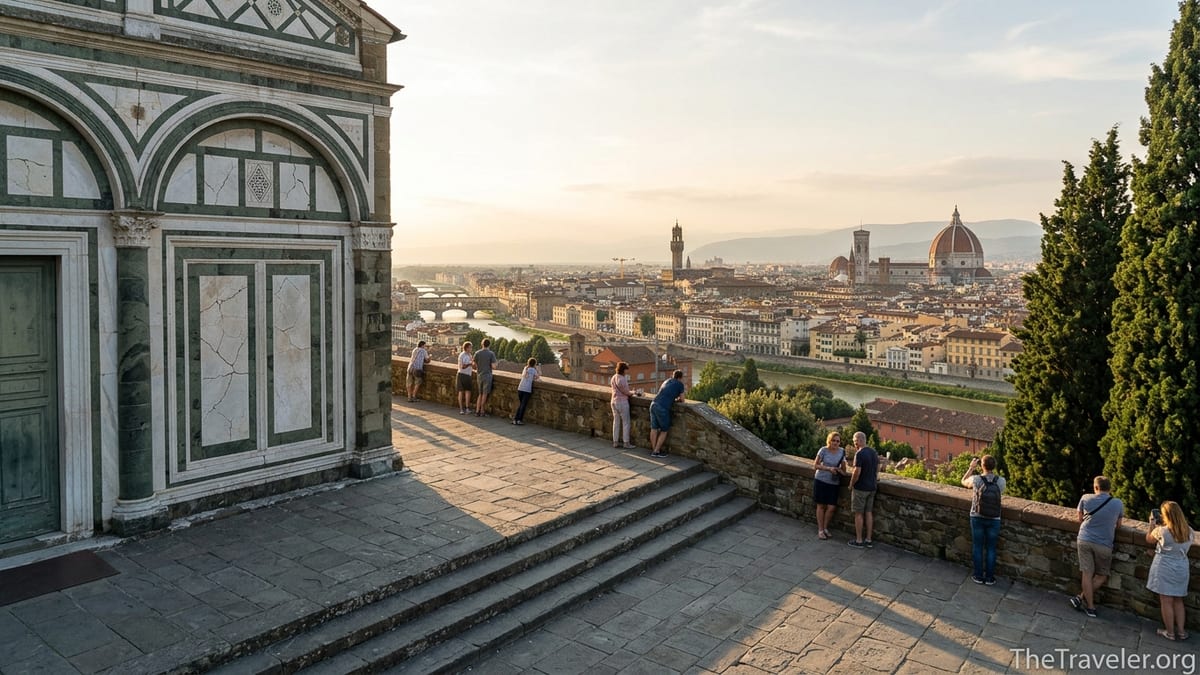
A Hilltop Sanctuary Above the City
Most of Florence’s famous churches sit tightly woven into the urban fabric: the Duomo dominates Piazza del Duomo, Santa Croce anchors its busy square, and Santa Maria Novella faces the main railway station. San Miniato al Monte, by contrast, stands on Monte alle Croci, about one hundred meters above the Arno, surrounded by trees and old defensive walls. Reaching it usually means a fifteen to twenty‑minute uphill walk from the riverside near Piazza Poggi or a short taxi ride from the historic center, and that effort is the first thing that makes the visit feel different.
Many travelers combine San Miniato with the better known Piazzale Michelangelo below. A common route is to climb the monumental stone ramps to Piazzale Michelangelo, pause for the classic postcard view, then continue up another broad flight of stairs through cypress trees to the church terrace. Unlike the crowded piazzale, where bus tours park and souvenir vendors cluster around the balustrade, the forecourt of San Miniato often remains relatively quiet even in high season. You may find a few art students sketching, a couple of locals walking dogs and a handful of visitors leaning on the low wall to watch the sun sink behind Brunelleschi’s dome.
The setting changes how you experience Florence. From the terrace, the red roofs, the Duomo, Palazzo Vecchio and even the line of the old city walls spread out below like a three‑dimensional map, yet the traffic noise and crowds feel distant. At other churches, you step out of the nave and immediately back into busy streets; here, you exit into open air and a wide horizon. Many repeat visitors to Florence end up timing their day around this view, buying a gelato near the river and carrying it up for an early‑evening pause while bells ring across the city below.
Romanesque Florence in Rarely Preserved Form
San Miniato al Monte is widely regarded as one of the finest examples of Romanesque architecture in Tuscany, and one of the best‑preserved 11th‑century buildings in Florence. Where the Duomo’s Gothic nave and Renaissance dome showcase later styles, San Miniato offers a glimpse of the city’s earlier medieval past. Construction began in the early 1000s and continued into the 13th century, long before the great age of Florentine banking families and Renaissance palaces.
The facade hints at similarities with Santa Croce and Santa Maria Novella, with their familiar panels of white and green marble. But up close, you notice the differences: the composition is simpler and more compact, with a low gable, a central blind arcade and a shimmering gold mosaic of Christ between the Virgin and San Miniato set above the central window. On sunny evenings, this mosaic catches the light in a way that feels almost like a lantern above the hillside. As of 2026, parts of the facade and its bronze eagle symbol are undergoing careful restoration, so visitors may see scaffolding on certain sections and signage explaining the conservation work, something that can be fascinating to observe if you are interested in how historic buildings are preserved in practice.
Inside, San Miniato looks markedly different from Florence’s later churches. Instead of a stone vault like Santa Croce or the vast painted dome of the cathedral, the basilica has a timber trussed roof and a dark, atmospheric nave lined with alternating columns and piers. A marble choir platform rises above the nave floor, and beyond it the raised presbytery sits over a crypt. Soft daylight filters in through small windows, falling on inlaid marble floors decorated with zodiac motifs and geometric patterns. Many visitors comment that it feels closer to churches in rural Tuscany or Umbria than to the monumental urban interiors a few minutes’ walk away in the center.
Living Monastic Tradition and Gregorian Chant
Where many of Florence’s major churches now function primarily as museums with ticketed entry, San Miniato al Monte retains the atmosphere of a working monastery. The complex originally belonged to Benedictine monks and later passed to the Olivetan order in the 14th century, whose community still lives here today. This ongoing monastic life shapes both the rhythm of the day and the visitor experience in a way that sets the basilica apart.
One of the most distinctive experiences is attending evening vespers, sung in Latin with Gregorian chant in the main church. On most days, the community gathers around the choir stalls in the early evening and the public can quietly sit in the nave. Travelers often time their climb so they can listen to the chants and then step outside for sunset over the city. In practical terms, this means planning your visit for late afternoon rather than only dropping by in the middle of the day. While schedules can shift slightly, a common pattern is that the church remains open through the afternoon and the monastic office begins toward early evening, so it is wise to arrive well before closing time so you can find a seat without rushing.
The monastery’s presence is visible in small details that recall a slower, more contemplative Florence. In the gift shop and cloister area next to the church, monks and lay helpers sell products such as herbal liqueurs, honey, soaps and creams made using traditional recipes. Prices are generally reasonable by local standards, and buying a small bottle of liqueur or a bar of soap can be a tangible way to support the community. Compared to the high‑volume, ticket‑controlled entrances of the Duomo complex or Santa Croce, where you pass through scanners and timed entry points, the experience here feels deliberately low‑key: you step through an old doorway into a working religious house rather than a large‑scale attraction.
Art, Light and Atmosphere Inside the Basilica
Despite its relatively small size, San Miniato contains several remarkable works of art that reward an unhurried visit. In the apse, a 13th‑century mosaic of Christ in Majesty dominates the space, its gold tesserae echoing the facade mosaic outside. Unlike the overwhelming fresco cycles in Santa Croce’s chapels or Santa Maria Novella’s choir, this image is compact and intensely focused. Visitors often drop a coin in the lighting box to briefly illuminate the mosaic more brightly, a one‑euro gesture that dramatically changes how the colors and gold leaf appear.
The marble pulpit and choir enclosure, carved in the 12th century, preserve intricate Romanesque ornament, including animals and symbolic foliage. On the floor, an inlaid marble zodiac from the 13th century runs across the nave, a reminder that medieval churches often integrated astronomical and calendrical symbolism into their design. By contrast, in the Duomo you encounter painting on a monumental scale, such as the Last Judgment frescoes inside the dome, while at Santa Croce the eye is drawn to tomb slabs and wall‑filling fresco cycles. San Miniato’s art is smaller in scale and demands that you step closer, sometimes crouching to examine floor details or leaning over the choir rail to see carved capitals.
Light plays a different role here as well. Because San Miniato lacks the huge stained‑glass windows of later Gothic churches, daylight enters more sparingly through small openings high on the walls and in the apse. On a bright afternoon, bands of light cut across the nave, picking out the green and white stripes of the columns and the warm tones of the wooden roof; on overcast days, the church feels almost cave‑like, with the crypt glowing softly below the raised choir. Travelers who have just come from the relatively well‑lit Duomo interior are often surprised by how quickly their eyes need to adjust, and photographers find themselves working with higher ISO settings or slower shutter speeds to capture the atmosphere without flash.
Defensive Walls, Fortress History and a Monumental Cemetery
Another feature that distinguishes San Miniato from most other Florentine churches is its integration into a fortified complex. During the siege of Florence in the 16th century, the area around the basilica was strategically important; Michelangelo is said to have advised on reinforcing the campanile with protective materials when it was used as an artillery post. Later, Cosimo I de’ Medici extended the defenses into a proper fortress. Even today, as you approach along the upper road or climb the final flights of stairs, you pass stretches of high brick wall that remind you this was once a military as well as spiritual stronghold.
Within these walls lies the monumental cemetery known as the Cimitero delle Porte Sante, created in the mid‑19th century. Its terraces climb around and behind the church, lined with elaborate family chapels, statues and marble slabs. Notable Italians are buried here, including Carlo Collodi, author of “Pinocchio,” and filmmaker Franco Zeffirelli. For travelers, the cemetery offers an unusual combination: a lesson in local history, a sculpture garden in all but name, and another exceptional vantage point over Florence. Because it is still an active burial ground, visitors are expected to move quietly and respectfully, but there is no complex ticket procedure; you simply follow the paths and pause where a name or monument catches your eye.
Compared with Santa Croce, whose interior also holds the graves of famous figures such as Michelangelo and Galileo, the memory of the dead at San Miniato is largely outside, under the open sky. Families still arrive with fresh flowers, and stonemasons’ names carved on recent tombs hint at workshops just beyond the city. Walking through the cemetery after visiting the basilica connects the hillside complex to contemporary Florence in a way that many indoor monumental tombs do not. It is easy to spend half an hour or more wandering the terraces, reading inscriptions and watching the light change over the rooftops below.
Practical Visiting Experience: Costs, Crowds and Access
Practical considerations also set San Miniato apart from Florence’s other churches. At the time of writing, entry to the basilica itself remains free, although donations are encouraged and small fees apply for certain areas or lighting particular artworks. By contrast, visiting Santa Croce, Santa Maria Novella or the museum areas of the Duomo complex usually involves ticket prices in the range that many travelers now factor seriously into their budgets, especially for families. For a couple or a family of four, the difference between several paid church entries and an afternoon at a free site like San Miniato can quickly add up to the price of a good trattoria dinner or a taxi back to your accommodation.
Crowding is another tangible difference. Even in shoulder seasons like late April or early October, the line to climb the Duomo dome can stretch far across the square, and Santa Croce’s nave may be full of guided groups. Up at San Miniato, there are certainly busier days, particularly around holidays, but on an ordinary weekday you can often find entire side aisles nearly empty. This makes it easier to slow down, sit on a bench and let children explore details like animal carvings or floor patterns without constantly dodging tour parties. It is also a gift for photographers who prefer to work without dozens of raised phones in the frame.
Reaching San Miniato, however, does require more planning. The climb from the riverside includes several flights of stone steps, so comfortable shoes and a bottle of water are essential in warm weather. Public buses run to stops near Piazzale Michelangelo, from which it is a further, steeper walk to the church. Taxis will usually drop passengers directly in front of the basilica forecourt, which can be worth the cost if you are traveling with luggage, small children or mobility issues. Unlike the level walk from the train station to Santa Maria Novella or the short stroll from many central hotels to the Duomo, a visit here is more of a small excursion. Many travelers find that building it into a half‑day, with a coffee stop in the Oltrarno district before or after, turns it into one of the most memorable parts of their stay.
How San Miniato Compares with Florence’s Other Great Churches
Seeing San Miniato alongside Florence’s other major churches highlights the distinct role each one plays in the city’s story. The Duomo, with its massive dome and marble‑paved square, is the visual and symbolic heart of Florence, tied to civic pride and the city’s Renaissance ambitions. Santa Croce is closely associated with famous burials and patriotic memory, while Santa Maria Novella showcases the shift toward Gothic architecture and houses important fresco cycles. Many visitors also seek out Santo Spirito in the Oltrarno for its quieter atmosphere and Michelangelo‑designed sacristy. San Miniato occupies a different niche: part pilgrimage church, part monastic enclave, part belvedere.
Architecturally, its early Romanesque style predates the Gothic experiments of Santa Maria Novella and the later classicism visible in many side chapels across the city. The tripartite division of nave, raised choir and crypt at San Miniato contrasts with the more straightforward longitudinal plans of churches like Santa Croce, where side chapels line a single level nave. For travelers without a background in architectural history, the simplest way to register this difference is experiential: in San Miniato you walk up and down steps within the church, moving between levels, whereas in most other Florentine churches you remain on more or less one continuous floor.
Spiritually and atmospherically, San Miniato combines contemplation and view‑seeking in a way that few other sites do. Piazzale Michelangelo offers a similar panorama but feels primarily like an outlook, often buzzing with buskers and food trucks. The Duomo dome climb rewards you with a summit experience but is physically demanding and ticketed with fixed time slots. At San Miniato, you can arrive at your own pace, step into a sung vespers service if you wish, then walk out to the terrace and watch the last light on the city. For many repeat visitors, that combination of quiet interior, live chant and open sky has become their preferred Florence ritual, one they return to even after they have ticked off the more famous sights on earlier trips.
The Takeaway
In a city dense with extraordinary churches, San Miniato al Monte stands out not by being bigger or richer but by offering a different balance of elements: early medieval architecture, active monastic life, hilltop setting and living cemetery, all wrapped in a surprisingly peaceful atmosphere. While the Duomo and Santa Croce remain essential for a first visit, making time to climb to San Miniato can reset your relationship with Florence, showing you the city as a whole rather than one crowded street at a time.
For travelers looking to move beyond a checklist of must‑see sites, San Miniato provides a chance to slow down. You may buy a small bottle of monastic liqueur instead of another museum ticket, listen to prayers sung in a language you do not speak, or simply stand by the terrace wall tracing the line of the Arno with your eyes. However you structure your itinerary, leaving a late afternoon open for this hilltop basilica is one of the most rewarding choices you can make in Florence.
FAQ
Q1. How long should I plan for a visit to San Miniato al Monte?
Most visitors are comfortable with about one and a half to two hours, including time inside the church, a walk through the cemetery and a pause on the terrace for photos or simply enjoying the view.
Q2. Is there an admission fee to enter the basilica?
Entry to the main church is generally free, though donations are appreciated. You may pay small fees to light specific artworks or to access certain side areas, so it is helpful to carry a few coins.
Q3. How does the walk up compare with climbing the Duomo dome?
The climb to San Miniato involves outdoor steps and sloping streets rather than a tight spiral staircase. It is shorter and less intense than the Duomo dome climb, but it is still noticeably uphill, so comfortable shoes and water are important.
Q4. Can I attend the monks’ Gregorian chant, and do I need a reservation?
Visitors are usually welcome at evening vespers, which are sung in Latin with Gregorian chant. No reservation is required, but you should arrive a little early, sit quietly in the nave and avoid photography during the service.
Q5. What is the best time of day to visit San Miniato?
Late afternoon is ideal for many travelers. You can explore the interior while there is still daylight, listen to evening vespers if you wish, and then step outside to watch sunset over Florence from the terrace.
Q6. How does San Miniato differ from more famous churches like Santa Croce?
Santa Croce is larger, heavily visited and known for its indoor tombs of famous Italians. San Miniato is smaller, quieter, earlier in style and combines its church with a hilltop cemetery and monastic community.
Q7. Is San Miniato suitable for visitors with limited mobility?
Reaching the basilica involves a significant uphill approach, and the interior has steps between the nave, choir and crypt. A taxi can drop you closer to the entrance, but some walking and stair navigation are difficult to avoid.
Q8. Are there places to eat or drink near San Miniato?
There are usually small kiosks and cafes around Piazzale Michelangelo below the church, and more options in the Oltrarno district at the base of the hill. Many visitors bring a bottle of water or a snack to enjoy on the terrace.
Q9. Can I take photos inside the basilica and cemetery?
Photography without flash is generally tolerated inside the church, but it is important to be discreet, especially during services. In the cemetery, visitors may take respectful photos of views and monuments, avoiding intrusive shots of people mourning or private ceremonies.
Q10. Is it safe to walk back down from San Miniato after sunset?
Many travelers walk down via the main staircases toward Piazzale Michelangelo and the riverside even after sunset, when other visitors are still around. As in any city, sticking to well‑lit routes, avoiding isolated shortcuts and keeping an eye on personal belongings is recommended.