


Perched high above Florence on the same hill as Piazzale Michelangelo, the Basilica of San Miniato al Monte often appears in guidebooks as a quiet side trip. In reality, it can be one of the most memorable stops of a Florence itinerary, provided you know what to expect and how to fit it into your day. From sweeping city views and thousand-year-old mosaics to evening Gregorian chant, San Miniato offers a very different experience from the crowded streets around the Duomo. The question is not just whether it is beautiful, but whether it is worth the time and climb for your particular trip.
Get the latest updates straight to your inbox!
What Makes San Miniato al Monte Special
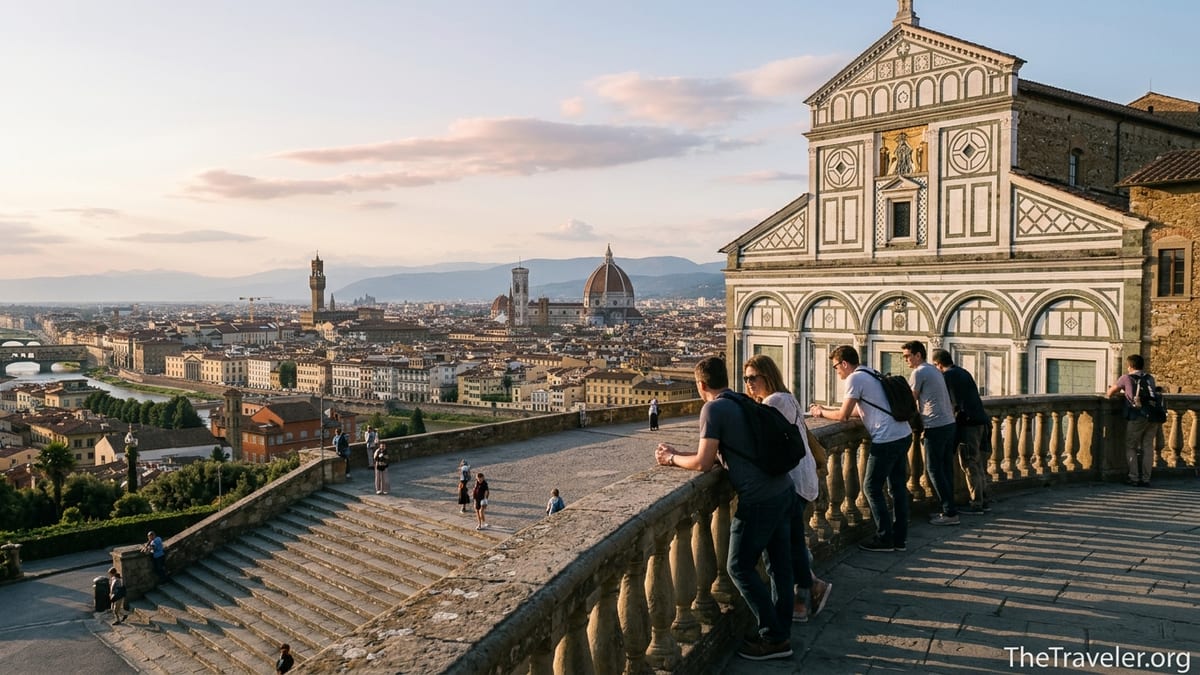
San Miniato al Monte is one of the oldest churches in Florence, with construction beginning in the early 11th century. Its facade of white and green marble mirrors the style of Santa Maria Novella and the Baptistery in the city center, but here you see it without the crush of tour groups. Inside, you find dim candlelight, a raised choir, a crypt supported by forest-like columns, and medieval frescoes that give a sense of Florence before the Renaissance boom.
Historically, the church has watched over the city through turbulent times. During the siege of Florence in 1530, it even served as an artillery post, with defenders reportedly protecting the facade from cannon fire using mattresses. Standing on the terrace today, with the Duomo and Palazzo Vecchio spread out below, it is easy to imagine the strategic importance of this hilltop position.
Most visitors, however, remember San Miniato less for its dates and more for its atmosphere. Compared with the Duomo complex, where you might line up for 30 to 60 minutes just to enter, San Miniato often feels calm, especially in the morning or late evening. Travelers who have already seen big-name sites frequently describe it as the place where Florence finally “slows down” and becomes contemplative.
The surrounding complex adds to that feeling. Just beside the basilica lies the monumental cemetery, with ornate tombs and sculptures of prominent Florentines. Even without knowing the names, wandering past the graves under cypress trees gives the visit a more local, lived-in dimension than many city-center stops.
The View: How It Compares to Piazzale Michelangelo
Most travelers first hear about San Miniato in the context of Florence’s viewpoints. Piazzale Michelangelo, a broad terrace built in the 19th century, is the city’s most famous panorama, often packed around sunset with bus tours, food trucks, and street musicians. San Miniato sits slightly higher up the same hill, a five to ten minute walk above the piazzale, which means you get almost the same postcard skyline but from a quieter, more elevated perch.
On a practical level, the difference in altitude is modest, but it changes the feel of the view. From the terrace in front of the church, you see not only the red-tiled roofs and the Duomo dome, but also more of the hills that frame Florence. Many photographers and local guides now suggest walking up beyond Piazzale Michelangelo precisely because San Miniato’s terrace gives a broader, less obstructed panorama and fewer selfie sticks in your frame.
If your main goal is a quick, classic sunset look at Florence, Piazzale Michelangelo alone may suffice. Shuttle buses, taxis, and even golf-cart-style tours drop visitors directly in the piazza, which is particularly convenient if you are short on time or traveling with mobility issues. But if you are willing to climb one extra flight of steps or stroll further up Viale Galileo, San Miniato adds depth to what would otherwise be just a viewpoint stop. You can watch the city turn gold as bells ring from multiple churches below, then step inside for evening prayers.
Many visitors now time their afternoon so they watch the sunset from Piazzale Michelangelo, then walk up to San Miniato immediately after, when the crowds begin to thin. This sequencing gives you both the lively piazza scene and the quieter, more reflective terrace in a single outing, usually within a two to three hour window including the walk from the historic center.
Experiencing the Interior and Gregorian Chant
While some people climb to San Miniato only for the view, the interior is what convinces many that the detour was genuinely worth it. Compared with the Duomo’s largely empty nave, San Miniato still feels like an active monastic church. The floor is a patchwork of marble inlay, and the raised choir area above the crypt creates dramatic shadows when lit by candles and small lamps.
If you are interested in sacred music, one of the highlights is the Gregorian chant sung by the monastic community. On Sundays and religious feast days, the monks typically accompany Mass in the crypt with chant, and in the late afternoon or early evening they sing vespers in Latin on most days. The exact schedule can shift with seasons and church calendars, so it is wise to check the latest times once you are in Florence, either by asking at your accommodation or calling the church information number posted locally.
For many travelers, attending vespers becomes a standout memory. Around 5.30 or 6.30 pm on a typical day, as the light fades outside, you sit in the dim church while the chant rises and falls without amplification. There are no tickets, and the congregation is a mix of locals, a few in-the-know visitors, and occasionally students from nearby language schools. Compared with large concert-style church events where you might pay 20 to 40 euros, this is free and entirely non-commercial, provided you are prepared to behave as a respectful participant rather than an audience member.
To get the most from the interior, try visiting at a quieter time, such as late morning on a weekday. This allows you to explore the side chapels and crypt before the evening services, then perhaps return later the same day for vespers. Photography policies may be restricted during services, so if you want interior photos, take them earlier and put your camera away once prayer begins.
Getting There: Transport, Time and Effort
San Miniato al Monte sits on the hill south of the Arno, in the Oltrarno district. From the Duomo area, walking to the church typically takes about 30 to 40 minutes one way, depending on your pace and how often you stop for photos. The most common route leads across the river near Ponte alle Grazie, then up a series of staircases and ramps through the neighborhood of San Niccolò to Piazzale Michelangelo, and finally up another short climb to San Miniato.
If you prefer to minimize uphill walking, city buses offer a practical alternative. At the time of writing, bus lines such as 12 and 13 connect the historic center with the hill above the Arno. A single ticket bought from a tobacconist or newsstand typically costs under 2 euros and is valid for 90 minutes from validation. You can ride up to or near Piazzale Michelangelo, then walk the last stretch to the church on a paved sidewalk suitable for most travelers, including those pushing a stroller.
Taxis remain the simplest door-to-door option, especially if you are visiting around sunset or heading back after dark. Expect to pay roughly 12 to 18 euros one way from central locations like Santa Maria Novella station or Piazza della Signoria, depending on traffic and exact starting point. Many drivers are used to taking visitors to Piazzale Michelangelo; you can ask them either to drop you directly at San Miniato or at the piazza if you want to walk the final segment.
In terms of time commitment, most travelers spend about 45 minutes to one hour at the church and terrace, not counting the journey. If you are attending Mass or vespers, allow at least 90 minutes on site. Factoring in walking or bus rides, visiting San Miniato usually requires a 2 to 3 hour block in your day, which is important to consider if you only have one or two days in Florence.
When San Miniato Is Worth Prioritizing in Your Itinerary
Whether San Miniato is worth visiting depends heavily on how long you are in Florence and what you value most. If you have three or more full days in the city, it is generally an easy yes. By that point, you will likely have seen the Duomo, Uffizi, and Ponte Vecchio, and you may be craving a quieter experience and a big-picture view of where you have been walking. San Miniato offers both, without an entrance fee and without the queues of the major museums.
For shorter stays of one to two days, the decision becomes more strategic. If you are passionate about photography, sacred architecture, or contemplative spaces, it is often still worth carving out a half-day, perhaps by combining San Miniato with a walk through the Rose Garden and a simple dinner in the Oltrarno neighborhood below. On the other hand, if this is your first visit to Florence and you are more interested in Renaissance painting and sculpture, you may find that the Uffizi, Accademia, and a Duomo climb already fill your schedule.
Season and time of day matter too. In peak summer months, when the city center can feel stifling by mid-afternoon, escaping up the hill around 5 pm offers a noticeable drop in temperature and crowd density. Spring and autumn evenings at San Miniato, with soft light and long shadows across the rooftops, are particularly atmospheric. In winter, shorter days mean that vespers may coincide with darkness, which can make the uphill walk after sunset less appealing unless you rely on a taxi back down.
Your mobility and fitness are also important factors. If steep steps or uneven pavement are challenging for you, prioritize the bus or a taxi and keep your walking on the hill to a minimum. The terrace itself is relatively flat once you arrive, so many visitors with limited mobility still find it manageable, but the staircase route from the river is not ideal for everyone.
Combining San Miniato With Nearby Experiences
One of the strongest arguments in favor of visiting San Miniato is how easily you can pair it with other worthwhile stops. The most popular combination is Piazzale Michelangelo plus San Miniato in a single outing. You might, for example, leave the city center around 4.30 pm, stroll up to the piazza in time for pre-sunset light, then climb to the church for the final color change and evening chants. Afterward, you can walk downhill in about 20 minutes to the bars and trattorias of the San Niccolò area for dinner.
Just below Piazzale Michelangelo lies the Rose Garden, which is often far quieter than the piazza itself. In late spring and early summer, the garden is filled with dozens of rose varieties and scattered sculptures, with benches positioned to capture framed views of the city. Many locals prefer to bring a simple picnic or takeaway panini from a central bakery, enjoy it in the garden, then continue up to San Miniato once the worst of the afternoon heat has passed.
The broader Oltrarno district also rewards exploration before or after your hill visit. Streets around Piazza Santo Spirito and Via Romana host small artisan workshops, neighborhood cafes, and wine bars that feel different from the more polished streets around Via de’ Tornabuoni. A common pattern for visitors is to spend the late morning in the Pitti Palace or Boboli Gardens, have a casual lunch in the Oltrarno, then make their way uphill in the later afternoon, turning the day into a mix of art, gardens, and panoramic views.
If you are celebrating a special occasion, San Miniato can even set the tone for an evening. Some travelers choose to propose on the terrace or in the nearby gardens precisely because the setting is romantic but not overwhelmingly crowded. From there, you can book a dinner at a more relaxed, garden-style restaurant in the lower Oltrarno, which tends to be less formal and slightly less expensive than the dining rooms in the historic core north of the river.
Practical Tips: Hours, Costs, Safety and Etiquette
San Miniato al Monte remains an active church and monastery, so visiting hours and access to certain areas can vary. The basilica is generally open daily, with closures during part of the midday and later evening. Because schedules can change from year to year, especially around religious holidays, it is sensible to confirm the current opening times once you arrive in Florence, either via local tourist information points or your accommodation host who will usually have up-to-date printed leaflets.
There is no admission fee to enter the church or stand on the terrace, which is increasingly rare in heavily visited European cities. You might, however, choose to leave a small donation in one of the boxes inside, especially if you attend a service or spend longer photographing the interior. Consider a few euros per person as a reasonable gesture, similar to leaving a tip for a particularly informative free walking tour.
In terms of safety, the area around San Miniato is generally considered safe during daylight and early evening. The route from the river through the Rose Garden and Piazzale Michelangelo is heavily used by both tourists and locals, particularly around sunset. Standard big-city precautions apply: keep valuables out of sight, be cautious of pickpockets in crowded spots, and avoid wandering alone on unlit side paths late at night. If you feel uneasy about walking back down in the dark, taxis can be called from the piazza area or booked via phone-based car services once you reach the terrace.
As for etiquette, remember that this is a place of worship first and a viewpoint second. Dress modestly enough for a church visit, with shoulders and knees covered if possible, especially if you plan to stay for Mass or vespers. Keep voices low inside, silence your phone, and avoid flash photography. During services, it is respectful not to roam around taking pictures; instead, remain seated or kneeling and take part quietly, even if you are not familiar with the Latin liturgy.
The Takeaway
San Miniato al Monte is not just “another church” or a bonus viewpoint tacked onto Piazzale Michelangelo. For many travelers, it becomes the emotional high point of their time in Florence, precisely because it combines so many elements the city is known for: history, art, skyline views, and living religious tradition, all in a single, relatively uncrowded place.
If you have at least two full days in Florence, are comfortable with a bit of uphill walking or using public transport, and are drawn to either panoramic photography or contemplative spaces, San Miniato is very likely worth including in your itinerary. Ideally, plan your visit for late afternoon or early evening, combine it with a stop at the Rose Garden or Piazzale Michelangelo, and, if possible, stay for Gregorian chant to experience the basilica at its most atmospheric.
On the other hand, if your time is extremely limited, you struggle with steep climbs, or your interests lie almost entirely in museum collections and shopping streets, you may be satisfied with the more accessible city-center highlights. In that scenario, think of San Miniato as something to save for a future trip when you can afford to slow down.
Ultimately, San Miniato al Monte is worth visiting not because every traveler must see it, but because it offers what Florence does best in a distilled, less commercial form. If that appeals to you, it deserves a thoughtful place in your plans.
FAQ
Q1. How much time should I budget to visit San Miniato al Monte?
Most travelers spend about 45 minutes to one hour at the church and terrace, plus travel time. If you also attend vespers or Mass, plan on a total of two to three hours including the journey up and down the hill.
Q2. Is there an entrance fee for San Miniato al Monte?
No, entrance to both the church and the terrace is free. Many visitors choose to leave a small voluntary donation of a few euros to support the monastery and the upkeep of the building.
Q3. What is the best time of day to visit San Miniato al Monte?
Late afternoon leading into sunset is ideal, as you can enjoy softer light over the city and, on many days, stay for evening vespers. Early morning is also pleasant if you prefer cooler temperatures and very few people.
Q4. How do I get to San Miniato al Monte from the Florence city center?
You can walk from the historic center in about 30 to 40 minutes, using stairways and ramps through the San Niccolò neighborhood and past Piazzale Michelangelo. Alternatively, local buses and taxis can take you most of the way up the hill, with only a short final walk to the church.
Q5. Is San Miniato al Monte suitable for visitors with limited mobility?
The direct stairway route from the river is steep and not ideal for those with mobility issues, but the road from Piazzale Michelangelo offers a gentler incline and paved sidewalks. Many visitors with limited mobility use a bus or taxi to reach near the top and then walk the shorter, flatter section to the terrace.
Q6. Can I hear Gregorian chant at San Miniato al Monte every day?
The monks typically sing Gregorian chant during certain Masses on Sundays and religious feast days, and at evening vespers most days. Times can shift with seasons and church calendars, so check the latest schedule once you arrive in Florence rather than relying solely on older printed or online information.
Q7. Is it safe to walk back from San Miniato al Monte after sunset?
The main route via Piazzale Michelangelo and the Rose Garden is generally busy and considered safe around sunset, but paths become quieter later at night. If you are uncomfortable walking in the dark or are traveling alone, it is sensible to arrange a taxi from the piazza area for the return to your accommodation.
Q8. Can I visit San Miniato al Monte with children or a stroller?
Yes, many families visit with children, and the terrace itself is stroller-friendly. The steep stairways from the river are challenging with a stroller, so using the road route from Piazzale Michelangelo or taking a bus or taxi up the hill is usually more comfortable.
Q9. How does the view from San Miniato compare to the Duomo climb?
The Duomo and nearby bell tower offer bird’s-eye views from inside the city center, looking down on narrow streets and nearby rooftops. San Miniato, by contrast, provides a wider, more cinematic panorama of the entire historic core, the Arno, and the surrounding hills, without the tight staircases and ticketed entry.
Q10. Is San Miniato al Monte worth it if I am only in Florence for one day?
If you have just one day and want to see headline sights like the Duomo complex and one major museum, San Miniato may feel rushed. However, if panoramic views and quieter spiritual spaces are top priorities for you, you can still fit in an early evening visit by focusing the rest of your day on a smaller selection of central attractions.