


Planning to explore your next destination on two wheels and wondering whether to reserve through BikesBooking.com or simply walk into a local rental shop when you arrive? Both options can work well, but they come with very different trade-offs around price, reliability, choice, and support when something goes wrong. Understanding those differences before you click “Book now” can save you money, time, and a lot of stress on the road.
Get the latest updates straight to your inbox!
What BikesBooking.com Actually Does
BikesBooking.com is an online platform that aggregates rental offers for bicycles, scooters, motorbikes, quads and some ATVs from local companies around the world. Instead of contacting a shop in Dubrovnik, Santorini or Bali one by one, you enter your destination and dates on the site and see a list of available vehicles, typically with basic specs, photos and daily prices in your currency.
According to its own description, BikesBooking positions itself as a leading global booking service with a multilingual interface and a wide partner network, promising verified reviews and the best available prices. In practice, it functions much like a hotel metasearch site, but for two-wheeled rentals: the platform does not own the bikes. A partner shop in, say, Barcelona or Split provides the actual scooter and handles handover, contracts and deposits on the ground.
The company highlights that it does not charge a booking commission to the customer and that your payment is split between an online prepayment and a balance paid locally at pickup. Exact terms vary by partner. For travelers, the appeal is obvious. You can land in Milan with a 125 cc scooter already reserved for the next morning instead of wandering from storefront to storefront hoping someone has a bike left.
Coverage is broad in popular tourist regions. Major Mediterranean destinations like Greece, Italy, Spain and Croatia often show dozens of options across islands and coastal towns. Urban hubs in Western Europe and North America also appear, though availability can be patchier for pure pedal bikes compared with scooters and small motorcycles.
Pros of Using BikesBooking.com: Convenience, Choice and Predictability
The biggest advantage of BikesBooking is planning security. If you are heading to a small island in August or to a city during a big festival, scooters and e-bikes can sell out days in advance. On several Adriatic islands in high season, travelers report finding all 50 cc scooters already taken by midday. Booking a scooter through a platform before you arrive greatly reduces the risk of spending your beach week on foot or in expensive taxis.
Browsing online also makes it easier to compare classes and prices. In Dubrovnik in summer, for example, local shops commonly advertise 50 cc scooters from about 40 to 45 euros per day, with 125 cc models closer to 55 to 60 euros per day for short three-day rentals, often dropping slightly for a week-long hire. Seeing a similar spread on BikesBooking lets you quickly decide whether an upgrade from 50 cc to 125 cc fits your budget for a hilly destination.
The user interface can be especially helpful if you are not yet familiar with local brands or model names. Seeing displacement, luggage options, helmet inclusion and sometimes mileage limits side by side is easier than deciphering handwritten signs at a pier-side stall. Many listings include customer photos and brief reviews that at least give some sense of the rental team’s professionalism and whether previous renters found the condition of the bikes acceptable.
For multi-stop itineraries, centralization is another plus. A traveler riding from Barcelona to Valencia and then flying to Rome could use the same account to manage a scooter in Spain and an e-bike in Italy, instead of tracking separate email threads in different languages. If your plans shift a day or two, you update dates in one familiar interface rather than trying to phone three different shops during their lunch breaks.
Cons of Using BikesBooking.com: Mixed Reviews, Extra Layers and Limited Control
The downside is that experiences with BikesBooking vary sharply. Public review platforms show a split picture: some recent users praise smooth rentals and attractive rates, while others describe last-minute cancellations, disputes about refunds, or difficulty reaching support when a local partner fails to deliver. It is not unusual to see comments from the last year in which a confirmed booking was cancelled close to the trip and the customer had to chase the refund through their bank.
Part of the problem is structural. BikesBooking sits between you and the local shop. If you arrive in Milan and the motorcycle offered is older than the one in the photos or shows mechanical issues, your negotiation first happens at the counter with the shop staff. If you refuse the bike and ask for a refund of your online prepayment, the shop may direct you back to BikesBooking, arguing that the platform holds that money. The platform, in turn, may say the partner has to approve any refund. Disputes can drag on, especially across time zones.
Communication before pickup can also be slower through an intermediary. With a direct email or WhatsApp exchange, you can ask a shop in Santorini for real photos of the actual scooter, confirm if your 50 cc license is sufficient, or check whether they can provide a top box and phone holder. Through a platform, you often send messages into a generic system and rely on the partner to respond in time.
Finally, although BikesBooking advertises best prices, that does not guarantee it will always be cheaper than walking into a shop. In Bali, for example, long-stay visitors frequently report basic automatic scooters rented on the ground for about 5 US dollars per 24 hours, while pre-booked online scooters for similar models can show significantly higher daily rates for casual tourists. Markups are not universal and can still be good value in high-demand places, but you should not assume an aggregator is automatically the least expensive option.
Pros of Renting Directly From Local Shops
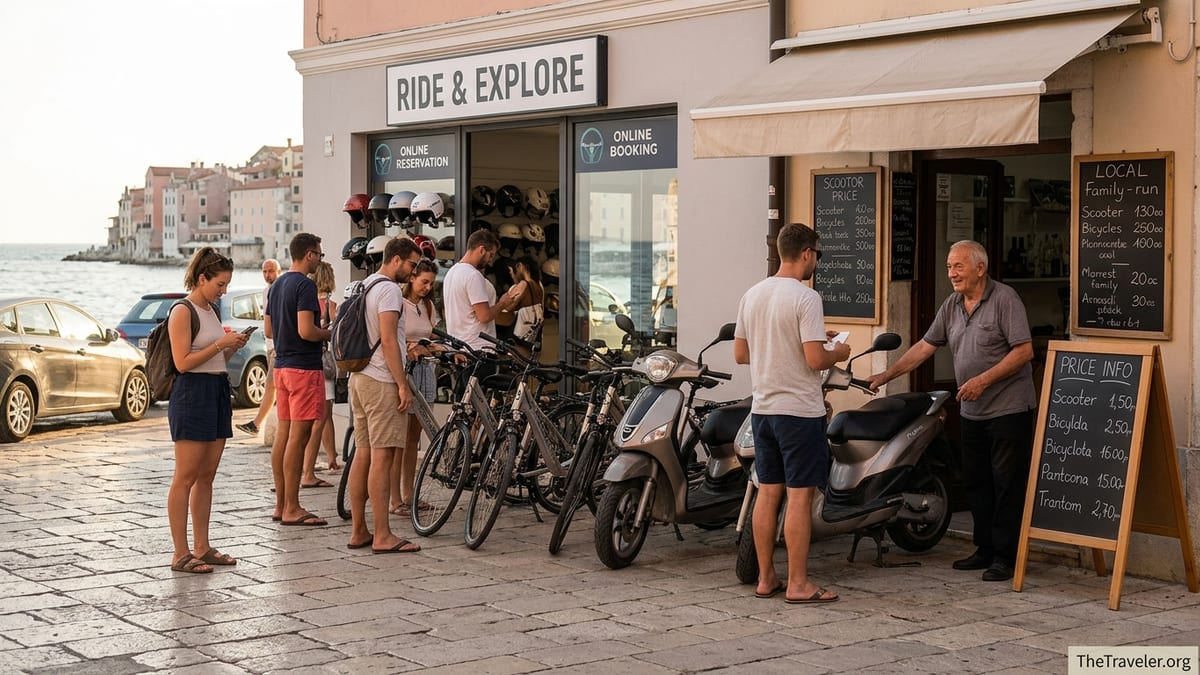
Renting on the spot from a local shop gives you immediate, physical inspection before you commit. In a Croatian coastal town, you can walk along the harbor where several scooter stands cluster, look at the tread on the tires, check the brakes, confirm that lights and horn work, and only then sign the contract. If a bike looks poorly maintained, you simply walk to the next stand.
Direct rental also simplifies communication and negotiation. Imagine you are in Trogir or Split and see a shop offering a city bike for 80 kuna (roughly around 10 to 12 euros) for six hours. You can ask about discounts for a full day or multiple days in person, clarify whether helmets and locks are included, and sometimes secure a better price by committing to a three-day hire. Many small operators would rather adjust a price slightly than watch you walk to a competitor down the street.
Over longer rentals, local shops may be noticeably cheaper. In smaller Indonesian towns or on Thai islands, for instance, travelers regularly arrange month-long scooter rentals directly with a neighborhood garage at a significant discount per day compared with short-term tourist bookings made online. A basic automatic scooter that costs the equivalent of 7 to 10 US dollars per day at a beachfront stand might drop to the mid-100s of dollars for a full month when negotiated in cash.
There is also a cultural benefit. Dealing with a local owner in a family-run shop can yield tips about scenic routes, safe places to park overnight, which fuel stations to use, and where potholes lurk. Some Croatian and Montenegrin rental owners will mark out recommended loops on a paper map, or explain which mountain passes turn icy early in the evening. That kind of nuanced local intel rarely appears in a platform listing.
Cons of Direct Local Rentals: Availability, Language and Paperwork
Direct rentals have their own risks. The most obvious is availability in peak season. Arrive in Hvar or Vis on a sunny August Saturday without a reservation and you may find every scooter already rented out by noon. Travelers have reported walking from shop to shop only to hear “maybe tomorrow” or being offered the last, tired-looking scooter at a premium rate of 60 to 75 euros per day because demand is so high.
Transparency can also be weaker. Smaller shops do not always have detailed websites or up-to-date reviews. In some island ports, laminated price boards might not match what you are quoted when you sit down to sign the contract. Key conditions like mileage limits, fuel policies, late return fees or scratch charges might be stated quickly in the local language. If you do not slow the process down and ask to see them in writing, you could be surprised at checkout.
Language barriers can matter when problems arise. If you pick up a scooter in a small Montenegrin town and later need a written statement after a minor traffic incident for your travel insurance, you might find it hard to explain your needs. A platform can sometimes help mediate in a common language, while a tiny shop may rely on machine translation on a phone and a lot of gesturing.
Finally, paperwork like cross-border permission and insurance extensions can be more cumbersome to arrange informally. One rider planning a loop through Montenegro, Croatia and Albania with a rented motorbike discovered at a border that guards wanted to see a very specific contract clause authorizing the bike to leave the country. Resolving that by phone with a small shop can be stressful. Some larger platform-affiliated shops are more accustomed to printing standardized letters or adding extra green-card insurance for border crossings when requested in advance.
Price and Value: When Each Option Tends to Be Cheaper
Price comparisons between BikesBooking and direct rentals depend heavily on destination, season and how far in advance you book. In European coastal cities such as Dubrovnik, public price lists at established shops commonly show 50 cc scooters at around 40 euros per day for one to three days, with a small discount to about 36 euros per day if you commit to a week. A 125 cc scooter might list at 60 euros per day, dropping to the mid-50s with a longer hire, including basic damage coverage and two helmets.
On BikesBooking, you might see similar headline prices for the same city in July, especially once you factor in guaranteed availability and the ability to pay part of the cost online with a card instead of carrying large amounts of cash. In shoulder season months like May or late September, however, walking into a shop can yield unadvertised discounts, such as extra free hours on the last day or a complimentary upgrade to a more powerful scooter because several are idle.
In Southeast Asia, meanwhile, the equation often flips. Long-stay visitors in Bali describe walk-up rates of roughly 5 US dollars per 24 hours for basic scooters from independent local providers, sometimes dropping further with weekly or monthly deals. Online pre-booked scooters marketed to short-term tourists through various intermediaries can cost multiple times that amount for similar models, paying for delivery and English-speaking customer service rather than the vehicle itself.
Beyond the sticker price, you should weigh deposits and potential charges. Local shops in Europe might ask for a cash deposit of 100 to 300 euros or hold a similar amount on your card. Platform-based bookings sometimes rely more on card pre-authorizations, which can be more familiar if you are used to hotel holds but still tie up part of your credit limit. Ask in advance how minor cosmetic damage is handled. A shop that charges 50 euros for every small scratch can turn a seemingly cheap deal into an expensive one, whether booked online or in person.
Reliability, Safety and Support if Things Go Wrong
Mechanical condition is one of the most important factors in choosing between BikesBooking and local shops, and unfortunately neither model guarantees perfection. Some renters using BikesBooking in recent seasons describe scooters in excellent shape and near-new helmets. Others recount receiving old, poorly maintained bikes that broke down multiple times in a single trip, combined with slow or unhelpful responses from both the local shop and the platform.
When dealing directly with a shop, your main protection is your own inspection before riding away. In Barcelona or Lisbon, for example, reputable city bike renters will walk you through a checklist: brakes, lights, bell, quick-release clamps, tire pressure. You can request a different bike on the spot if anything feels off. On a platform, the condition of the actual bike that appears on the day can deviate more from the generic photo and description, because inventory is not tied to a specific frame or scooter unit.
Support during incidents also differs. With a direct rental, if your chain snaps or your scooter will not start in the morning, you call the shop’s phone number on your contract. In well-run operations, someone either comes out with tools or tows you in, or they swap the vehicle. In smaller shops, especially in rural areas, you may have to wait until they reopen after a midday break. With a platform booking, you might have two contacts: the shop and the platform’s helpdesk. Ideally, that means more backup; in reality, it can lead to finger-pointing about who should arrange a replacement or approve a partial refund for lost days.
From a safety perspective, you should treat both models with the same caution. Always test ride for a few minutes in a quiet side street before accepting the bike, confirming that brakes bite evenly, steering is straight, mirrors adjust properly and the engine pulls cleanly without strange noises. Verify that helmets are not cracked and that they fit reasonably well. On island roads with steep drop-offs or busy urban traffic, the risk of riding an under-maintained vehicle far outweighs a modest saving from a cheaper rental channel.
How to Decide: Matching the Channel to Your Trip
The choice between BikesBooking and local shops should ultimately reflect your destination, season, risk tolerance and travel style. If you are flying into a Greek island during the first week of August and you know you absolutely want a 125 cc scooter for three full days, reserving through a platform can be sensible. The peace of mind of a confirmed booking, clear pickup location and English-language paperwork might outweigh the possibility that you could have saved 10 euros per day by shopping around on arrival.
If, instead, you are spending a shoulder-season week in a medium-sized Spanish city with multiple bike rental outlets in the historic center, you may be better off visiting two or three shops after you arrive. You can physically compare e-bikes and city bikes, test the gears on cobbled streets, and possibly negotiate a multi-day discount that a platform does not offer. In that context, flexibility and direct contact often translate into better value.
Extended stays tilt further toward local rentals. A digital nomad based in Bali for a month or two is likely to get the best deal by arranging a scooter in person, perhaps even switching providers if the first bike proves unreliable. Negotiating a fair monthly rate, checking storage for rainy nights, and maintaining a direct WhatsApp line to the mechanic all work better face to face than through a multi-step online booking.
Conversely, if you are nervous about language barriers or about reading local contracts, an intermediary can help. Large, well-reviewed BikesBooking partners in cities such as Rome or Paris often have standardized English contracts, clear insurance explanations and staff accustomed to working with international visitors. For a first-time scooter renter who wants maximum clarity, that structure can be reassuring even if it is not always the absolute cheapest route.
The Takeaway
BikesBooking.com is neither a magic bullet nor a platform to avoid at all costs. It is a tool, and like any tool, it works well in some scenarios and poorly in others. Its strengths lie in advance planning, broad choice and convenience, especially in high-season destinations where two-wheeled rentals routinely sell out. Its weaknesses center on inconsistent partner standards, occasional communication gaps and the complexity of resolving problems through an intermediary.
Direct local rentals, on the other hand, shine when you value hands-on inspection, personal negotiation and deeper contact with local businesses. They can deliver better prices, especially for longer stays in places with abundant competition, at the cost of more legwork and some risk of misunderstanding around terms and insurance.
For many travelers, a hybrid strategy works best: use BikesBooking or a similar platform to secure a must-have rental in peak periods or remote areas where options are limited, and rely on walk-up local shops in bigger cities or during quieter months when you can afford to be flexible. Whichever route you choose, slow down the handover, read every clause related to deposits and damage, photograph the bike from all sides before you leave, and take a short test ride. That attention to detail matters far more than whether you clicked “Book” online or shook hands at a harbor-front stand.
FAQ
Q1. Is BikesBooking.com safe to use for scooter or bike rentals?
It is generally used by many travelers, but experiences are mixed and depend heavily on the local partner. To reduce risk, favor listings with numerous recent positive reviews, read cancellation and damage policies carefully before paying, and always inspect the vehicle thoroughly at pickup.
Q2. Will I save money by renting directly from a local shop instead of using BikesBooking?
Often, but not always. In places with many competing rental shops, walk-up rates and negotiated multi-day discounts can undercut platform prices. In very busy periods or on small islands with limited fleets, platform prices may be similar to or even better than last-minute local offers, especially once everything else is sold out.
Q3. What happens if my bike or scooter breaks down when I booked through BikesBooking?
Operational support usually comes from the local shop, not the platform. You will call the number on your voucher or rental contract and ask for assistance or a replacement. If you lose rental days or feel the bike was unfit, you can later contact BikesBooking with documentation to request a partial refund, but resolution can take time.
Q4. How can I check if a local rental shop is trustworthy?
Look for a physical storefront in a visible location, clear written price lists, and recent reviews mentioning well-maintained bikes and helpful service. Ask to see the contract before handing over your passport or card, inspect the bike carefully, and avoid shops that refuse to note existing scratches or dents on the paperwork.
Q5. Is it better to book my scooter before I arrive in peak season?
Yes, if you are traveling in high season to popular islands or resort towns and you know you need a scooter or motorbike for specific dates. In July and August in much of the Mediterranean, same-day availability can be very limited. Having a confirmed booking, whether through BikesBooking or directly with a large shop, can prevent disappointment.
Q6. Do platforms like BikesBooking always show the exact bike I will get?
Not necessarily. Listings typically represent a class or model type rather than a specific unit. You might receive a similar scooter or bike from the same category, not the exact vehicle in the photo. This is why it is important to inspect the actual bike offered at pickup and request a swap if something looks unsafe.
Q7. What should I look for when inspecting a rental bike or scooter?
Check tire tread and pressure, front and rear brakes, lights, indicators, horn, mirrors and, on bicycles, the condition of the chain and gears. Make sure the steering feels straight and there are no strange noises during a short test ride. Confirm that helmets fit properly and that any included lock or luggage rack works as promised.
Q8. Can I cross borders with a rental motorbike or scooter?
Sometimes, but only with explicit permission from the rental company. You typically need written authorization in the contract and, in Europe, additional insurance documentation for border guards. This is easier to arrange in advance with larger, experienced rental companies; small shops may decline or require extra fees and processing time.
Q9. How do deposits and damage charges usually work?
Many shops hold a deposit either in cash or as a card pre-authorization, which they release when you return the bike without new damage. Scratches, broken mirrors or bent rims can be charged at set rates. To protect yourself, photograph the bike from all angles at pickup and ensure existing marks are written into the contract.
Q10. If I prefer flexibility, should I avoid booking ahead through BikesBooking?
If your schedule and transport mode can change day by day, you may enjoy more freedom by renting directly on the ground, especially in destinations with plenty of supply. However, if your plans are fixed or you are traveling during peak season, booking ahead through a platform or directly with a shop can be worth the reduced flexibility in exchange for guaranteed wheels.