


Search any popular city and you will see the same hotel pop up three times: on its own website, on Booking.com and on Expedia. The nightly rate often looks identical, yet your final bill and flexibility can be very different. To understand which option actually works out cheaper in real life, you need to look beyond the first price and compare taxes, fees, cancellation rules and loyalty benefits side by side.
Get the latest updates straight to your inbox!
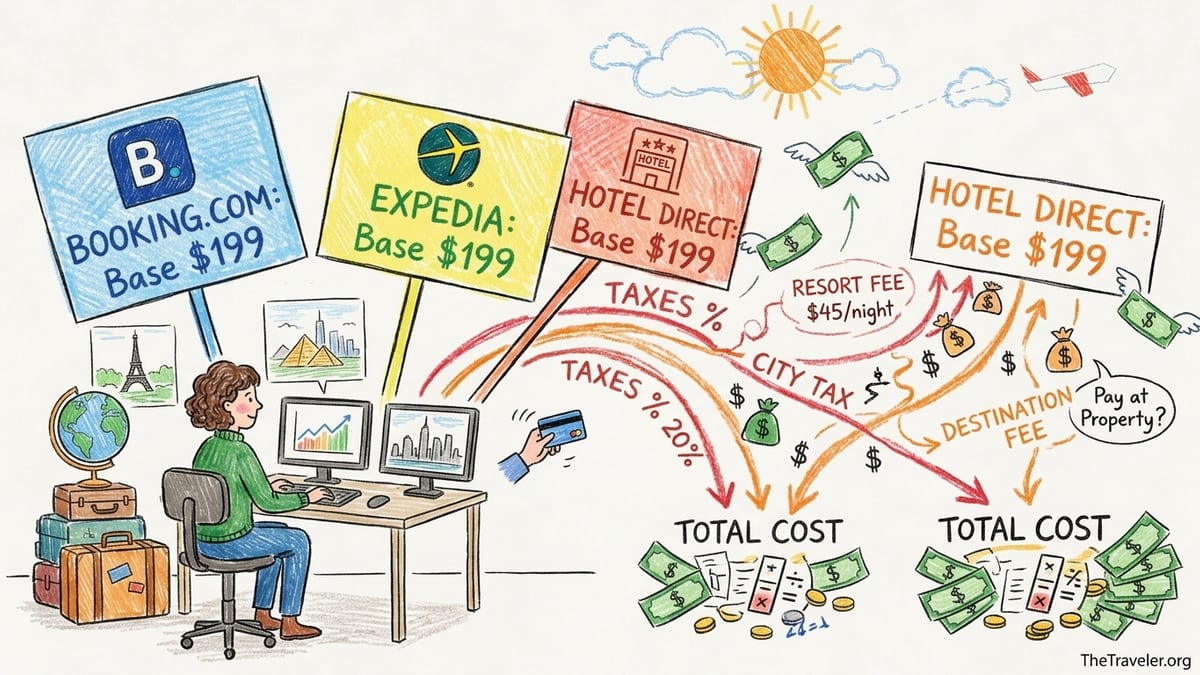
Why Prices Often Match Yet Your Total Cost Does Not
Hotels, Booking.com and Expedia typically work under rate parity agreements, which means the base room price for a standard refundable rate is meant to be the same across channels when the dates and conditions match. Several independent price studies in 2025 and 2026 that sampled thousands of U.S. and European hotels found that for the exact same room, Booking.com and Expedia were either identical or within a couple of dollars of each other for well over half of properties checked. Where there was a difference, one site might be 5 to 10 percent cheaper, but neither platform won consistently.
That does not mean the total you pay is the same. Big gaps usually come from how each site shows taxes and mandatory fees. For example, in New York City a hotel might display 200 dollars per night on all three channels, but at checkout Booking.com could show city and state hotel taxes as “pay at property,” Expedia might roll those into an all-in total, and the hotel’s own site may bundle taxes but add a separate destination fee. The underlying base rate is similar, yet the amount that actually leaves your card differs by tens of dollars once you factor in local room taxes that can easily exceed 15 percent in major U.S. cities.
Some hotels deliberately use different combinations of free breakfast, parking or resort fees to make one channel look cheaper at first glance. A Las Vegas resort, for instance, might sell a 150 dollar room on its own site and on Booking.com, but bundle a 45 dollar nightly resort fee differently. The hotel website might show a higher room rate that already includes some benefits, while an online travel agency could highlight a lower room rate but hide the resort fee until the final step. The only meaningful way to compare is to look at the final “total to be charged” including all taxes and mandatory fees before you enter payment details.
Testing Real Prices: Direct vs OTA in Popular Destinations
When comparison sites and travel blogs put booking channels to the test, the headline result is that there is no single winner, but patterns do emerge. A 2026 analysis by an independent travel tool that scraped roughly 3,700 hotels worldwide over several days found that Expedia’s lowest rate came out more than two percent cheaper than Booking.com at about a third of the hotels where both were on the same tax footing, while Booking.com was cheaper at under 10 percent. In the majority of cases, the two were effectively tied. That supports what most travelers see when they manually check a city like Paris or Chicago: prices are broadly aligned with occasional pockets of savings.
Other studies that compared city breaks such as Rome, Amsterdam and New York across Booking.com, Expedia and a hotel’s own site have found similar patterns. For a four star Amsterdam property, for example, a researcher in 2025 pulled prices for a weekend stay and saw Booking.com showing around 340 dollars per night for a flexible rate, while a comparable four star hotel on Expedia was closer to 100 dollars for the same dates. The difference there was not about Booking.com versus Expedia so much as two different hotels and room categories, which highlights another risk: results pages can mix apples and oranges. To genuinely test channels, you must match the same property, room type, dates and cancellation terms. When you do, the gap usually shrinks.
In practice, that means you might see a New York Midtown hotel at 289 dollars flexible on the hotel website, 283 dollars on Expedia with a “member price,” and 281 dollars on Booking.com with a mobile-only discount for the same night. In destinations like Tokyo or Mexico City, recent anecdotal comparisons posted by frequent travelers suggest Expedia has been marginally cheaper than Booking.com more often, especially when member discounts stack with temporary sales. In Japan, for instance, some travelers reported consistently finding Expedia a few dollars below Booking.com for business hotels, while the hotel’s own site stayed at the headline rack rate until local campaigns kicked in.
Taxes, Fees and Drip Pricing: Where “Cheaper” Disappears
The headline rate battle hides what often matters more: how each channel displays and passes on taxes and mandatory fees. In the United States, room taxes can exceed 15 or even 20 percent once you combine state, city and local tourism levies. Many booking agents show a low nightly price first and only reveal the full tax figure at the final step. Some also exclude resort or destination fees from the online total altogether and label them as “pay at property.” Consumer regulators have warned repeatedly that this kind of drip pricing can make one site look cheaper when, in reality, the fully loaded price is the same or higher.
Booking.com often lists city tax or occupancy tax as a separate line that you pay directly to the hotel. Travelers comparing screens may believe Booking.com is cheaper than the hotel’s own site or Expedia when the base rate is, for example, 180 dollars and total shows 195 dollars, not realizing a further tax component is still due at checkout. Meanwhile, Expedia tends to roll more taxes and fees into the “total due today” number, so the upfront figure can look higher even if the ultimate out of pocket cost is identical. Some European hotels also structure things so that the online agency prices exclude a small per person city tax that all guests pay on arrival, so your card statement will be lower but your wallet still opens at check in.
Resort fees add another layer of confusion. Urban hotels in cities like Las Vegas, Orlando and New York frequently add nightly resort or destination fees that can be 30 to 50 dollars plus tax. Online agencies sometimes list a room at 120 dollars with a prominent “great deal” badge while noting the 45 dollar resort fee only on the room details page. The hotel’s direct site may quote 160 dollars upfront and label the resort fee separately but include extras such as Wi Fi, gym access or a welcome drink. In this scenario, a traveler captivated by the 120 dollar figure could end up paying slightly more overall than the clearly disclosed 160 dollar direct rate once all extras and taxes are added.
Cancellation Rules and Customer Service When Things Go Wrong
Even when the nightly price is identical, the fine print around cancellations and changes can tip the balance between booking direct and using an online agency. Expedia and Booking.com both sell a mix of fully flexible, semi flexible and non refundable rates, and hotels usually mirror those on their own sites. The difference is who you deal with when something goes wrong. If you booked through an online travel agency and the hotel claims it never received your reservation, you must contact the agency to fix it. Hotel staff can be sympathetic, but technically they are not party to your payment contract.
Real world stories illustrate the stakes. Travelers posting in late 2026 described scenarios where they arrived close to midnight to find that a third party booking had not been correctly transmitted. In a hypothetical example that reflects typical pricing, imagine a hotel that sells at 214 dollars per night direct, but is listed at 187 dollars on an agency site for a non refundable promotion. If a glitch means your room is missing at 11:40 p.m., the hotel might be willing to re accommodate direct guests first, while guests booked on the cheaper third party rate could be dependent on the agency finding an alternative or issuing a refund later.
Cancellation windows are another differentiator. A Marriott or Hilton property might show a non refundable advance purchase rate on Expedia and Booking.com that must be paid in full at booking, while on the brand site the equivalent price bracket allows cancellation until one or two days before arrival. Some hotels also reserve their most flexible “cancel for any reason” or same day cancellation rates exclusively for direct channels, sometimes at the same or only slightly higher price than the online agency’s semi flexible option. For travelers with uncertain plans or those connecting to long haul flights, that extra flexibility can easily justify paying a few dollars more.
Customer service channels matter too. If a winter storm closes an airport and you need to trim a three night stay to one, dealing with the hotel directly can be faster and more forgiving than trying to reach a third party call center handling thousands of disrupted bookings at once. On the other hand, Expedia and Booking.com can sometimes negotiate exceptions with hotels in mass disruption events, using their volume and dedicated teams. The key is to understand that the cheaper headline rate may come with more friction when plans change.
Loyalty Programs: Hotel Points vs OTA Rewards
Hotel chains and online travel agencies increasingly compete through loyalty programs rather than big differences in base price. Marriott Bonvoy, Hilton Honors, IHG One Rewards and similar schemes reward you with points, elite nights and on property perks such as late checkout, free breakfast or room upgrades when you book direct through brand channels. Most major hotel groups explicitly do not award points or elite credits on third party bookings. They may still honor elite benefits as a courtesy, but they are not obliged to, and many frequent guests report better treatment when their booking is visible as a direct reservation in the property’s system.
Some chains also operate best rate guarantees that promise to match or beat any publicly available rate you find elsewhere. Marriott, for example, allows guests to submit a claim if they discover a lower rate for the same hotel, room type and dates on a non Marriott site. If the claim is approved, the chain will usually match the lower rate and may add a further percentage discount or bonus points. In real terms, that can turn an Expedia or Booking.com discovery into a cheaper direct stay with full points and elite credit, preserving loyalty benefits while still taking advantage of the third party’s lower price.
On the online travel agency side, Booking.com offers its Genius program, which unlocks incremental discounts and perks after you complete a small number of stays, such as 10 percent off participating properties, complimentary breakfast or free room upgrades at select hotels. Expedia has folded its brands into a unified One Key loyalty program, where you earn a cash style currency on flights, hotels and packages that can be used toward future bookings. Higher tiers can unlock extra savings and VIP Access hotel benefits like room upgrades or late checkout, especially at properties that partner closely with Expedia Group.
For infrequent travelers who rarely return to the same brand, an agency program that gives multipurpose credit across airlines, independent hotels and car rentals can be more valuable than slowly accumulating points with a single chain. Conversely, road warriors who stay frequently at Marriott, Hilton or similar brands usually find that booking direct and maximizing elite status delivers far more tangible savings over a year through free breakfasts, lounge access and upgrades, even if an occasional stay might have been a few dollars cheaper on Expedia or Booking.com.
Mobile Only Deals, Member Rates and Opaque Discounts
One reason travelers still discover big differences for what appears to be the same room is the proliferation of private or semi private discounts. Both Booking.com and Expedia show member only prices once you are logged in, and they often stack with mobile only deals available through their smartphone apps. Travelers have documented examples where a hotel that cost just over 900 dollars for several nights on the desktop website dropped by around 50 or more when viewed in the app, triggering last minute cancellations and rebookings to capture the lower mobile rate.
Hotels themselves play the same game, offering lower rates to registered members or through promotion codes that only appear in email newsletters. A property might display 220 dollars per night to casual visitors but 198 dollars once you log into its loyalty program, with further reductions for corporate, senior or government rates. In some situations, an aggressive online agency promotion combined with a credit card rebate can still beat the member rate. For example, a traveler might see a 10 percent Expedia member discount plus a targeted credit card offer that refunds 10 percent on Expedia bookings, effectively cutting a 250 dollar room to around 202 dollars without sacrificing flexibility.
There is also the world of opaque inventory, where sites sell unnamed hotels at steep discounts until after payment. Brands that specialize in this model have long sold three or four star hotels in major cities at 40 percent off in exchange for hiding the property name up front. Expedia and its competitors offer similar “secret deal” or “mystery hotel” rates for unsold inventory. These can be significantly cheaper than both direct and standard agency listings, but they come with strict non refundable terms, weaker recourse if the hotel disappoints, and no ability to earn or redeem hotel loyalty points. They are best treated as a distinct product rather than a simple cheaper version of the same booking.
When Booking Direct Genuinely Wins on Value
Despite headline parity, there are clear scenarios where booking direct is the smarter financial move. Independent hotels and small regional chains often use online agencies to fill rooms but still save their best packages for their own sites. You might see a standard room in a boutique Lisbon hotel at 190 dollars on Booking.com and Expedia, while the hotel website lists the same room at 200 dollars but includes breakfast for two and free airport pickup. If breakfast would otherwise cost 20 dollars per person, the direct offer is substantially better value even with a slightly higher nightly rate.
Some properties also match online agency rates behind the scenes. Travelers have reported calling hotels after finding a cheaper rate on Expedia or Booking.com and asking whether the property would honor that price directly. Front desk or reservations staff will sometimes agree, especially outside peak season, because they avoid paying commission to the agency. One guest described an example where Expedia offered a 435 dollar total for a multi night stay, while the hotel’s site wanted 587 dollars. A quick call led the hotel to match the 435 dollar price when booked direct, and the guest then gained direct customer service and loyalty credit on top.
Direct booking can also unlock special promotional offers that agencies are not allowed to sell. These might include day of arrival cancellation with no penalty, flexible check in and checkout hours, free parking or resort fee waivers for loyalty members. Some hotels explicitly state that certain premium room categories, such as suites or family rooms with guaranteed connecting doors, can only be reserved directly. In those cases, even if an agency shows a slightly lower rate on a standard room, you may get more usable value by paying a similar or marginally higher price direct for a better room and conditions.
Local regulations can tip the scales as well. In some European countries, authorities have restricted the strictest forms of rate parity, allowing hotels more freedom to undercut online agencies on their own websites. In practice, this means you might see a Berlin or Paris hotel quietly offering a slightly lower rate to direct bookers while keeping agency rates flat. These offers often target domestic travelers or members of the hotel’s newsletter list, so international visitors only see them if they check the property’s site after spotting it on an aggregator.
Putting It All Together: How to Decide for Your Next Trip
Given the complexity of rates, taxes, cancellation policies and loyalty rules, the best strategy is to treat Booking.com and Expedia as powerful comparison tools, then verify whether booking direct can match or improve what you have found. Start by using one or both online agencies to shortlist hotels that meet your location, rating and review criteria. Once you have a candidate, open the same dates and room type on the hotel’s own site and walk each option through to the last booking step, noting the final total including taxes and fees, as well as the cancellation window and whether payment is due now or at the property.
If Booking.com or Expedia is cheaper by only a few dollars and the cancellation rules are stricter, consider booking direct, especially with a major chain where loyalty points and elite benefits have real monetary value over time. If an agency is significantly cheaper for the exact same flexible rate and you are not chasing hotel points, the lower price plus any credit card or portal rebates may justify the extra layer of customer service. In all cases, use logged in member accounts and mobile apps to surface any hidden discounts, and factor in rewards on future stays rather than focusing solely on the immediate bill.
For complex itineraries, such as multi city trips or package holidays that bundle flights and hotels, Expedia and similar platforms can create savings by negotiating wholesale rates and applying package only discounts that hotels will not match directly. For simple one or two night city stays, direct booking often competes strongly once you include breakfast packages, parking, loyalty earnings and the ability to resolve issues with a single phone call to the hotel. The key is to compare like with like and be wary of any price that looks dramatically cheaper without a clear explanation in the conditions.
In the end, there is no universal winner between booking direct, Booking.com and Expedia. The cheapest and best option varies by city, date, hotel and your own priorities. By slowing down long enough to compare total prices, tax treatment, cancellation rules and loyalty value for the same room, you can turn the competition between channels to your advantage and ensure that the rate you choose is genuinely cheaper for your style of travel, not just cheaper at first glance.