


More news on this day
Europe’s long-planned shift to biometric border checks is colliding with real-world passenger flows, leaving some travellers stranded in airport queues that stretch for hours as the European Union’s new Entry/Exit System moves from pilot phase to full operation.
Get the latest news straight to your inbox!
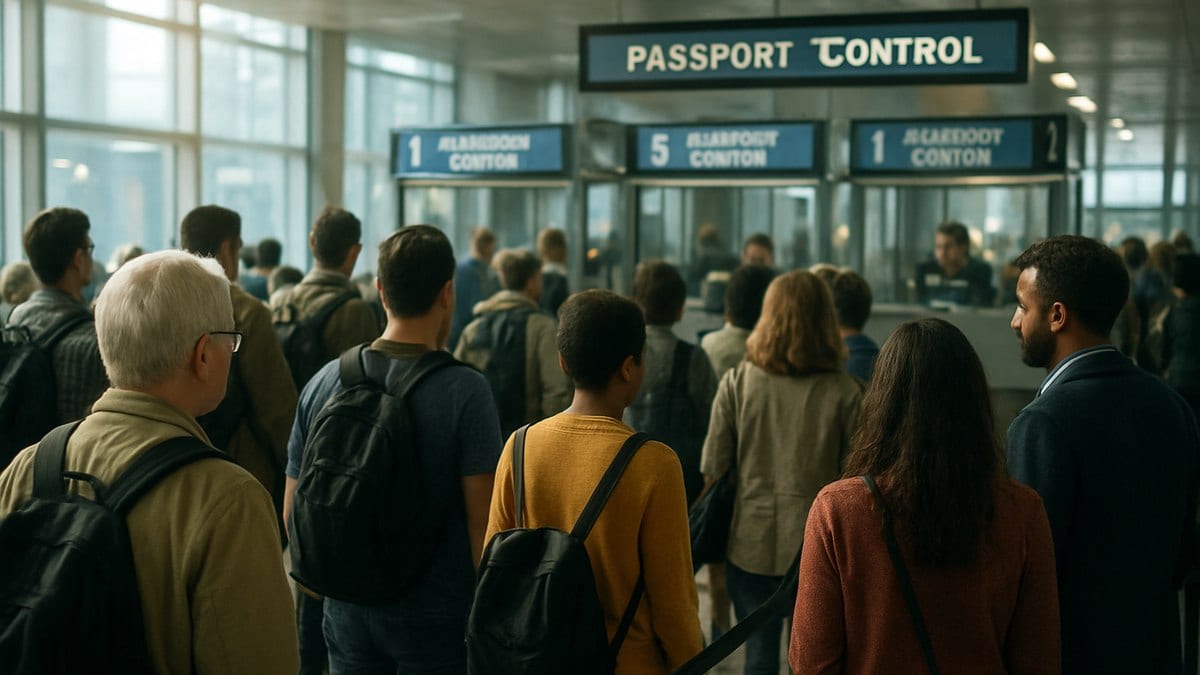
Biometric border overhaul collides with peak travel
The EU’s Entry/Exit System, or EES, is designed to replace manual passport stamping for non-EU visitors with a centralised database that records each arrival and departure using fingerprints, facial images and biographic data. Publicly available information shows that the system went fully live at all Schengen border checkpoints on 10 April 2026 following a phased rollout across airports, seaports and land crossings.
In practice, the change has added a new layer to already complex border procedures. First-time EES users must stop at kiosks or staffed desks to have their biometrics captured before proceeding to regular passport inspection. Airport groups and travel industry bodies report that this initial registration can take several minutes per person, magnifying congestion when large numbers of passengers arrive at once on long-haul flights.
Recent coverage in European media indicates that waits of two to three hours at border control are now common at peak times in major hubs in France, Germany, Italy, Spain, Belgium and Greece, with some locations registering even longer lines. These delays are hitting just as spring and Easter holiday travel increases, raising concern that the situation could deteriorate further as the summer high season approaches.
The bottlenecks are particularly acute for travellers from the United Kingdom and other non-EU countries who are required to enrol in EES. Many of these passengers are unfamiliar with the new steps, and reports suggest that confusion over what to do at kiosks, combined with limited staff to guide people, is compounding the slowdowns.
Stranded passengers highlight human cost of delays
Scenes of border gridlock have been widely reported from several Schengen gateways. At Milan Linate, British and European outlets have described how more than one hundred passengers missed an easyJet flight to Manchester after being trapped in queues at passport control while the EES system processed new registrations. The airline reportedly delayed departure by almost an hour but ultimately left with many ticketed travellers still stuck in the immigration hall.
Similar accounts have emerged from airports including Paris Charles de Gaulle, Geneva and Lisbon, where queues for non-EU arrivals have snaked through terminals and, in some cases, into adjacent corridors. In Portugal, earlier trial phases already prompted authorities to pause or scale back use of biometric kiosks at Lisbon’s main airport after reports of waits lasting several hours at the end of 2025.
Passenger stories shared through broadcasters and newspapers describe families with young children standing in line late into the evening, elderly travellers struggling without seating, and connections missed despite long scheduled layovers. In some instances, people arriving on time for outbound flights have been unable to reach departure gates because of gridlock at outbound border checks when leaving the Schengen area.
Travel trade associations say the disruption is also hitting workers who rely on frequent short trips. Business travellers and airline crew members who must clear border controls repeatedly are facing extended processing times if their EES records are not yet established, eroding the predictability that corporate travel planners depend on.
Airports and airlines urge flexibility on EES rules
Airport operators and airline groups have been warning of this scenario for months. A study released by European airport associations during the transition phase found that the introduction of biometric checks had already increased border processing times by up to 70 percent at some sites, even before the system reached full coverage. The same analysis pointed to regular queues of up to three hours during busy periods, a pattern that is now being echoed in current reports.
In recent statements and open letters, organisations representing airports and carriers have called on EU institutions and national governments to make greater use of flexibilities built into the EES regulation. These tools include the ability for member states to temporarily suspend biometric capture at specific border points or revert partially to traditional stamping when technical faults or surging passenger volumes threaten to overwhelm facilities.
Industry groups argue that chronic understaffing of border guard units is intensifying the impact of the new system. Public comments from airport leaders suggest that even where self-service kiosks and e-gates are installed, too few officers are available to supervise the equipment, assist confused travellers or open additional manual lanes when queues build rapidly.
Some airports and national authorities are already using the scope they have. Past months saw suspensions or reductions in EES use at certain Portuguese and Spanish airports when queues became unmanageable. More recently, local media in Greece report that authorities have scaled back biometric checks at key entry points after waits of up to four hours generated complaints from tourists and tour operators.
Patchwork responses create uneven experience for travellers
The combination of a centralised EU system and decentralised national responses is creating a patchwork of experiences for passengers. At some airports, particularly those with lower volumes of non-EU traffic or extensive staffing, travellers describe relatively smooth processing, with EES registration completed in a matter of minutes and no major impact on overall journey time.
Elsewhere, long queues, system slowdowns and ad hoc workarounds dominate. Travel forums and social media posts suggest that neighbouring airports within the same country can offer radically different experiences, depending on factors such as terminal layout, timing of flights from long-haul markets and the extent of advance planning for the new procedures.
Transport analysts note that the system’s teething problems are most visible in locations where a high proportion of passengers are first-time EES users arriving in concentrated waves. Regional gateways that traditionally relied on manual stamping and limited infrastructure are struggling to adapt quickly to equipment-heavy biometric processes that require space for kiosks, power and network connectivity, as well as privacy considerations.
The uneven rollout is complicating travel planning. Tourism bodies and online travel sites are advising visitors to allow additional time for border formalities when entering or leaving the Schengen area, but concrete guidance varies widely. In the absence of uniform official recommendations, many airlines are simply urging passengers to arrive significantly earlier than before, particularly for flights involving non-EU passport holders.
Fears grow over summer as calls mount for review
Looking ahead to late spring and summer 2026, the stakes are rising for Europe’s tourism sector. Travel and hospitality associations warn that if current patterns of congestion continue into the peak months, reputational damage to Europe as a destination could be significant, particularly among long-haul visitors who may face repeated exposure to bottlenecks when connecting through major hubs.
Recent joint statements by airport and airline bodies have called for an immediate review of EES operations ahead of the main holiday period, urging EU institutions and member states to prioritise practical adjustments. Proposals highlighted in public documents include deploying more border staff, speeding up the rollout of reliable kiosks, streamlining registration steps for families and vulnerable travellers, and clarifying when and how temporary suspensions can be triggered.
EU communications continue to frame the Entry/Exit System as a long-term investment intended to enhance security, combat irregular migration and eventually make border checks more efficient. Technical papers on the project emphasize that once a traveller’s biometric record is created, subsequent crossings should be faster, since the system will only need to verify identity rather than collect full data again.
For now, however, those promised efficiencies remain largely theoretical for many passengers. With border queues spilling into terminal concourses and some travellers still missing flights despite arriving well in advance, the immediate reality is one of strained infrastructure and mounting frustration. How quickly authorities and industry can stabilise the system will likely shape the travel experience across Europe for the rest of 2026 and beyond.