


More news on this day
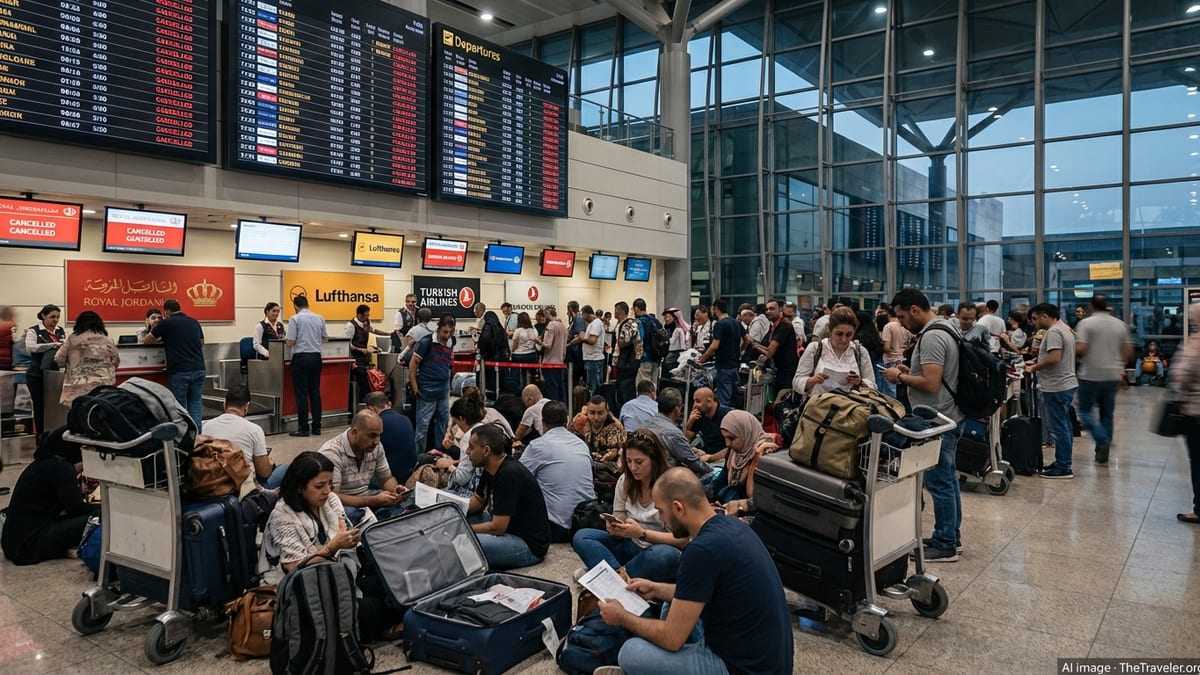
Operations at Queen Alia International Airport near Amman have been disrupted by a cluster of 23 flight cancellations and four delays affecting Royal Jordanian, Etihad Airways, Ethiopian Airlines and Kuwait Airways on routes linking Jordan with Abu Dhabi, Riyadh, Jeddah and Addis Ababa.
Get the latest news straight to your inbox!
Cluster of Disruptions Hits Regional Connectivity
Publicly available flight-tracking boards and aviation data for early June indicate that Queen Alia International Airport has experienced an unusual spike in schedule changes, with 23 cancellations and four delays recorded across a short time window. The affected services include departures and arrivals operated by Royal Jordanian, Etihad Airways, Ethiopian Airlines and Kuwait Airways, connecting Amman with Abu Dhabi, Riyadh, Jeddah and Addis Ababa.
The disruptions come at a time when airlines serving Jordan and the wider Gulf region are already operating within a fragile network environment shaped by shifting airspace permissions and recent regional security concerns. While routine weather, operational constraints and crew positioning can trigger isolated schedule changes, the concentration of affected flights on a handful of high-demand city pairs has drawn attention among travelers monitoring the airport’s departure and arrival screens.
Flight status platforms show Royal Jordanian services on Saudi routes such as Riyadh and Jeddah and regional links to Gulf hubs among the impacted operations, alongside partner and competitor carriers serving similar corridors. Etihad connections through Abu Dhabi, Ethiopian services on the Addis Ababa link and Kuwait Airways flights to and from Amman also feature in the wave of cancellations or extended delays.
Aviation analysts note that even when disruption totals remain modest relative to an airport’s full daily schedule, concentrated interruptions on strategic routes can quickly ripple through regional connectivity. Passengers with same-day onward flights from hubs like Abu Dhabi and Addis Ababa may face missed connections or forced rebookings, extending the practical impact beyond the immediate Amman sector.
Regional Factors Add Strain to Airline Operations
Industry reporting over recent months has highlighted the pressure that regional security developments and episodic airspace restrictions have placed on Middle East carriers. Several Gulf and Levant airports have confronted intermittent closures, airspace reroutings and schedule overhauls, reshaping traditional corridors and adding complexity to flight planning.
Coverage on recent events in Kuwait, for example, has described how Kuwait International Airport and its Terminal 1 only recently resumed a more regular pattern of international operations after months of disruption related to security conditions. Etihad Airways and Kuwait Airways have both been cited among the international airlines progressively rebuilding their Kuwait schedules, a process that continues to require tactical adjustments to planned flights.
Similarly, advisories from logistics and travel industry bulletins in March and April pointed to periods of suspended or reduced service to and from a number of Middle Eastern destinations, including Jordan, the United Arab Emirates and Kuwait, as operators navigated changing risk assessments and evolving route permissions. Even when core hubs like Abu Dhabi and Amman remain open, carriers must frequently recalculate routings, block times and fleet utilization on short notice.
Within this broader context, the batch of cancellations and delays at Queen Alia appears consistent with a network environment in which airlines are still balancing demand recovery with operational uncertainty. Schedule planners may opt to consolidate frequencies, prioritize long-haul connections or stand down select rotations temporarily when regional variables change, resulting in abrupt adjustments on specific city pairs such as Amman to Riyadh or Abu Dhabi.
Impact on Passengers Travelling Through Amman
For passengers, the immediate effect of the cancellations and delays at Queen Alia has been a higher risk of missed connections, extended layovers and last-minute itinerary changes. Travelers booked on Royal Jordanian services to Gulf hubs, or on Etihad, Ethiopian and Kuwait Airways flights linking Amman with Abu Dhabi, Addis Ababa and Kuwait City, have faced an elevated likelihood of being rebooked or rerouted.
Air travel rights organizations and consumer platforms emphasize that travelers affected by cancellations should consult the relevant airline’s published policies on rebooking, refunds and, where applicable, compensation under jurisdictional regulations. Some advisory sites tracking Royal Jordanian’s reliability, for instance, point out that eligibility for compensation can depend on factors ranging from the length of the delay to the underlying cause and the route’s legal regime.
Passengers with multi-leg itineraries involving onward travel from Abu Dhabi, Riyadh, Jeddah or Addis Ababa are particularly exposed to knock-on disruption. Missed long-haul connections can mean involuntary overnight stays or the need to accept alternative routings that add several hours to total journey time. Travel agents and online booking platforms typically recommend monitoring booking management pages closely and enabling alerts for schedule changes when flying through affected hubs.
Travel forums focused on the region show that many passengers now routinely track the recent performance of specific flight numbers before departure, looking for emerging patterns of delay or cancellation. While such information does not guarantee future outcomes, it can help travelers anticipate potential disruption on sensitive routes and decide whether to build in longer connection windows or consider alternative carriers.
Queen Alia Airport’s Role as a Regional Hub
Queen Alia International Airport serves as Jordan’s primary gateway and the main base for Royal Jordanian, with a network that spans the Middle East, Europe, North Africa and parts of Asia. The airport typically handles millions of passengers a year and connects Amman to dozens of regional and long-haul destinations, making operational continuity critical for both local travelers and transit passengers.
The airport’s position between the Levant, the Gulf and North Africa means that short-haul routes to cities such as Riyadh, Jeddah and Abu Dhabi carry strategic importance beyond point-to-point demand. These flights feed long-haul networks operated by Royal Jordanian and partner carriers, while also linking Jordan with key labor, business and religious travel markets in Saudi Arabia and the United Arab Emirates.
Disruptions on these sectors can therefore have disproportionate network effects. When a Jeddah or Riyadh rotation is cancelled, for example, it may reduce available options for passengers connecting between Europe and Saudi Arabia via Amman, or between the Gulf and North Africa. Likewise, interruptions on the Addis Ababa route affect links between Jordan and the broader African continent, where Ethiopian Airlines operates an extensive hub-and-spoke system.
Despite such challenges, publicly accessible boards still show the vast majority of flights at Queen Alia operating broadly as scheduled, suggesting that the airport remains functional as a regional hub even as airlines make targeted schedule adjustments. The current pattern appears to be one of localized disruption rather than systemic shutdown.
Advice for Upcoming Travelers on Affected Routes
Travel experts and industry guidance consistently recommend that passengers flying between Amman and hubs such as Abu Dhabi, Riyadh, Jeddah and Addis Ababa in the coming days treat their itineraries as subject to change. Checking flight status directly with airlines shortly before departure and signing up for SMS or app notifications can provide the earliest warning of any last-minute alteration.
Those with tight connections are often advised to consider lengthening layover times where booking conditions allow, particularly when routing through airports that have recently seen higher levels of disruption. Reconfirming visa, transit and accommodation arrangements is also prudent for travelers who may be forced into unscheduled stopovers if a cancellation or long delay occurs.
Travel insurance that covers disruption, including missed connections and involuntary schedule changes, can provide an additional layer of protection, though policies vary significantly in terms of triggers and payouts. Passengers are encouraged to review policy wording carefully and retain documentation such as delay notifications and boarding passes to support any subsequent claims.
For now, the cluster of 23 cancellations and four delays at Queen Alia underscores how quickly conditions on key Middle Eastern routes can shift. While most operations between Amman and regional capitals continue to run, the recent pattern highlights the importance of flexible planning and vigilant monitoring for anyone relying on these corridors in the current environment.