


The Bosphorus is not just a pretty stretch of water in Istanbul. This narrow, twisting strait slicing between Europe and Asia shapes how the city looks, moves, trades and even dreams. From Ottoman palaces and wooden waterfront mansions to modern suspension bridges and busy commuter ferries, almost everything in Istanbul eventually turns back toward the Bosphorus. Understanding this strait means understanding why Istanbul feels unlike any other city on earth.
Get the latest updates straight to your inbox!
Where the Continents Meet: Geography of the Bosphorus
The Bosphorus Strait, locally called İstanbul Boğazı, is a natural waterway about 30 kilometers long that connects the Black Sea in the north to the Sea of Marmara in the south. It is part of the Turkish Straits system, which continues through the Dardanelles and out to the Aegean and Mediterranean seas. For travelers, the key point is simple: this is the only maritime gateway linking the Black Sea region with the rest of the world, and it happens to run directly through the middle of Istanbul.
On a map, the Bosphorus looks like a crooked river, but it is a strait, with strong surface currents flowing south toward the Sea of Marmara and a deeper countercurrent moving north. This unusual two-layer system helps explain the swirling waters you see from ferry decks and why captains steer with such care, especially in bad weather. The width narrows to around 700 meters at points like Kandilli, making it one of the world’s narrowest straits used for busy international navigation.
The city itself is built on both sides of this watery corridor. The western bank is officially Europe, the eastern bank is Asia. Old Istanbul, including Sultanahmet and the historic peninsula, sits just south of the Golden Horn where it opens into the Bosphorus. To the north, districts like Beşiktaş, Ortaköy and Bebek line the European shore, while Üsküdar, Kuzguncuk and Beylerbeyi anchor the Asian side. For visitors, crossing between continents in 20 minutes on a public ferry becomes a surprisingly normal part of the day.
Because the Bosphorus links seas and continents, it is also a strategic waterway. Cargo ships, tankers and Russian, Ukrainian and other Black Sea vessels transit this channel as part of routes connecting to the Mediterranean, the Atlantic or, via the Suez Canal, to the Indian Ocean. Even on a short cruise you are likely to pass hulking commercial ships moving carefully between delicate wooden mansions, a contrast that shows just how vital and crowded this strait has become.
Why the Bosphorus Matters to Istanbul’s Story
Istanbul’s location on the Bosphorus helps explain why it has been repeatedly chosen as a capital city, first by the Eastern Roman (Byzantine) Empire and later by the Ottomans. The historic peninsula is ringed on three sides by water: the Golden Horn to the north, the Bosphorus to the east and the Sea of Marmara to the south. This made the city easier to defend, and control of the Bosphorus meant control of trade and naval access between inland seas and open waters.
In practice, this strategic importance gave Istanbul wealth and influence. Byzantine emperors and Ottoman sultans could tax and regulate ships passing between the Black Sea and the Mediterranean. In the 15th century, the Ottomans built imposing fortresses on both sides of the Bosphorus, such as Rumeli Hisarı on the European shore and Anadolu Hisarı on the Asian shore, to control naval traffic and prepare for the conquest of Constantinople. Today you can see these stone walls from a cruise boat, a reminder that the calm strait of sightseeing brochures was once a militarized frontier.
In the modern era the Bosphorus still matters far beyond tourism. It is part of a route that carries substantial volumes of oil and commodities from Black Sea ports toward world markets. This is one reason large cargo ships often anchor in the Sea of Marmara waiting for a pilot to guide them through. For Istanbul residents, it means watching massive tankers glide behind the silhouette of mosques and palaces, a daily reminder that the city sits on one of the world’s busiest waterways.
For travelers, the Bosphorus shapes practical aspects of a visit as well. Rush hour traffic between the European and Asian sides can clog bridges and tunnels, so many locals rely on public ferries that zigzag between piers like Eminönü, Karaköy, Beşiktaş, Üsküdar and Kadıköy. As a visitor you can step directly into this rhythm: a standard city ferry costs only a modest fare with an Istanbulkart transit card and doubles as a moving viewpoint on the skyline, far more atmospheric than sitting in a taxi on the ring road.
Bridges, Tunnels and Crossing Between Europe and Asia
The modern image of the Bosphorus is dominated by three suspension bridges that link Europe and Asia high above the water. The southernmost and oldest, commonly called the Bosphorus Bridge and officially the 15 July Martyrs Bridge, opened in 1973 and connects the European district of Ortaköy with Beylerbeyi on the Asian side. North of this, the Fatih Sultan Mehmet Bridge, often called the Second Bridge, opened in the 1980s, followed more recently by the Yavuz Sultan Selim Bridge near the entrance to the Black Sea.
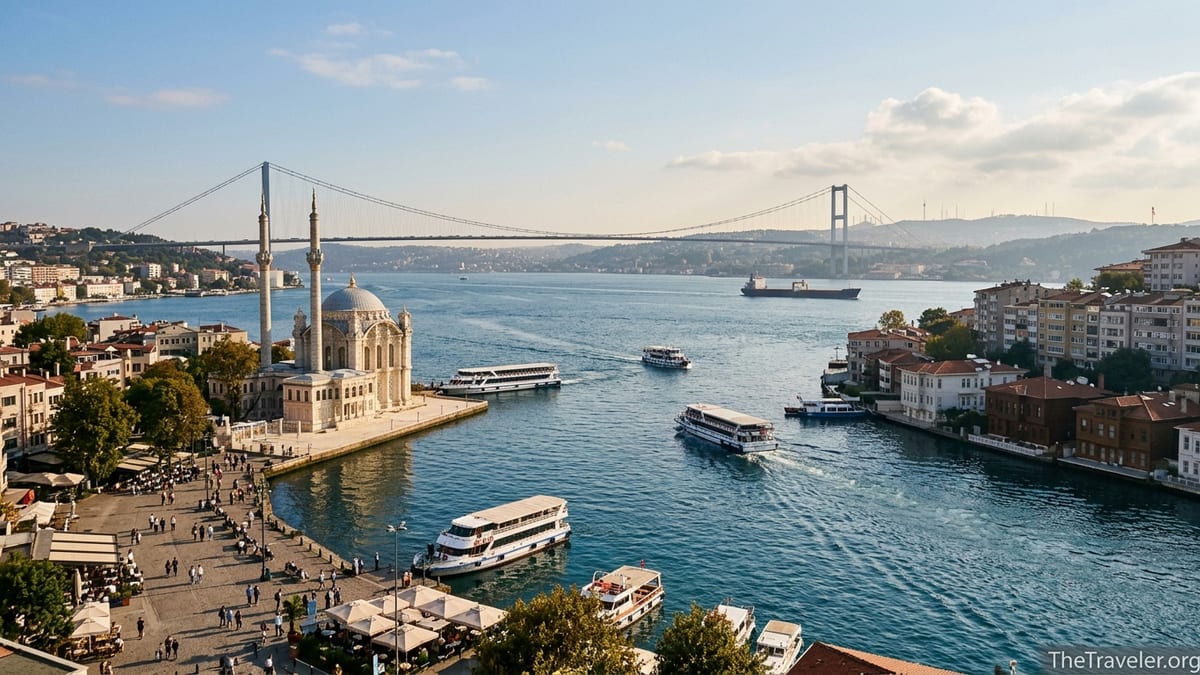
From a visitor’s perspective, these bridges are more than infrastructure. They frame many of the classic postcard views of Istanbul, especially around Ortaköy Mosque, where the white baroque-style building stands almost at the water’s edge with the First Bridge soaring behind it. At night, LED lighting schemes shift colors across the bridge cables, reflecting off the dark surface of the strait and turning an ordinary ferry ride into something memorable.
Most travelers will experience the bridges from below, passing under them on a Bosphorus cruise, or from the shore, watching traffic stream between continents. Pedestrians cannot routinely walk across the main Bosphorus bridges, but several city events, such as the Istanbul Marathon, open at least one bridge to runners and walkers for a day, creating the rare chance to cross between Europe and Asia on foot while looking down at the strait.
In addition to bridges, two modern tunnels link the shores beneath the Bosphorus. The Marmaray rail tunnel carries suburban and intercity trains, letting locals commute across the water in minutes, while the Eurasia Tunnel provides a road link for vehicles. For visitors staying near Sirkeci or Kadıköy stations, the Marmaray is an efficient, inexpensive way to hop between historic Sultanahmet and the Asian side, especially useful when surface traffic is congested on rainy evenings or during summer festivals.
Palaces, Fortresses and Mosques Along the Water
One of the pleasures of any Bosphorus trip is watching grand architecture appear one after another along the banks. After the Ottomans shifted royal life from the hilltop enclosure of Topkapi Palace toward the water in the 19th century, they built a series of showpiece palaces directly on the shoreline, often in ornate European-inspired styles that still define the Bosphorus today.
On the European side, Dolmabahçe Palace, with its long white façade and elaborate gates opening directly onto the water, marks a key point along many cruise routes. Farther along stands Çırağan Palace, now a luxury hotel, whose colonnaded exterior also sits right on the sea. On the Asian shore, Beylerbeyi Palace served as a summer residence and guesthouse for foreign dignitaries; from the deck of a boat you can pick out its pale stone mass at the foot of the First Bridge. Smaller pavilions such as Küçüksu Pavilion add further layers of 19th-century charm.
North of the city center, the stone walls and towers of Rumeli Hisarı rise steeply above the water on the European side. Built in the mid-1400s by Sultan Mehmed II as part of the Ottoman preparations for the conquest of Constantinople, the fortress stands opposite Anadolu Hisarı on the Asian bank, together forming a historical choke point for controlling ships sailing through the strait. Today the area around Rumeli Hisarı is lined with cafes and fish restaurants, and many shorter Bosphorus cruises turn around near here, so you have ample time to photograph the fortifications from the water.
Religious architecture along the Bosphorus is equally striking. Ortaköy Mosque, officially the Büyük Mecidiye Mosque, is one of the most photographed in Istanbul, its pink and white stone and delicate minarets set almost at the edge of the sea. In Üsküdar, the Mihrimah Sultan and Şemsi Paşa mosques look out over the ferry piers, creating atmospheric scenes at sunset when call to prayer mingles with the horn blasts of arriving boats. For many travelers, these views captured from public ferries or the upper deck of small cruise boats become some of their strongest memories of the city.
The combination of palaces, fortresses and mosques means that even a basic one-and-a-half to two-hour Bosphorus cruise functions as a condensed history lesson. You pass from Byzantine-era walls near the entrance of the Golden Horn to Ottoman waterfront residences and modern engineering in a single journey, with guides or audio commentary pointing out key landmarks as you go.
Yalı Culture and Waterfront Mansions
Perhaps the most distinctive buildings on the Bosphorus are the yalı, traditional wooden waterfront mansions built directly at the water’s edge. Originally summer residences for high-ranking Ottoman officials, court members and wealthy merchants, these houses once lined almost every curve of the strait. Fires, neglect and urban development have reduced their numbers, but several hundred remain, often painted in muted pastels or dark reds and featuring long balconies and private boat docks.
From a cruise boat, yalı can be easy to overlook next to palaces and bridges, but they are central to Istanbul’s coastal culture. Some of the most famous examples include the red Anadolu Kavağı yalı near the northern villages and Said Halim Paşa Mansion under the Fatih Sultan Mehmet Bridge, now frequently booked for weddings and events. Many yalı are privately owned, commanding some of the highest real estate prices in Turkey due to their direct waterfront access and unobstructed views.
As Istanbul has grown wealthier, a new generation of luxury residences, hotels and event venues has joined the historic yalı. High-end hotels along the Bosphorus on both shores offer rooms and terraces that open almost directly over the water, with rates that reflect their premium locations. For travelers, even if staying in such properties is beyond the budget, booking afternoon tea or an early evening drink on a Bosphorus-facing terrace provides a relatively affordable way to sample the yalı lifestyle for an hour.
Because many yalı are private homes, you will mostly see them from a distance, but certain walking routes, such as the promenade between Arnavutköy and Bebek on the European side or the coastal path from Kuzguncuk toward Beylerbeyi on the Asian side, let you appreciate the façades more closely. Here, small details such as carved wooden window shutters, boat houses and tiny private piers reveal the day-to-day life that has unfolded at the water’s edge for centuries.
Experiencing the Bosphorus: Ferries, Cruises and Viewpoints
For visitors, the most straightforward way to experience the Bosphorus is to ride the public ferries that crisscross the strait all day. Departing from piers such as Eminönü, Karaköy, Beşiktaş, Üsküdar and Kadıköy, these boats are part of Istanbul’s regular transit system. With an Istanbulkart loaded with a modest balance, you can tap in at the turnstile, grab a tea from the onboard kiosk and settle in on the open deck. Morning and evening commuter ferries in particular give a candid glimpse of local life, with office workers, students and families sharing the same benches as tourists with cameras.
Dedicated Bosphorus cruises offer a more structured way to see the strait. Operators run short tours of about 90 minutes that loop around key central landmarks, as well as longer half-day or full-day trips that continue north toward the Black Sea, sometimes stopping at villages like Anadolu Kavağı where you can climb up to the ruins of Yoros Castle for broad views over the entrance to the strait. Prices vary by operator and season but are generally accessible compared with private yacht charters, which cater to small groups seeking a more exclusive experience.
Time of day makes a major difference. Midday cruises offer clearer, brighter views, but late afternoon and sunset departures can be spectacular as the sun drops behind the European hills or silhouettes the minarets on the historic peninsula. In summer, many operators run evening cruises with simple dinners on board, combining views of illuminated bridges and palaces with a casual meal. In cooler months, consider a boat with indoor seating and large windows to stay comfortable while still enjoying the scenery.
Some of the best Bosphorus views are available from land. Parks and promenades, such as those in Emirgan, Bebek and Arnavutköy on the European side or Çamlıca Hill and Fethi Paşa Grove on the Asian side, provide sweeping perspectives without leaving shore. Cafes in districts like Kuzguncuk and Çengelköy cluster right at the water, serving tea, simit and Turkish breakfast while small fishing boats bob in the foreground and container ships slide past in the distance.
The Bosphorus in Everyday Life and Culture
Spend a few days in Istanbul and it becomes obvious that the Bosphorus is not just scenery; it is a living part of daily life. Commuters plan routes that combine buses or metros with ferries, checking schedules the way other cities check subway lines. School groups pile onto boats for class trips, and fishermen cast lines from the railings of the Galata Bridge at the mouth of the Golden Horn, hoping for a good catch to sell to nearby sandwich stalls grilling fresh fish.
The strait also shapes local food culture. Along many stretches of the Bosphorus, informal fish restaurants serve grilled seabass, mackerel and other catches accompanied by meze and raki, Turkey’s anise-flavored spirit. In neighborhoods like Arnavutköy, you can walk past a series of meyhanes, traditional taverns, that specialize in long, sociable meals where the view of the water is almost as important as the dishes on the table. Street vendors selling corn on the cob, roasted chestnuts or sesame-crusted simit circulate along the promenades, especially on weekends when families come out to stroll.
Culturally, the Bosphorus features in Turkish literature, songs and films as a symbol of both separation and connection. It is where lovers part or reunite, where characters contemplate leaving the city or returning home. The physical act of crossing between Europe and Asia several times a day gives Istanbul residents a casual relationship with geography that visitors quickly grow to appreciate: switching continents becomes as ordinary as switching subway lines.
Seasonal changes add further nuance. In spring and autumn, migratory birds use the Bosphorus corridor as a flyway, and keen birdwatchers gather on hills overlooking the strait to spot storks, raptors and other species riding the thermal currents. In winter, rare cold snaps can bring a dusting of snow to the banks, turning the wooden yalı and palace façades into unexpectedly wintry scenes, while ferries push through mist that hangs low over the water.
The Takeaway
Understanding the Bosphorus helps travelers make sense of Istanbul’s layout, its history and its energy today. This narrow strait is at once an international shipping route, a commuting corridor, a scenic backdrop and a cultural touchstone. Empires have risen and fallen along its banks, and yet on any weekday morning it feels like a bustling neighborhood waterway filled with ferries and fishing boats.
For visitors, taking time to experience the Bosphorus from different angles is worth as much as ticking off any single monument. A simple public ferry ride, a longer cruise past palaces and fortresses, an evening meal in a village like Arnavutköy or Kuzguncuk, and a walk along a shoreline park at sunset together offer a more complete picture of what this waterway means to the city.
Whether you are crossing between Europe and Asia for the novelty, photographing illuminated bridges at night or simply sipping tea on a bench while ships slide past, you are participating in a daily ritual that has defined Istanbul for centuries. The Bosphorus is not a side trip here; it is the thread that ties the whole city together.
FAQ
Q1. What exactly is the Bosphorus Strait?
The Bosphorus is a natural strait about 30 kilometers long that divides the European and Asian sides of Istanbul, linking the Black Sea to the Sea of Marmara.
Q2. How can I cross between Europe and Asia as a visitor?
The easiest way is to use public ferries running between piers like Eminönü or Beşiktaş on the European side and Üsküdar or Kadıköy on the Asian side, paying with an Istanbulkart.
Q3. Are Bosphorus cruises worth it, or is a public ferry enough?
Public ferries give excellent everyday views at low cost, while dedicated cruises usually travel farther, pass more palaces and fortresses, and often include commentary, making them worthwhile if you want a deeper overview.
Q4. What is the best time of day to see the Bosphorus?
Late afternoon and sunset often provide the most atmospheric light, with the added bonus of illuminated bridges and palaces after dark, though midday cruises offer clearer distant views.
Q5. Can I walk across a Bosphorus bridge?
On most days pedestrians cannot walk across the main suspension bridges, but special events such as the Istanbul Marathon occasionally open at least one bridge to walkers and runners.
Q6. Which landmarks should I look for from the water?
Key sights include Dolmabahçe Palace, Çırağan Palace, Beylerbeyi Palace, Rumeli Hisarı and Anadolu Hisarı fortresses, Ortaköy Mosque and numerous historic waterfront mansions called yalı.
Q7. Is the Bosphorus safe for boat trips year-round?
Passenger boats and ferries operate in all seasons, though services may be reduced in very bad weather. Reputable operators monitor conditions closely and may cancel or shorten trips during strong winds or storms.
Q8. How long does a typical Bosphorus cruise take?
Short sightseeing cruises usually last around 90 minutes, while longer trips that reach toward the Black Sea and stop in villages can take half a day or more, depending on the route.
Q9. What should I bring on a Bosphorus outing?
Bring layers or a light jacket, as it can feel cooler on the water, along with sunscreen, sunglasses, a hat in summer and a camera or phone with enough battery for photos.
Q10. Why is the Bosphorus so important beyond tourism?
Beyond its scenic value, the Bosphorus is a critical international shipping lane and the only maritime link between the Black Sea and the Mediterranean, making it strategically and economically significant.