


There are many ways to see Istanbul, but nothing matches watching the city slip into night from a boat on the Bosphorus. Minarets become silhouettes, bridges glow with LED patterns, and palaces turn into golden reflections on the water. To really capture that magic, though, timing and positioning matter more than the name of the boat. This guide breaks down when to sail, which side of the deck to claim, and how to work with Istanbul’s changeable light so you come home with photographs that look as good as your memories.
Get the latest updates straight to your inbox!
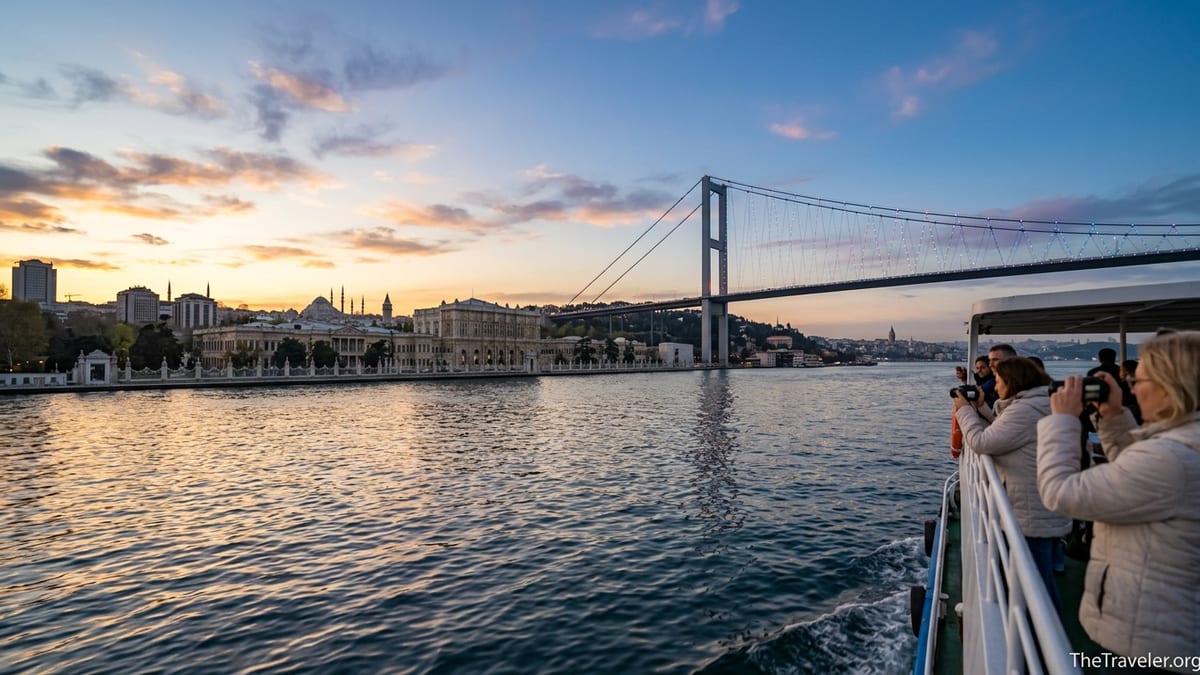
Understanding Bosphorus Light: Golden Hour vs Blue Hour
The Bosphorus runs roughly southwest to northeast, which shapes how the sun moves across the skyline. In practice, this means evening light often hits the European shore at a flattering angle, bathing Dolmabahçe Palace, Ortaköy Mosque and the grand waterfront mansions known as yalıs in warm tones. Golden hour, the hour before sunset, is especially kind to these creamy stone facades and pastel details, giving you natural contrast without harsh shadows.
Blue hour, the 20 to 40 minutes after sunset, is a completely different look. The sky deepens to cobalt while city lights come on along both shores. You lose some fine architectural detail, but gain atmosphere and reflections. Bridges such as the 15 July Martyrs Bridge and Fatih Sultan Mehmet Bridge cycle through colorful lighting schemes, and mosques like Ortaköy and the domes of Beşiktaş stand out in warm yellow against the cool sky. For many photographers, this mix of lingering ambient light and artificial glow is the most cinematic stage of the cruise.
In summer, these two windows can be long and gentle, giving you a soft transition from late-afternoon gold to blue hour. In winter, they compress into a brief, intense show, with the sun diving quickly and dusk arriving fast. If you want detailed, high-contrast photos of architecture, weight your planning toward golden hour. If you care more about mood, reflections and skyline silhouettes, make sure your cruise still has you on the water at least 15 to 30 minutes after sunset.
Because the Bosphorus is relatively narrow, perspectives change quickly. A mosque that was in perfect side light a few minutes ago can be backlit as the boat swings around a curve. Understanding these light phases, and knowing that you will pass the same structures in different light on the return leg, helps you decide when to shoot and when to simply put the camera down and enjoy the view.
Best Time of Year and Day: Summer vs Winter Sunsets
Istanbul sits at roughly the same latitude as New York or Rome, so seasonal daylight swings are noticeable. In July, sunset often falls around 20:35 to 20:45, while in January it can be closer to 17:10 to 17:30. This matters because tour companies tend to set departure times to capture golden hour, and you will see different offerings in summer and winter as a result. For example, some sunset yachts in July depart Kabataş or Karaköy between 18:30 and 19:00, while winter departures can be as early as 15:30 to 16:00.
From a photography and comfort perspective, shoulder seasons are arguably ideal. In late April, May, September and early October, evenings are usually mild enough to stand outside without freezing, yet the air is clearer and less hazy than in peak summer. Sunset falls at workable hours, often around 19:00 to 19:30 in spring and a bit earlier in autumn, so you are not out too late if you are traveling with children or planning a late dinner afterward in Karaköy or Galata.
Summer brings the classic postcard look: long days, high sun and a deep blue strait. But it also brings humidity and heat radiating off the city. By late July and August, daytime highs regularly rise into the high 20s or low 30s Celsius, and the late afternoon can feel sticky. Booking a cruise that starts no earlier than 18:00 means you avoid the harshest overhead sun and catch the cooler, slanting light as temperatures ease off. Families often gravitate to early evening departures so they can still be back near Sultanahmet or Taksim by 21:30.
In winter, sunset cruises become a different kind of experience: low, silvery light, a higher chance of rain or even sleet, and the possibility of dramatic clouds echoing the city skyline. Average January daytime temperatures in central Istanbul hover close to single digits, and cold winds funnel along the strait. The reward is atmosphere and fewer boats on the water. If you are prepared with gloves, a hat and layers under a windproof jacket, the reflections of lights in the early darkness can be some of the most evocative Bosphorus images you will take.
Exact Timing: How Early to Sail for the Perfect Sunset
For a classic sunset sequence, you want to be on open water 45 to 60 minutes before sunset and remain out for at least 30 minutes afterward. On a typical two-hour sunset yacht tour leaving Kabataş at 18:30 in July, you might spend the first part cruising past Dolmabahçe Palace and Çırağan Palace as golden hour shapes up, reach Ortaköy Mosque just before peak color, then continue under the 15 July Martyrs Bridge as the sun grazes the horizon. By the time you pass Rumeli Fortress and the Fatih Sultan Mehmet Bridge, you are in full blue hour with city lights fully on.
Because Turkey does not switch to daylight saving time but remains on UTC+3 year-round, seasonal sunset times shift smoothly month to month. A simple rule of thumb is to look up that day’s sunset for Istanbul, then aim for a departure around 75 minutes earlier. If your chosen boat leaves only 30 minutes before sunset, you may board in good light but spend much of the actual golden hour queuing, listening to the safety briefing or still maneuvering away from the pier.
Municipal operators also adjust their schedules seasonally. The city-run company Şehir Hatları, which offers a Short Bosphorus Tour, typically runs an afternoon sailing that can double as a de facto sunset cruise in spring and autumn. When this departure leaves Ortaköy around 15:10 in winter it can catch the descending sun on the return, while in the high summer timetable, late-afternoon ferries that leave Eminönü at around 16:00 and pass Ortaköy and Bebek later in the trip can deliver gentle pre-golden-hour light.
If you are serious about photography, consider working backward from the images you want. For example, if your goal is a golden-lit Ortaköy Mosque framed with the 15 July Martyrs Bridge, you want to be approaching it from Kabataş or Beşiktaş side roughly 30 to 40 minutes before sunset. For a silhouette of Maiden’s Tower against a fiery sky, you want a route that swings into the Sea of Marmara as the sun actually sets. Checking recent traveler photos on image-heavy platforms sorted by month can give you a realistic sense of how the sky has looked at similar times of year.
Which Side of the Boat: Positioning for Key Landmarks
On most standard sunset routes, boats depart from the European side at Kabataş, Karaköy or Eminönü, then sail northeast along the European shore to at least the Fatih Sultan Mehmet Bridge before turning back along the Asian side. For photography, this means the starboard (right) side of the vessel during the outbound leg gives you uninterrupted views of the European monuments: Dolmabahçe Palace, Beşiktaş waterfront, Ortaköy Mosque, the grand waterfront mansions at Kuruçeşme and Arnavutköy, and finally Rumeli Fortress under the second bridge.
The port (left) side becomes more attractive when the boat crosses mid-strait or heads closer to the Asian shore on the return. From there, you can frame the minarets of Üsküdar, the outlines of Kuzguncuk and the wooded slopes near Anadolu Hisarı. The Asian side offers fewer single “icon” buildings, but the neighborhoods feel more residential and the light can be softer once the sun has slipped behind the European hills. Many photographers start on the starboard side early in the cruise for architecture shots, then cross over to port as blue hour deepens to capture the entire European skyline glowing in warm light.
Some private yachts and smaller boats have open bow and stern decks instead of strict side seating. In these cases, the bow gives you leading-line compositions of bridges and the sensation of moving straight into the light, especially when heading northeast in late afternoon. The stern, facing back toward the historic peninsula, is ideal when you want layers of receding minarets and the Galata Tower caught in soft dusk haze. If the boat has two levels, the upper deck usually has clearer sightlines above railings and fellow passengers, but can be windier; the lower deck or partially enclosed areas may be better for long exposures on a tripod.
Landmarks such as Maiden’s Tower require special attention. Not every Bosphorus cruise passes close to it, since it sits slightly south of the standard up-the-strait route. Some dedicated sunset tours, particularly those marketed as “Bosphorus and Maiden’s Tower” trips, detour into the Sea of Marmara to circle it as the sun sets. When that happens, the south or southwest-facing side of the boat becomes prime real estate. If your heart is set on that particular shot, check the route map or written description and be ready to reposition when the captain announces the detour.
Choosing a Route: Short Loops vs Full-Length Cruises
Bosphorus routes fall into three broad categories: short loops, classic full-length cruises and private charters. Short loops, often 1.5 to 2 hours, are the most common sunset option. These usually depart from Kabataş, Karaköy or Eminönü, run as far as the Fatih Sultan Mehmet Bridge or sometimes a little beyond, then return along the opposite shore. You get key highlights like Dolmabahçe Palace, Ortaköy Mosque, the 15 July Martyrs Bridge, Rumeli Fortress and the Asian villages of Kandilli and Anadolu Hisarı without committing an entire afternoon or needing a turnaround stop.
Full-length cruises, such as the Long Bosphorus Tour run by the municipal operator, push all the way to Anadolu Kavağı near the Black Sea. In the daytime this is an excellent way to see the entire strait, including the third bridge and more remote fishing villages, but the schedule is designed for a daytime excursion with a lunch stop at the far end. As a result, it rarely aligns perfectly with sunset except in deep winter, when early departures can return toward the city just as lights come on. If you are in Istanbul outside those months and your priority is golden or blue hour on the central stretch, a dedicated shorter sunset cruise is more practical.
Private yacht charters, often marketed as “luxury sunset cruises,” allow you to customize timing and route. Groups or couples willing to share the cost can ask to depart later, linger near specific photo spots or include a Maiden’s Tower detour. For example, a three-hour private charter leaving Karaköy at 18:30 in late September might sail slowly as far as the second bridge, then cross to the Asian side at Kandilli and track back past Kuzguncuk and Üsküdar, timing a final pass near Maiden’s Tower just after sunset. This flexibility is valuable if you are shooting on a specific day and want to adapt to cloud cover and light conditions.
Whichever route you choose, confirm whether commentary and lighting will affect your shots. Some dinner cruises use bright floodlights on deck and stage shows indoors that spill colored light outside, which can produce odd color casts in photos during blue hour. In contrast, most sightseeing-focused sunset cruises keep lighting low on the open deck, which makes it easier to capture the natural tones of the sky and city. Reading recent reviews that mention “view,” “photo opportunities” or “open deck space” can help you pick operators that prioritize the visual experience.
Crowds, Weather and Practical Onboard Strategy
Sunset cruises are most popular from May through October, and boats can fill to capacity in peak summer. On busy evenings, you might find three or four different operators boarding at neighboring piers along Kabataş or Eminönü, each with touts calling out departures. If you want prime rail space on an open upper deck, aim to arrive 20 to 30 minutes before the stated boarding time rather than cutting it close. Traveling outside weekends and Turkish public holidays also helps; a Wednesday in early June is likely to be calmer than a Saturday at the height of August.
Weather on the Bosphorus can change quickly. Even on a hot day in Sultanahmet, the wind over the water can be surprisingly cool once the sun begins to drop. A lightweight windbreaker or fleece, even in July, makes it much easier to stay out on deck without retreating indoors just as light turns interesting. In cooler months, dress as if you were going on a winter hike, with layers, a beanie and perhaps a buff or scarf you can pull up over your face when the wind picks up. Gloves that allow you to operate camera controls are worth packing if you plan to shoot extensively in January or February.
Rain does not necessarily ruin a sunset cruise. Low clouds can deepen colors at the horizon and create dramatic shafts of light over the bridges. The main challenge is keeping your lens free of droplets. A simple microfiber cloth in your pocket and a lens hood can make a big difference. On larger vessels, you can often step just inside a doorway to compose through a partially open window or wait out a passing shower before heading back to the rail as the sky clears. In winter, visibility can drop in mist or light fog, so prioritize wider skyline compositions rather than distant telephoto shots.
Onboard strategy matters almost as much as your ticket choice. Avoid locking yourself into a single seat. As the boat turns, do not hesitate to move from one side to the other with your camera or phone, as long as you are respectful of other passengers. Take your “must have” shots early in the cruise in case crowds build or conditions change, then relax later with a tea or juice from the small onboard kiosk that most operators offer. If your cruise includes complimentary drinks, be aware that glassware on railings is easily knocked over in the wake of passing ferries, and broken glass on deck is neither photogenic nor safe.
Essential Photo Tips: From Phones to Full-Frame Cameras
You do not need professional gear to bring home strong Bosphorus images. Modern smartphones handle low light better than ever and offer night modes that automatically blend multiple exposures. For phone users, the most important habits are keeping the lens clean, using both wide and standard lenses thoughtfully and bracing your elbows on the rail or a solid surface when light drops. Instead of tapping zoom repeatedly, which degrades image quality, crop slightly afterward or step closer along the rail if it is safe to do so.
If you are shooting with a mirrorless or DSLR camera, a standard zoom in the 24–70 mm range (full-frame equivalent) will cover most situations: 24 mm for sweeping bridge views, 35–50 mm for palaces and mosques, and 70 mm when you want to isolate a waterfront mansion or detail. A fast prime lens, such as a 35 mm f/1.8, is excellent for blue hour when you want to keep ISO lower without resorting to slow shutter speeds. Because you are on a moving platform, long exposures under half a second rarely stay sharp, even with optical stabilization, so prioritize higher ISO over very slow shutters.
Shutter speeds of around 1/250 to 1/500 second are a good baseline while the boat is moving, especially if other vessels are passing nearby or there is chop on the water. As light fades, you can ease down to 1/125 if you brace yourself and your subject is not moving fast. Use continuous shooting mode to fire short bursts as you pass key landmarks; often the middle frame in a sequence will be the sharpest. If your camera offers it, enable lens or in-body stabilization and consider using auto ISO with a minimum shutter speed, letting the camera float ISO up as light drops.
Composition-wise, try to include foreground elements to anchor the scene: a section of the boat’s rail, another ferry crossing the frame, or a fisherman on the shore. These details help convey scale and place better than distant skylines alone. For iconic spots like Ortaköy Mosque, wait for small gaps in passing traffic so your subject is not entirely blocked by another boat. When shooting bridges, tilt the camera slightly upward and include reflections in the water rather than cutting the image at the horizon; this accentuates their sweep and emphasizes the lights that will glow more intensely during blue hour.
The Takeaway
A Bosphorus sunset cruise is more than a box to tick in Istanbul. With a bit of planning around light, timing and where you stand on deck, it becomes a moving vantage point on how the city transforms from day to night. You do not need elaborate gear, and you do not need the most expensive yacht in the harbor. What you need is to be on the water about an hour before sunset, on the right side of the boat when you pass your must-see landmarks, and dressed well enough to stay outside when the breeze picks up.
Think of the experience in layers: warm golden light on palaces and mosques, a glowing strip of sunset at the horizon, then the cool blues of early night with bridges and minarets lit up. Whether you book a simple municipal tour that happens to return at dusk or a carefully timed private charter that detours for Maiden’s Tower silhouettes, working with these layers is what will give your photos and your memories real depth.
In the end, the most important step is simply to go. Check the sunset time for the day you are in Istanbul, choose a departure that has you mid-strait when the sun dips, and let the city do the rest. The Bosphorus has been reflecting Istanbul’s changing light for centuries, and with a little attention to timing and position, your own evening on the water will fit beautifully into that story.
FAQ
Q1. What is the single best month for a Bosphorus sunset cruise?
Late September is a strong all-round choice, with comfortable temperatures, softer light, fewer peak-season crowds and sunset at a convenient early-evening hour.
Q2. How far in advance should I book a sunset cruise in summer?
In July and August, it is wise to reserve at least a few days ahead for popular evening departures, especially on weekends, to secure a good spot on the upper deck.
Q3. Which pier is most convenient if I am staying near Sultanahmet?
Eminönü is usually the easiest option, reachable by tram or a 15 to 20 minute downhill walk, and many Bosphorus boats and city ferries depart from its cluster of piers.
Q4. Is the municipal Bosphorus tour good enough for photography?
Yes. The municipal boats offer open decks, pass major landmarks and cost less than private cruises. As long as departure roughly matches golden hour, you can get excellent shots.
Q5. Do I need a tripod for Bosphorus sunset photos?
You can get sharp results handheld if you use sensible shutter speeds and brace yourself. A tripod is awkward on a moving deck and most photographers manage fine without one.
Q6. What should I wear on a winter sunset cruise?
Dress in warm layers with a windproof outer shell, hat, scarf and gloves. It often feels several degrees colder on the open water than it does in the city streets.
Q7. Are dinner cruises good for serious photography?
Dinner cruises can work, but interior lighting, entertainment and fixed seating make moving around with a camera harder. Sightseeing-focused sunset cruises are usually better for photos.
Q8. Can I get good photos from the Asian side of the Bosphorus?
Yes. Routes that start or stop at Üsküdar or Kadıköy can give you beautiful perspectives back toward the historic peninsula and Galata, especially during blue hour.
Q9. Is it worth doing a sunset cruise if the forecast is cloudy?
Often yes. Broken cloud can produce dramatic skies and color streaks. Only in heavy rain or thick fog does the experience become mainly about being on the water rather than photography.
Q10. Which side of the boat should I choose for Ortaköy Mosque and the main bridges?
On standard sunset routes departing the European side, the starboard (right) side on the outbound leg gives the best views of Ortaköy Mosque, Dolmabahçe and the main Bosphorus bridges.