


More news on this day
California is examining a futuristic “bullet bus” concept that could allow high-speed coaches traveling up to 140 miles per hour on dedicated freeway lanes, potentially shrinking the long haul between Los Angeles and San Francisco to about three hours and reframing how travelers move along the state’s busy north–south corridor.
Get the latest news straight to your inbox!
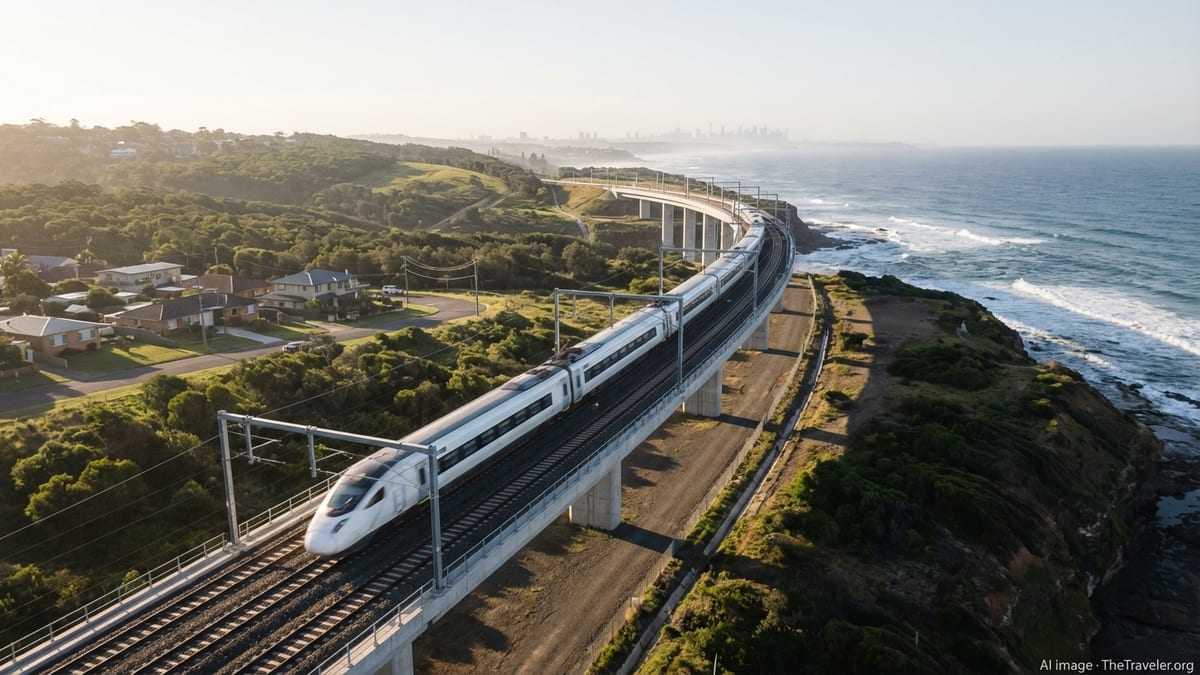
A New Contender in the LA–San Francisco Race
The bullet bus idea, outlined in recent coverage of a Caltrans research initiative, envisions intercity coaches operating at sustained triple-digit speeds between roughly 100 and 140 miles per hour. The service would run on purpose-built lanes carved out of existing freeway rights-of-way, rather than entirely new rail corridors. Published reports describe the concept as exploratory and in an early feasibility stage, but its headline promise is clear: a point-to-point journey between the Los Angeles and San Francisco regions in around three hours, far faster than today’s highway or conventional bus trips.
The proposal arrives as California’s existing options remain time-consuming. Public information on current road travel indicates that driving between the two metros via the fastest Interstate 5 route typically takes about five and a half to six and a half hours, depending on traffic and weather, while intercity buses and mixed train-bus journeys often stretch closer to eight hours. Against that backdrop, a three-hour bus link would move highway travel into territory more commonly associated with high-speed rail or short-haul flights.
The bullet bus study is framed as one of several efforts to rethink long-distance mobility in the state. Reports indicate that planners are examining how such a system could connect with local transit at each end and potentially serve intermediate communities in the Central Valley, which are often bypassed by air travel and currently rely on slower bus or car trips.
How a 140 mph Bullet Bus Would Work
According to publicly available descriptions, the envisioned network would rely on exclusive high-speed lanes running parallel to existing freeways, conceptually similar to bus-only or high-occupancy toll corridors but engineered for far higher speeds. Renderings and planning presentations referenced in recent coverage depict wide, separated lanes with controlled access, advanced barriers, and limited entry points designed to keep private vehicles out and maintain consistent operating conditions for buses.
The vehicles themselves would likely require substantial redesign compared with today’s intercity coaches. Analysts note that running at up to 140 miles per hour on rubber tires over long distances would demand upgraded suspension systems, braking technology, active safety controls, and rigorous maintenance standards for both vehicles and pavement. Some commentary likens the infrastructure to a highway version of a dedicated rail right-of-way, emphasizing alignment quality and surface smoothness to keep ride comfort within acceptable limits at very high speeds.
Operational concepts discussed in media reports suggest that service patterns could mix limited-stop express runs between the Los Angeles and San Francisco regions with select intermediate stops in major Central Valley hubs. Scheduling would need to factor in integration with local transit at both ends, with planners exploring options for stations near existing rail and bus terminals to simplify transfers.
Positioning Beside California’s High-Speed Rail Effort
The bullet bus exploration is unfolding against the backdrop of California’s long-running high-speed rail project. The state’s official high-speed rail authority continues to focus on building an electrified 220 mile-per-hour train line designed to link Los Angeles and San Francisco in under three hours, but its latest business plans show that the full north–south spine remains years away from opening. Construction is concentrated for now in the Central Valley, and current planning documents highlight staged service that will initially fall short of connecting both major metropolitan endpoints.
According to recent reporting, some transportation researchers have floated high-speed bus links as a complementary strategy, potentially acting as a bridge between early high-speed rail segments and the coastal cities. Concepts presented in public forums include bus connections from future rail termini such as Merced and Bakersfield to the Bay Area and Southern California, using higher-speed road corridors to close current gaps in the system.
Supporters of the bus study frame it as a comparatively lower-cost and faster-to-deploy alternative if the state can adapt existing freeway rights-of-way instead of acquiring long new rail corridors through dense urban and agricultural land. Commentators note, however, that the bullet bus initiative remains at the level of research and scenario testing rather than a funded construction program, and that it would not replace the legally mandated objectives of the voter-approved high-speed rail system.
Cost, Safety and Environmental Questions
Early analyses circulated in the media emphasize that the bullet bus concept raises complex questions about cost, safety, and environmental impact. Dedicated, grade-separated bus lanes suitable for 140 mile-per-hour operation would require major investment in pavement, separation barriers, interchanges, and monitoring systems. While proponents argue that building and maintaining specialized highway lanes may be less expensive than constructing an entirely new electrified rail line, the scale of work along hundreds of miles of corridor would still be significant.
Safety is another central concern. Commentary from transportation experts and public observers points out that operating large buses at aircraft-like speeds on the ground would demand strict control of access points, advanced driver-assistance or automated control systems, and intensive oversight of vehicle condition. Any debris, weather-related surface damage, or mechanical issue could become much more serious at triple-digit speeds than on conventional highways. Feasibility research is expected to focus heavily on risk management, emergency response planning, and crash avoidance technology.
Environmental assessments would need to weigh the benefits of shifting passengers out of cars and short-haul flights against the continued reliance on rubber-tire vehicles. Study materials and related discussions suggest that bullet bus fleets could be fully electric or use low-emission drivetrains, allowing the system to align with California’s broader climate goals while leveraging the flexibility of road-based infrastructure.
From Concept Study to Potential Corridor
For now, the bullet bus remains an idea on paper rather than a construction site. Reports indicate that Caltrans and partner agencies are in a data-gathering phase, looking at international examples of high-performance bus corridors and modeling potential travel times, ridership, and cost ranges. Publicly available information suggests that upcoming work will include more detailed corridor alignments, station location concepts, and analysis of how a high-speed bus spine could integrate with projects such as Los Angeles bus-priority lanes and Bay Area express lane networks.
Any path toward implementation would likely require a sequence of environmental reviews, design studies, and legislative or funding approvals. Observers expect that early pilot segments, if pursued, might focus on portions of the Central Valley where rights-of-way are more available and traffic densities are lower, before extending into the more constrained urban approaches to Los Angeles and the Bay Area.
As California continues to grapple with crowded highways, delayed rail timelines, and climate targets, the bullet bus study underscores how transportation planners are testing unconventional ideas alongside more familiar rail and highway projects. Whether the 140 mile-per-hour coach ever becomes a reality, the concept signals a willingness to reconsider how the state’s most important travel corridor could function in the coming decades.