


More news on this day
Canada’s busiest air travel corridors faced severe disruption this week as a reported 526 flight cancellations and delays involving Air Canada, Jazz and WestJet rippled across Toronto, Montreal and Vancouver, stranding passengers, snarling connections and heightening concern over the resilience of the country’s airline networks.
Get the latest news straight to your inbox!
Major Hubs Buckle Under Wave of Disruptions
According to multiple operational tracking reports and recent aviation coverage, the latest bout of disruption swept through Canada’s three largest gateways in rapid succession, with Toronto Pearson, Montreal Trudeau and Vancouver International recording hundreds of delayed and cancelled flights in a matter of hours. The tally of 526 affected services includes regional and mainline operations flown by Air Canada and Jazz, alongside WestJet departures and arrivals on key domestic corridors.
Publicly available data from flight-status dashboards for mid June shows dense clusters of delayed departures between Toronto and Vancouver, Toronto and Montreal, and Vancouver and Montreal, indicating pressure on the core east west spine of Canada’s network. The disruption extended into regional feeder flights that connect smaller communities to these hubs, aggravating missed connections and overnight stranding for passengers.
Travel industry analyses suggest that a combination of factors is likely at work, with recent reporting pointing to air traffic management issues, localized weather and knock on effects from earlier schedule reductions. While the exact mix behind this latest spike is still being parsed, observers note that Canada’s hub and spoke system means even a localized failure can quickly cascade into apparent nationwide chaos.
The latest episode follows a pattern that has seen Canadian airports periodically rank among the most disrupted in North America during peak strain events, underscoring continuing vulnerabilities despite post pandemic schedule adjustments and investments in technology.
Operational Strain for Air Canada, Jazz and WestJet
Publicly available information shows that Air Canada and its regional partner Jazz once again shouldered the largest share of impacted services, reflecting their dominant presence at Toronto and Montreal. On busy transcontinental routes such as Toronto to Vancouver, schedules that already run near capacity leave little slack when aircraft or crews fall out of position.
Recent coverage of Air Canada’s 2026 outlook highlights how volatile jet fuel prices and a more fragile operating environment have already forced the carrier to trim routes and revisit capacity plans. Those strategic cuts, largely focused on marginal or seasonal services, can inadvertently make the remaining network more brittle when irregular operations hit, since there are fewer alternative flights available for same day recovery.
WestJet, which has previously dealt with system outages and has been reshaping its network toward Western Canada and selective transatlantic flying, also appears heavily represented in the latest figures. Past episodes have shown that even when a technical issue is quickly resolved, residual delays can trail through the system for many hours, turning a brief outage into a full day of cancellations and missed connections.
For Jazz, which operates regional services under the Air Canada Express banner, the latest turmoil highlights how regional operators are deeply exposed to upstream shocks. When mainline flights into major hubs such as Toronto or Montreal are delayed or cancelled, inbound aircraft and crews may not arrive in time to operate subsequent regional sectors, forcing last minute schedule changes for passengers traveling to and from smaller Canadian communities.
Passengers Confront Long Lines, Missed Connections and Limited Options
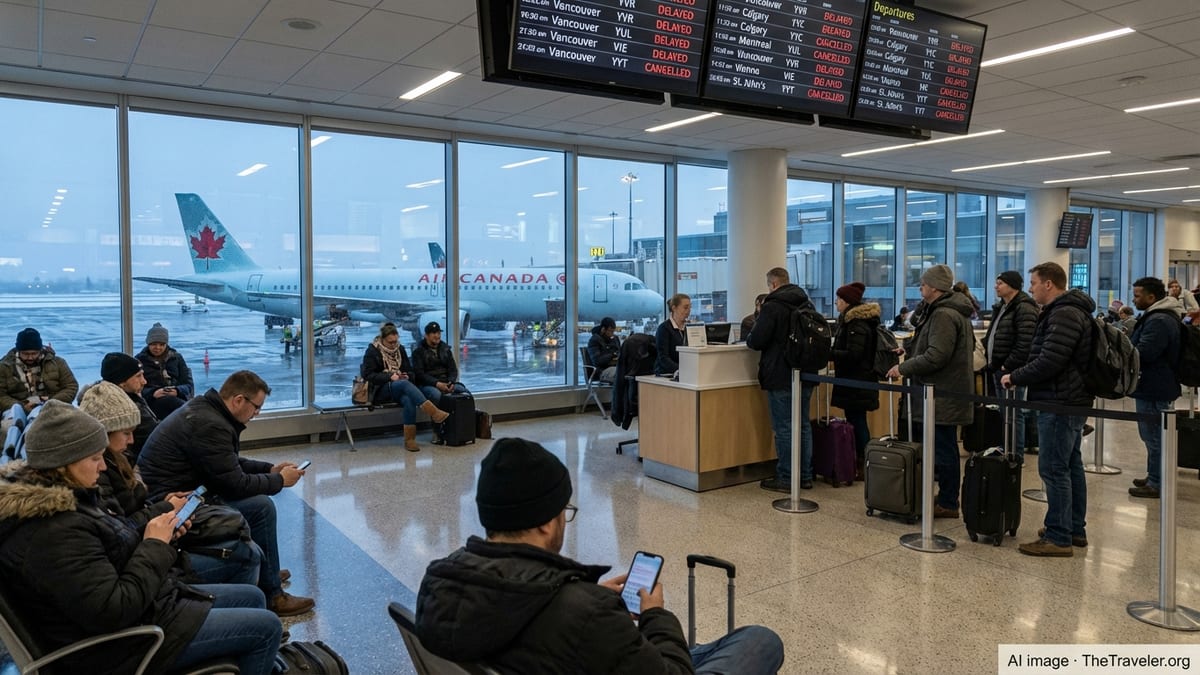
Reports from affected airports describe scenes that have become familiar to Canadian travelers in recent years: long check in and security lines, crowded departure halls, and passengers queueing at rebooking counters late into the night. When multi hundred flight disruption tallies hit, even automated rebooking tools can struggle to keep pace, particularly for families or groups traveling together on complex itineraries.
Travel rights advocates note that when airlines cite issues within their control, passengers may be eligible for care and, in some circumstances, compensation under Canada’s Air Passenger Protection Regulations. However, determining whether a disruption was within an airline’s control or caused by external factors such as weather or air traffic management can be complex, and travelers are frequently urged by consumer groups to document their experiences and retain boarding passes, receipts and written notifications.
For many passengers, the most immediate concern during such events is basic welfare: access to timely information, meal vouchers where required, and accommodation when overnight stays become unavoidable. Airline customer guidance documents indicate that carriers will attempt to rebook travelers on the next available service, sometimes using partner airlines where capacity permits, but during large scale events the next available seat may be many hours or even days away.
Domestic travelers connecting to international long haul flights through Toronto, Montreal or Vancouver are particularly vulnerable. A missed transatlantic or transpacific departure can derail tightly planned holidays or business trips, with rebooking dependent on available inventory on already busy routes and, in some cases, seasonal services with limited weekly frequencies.
Regulatory and Industry Context Behind the Chaos
The latest wave of disruption lands against a broader backdrop of regulatory scrutiny and shifting airline strategies in Canada. In recent months, the Canadian Transportation Agency has imposed penalties on carriers over previous delay and cancellation handling, and consumer groups have continued to push for clearer standards and stronger enforcement of passenger protections.
At the same time, both Air Canada and WestJet have been restructuring networks in response to elevated fuel costs and changing demand patterns. Air Canada has announced suspensions of several routes it considers no longer economically feasible, including links between major Canadian hubs and select U.S. cities, while WestJet has pared back some transborder services from Vancouver and other points amid what it has characterized as softening demand.
Industry analysts argue that these shifts, while financially rational for the airlines, contribute to a leaner system with fewer redundant options. When irregular operations hit, there are simply fewer alternative flights or routings available to absorb displaced passengers, increasing the visible severity of disruption events when they occur.
Recent aviation incident summaries have also highlighted how disruptions can arise from complex interactions between airlines, airports and air navigation service providers. Issues in the transmission of flight plans, for example, can slow or halt departures across multiple airlines simultaneously, even when aircraft and crews are ready, illustrating how interdependent the modern air travel ecosystem has become.
What Travelers Can Expect in the Coming Weeks
With summer peak season approaching and fuel costs still volatile, aviation commentators suggest that Canadian travelers should be prepared for continued pockets of disruption, particularly on already busy domestic trunk routes and at hub airports with tight turnaround schedules. While the specific one day tally of 526 affected flights may prove exceptional, the structural factors behind it are unlikely to vanish quickly.
Passenger advocacy organizations and travel insurance specialists continue to advise travelers to build longer connection times into itineraries, monitor flight status aggressively in the 24 hours before departure, and consider earlier departures when same day connections are time sensitive. Flexible tickets, while often more expensive, can provide added options if schedules unravel.
For airlines, the challenge will be balancing financial discipline with operational resilience, ensuring that networks remain robust enough to handle weather events, technical glitches and airspace constraints without cascading into national level chaos. The latest disruption episode across Toronto, Montreal and Vancouver serves as a sharp reminder that Canada’s air transport system, though largely reliable on an average day, can still be pushed to breaking point when multiple stressors collide.
As investigations into the precise drivers of the most recent chaos continue and airlines work through recovery, travelers, regulators and industry watchers alike will be watching closely for signs that lessons are being translated into more resilient operations before the next major test of Canada’s crowded skies.