


More news on this day
Canada’s busiest air corridors were thrown into disarray today as Toronto, Montréal, Vancouver, Ottawa and Québec reported a combined 131 flight cancellations and 601 delays, stranding passengers across the country and rippling through domestic and international schedules.
Get the latest news straight to your inbox!
Wave of Disruptions Hits Canada’s Core Air Corridor
The latest data from flight-tracking and industry reports indicates that the disruption spans Canada’s main east–west and transborder network, with Toronto Pearson and Montréal-Trudeau once again emerging as the most affected hubs. Ottawa, Vancouver and Québec City are also reporting significant knock-on delays as aircraft and crews fall out of position.
Figures circulating across aviation trackers and travel-industry coverage point to 131 flights canceled and 601 delayed across the five cities over the course of the day. The pattern mirrors recent days in which Toronto, Montréal and Vancouver in particular have repeatedly appeared among the North American airports with the highest levels of disruption, affecting both departing and arriving services.
The total includes cancellations and delays across a mix of domestic, transborder and long-haul international routes, meaning disruption is being felt not only by point-to-point travelers but also by those relying on tight connections through Canada’s main hubs. For many, a delay of a few hours on a short-haul link is resulting in missed overnight flights to Europe, the United States and Latin America.
Publicly available information also shows that the impact is not confined to any single airport in isolation. With the same airlines and aircraft cycling repeatedly between Toronto, Montréal, Ottawa, Vancouver and Québec City in a single operating day, operational snags in one location are quickly cascading along the entire corridor.
Airlines Struggle With Knock-On Effects and Capacity Limits
Reports from flight-status dashboards show that the bulk of the disrupted flights involve Canada’s largest carriers and their regional partners, including services marketed by the country’s flag carrier as well as rivals and feeder airlines. Travel-industry outlets tracking the irregular operations note that all major players are contending with a combination of weather-related restrictions, congestion and aircraft or crew availability issues.
Operational analyses published in recent weeks have highlighted how tightly scheduled turnarounds in Toronto, Montréal and Vancouver leave little room to absorb even modest delays. When an inbound aircraft arrives late in one city, it often forces a subsequent delay or cancellation on a different route hours later, sometimes departing from another airport entirely. This type of knock-on disruption is increasingly visible today across the Toronto–Montréal–Ottawa triangle and onward to Vancouver.
Industry commentary also points to capacity constraints that limit how quickly airlines can recover once delays begin to mount. Canada’s major hubs have limited spare aircraft and crew standing by, particularly in shoulder and off-peak seasons. When dozens of flights are delayed or canceled across several airports, the available slack is quickly exhausted and rebooking options for affected passengers become more constrained.
Travel-sector analyses note that some airlines have periodically introduced change-fee waivers or flexible rebooking policies during similar disruption events earlier this year, particularly when weather or airport constraints have been clearly identified. However, passengers today are still largely reliant on general customer-service channels, which are often overwhelmed when hundreds of flights are affected across the national network at the same time.
Thousands of Passengers Face Long Lines and Rebooking Headaches
With more than 700 flights across the five cities either canceled or delayed, travel data firms estimate that thousands of passengers are encountering extended airport waits, missed connections and unexpected overnight stays. Disruption totals of this scale typically correspond to tens of thousands of individual itineraries being affected, given that many flights involved are operated with narrowbody jets on high-demand routes.
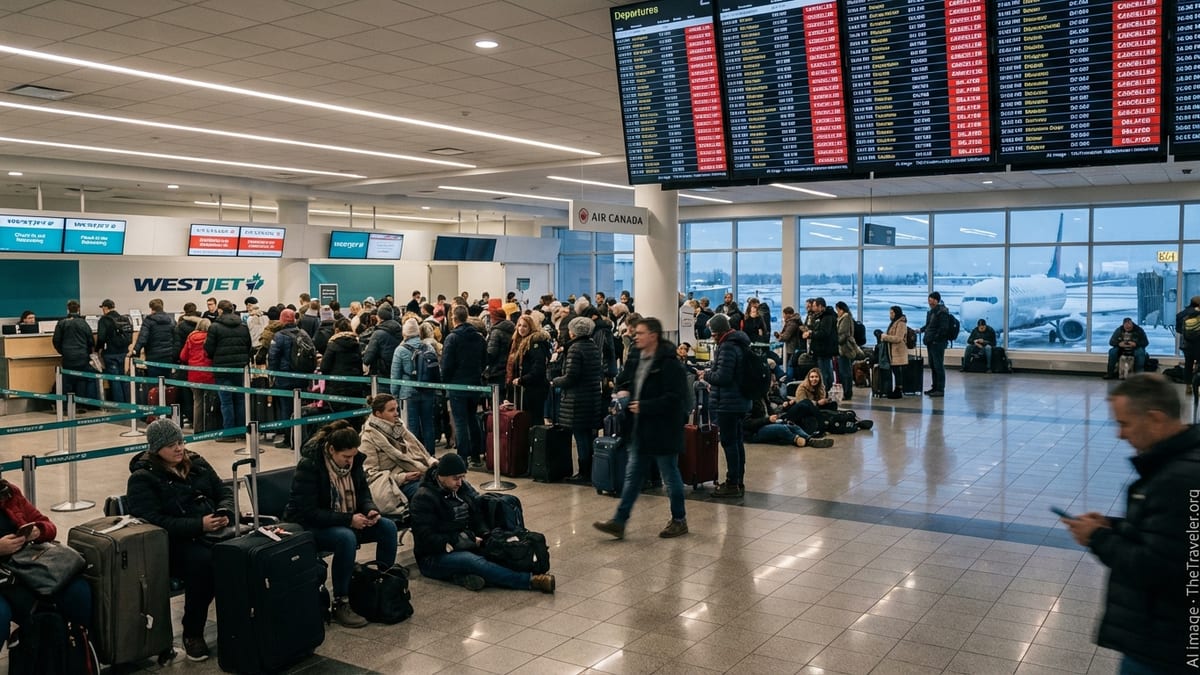
Scenes of crowded departure halls and departure boards dotted with “delayed” and “canceled” notices have become increasingly common in Toronto and Montréal during recent disruption waves. Reports from today suggest a similar pattern, as passengers queue for rebooking assistance and scramble to secure scarce seats on later flights to key destinations such as Calgary, Edmonton and major U.S. hubs.
For travelers with onward international journeys, a missed connection in Toronto or Montréal often means a minimum delay of 24 hours when evening transatlantic or transpacific departures are involved. Publicly available information from travel-compensation platforms notes that a single missed long-haul connection can sometimes trigger additional missed flights at the far end of the itinerary, amplifying the overall disruption and complicating rebooking.
Passengers on shorter domestic hops, such as Ottawa–Toronto or Québec City–Montréal, face a different set of challenges. These routes are heavily used by business travelers and government staff commuting within the Québec–Ontario corridor, and rolling delays across the day can erase the time savings that usually make air travel competitive with rail or road options.
Weather, Congestion and Tight Schedules Under Scrutiny
Although a single clear cause has not been identified for today’s exact totals of 131 cancellations and 601 delays, recent patterns across Canadian airports point to a recurring mix of weather volatility, airspace congestion and tight airline schedules. Past disruption days this year have frequently coincided with storms, low visibility or high winds in southern Ontario and Québec, prompting increased separation between aircraft and temporary runway restrictions.
Analyses produced by travel-industry outlets and passenger-rights organizations also emphasize the role of so-called “reactionary delays,” in which a flight that departs late from one city causes a ripple effect many hours later in another. In a network where aircraft may start the day in Vancouver, pass through Toronto and Montréal and end in Ottawa or Québec City, a relatively short delay at the beginning of the rotation can spill into cancellations by the end.
Longer-term performance data published by federal transportation agencies has previously shown that Canada’s major hubs, including Toronto, Vancouver and Ottawa, can see sharp swings in on-time performance during peak travel periods. Staffing levels at airlines, ground handlers and airport authorities, as well as the capacity of security and border-control lines, all contribute to whether schedules can be maintained once terminals reach saturation.
Travel analysts note that the cumulative impact of repeated disruption days is beginning to erode confidence among frequent flyers, some of whom are increasingly padding layover times or shifting short-haul journeys to rail where practical. Others are opting for earlier departures or avoiding last flights of the day on busy corridors such as Toronto–Montréal and Toronto–Vancouver in an effort to retain more fallback options if delays occur.
Passengers Turn to Rights, Refunds and Workarounds
The renewed wave of cancellations and delays is drawing attention back to Canada’s air passenger protection framework, which sets out compensation and care obligations in cases where flights are significantly disrupted. Publicly available guidance from passenger-rights advocates explains that eligibility depends on factors such as the cause of the disruption, the size of the airline and how much advance notice travelers received.
In practical terms, travelers affected today are focusing first on securing alternate transport, whether by being rebooked on later flights, rerouted through different hubs or, in some short-haul cases, shifting to rail or long-distance coach services between cities such as Toronto, Ottawa and Montréal. Travel forums and prior disruption coverage suggest that passengers who have flexibility in routes and dates often fare better during widespread irregular operations.
Consumer groups that track disruption patterns urge passengers to document their experiences, retain receipts for meals and accommodation, and save boarding passes or booking confirmations in case they pursue reimbursement or compensation afterward. They also recommend checking both airline communications and independent flight-status tools, particularly when airport departure boards lag behind real-time information.
With no immediate indication that Canada’s air network will be fully clear of delays by the end of the operating day, many passengers in Toronto, Montréal, Vancouver, Ottawa and Québec are preparing for extended waits, improvised overnight stays and rearranged plans. The latest figures underline how swiftly a bad day in the country’s interconnected air corridor can strand travelers across multiple provinces and place fresh pressure on airlines already struggling to keep their schedules on track.