


Cancun International Airport is the main gateway to Mexico’s Caribbean coast, handling millions of travelers heading to Cancun, the Riviera Maya, Tulum and beyond. The airport layout can feel confusing on arrival, especially with three different passenger terminals in regular use. This guide walks you step by step through Terminals 2, 3 and 4, how they differ, how to move between them, and exactly where to find buses, shuttles and pickup zones in real-world terms.
Get the latest updates straight to your inbox!
Understanding Cancun Airport’s Overall Layout
Cancun International Airport is located about 16 kilometers south of downtown Cancun and is organized around three main terminals for regular flights: Terminals 2, 3 and 4. Terminal 1 is used for some charter and private operations, and a separate FBO handles private aviation, so most visitors will only ever see Terminals 2, 3 and 4 on arrival or departure.
The three active passenger terminals are spread along the same access road, roughly in a line. Terminal 2 sits in the center of the complex, with Terminal 3 and Terminal 4 extending outward along the same main airport road. There are sidewalks and vehicle lanes between them, and while it is technically possible to walk between some terminals in 20 to 30 minutes, the heat, luggage and traffic make the free interterminal shuttle or your bus transfer a far more practical choice for most travelers.
All terminals have their own arrivals halls, immigration and customs, baggage claim, and curbside pickup zones. That means that if you land in Terminal 4 and your ADO bus, private shuttle or hotel driver is expecting you there, you do not need to walk or transfer to Terminal 2 or 3 first. The key to a smooth arrival is knowing which terminal your airline uses and where the ground transportation options line up outside.
When planning your route, keep in mind that airlines sometimes change terminals seasonally or after schedule updates. Before flying, check your airline’s latest guidance and your boarding pass, which usually indicates the operating terminal. On arrival, terminal signs in the immigration hall and at baggage claim confirm exactly where you are, which is helpful if you agreed to meet friends or a driver at a specific terminal.
Terminal 2: Mixed Domestic and International Hub
Terminal 2 is the oldest of the three main terminals and sits roughly in the middle of the airport complex. It handles a mix of domestic and international flights. Mexican carriers like Aeromexico, Viva Aerobus and some Volaris flights frequently use Terminal 2, along with a rotating list of international airlines from the United States, Canada, South America and Europe. Because it serves both domestic and international operations, it often feels busy throughout the day.
Inside Terminal 2, arrivals are split into two zones. Domestic arrivals are on one side of the terminal and international arrivals on the other, each with its own immigration or passport control setup. After exiting immigration and collecting your bags, you pass through customs and then emerge into a public arrivals area where you will see transport counters, currency exchange booths and a flow of representatives offering prebooked shuttles and taxis.
Once outside the sliding doors of the arrivals hall, the curb immediately in front of Terminal 2 is used by prebooked private shuttles, hotel vans, official taxis and family pickups. To catch the ADO bus from Terminal 2, you typically exit the arrivals doors, turn slightly left or right depending on the configuration at the time, and look for the red ADO logo on a small kiosk or sign near the curb. Staff usually wear shirts or vests with the company name and can confirm if the next bus is going to downtown Cancun, the Hotel Zone, Playa del Carmen or Tulum.
Because Terminal 2 is in the middle of the airport road, it is also an easy reference point if you are transferring. For example, if you arrive on a domestic flight to Terminal 2 and later depart on an international flight from Terminal 4, you can either ride the free interterminal shuttle that circulates between the terminals or book transport that takes you directly to Terminal 4, which many private shuttles and airport taxis are happy to do.
Terminal 3: Classic International Arrivals Experience
Terminal 3 is historically known as Cancun’s main international terminal and is still heavily used by major North American and European airlines. Carriers such as American Airlines, Delta, United, Air Canada and several European leisure airlines frequently operate into this terminal, though assignments can change. Many visitors from the United States and Canada will have their first Cancun experience walking off a plane and into Terminal 3’s long immigration hall.
The layout of Terminal 3 is straightforward. Passengers arrive at one end of a linear concourse, pass through immigration, and then reach a duty-free shopping zone before baggage claim. After picking up luggage and crossing customs, everyone is funneled through a single exit into the public arrivals area. This central exit makes it easier to find your driver or bus counter, because there is only one main flow of arriving passengers coming out.
Immediately after the arrivals doors, you enter a zone crowded with transport desks, tour operators and hotel representatives. If you have prebooked a private shuttle with a company serving Cancun and the Riviera Maya, they will usually instruct you to meet outside Terminal 3 at a numbered meeting point near the curb. For example, a transfer company might tell you to “exit Terminal 3 and walk to Meeting Point 12 by the far right side of the curb” where a uniformed staff member will be holding a sign. These meeting points are marked by small signs or columns along the sidewalk.
For ADO buses at Terminal 3, once you exit the arrivals doors, you walk toward the outer lane of the roadway and look for the ADO kiosk or staff along the curb. The buses typically pull into a designated bus lane set slightly away from the immediate taxi pickup area, so you may need to cross one or two vehicle lanes with marked pedestrian crossings. Staff will guide you to the correct bus for your destination and scan your ticket if you bought it online in advance or sell you a ticket on the spot, usually in Mexican pesos or with a card.
Terminal 4: Newer, Spacious and Heavily International
Terminal 4 is the newest major terminal at Cancun Airport and was designed to handle a growing wave of international traffic. Many long haul and high volume routes from airlines based in the United States, Canada, South America and Europe have shifted to this terminal. Canada based low cost carriers and several U.S. airlines often use Terminal 4, although exact assignments vary by season.
The interior of Terminal 4 is modern and more spacious than the older buildings, with a large arrivals hall and numerous dining and shopping options on the departures level. After your international flight lands, you follow a relatively wide corridor through immigration, then continue to baggage claim and customs. The passenger flow is designed to minimize bottlenecks, although during peak travel periods such as winter holidays or spring break you can still see significant lines at passport control.
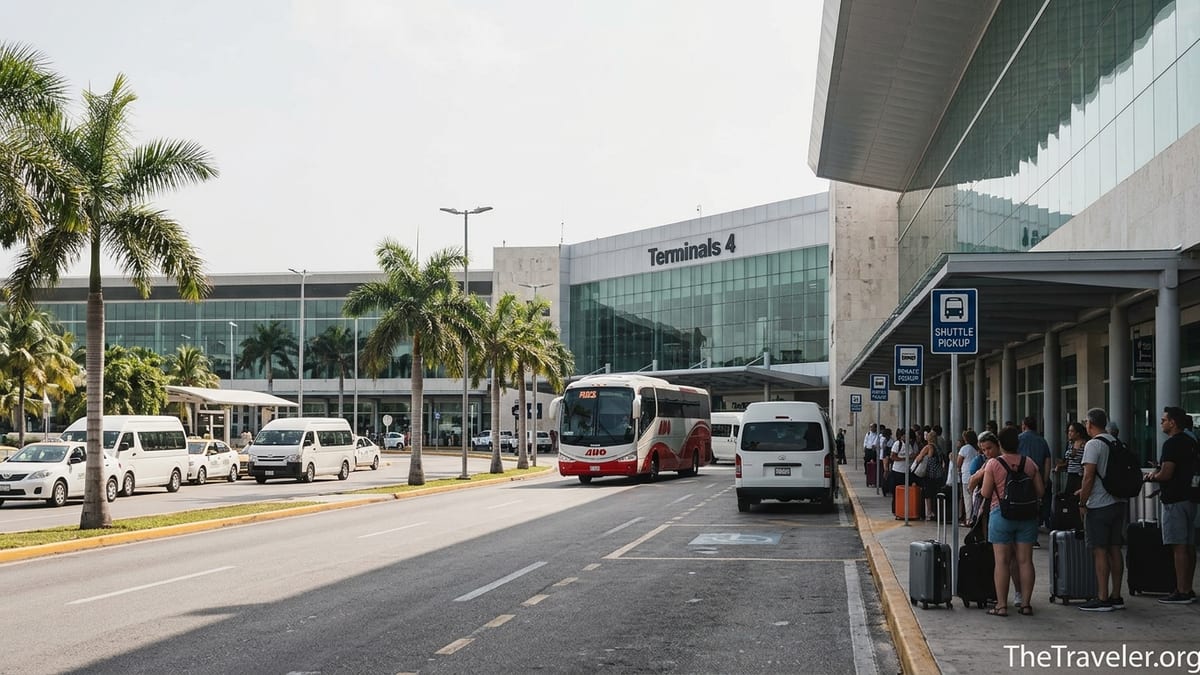
When you step out of the Terminal 4 arrivals doors, you enter a broad plaza style area with space for people to gather. The curbside here is organized into several zones: one for prebooked private shuttles and hotel vans, one for officially authorized taxis, and another area slightly farther along where buses, including ADO, pull in. A practical example is a traveler landing from Toronto and heading to Playa del Carmen. After clearing customs, they exit the arrivals hall, stay on the right side of the plaza following signs for “Buses” or “ADO,” and reach the ADO boarding area where buses to downtown Cancun, Playa del Carmen and Tulum stop in sequence.
Because Terminal 4 handles many international flights, it is a common meeting point for groups. However, it is important to be clear about the exact arrival terminal when coordinating. If one friend flies in from Chicago with an airline landing at Terminal 3 and another from Vancouver with a carrier using Terminal 4, they should either agree to meet at a specific terminal’s curbside cafe or simply meet on the ADO bus itself, which stops at Terminals 2, 3 and 4 in a fixed order.
Airline Differences and How They Affect Your Route
Airline terminal assignments at Cancun Airport are not entirely fixed and can change, but there are broad patterns. Terminal 2 tends to see a mix of Mexican carriers and some international airlines from South America and Europe. Terminal 3 is heavily used by major U.S. legacy carriers and some Canadian and European leisure airlines. Terminal 4 has become a hub for newer or expanding routes, especially from North America and Europe, including many low cost and holiday oriented carriers.
For travelers, the most important detail is the arrival terminal printed on your boarding pass or in your airline’s booking confirmation. For example, if your Delta flight from Atlanta lists Terminal 3 as the arrival terminal, you should tell your hotel shuttle or private transfer company to meet you at Terminal 3’s arrivals curb. If you later discover on the airport’s display that your flight is using Terminal 4 that day, you can update your driver via messaging so they wait at the correct location.
On departure, the terminal assignment shapes your check in experience. Many U.S. carriers use Terminal 3 or 4 check in counters where lines for economy class can be long at peak hours such as Saturday mornings in winter. If you are flying on a Mexican low cost carrier from Terminal 2, your departure process may feel different, with more domestic travelers in line and possibly fewer long haul international routes in the waiting area. Knowing in advance which terminal you leave from helps you plan how early to arrive; for popular North American flights in high season, many travelers aim for 3 hours ahead of departure.
If you have a separate onward ticket by bus, train or domestic flight, understanding terminal assignments is also critical. For instance, a traveler flying into Terminal 4 and then taking an ADO bus to downtown Cancun must allow enough time to clear immigration and customs before reaching the bus stop. If their onward ADO ticket is for a specific departure, they might choose a slightly later bus to allow for delays at passport control, rather than risking a missed connection.
International Arrivals: What to Expect Step by Step
Most international passengers will experience a similar sequence on arrival whether they land in Terminal 2, 3 or 4. After the aircraft parks, you walk through an arrivals corridor toward immigration. Here, travelers queue for passport control where Mexican immigration officers review entry documents. Wait times can vary significantly; in quieter shoulder season periods it might take 20 minutes, but at peak holiday times waits of 45 to 60 minutes or more are not unusual.
Once through immigration, you proceed to baggage claim. In Terminals 2, 3 and 4, the carousels are arranged in a relatively compact space, with overhead monitors indicating flight numbers. After collecting bags, you move toward customs where luggage may be screened. Mexico has been gradually phasing out the traditional red or green light system, but procedures can vary, so simply follow staff instructions and signage in your arrival hall.
After customs, you exit into the public arrivals hall. This is where many travelers encounter an intense mix of offers from tour desks, shuttle companies and time share promoters. If you already have a prebooked private transfer or know you want the ADO bus, you can politely decline offers as you walk straight toward the exit doors. Have your ground transport instructions handy, such as “meet outside Terminal 3 at the shared shuttle signs” or “look for the ADO bus kiosk at Terminal 4.”
A practical example helps illustrate the flow. Imagine a family flying from New York on a major U.S. airline and landing in Terminal 3. They clear immigration, collect their checked bags from carousel C8, pass through customs, and step into arrivals. Keeping left, they exit the building and see multiple transfer company representatives holding signs. They walk past this crowd toward the main roadway, spot a red ADO sign, buy tickets for the next bus to Playa del Carmen, and are boarding the bus within about 20 to 30 minutes of leaving customs on a typical day.
ADO Bus Stops and How They Work
ADO is the primary intercity bus company that serves Cancun Airport. Its buses connect Terminals 2, 3 and 4 with downtown Cancun, the Hotel Zone area, Playa del Carmen, Tulum and other destinations in the region. Importantly, ADO buses stop directly outside all three main terminals, so you do not need to change terminals just to catch a bus.
At each terminal, the pattern is similar. After exiting the arrivals hall, you head to the curb and look for a small kiosk or counter with the ADO name, often in red letters. Staff can sell you a ticket on the spot in Mexican pesos and increasingly accept cards. Typical fares from the airport to downtown Cancun are in the low hundreds of pesos, while buses to Playa del Carmen or Tulum cost more, often in the range of the mid hundreds of pesos depending on service type and season. These buses are generally modern, air conditioned coaches with assigned seats and underfloor luggage storage.
ADO buses circulate between the airport terminals and then continue to their final destinations. For instance, an airport to Playa del Carmen bus may stop at Terminal 2, then Terminal 3, then Terminal 4 before leaving for the highway. This means that if you and a friend land at different terminals, you can agree to board the same bus route and meet on the vehicle rather than trying to navigate between terminals on foot. Conversely, when returning to the airport from downtown Cancun or Playa del Carmen, most airport bound ADO buses again stop at Terminals 2, 3 and 4 in that order, allowing you to get off at the terminal printed on your outbound flight.
The company also runs services to the Cancun Hotel Zone, with buses heading toward a stop near the heart of the strip. For travelers who prefer public style transport instead of private transfers, this can be an economical alternative to taxis or hotel shuttles. For example, a solo traveler landing in Terminal 4 in the afternoon might purchase an ADO ticket to the Hotel Zone and spend significantly less than a private taxi would cost for the same route, arriving near kilometer 9 of Boulevard Kukulkan and then continuing by local bus or on foot to their specific hotel.
Shuttles Between Terminals and Other Transfer Options
Cancun Airport operates a free internal shuttle that circulates between Terminals 2, 3 and 4. The shuttle is primarily used by passengers with connecting flights in different terminals or by those who accidentally arrive at the wrong terminal for a pickup or departure. Buses usually run roughly every 15 to 30 minutes, though intervals can vary with traffic and demand.
To find the shuttle, look for signs pointing toward interterminal transport or ask an airport staff member at the curb. In many cases, the shuttle stop is marked by a column or sign indicating terminal transfers and sometimes the Tren Maya station. The shuttle typically runs in a loop, for example from Terminal 2 to Terminal 3 to Terminal 4 and back. Travel time between neighboring terminals is usually around 5 to 10 minutes, not counting waiting time.
If you find yourself at the wrong terminal for a pickup, the shuttle is the safest way to move between buildings without dealing with the main highway. For instance, if your friend’s private shuttle is waiting at Terminal 4 but your airline unexpectedly directs your flight to Terminal 2, you can exit Terminal 2, follow signs to the interterminal shuttle stop, ride to Terminal 4, and then walk to the prearranged meeting point. This is often easier than trying to rebook separate transport at the new terminal.
While some travelers mention walking between terminals, this is not ideal for most visitors due to the tropical heat, lack of shade, and the need to cross busy access roads. For safety and convenience, the free shuttle or an ADO bus that serves all terminals is usually the better option when you must move from one terminal to another.
Pickup Areas: Where to Meet Drivers, Friends and Shuttles
Each terminal at Cancun Airport has distinct curbside zones used for different types of pickups. Understanding these zones can save you time and confusion. Generally, the first lane outside the arrivals doors is for authorized taxis and prebooked private shuttles, while additional lanes and outer areas accommodate buses, hotel shuttles, and personal vehicles.
If you book a private transfer in advance, the company will usually instruct you to proceed to a specific meeting point outside your arrival terminal. A typical instruction might be: “For Terminal 3 arrivals, exit the building, turn right, and look for our representative near the designated meeting point sign.” The representative will often wear a company logo shirt and carry a clipboard or tablet. It is a good idea to confirm your driver’s name and vehicle details before getting in, especially because there can be many similar looking vans in the same area.
Travelers meeting friends or family in a personal vehicle should agree on a clear landmark outside the terminal. For example, at Terminal 4, you might choose a particular cafe or a pillar number in the arrivals area, then use messaging apps to confirm when each person is on site. Personal vehicles often have limited time to wait at the curb, so many locals use a nearby parking lot while they wait for a message that their guests have cleared customs and are heading outside.
For ADO and other buses, the pickup areas are usually slightly removed from the immediate taxi and private shuttle lane. After exiting the terminal, you walk a short distance toward the outer lanes where larger vehicles can safely load passengers without blocking curb traffic. If you are unsure where to wait, ask uniformed staff or look for signage that includes the word “buses” or the ADO logo. Having your ticket or reservation number ready on your phone or printed page will help you board quickly when the bus arrives.
The Takeaway
Cancun International Airport’s three main passenger terminals can seem overwhelming on first arrival, but once you understand the general layout they become manageable. Terminal 2 acts as a mixed domestic and international hub in the center of the airport, Terminal 3 is a long standing base for many North American and European flights, and Terminal 4 is the newer, more spacious building handling a growing share of international traffic.
For ground transport, the key facts are simple. ADO buses stop directly at Terminals 2, 3 and 4, connecting the airport with downtown Cancun, the Hotel Zone, Playa del Carmen, Tulum and other points. A free interterminal shuttle circulates between terminals, which is useful if your pickup or onward flight is in a different building. Each terminal has clearly defined pickup areas, but you should always confirm the exact meeting point with your shuttle company, hotel or friends before you travel.
Arriving prepared with your terminal number, a sense of where the ADO kiosks and shuttle stops are, and a pre agreed meeting spot for pickups will make your first steps in Cancun significantly smoother. With a little planning, you can move from plane to bus, shuttle or car quickly and start focusing on the real reason you came: enjoying Mexico’s Caribbean coast.
FAQ
Q1. Which terminal does ADO use at Cancun Airport?
ADO buses serve Terminals 2, 3 and 4 at Cancun Airport. You can board at the curbside bus area outside any of these terminals without changing buildings.
Q2. How do I know which terminal my flight uses at Cancun?
Check your airline confirmation and boarding pass, which normally list the arrival terminal. You can also verify on the airport’s departures and arrivals displays closer to your travel date.
Q3. Can I walk between Terminals 2, 3 and 4?
It is physically possible but not recommended for most travelers due to heat, distance and traffic. It is usually better to use the free interterminal shuttle or an ADO bus that stops at all terminals.
Q4. Is there a free shuttle between Cancun Airport terminals?
Yes, there is a free shuttle bus that circulates between Terminals 2, 3 and 4. It typically runs every 15 to 30 minutes, with travel times of about 5 to 10 minutes between terminals.
Q5. Where do I meet my private shuttle or hotel transfer?
Most private shuttles and hotel transfers meet passengers outside the arrivals doors at a designated meeting point at your arrival terminal. Your confirmation should state the exact spot and directions.
Q6. How long does it take to get from the plane to the ADO bus?
Timing varies, but many travelers reach the ADO stop 30 to 60 minutes after landing, depending on immigration lines, baggage delivery and customs.
Q7. Do ADO buses stop at every terminal when leaving the airport?
On most routes to downtown Cancun, the Hotel Zone, Playa del Carmen or Tulum, airport bound ADO buses stop at Terminals 2, 3 and 4 in sequence before continuing to the highway.
Q8. Are ADO tickets cheaper than a taxi from Cancun Airport?
For solo travelers or couples going to downtown Cancun, Playa del Carmen or Tulum, ADO is usually significantly cheaper than a private taxi, though less flexible than door to door transfers.
Q9. If my friend lands at a different terminal, where should we meet?
A practical option is to agree to meet on the same ADO bus route, since buses stop at Terminals 2, 3 and 4. Otherwise, use the free interterminal shuttle and meet at a specific curbside landmark.
Q10. How early should I arrive at the correct terminal for my departing flight?
For international flights, arriving about 3 hours before departure is common, especially in high season. This gives time for check in, security and potential lines at Terminals 2, 3 or 4.