


Stepping out of Cancun International Airport and straight into your own rental car can be one of the most convenient ways to explore Cancun, Playa del Carmen, Tulum and the wider Riviera Maya. It can also be one of the most confusing parts of the trip, thanks to unfamiliar insurance rules, surprise deposits and aggressive upselling at the counter. This guide breaks down how car rental at Cancun Airport really works, what to watch for in the contracts, and how to decide if driving yourself is worth it for your style of trip.
Get the latest updates straight to your inbox!
How Car Rental Works at Cancun International Airport
Cancun International Airport (CUN) is one of Latin America’s busiest vacation gateways, and that shows in the density of car rental options. Major international brands like Hertz, Avis, Budget, Alamo, Enterprise, National and Sixt operate alongside regional companies such as America Car Rental, Mex, Avant, Royal, and a long list of small local agencies. Many advertise cars from just a few dollars per day, which understandably catches travelers’ attention.
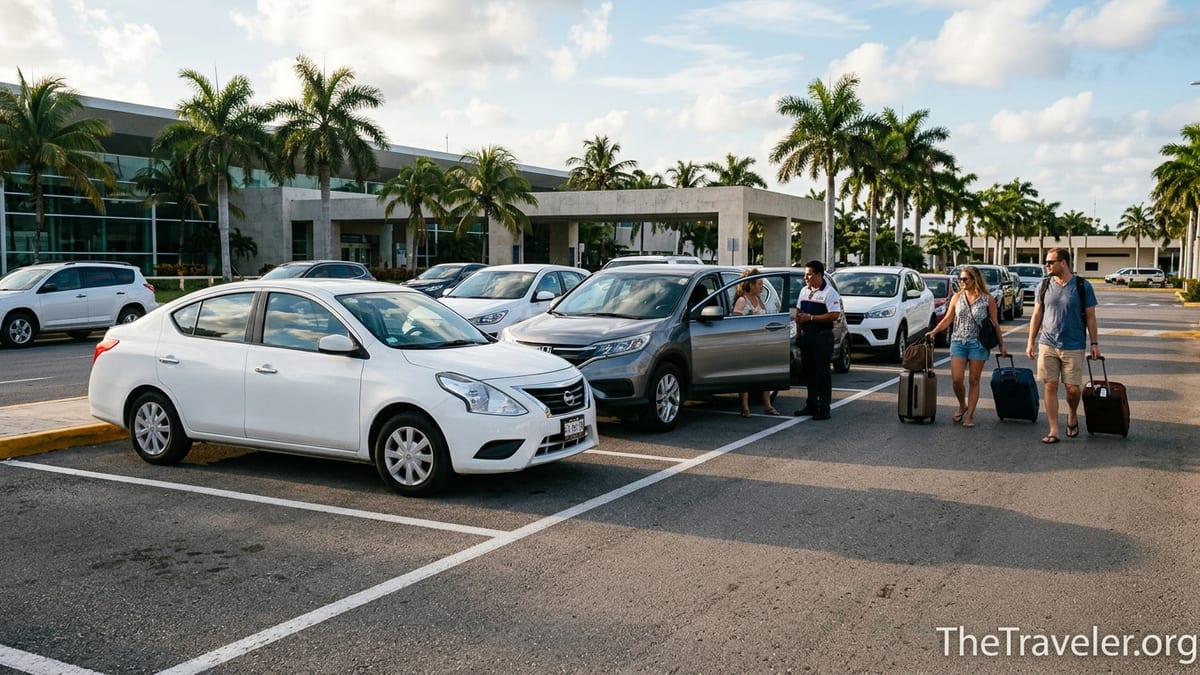
Inside the terminals you will find rental counters in the arrivals halls, especially in Terminal 3 and Terminal 4, where most international flights land. These in-terminal desks are primarily for paperwork and payment. The actual cars are held at depots along the airport perimeter road or just outside the property. After signing your contract, an agent typically walks you outside to a shuttle van, which takes 3 to 10 minutes to reach the lot, where you inspect and collect the vehicle.
Some companies market themselves as “airport” locations but are in fact entirely off-site. In practice, that simply means your representative waits outside the arrivals doors with a sign, then drives you to their office on Highway 307 or in the hotel zone. This is common with smaller brands promising “all-inclusive” rates that bundle insurance and extra drivers. For example, several Riviera Maya focused agencies offer packages that include third-party liability, collision coverage, basic medical coverage and one additional driver, plus airport pickup and drop-off built into the price.
Most Cancun Airport rental operations run 24/7 or close to it, in line with the airport’s flight schedule. That said, late-night arrivals around midnight or early morning can involve longer waits, slimmer inventory and more pressure at the counter. If you know you will arrive late, it is worth choosing a company that explicitly confirms 24-hour service and putting your flight number in the reservation so they track delays.
Understanding Mexican Car Rental Insurance at CUN
The biggest shock for many travelers picking up a car at Cancun Airport is that the price they booked online can balloon once insurance is added. Mexico has its own rules, and foreign personal auto policies or many credit card “free CDW” benefits are not recognized for the crucial liability portion. Understanding the types of coverage involved helps you push back on upsells while staying properly protected.
Third Party Liability, often abbreviated TPL or PLI, is the key coverage that is mandatory to drive legally in Mexico. It covers damage or injury you may cause to others with the rental car. Mexican law requires every vehicle on the road to have at least a basic level of liability insurance issued by a Mexican insurer. That is why rental companies in Cancun build some level of TPL into every legal contract, even if the advertised base rate looks tiny. Many mid-range local agencies now highlight that their rates already include TPL plus a higher supplemental liability limit to make pricing clearer.
Collision Damage Waiver (CDW) and Loss Damage Waiver (LDW) deal with damage to or theft of the rental vehicle itself. They are typically optional but strongly encouraged at the counter. A common model in Cancun is CDW with a deductible of about 10 percent of the vehicle’s market value. So if you damage a car worth the equivalent of 15,000 US dollars, you could still be on the hook for roughly 1,500 dollars unless you pay extra for a reduced deductible package. Some agencies in the Riviera Maya advertise “full coverage” packages where CDW, theft protection, TPL and basic medical expenses are bundled, but the fine print still describes deductibles and exclusions.
Credit cards such as certain Visa, Mastercard, American Express and travel cards often provide CDW coverage when you decline the rental company’s CDW and pay with the card. However, these benefits usually do not replace Mexican liability insurance. They can reduce what you pay for collision and theft coverage, but you almost always still need to accept at least the included TPL at the desk. It is wise to bring printed proof of your card’s CDW benefit, because some Cancun agents will insist you must purchase their CDW unless you can show documentation in the moment.
Deposits, Holds and the Fine Print on Your Contract
Even when you choose a company with transparent pricing, the security deposit process in Cancun can surprise travelers. Most airport agencies place a hold on your credit card at pickup as a guarantee against damage, traffic fines and late returns. Typical deposit ranges in Cancun as of 2025 and 2026 are roughly 800 to 2,500 US dollars, depending on the class of car and what insurance package you accept.
For example, a mid-size sedan rented from a regional agency that includes full coverage in the rate might carry a deposit closer to the equivalent of 800 to 1,000 dollars. The same category from a big global brand where you use your credit card’s CDW and only take the minimum liability could result in a significantly higher hold, often well over 1,500 dollars. Agencies do this to reduce their risk if a claim has to go through your external insurance rather than their own policy.
Deposits are normally taken as a pre-authorization, not an immediate charge, and released after you return the car without new damage. Banks can take several business days to clear the hold, and cross-border banking systems sometimes stretch that to a week. If you have a lower credit limit card, or you are traveling for an extended period through Mexico and elsewhere, it can be smart to dedicate one higher-limit credit card just to the car rental deposit so you do not find yourself bumping into limits when paying for hotels and tours.
Paying the rental fee itself with a debit card is possible with some Cancun agencies, but most still insist that the deposit be secured with a proper credit card in the main driver’s name. If you arrive with only cash or debit, you may be refused the rental or forced into an extremely expensive insurance package that lets them reduce the deposit. Always read the policies on deposits and accepted cards on the company’s own site before finalizing a reservation, and take screenshots of any conditions that seem favorable in case you need to reference them at the counter.
Common Insurance Traps and How to Avoid Them
Cancun has a reputation for aggressive rental car upselling, and while many agencies operate fairly, a few rely on confusion to boost revenue. One common trap is advertising extremely low daily rates on international booking sites that do not clearly include the cost of Mexican liability coverage. When you arrive at the airport desk, the agent calmly explains that your online insurance is “invalid in Mexico” and that you must add their insurance for several hundred extra dollars to take the car.
In reality, what is often happening is that the basic TPL required by law is indeed missing from the online quote or buried in fine print. The solution is not to drive without it, but to avoid teaser rates in the first place. Comparing offers where TPL and realistic CDW coverage are already bundled, even if the daily rate appears higher, usually results in a total cost closer to what you expected. Travelers who book with local firms that clearly list “all insurance included” and specify the deductible in advance frequently report a much smoother pickup experience.
Another frequent frustration involves double-charging for coverage. You might arrive with a reservation through a major car hire broker where TPL already shows as included, only to have the Cancun counter agent insist you need “additional local liability” or a separate “supplemental” policy. In practice, a modest upsell to raise liability limits above the legal minimum can be reasonable, but enormous add-ons should be questioned. Asking for a printed breakdown of what each fee covers, and politely but firmly declining non-essential extras, can keep costs under control.
Finally, be careful when an agent suggests that declining their CDW will mean an “extra large deposit” on your card. That can be true and is not necessarily a scam, but the size of the deposit should be clearly shown in the contract before you sign. If the hold would exceed your comfort level or your credit limit, it may be worth taking a mid-level CDW option to reduce it. The key is making that choice with full information rather than under last-minute pressure at a crowded airport desk after a long flight.
Driving from Cancun Airport to the Riviera Maya
Once you have your keys, driving out of Cancun Airport is more straightforward than many first-time visitors expect. There is essentially one main exit road that funnels all traffic to Highway 307, the coastal artery that connects Cancun with Puerto Morelos, Playa del Carmen, Akumal, Tulum and beyond. Signage for “Cancún / Zona Hotelera” in one direction and “Playa del Carmen / Tulum” in the other is clear, and within a few minutes you are on a multi-lane divided highway.
The stretch of Highway 307 between the airport and Playa del Carmen is relatively modern and well-signed, but you should expect frequent lane changes, tour buses, colectivos (shared vans) and delivery trucks. Daytime driving is generally comfortable for cautious drivers used to highways in North America or Europe. Night driving requires more attention, as some sections have dim lighting, and you may encounter pedestrians or cyclists near resort entrances. If your flight arrives late in the evening and you are heading to a resort deep in the Riviera Maya, consider whether you are comfortable navigating unfamiliar roads at night after a long travel day.
Most resorts between Cancun and Tulum sit on the ocean side of Highway 307 and are accessed via signed turnoffs. For example, travelers bound for resorts near Puerto Morelos watch for signs with the resort names along the right-hand side, then turn off through a security gate and continue on private hotel roads towards the beach. For Playa del Carmen, several eastbound avenues such as Avenida Constituyentes connect the highway to the town center and beach zone. Using a navigation app in offline mode is helpful, but be cautious about sudden U-turn instructions and always obey posted signs.
Police checkpoints do appear along Highway 307, especially near Cancun, Puerto Morelos and Playa del Carmen. These are usually routine inspections looking for documents or intoxicated drivers. Always keep your passport, driver’s license, rental contract and proof of insurance in the car. Stay calm, be polite, answer questions briefly, and avoid handing over original documents unless specifically requested. Most travelers pass through with nothing more than a quick wave.
Tolls, Fuel and Practical Road Rules in Quintana Roo
Unlike some regions of Mexico with frequent toll plazas, the main tourist corridor from Cancun Airport south through the Riviera Maya runs mostly on a free highway. The well-known expensive toll road in the region is the faster inland route toward cities like Mérida, which many visitors do not need if they are staying between Cancun and Tulum. That said, new infrastructure evolves, so always double-check your route on a current map and keep some cash in Mexican pesos for any local tolls or parking fees.
Fuel stations in Quintana Roo are a mix of national brands and newer independent chains. Full-service attendants pump gas for you, and you pay at the car. A common real-world tip is to clearly state the amount you want in pesos and watch the pump reset to zero before fueling begins, to avoid misunderstandings. Using a credit card is increasingly common at larger stations along Highway 307, though smaller or more rural stations may still prefer cash. Keeping the tank at least half full is wise if you are making longer day trips to cenotes, archaeological sites or inland villages where stations are less frequent.
Speed limits can change quickly around resort zones, small communities and construction zones. While some local drivers treat posted limits as suggestions, rental car drivers are conspicuous and may be more likely to be stopped if speeding. Fixed speed cameras and mobile traffic enforcement have become more common in tourist areas, with fines sometimes passed on to the rental company, which then charges your credit card after the fact. Driving at or slightly under the limit not only increases safety but also reduces the risk of unwelcome surprises weeks after you return home.
Seat belts are required, mobile phone use while driving is restricted, and drinking and driving laws are strict. Police in the Mexican Caribbean periodically conduct sobriety checkpoints, especially on weekends and during holiday periods. Given the number of beach clubs and all-inclusive bars in the region, assigning a sober driver or using taxis or rideshare services on nights out remains the safest approach.
Parking at Cancun & Riviera Maya Resorts and Attractions
One advantage of renting a car from Cancun Airport is the flexibility it gives you for day trips to cenotes, Mayan ruins, beach clubs and towns along the coast. Parking logistics vary by resort and attraction but are generally manageable if you plan ahead. Most large all-inclusive resorts between Cancun and Tulum offer on-site parking at no extra charge for guests, often in open-air lots near the main entrance gate. You simply show your room key or reservation to the security staff and park where directed.
In downtown Cancun and Playa del Carmen, parking becomes more like any busy urban area. Many hotels have small on-site lots or arrangements with nearby garages for a nightly fee. Street parking can be tight in central Playa del Carmen, especially near Fifth Avenue and the beach. Private parking lots charge hourly or daily rates that are modest by North American standards but add up over a week-long stay. Building a small parking budget into your trip, especially if you plan to dine frequently in town, keeps surprises to a minimum.
Major attractions such as Xcaret, Xplor, Xel-Há and many popular cenotes offer large parking areas included in the cost of admission. At archaeological sites like Tulum or Coba, expect to pay a separate small parking fee to a lot operator before walking to the ticket area. It is common for unofficial attendants to wave drivers toward certain lots in tourist zones; when in doubt, choose parking that is clearly signed and close to the official entrance, and confirm the price before you pull in.
At the airport itself, rental car returns are generally straightforward. Instead of navigating public parking structures, you follow “Car Rental Return” signs or the logo of your company along the airport perimeter road and drive straight into the dedicated lot. From there, a shuttle or staff car takes you to your departure terminal. Because Cancun Airport can be busy at peak times, allowing an extra 30 to 45 minutes for return procedures is sensible, especially if you also need to claim back the fuel deposit or clarify any minor damage notes.
Is Renting a Car at Cancun Airport Worth It?
Deciding whether to rent a car at Cancun Airport comes down to your itinerary, comfort with driving abroad, and budget priorities. For travelers staying exclusively at a single all-inclusive resort in the Cancun Hotel Zone, where airport transfers, on-site restaurants and guided excursions are easy to arrange, a rental car may sit unused in the parking lot. In that case, private transfers or shared shuttles can be more cost-effective and less stressful, particularly for shorter trips of three or four nights.
On the other hand, visitors planning to split time between Cancun, Playa del Carmen and Tulum, or those who want to explore cenotes, smaller beach towns, local taco spots and ruins at their own pace, often find a rental car invaluable. The ability to leave your resort in the morning, spend a few hours at a cenote near Puerto Aventuras, continue to Akumal Bay for snorkeling, and dine in central Playa del Carmen before driving back gives you a level of flexibility that scheduled tours cannot match.
Financially, the picture is mixed. The headline daily rates you see online rarely reflect what you will actually pay once mandatory liability insurance, reasonable CDW coverage and taxes are added. For a compact car picked up at Cancun Airport in high season, a realistic all-in rate might end up closer to what you would pay for two people on a quality shared shuttle both ways plus one or two organized day tours. For families or small groups of three or four people staying a week or longer, that equation tilts more in favor of renting, because the cost of per-person transfers and tours multiplies quickly.
Comfort with uncertainty is also part of the decision. Renting at Cancun Airport means dealing with contracts in Spanish and English, police checkpoints, different driving etiquette and the possibility of damage disputes after the trip. Most visitors who drive the Riviera Maya have uneventful experiences, but it is not a completely frictionless process. If those variables feel intimidating, you may enjoy your vacation more by letting a professional driver worry about the road while you focus on the beaches.
FAQ
Q1. Do I really need to buy extra insurance when renting a car at Cancun Airport?
In Mexico, third party liability insurance issued by a Mexican insurer is mandatory to drive legally, and this is usually not covered by your home auto policy or credit card. Most Cancun Airport rental companies include at least a basic level of this liability coverage in any legal rental, but it may not be obvious in online quotes. Additional coverage like collision damage waivers or higher liability limits are optional but often recommended, so you should budget for more than just the bare rental rate.
Q2. How big are the typical credit card deposits for Cancun Airport rentals?
Security deposits at Cancun Airport commonly range from the equivalent of about 800 to 2,500 US dollars, depending on the rental company, car class and insurance package. Accepting the company’s full coverage with low deductibles usually means a lower hold, while relying on your own credit card CDW and taking only the minimum liability can result in a higher deposit. The amount is normally a temporary hold, not an immediate charge, and is released after you return the car without new damage.
Q3. Can I rely only on my credit card’s rental car insurance in Cancun?
Credit card rental coverage often helps with collision and theft, but it generally does not replace the Mexican third party liability insurance that is required by law. You can sometimes decline the rental company’s CDW if your card offers strong coverage and you are comfortable handling any claims process, but you will still need to accept at least the included liability coverage from the rental company. Bringing printed proof of your card’s benefits can make the conversation at the counter easier.
Q4. Is it safe to drive from Cancun Airport to Playa del Carmen or Tulum at night?
The main highway from Cancun Airport to Playa del Carmen and Tulum is a modern multi-lane road that many visitors drive at all hours, but night driving does carry more risk. Lighting can be uneven, and you may encounter pedestrians, cyclists or unlit vehicles near resort entrances. If your flight lands late and you are tired, or if you are not very confident driving in unfamiliar places, you might prefer to spend the first night closer to the airport or use a transfer service and pick up a car the next morning.
Q5. Are there many toll roads along the Riviera Maya corridor?
The primary tourist route from Cancun Airport south through the Riviera Maya along Highway 307 is mostly toll-free. The main significant toll road in the region is the faster inland route toward Mérida, which many beach-focused visitors do not need. However, infrastructure changes over time, so it is wise to check your planned routes on a current map and carry some pesos for any unexpected local tolls or parking charges.
Q6. Where do I park at big all-inclusive resorts between Cancun and Tulum?
Most large all-inclusive resorts along the Riviera Maya offer on-site parking for guests at no extra charge, typically in open-air lots near the main gate or lobby. When you arrive, security staff at the entrance will usually ask your name or booking details and then direct you to the appropriate parking area. Smaller boutique hotels or condo-style properties may have more limited parking and sometimes charge a nightly fee, so it is worth confirming this before you book.
Q7. What should I do if I get stopped at a police checkpoint on Highway 307?
Police checkpoints along Highway 307 between Cancun and Tulum are usually routine and not a cause for alarm. Keep your seat belt on, slow down as you approach and be prepared to show your driver’s license, passport, rental contract and proof of insurance if asked. Answer questions politely and briefly. Most travelers are waved through quickly, especially when they are sober, respectful and have their documents in order.
Q8. Is a rental car worth it if I am staying at an all-inclusive in the Cancun Hotel Zone?
If your plan is to relax primarily at a single all-inclusive in the Hotel Zone and join a couple of organized excursions, a rental car may not offer great value. Airport transfers and hotel pickup for tours are easy to arrange, and parking alone does not justify the cost and responsibility of a car that you rarely use. In that scenario, many travelers prefer to rely on shuttles, taxis and the local bus that runs the length of the Hotel Zone.
Q9. How can I avoid surprise fees when picking up my car at Cancun Airport?
To minimize surprises, choose a rental offer that clearly lists mandatory Mexican liability insurance and realistic collision coverage up front rather than chasing the lowest teaser daily rate. Read the company’s own policy pages about insurance and deposits, take screenshots of what is included, and bring them with you. At the counter, ask for a printed breakdown before signing, confirm the total cost and deposit in local currency and in your home currency, and politely decline extras you do not need, such as roadside club memberships or prepaid fuel if they are not useful for your plans.
Q10. Do I need an international driving permit to rent a car in Cancun?
Most visitors from the United States, Canada and many European countries can rent and drive in Cancun using their valid home country driver’s license for short tourist stays. Rental companies at Cancun Airport routinely accept these licenses as long as they are in Roman alphabet and not expired. An international driving permit can be helpful as a translation if your license is in a different script, but for many travelers it is a convenience rather than a strict requirement.