


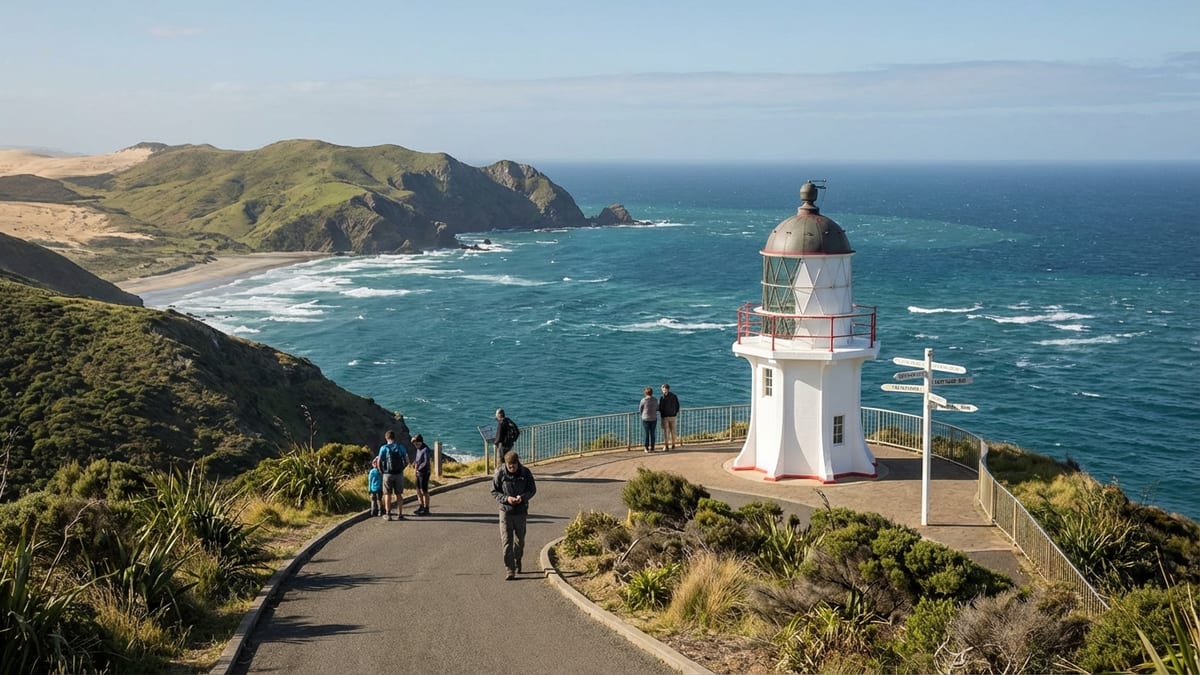
Northland’s far north feels like the edge of the world, a place where highways taper into sand, ancient dunes glow gold and two great oceans collide. From the Bay of Islands, a day trip to Cape Reinga and its surrounding highlights is one of the most memorable excursions you can make in New Zealand. With careful planning, you can leave Paihia or Russell before dawn and be back in time for dinner having stood at Te Rerenga Wairua, raced down the Te Paki sand dunes, and watched the sun drop over Ninety Mile Beach.
Why Cape Reinga Belongs on Your Bay of Islands Itinerary
The Bay of Islands is renowned for its sheltered coves and maritime history, but the road north from Paihia opens up a very different face of Northland. Within a single long day you can move from polished resort town to remote peninsula, where service stations thin out, mobile reception flickers and sky, sea and sand seem to swallow the horizon. For many visitors this contrast is precisely the appeal. Cape Reinga is not simply another lookout; it is a journey into a wilder, spiritually resonant region that feels worlds away from the yacht-filled bays you left that morning.
Cape Reinga itself is one of New Zealand’s iconic viewpoints. A compact white lighthouse stands above cliffs that plunge down to swirling water, where the Tasman Sea and the Pacific Ocean meet in visible lines of turbulence and shifting colour. The headland is both accessible and dramatic. A sealed walking path from the car park makes the site manageable for most visitors, yet the exposure to wind and weather preserves its raw edge. On a calm, clear day the headland can appear serene, but in strong winds the cape delivers the sense that you are indeed at the very tip of the country.
Adding Cape Reinga to a Bay of Islands stay also gives context to Northland as a whole. In one sweep you experience sheltered east-coast inlets, the more rugged west coast around Ninety Mile Beach and the dune landscapes of the Aupouri Peninsula. Rather than treating the Bay of Islands as an isolated pocket, this day trip frames it as one stop in a larger story that runs from ancient kauri forests to the “long beach of Tōhē.”
Planning Your Day: Routes, Timing and Tours
From Paihia or Kerikeri, the road to Cape Reinga is straightforward but long. Most itineraries follow State Highway 10 or State Highway 1 north to Kaitaia then continue along State Highway 1 up the spine of the Aupouri Peninsula. Without detours the drive from Paihia to Cape Reinga typically takes around three hours and thirty minutes to four hours each way, not accounting for comfort stops or photo breaks. That makes for a very full day behind the wheel if you are driving independently, especially if you also plan to walk at the cape and visit the Te Paki sand dunes.
Because of the distance and the unique driving conditions on the western beaches, many visitors opt for a guided coach tour from the Bay of Islands. These day trips generally depart Paihia early in the morning, travel north via Kaitaia and then return partly along Te Oneroa a Tōhē / Ninety Mile Beach, which is legally classified as a highway. Touring companies use specially equipped coaches and drivers who are familiar with the tides and soft sand; self-drive rental contracts commonly prohibit taking standard vehicles onto the beach, and for good reason. A tour removes those risks and allows you to relax and watch the landscape unfold.
Organised day trips typically include a stop at the Te Paki sand dunes for sandboarding, time at the lighthouse and signpost at Cape Reinga, photo stops along the peninsula and a beach or café break for lunch. Expect a ten to twelve hour round trip door to door from Paihia. If you are hiring a car and prefer to explore independently, building in an overnight stop somewhere in the Far North, such as Kaitaia or Ahipara, can make the journey more manageable and allows room for detours to lesser-known bays or short walks.
Whatever your transport choice, pay attention to fuel and provisions. Once you leave the larger towns, fuel stations become infrequent and there are no services at Cape Reinga itself beyond toilets and basic information panels. In the height of the southern summer from late December through February, traffic along the peninsula increases significantly, while in winter the days are shorter and conditions can be windy, wet and cool. Checking the weather forecast before you commit to the drive is essential, as visibility and sea conditions are a major part of the experience.
Cultural Significance: Te Rerenga Wairua at the Edge of Aotearoa
Cape Reinga is not just the geographic northern tip of the New Zealand road network; it is one of the most spiritually important sites in Aotearoa. In te ao Māori, the Māori world, this headland is known as Te Rerenga Wairua, often translated as “the leaping place of spirits.” According to tradition, it is here that the spirits of the dead begin their final journey, descending the roots of a lone pōhutukawa tree clinging to the cliffs and then travelling north to Hawaiki, the ancestral homeland. This belief gives the cape a solemn, reflective atmosphere that sits alongside its touristic appeal.
Visitors are welcomed to experience the landscape but are asked to respect its tapu, or sacred, status. Current guidance from the Department of Conservation and iwi guardians requests that people do not eat food at the lighthouse precinct or on the immediate headland around it. Drinking water is acceptable, but picnics are better taken at nearby beaches such as Tapotupotu Bay or Sandy Bay. It is also considered inappropriate to scatter ashes at Cape Reinga. For many families it is a place to remember loved ones, but formal farewells are better conducted at other sites.
Simple behaviour choices can help preserve the mana of the place. Keep noise levels low, avoid playing music through speakers and stay on the formed paths and viewing platforms. Drones are discouraged, partly for safety and partly because their presence can intrude on others’ quiet reflection. There are interpretive panels near the lighthouse that explain aspects of Māori cosmology, the meeting of the seas and the history of the Cape Reinga lighthouse itself. Taking time to read these helps frame the view in cultural and historical terms, rather than seeing it purely as a scenic backdrop.
For travellers who have spent most of their time in New Zealand focused on adventure activities or coastal scenery, Te Rerenga Wairua offers a chance to engage with deeper layers of narrative. Standing on the headland, with the wind pressing against you and the converging currents below, it is easy to understand why this remote tip has held such significance for centuries. Treating the visit as both a highlight and a moment of contemplation adds depth to your journey through Northland.
Experiencing the Cape: Lighthouse Walks and Short Trails
The most approachable way to experience Cape Reinga is the lighthouse walk. From the main car park at the end of Cape Reinga Road, a sealed path winds down along a ridgeline toward the white lighthouse, taking around ten to fifteen minutes each way for most visitors. The gradient is gentle but consistent, and while the track is designed to be accessible, some wheelchair users may find the steeper sections challenging. Families with pushchairs and those with limited mobility generally find the path manageable if they allow time for rests on the return uphill section.
Along the route, viewpoints open up to both sides of the peninsula. On one side you can see back toward Te Werahi Beach and the Te Paki coastal dunes; on the other, steep headlands drop to rocky inlets and deep blue water. In calm weather the meeting line of the Tasman Sea and the Pacific Ocean may appear as subtle patterns in the waves, while on rougher days it can stand out as a more dramatic clash of swells. At the end of the path, the lighthouse and its famous direction-signpost sit on a small terrace, offering 270-degree views and plenty of photo opportunities.
For visitors with extra time and energy, the surrounding Te Paki Coastal Track offers further short sections that can be walked as day hikes. A popular option is the short side track from the lighthouse area down toward Te Werahi Beach, which provides a different perspective looking back to the cape. Another rewarding half-day walk connects Tapotupotu Bay, a lovely, often sheltered beach to the east, with Cape Reinga itself. This five-kilometre one-way section involves some steep climbs and descents and is suitable for those with moderate fitness who are comfortable on occasionally muddy or uneven surfaces.
If you choose to walk any of these longer sections, plan carefully around tide times, particularly at Sandy Bay, where parts of the route can be affected by high water. Good footwear, windproof layers and sun protection are vital in all seasons, as the cape is very exposed and weather can shift quickly. Even on apparently settled days, strong gusts can sweep across the headland. Keeping a respectful distance from cliff edges and supervising children closely is essential, especially when winds are high.
Te Oneroa a Tōhē / Ninety Mile Beach and Te Paki Sand Dunes
No day trip from the Bay of Islands to the Far North would feel complete without at least glimpsing Te Oneroa a Tōhē, commonly known as Ninety Mile Beach. Stretching for around 88 kilometres along the western coast of the Aupouri Peninsula, this broad sweep of firm sand has long been used as an informal highway for local traffic and, more recently, as a playground for surf casters, shellfish gatherers and sandboarding day trippers. On fine days the beach can seem almost endless, the line of white surf merging with heat shimmer in the distance.
Coach tours from the Bay of Islands often use a combination of sealed roads and the beach itself to complete a loop around the peninsula. This allows you to experience the surreal sensation of driving parallel to the Tasman Sea with no marked lanes and only tyre tracks to follow. At low tide the sand can be as firm as a paved road in many sections, but hidden streams, soft patches and rapidly shifting conditions mean this is not a place for casual self-drive experiments, especially in standard rental vehicles. Visitors are strongly advised to respect any prohibitions in hire agreements and to let trained local drivers handle the beach sections.
Near the northern end of Ninety Mile Beach lie the Te Paki sand dunes, one of Northland’s most distinctive landscapes. Rising in draped ridges above Te Paki Stream, the dunes form a kind of coastal desert where visitors can hire sandboards and launch themselves down steep faces into soft sand. The activity is simple, high-energy fun and usually included as a stop on Cape Reinga day tours. For photographers and more contemplative travellers, climbing higher onto the dunes reveals sweeping views back toward the coast and inland across sculpted ridgelines.
Conditions at the dunes can be intense, particularly on sunny afternoons. The sand heats quickly, making bare feet uncomfortable, and strong winds can drive grains into eyes and camera lenses. Sunglasses, a hat and a buff or scarf can make the experience far more pleasant. The stream that runs along the base of the dunes, which vehicles often use as an access corridor, can also rise or alter its path after heavy rain. If you are exploring independently, avoid driving in unfamiliar water channels and follow local advice, or simply leave the vehicle in the designated car park and explore on foot.
Other Northland Highlights to Pair with Cape Reinga
While Cape Reinga, Ninety Mile Beach and the Te Paki dunes form the classic Far North triangle, Northland offers several additional stops that can enrich your journey either on the way up from the Bay of Islands or on the return. Kaitaia serves as the main service town for the region and is a useful base for fuel, supplies and information. From here, short detours lead to quieter west-coast settlements such as Ahipara, which sits at the southern end of Ninety Mile Beach and has a relaxed, surf-town feel, or east-coast bays such as Doubtless Bay with its sheltered, golden-sand beaches.
Closer to the Bay of Islands, you may choose to combine a Far North day trip with a separate outing to the kauri forests of Waipoua or the arts and café scene of Kerikeri. These are better treated as stand-alone day trips rather than squeezed into the same day as Cape Reinga, but together they help round out an understanding of Northland’s varied landscapes and communities. If time allows, some visitors structure a loop over several days, heading from Auckland to the Bay of Islands, up to Cape Reinga, down the west coast through forest and beach country, then back to Auckland.
For those interested in walking, the Te Paki Coastal Track offers multi-day options that link several of the areas you glimpse on a day trip. This 48-kilometre track can be walked in sections and combines headland views, dune landscapes and remote beaches. While beyond the scope of most Bay of Islands visitors on a tight schedule, it is worth knowing that the headland around Cape Reinga is part of a larger network of trails and campsites that reward more extended exploration.
Wildlife enthusiasts should keep an eye out for seabirds along the cape and shorebirds feeding at the water’s edge on Ninety Mile Beach. While you are unlikely to see larger marine mammals on a single day trip, the nutrient-rich waters where the currents meet support a rich food chain. In the Bay of Islands itself, separate marine cruises focus on dolphins and other marine life, making a pleasing counterpoint to the more land-focused Far North excursion.
Practical Tips: Safety, Seasons and Respectful Travel
Travel in the Far North rewards preparation. The climate is generally mild, with warm summers and cool but rarely harsh winters, yet the combination of strong sun, high humidity and exposed terrain can catch visitors off guard. In summer, daytime highs commonly reach the mid to high twenties Celsius, and ultraviolet levels are intense even under light cloud. Sunscreen, a wide-brimmed hat and light, long-sleeved clothing are more than optional extras. Carry more water than you think you will need, particularly if your day includes walking at the cape and climbing on the Te Paki dunes.
From a safety perspective, road conditions along State Highway 1 north of Kaitaia are typically good, but the route is two-lane and can be narrow and winding in parts. Fatigue is a real risk on a long out-and-back drive. Sharing the driving, planning regular rest stops and avoiding late-night returns after a full day in the elements all contribute to a more comfortable experience. If you join a coach tour, expect early departures and late returns and plan a low-key evening afterwards in the Bay of Islands rather than more activities.
Beach and dune environments bring their own considerations. Tides and weather can change rapidly, turning previously safe stretches of sand or stream crossings into hazards for vehicles. Even when traveling with an experienced driver, remain aware of your surroundings and follow instructions about where to walk or stand. At the dunes, collisions between descending sandboarders and those climbing up can occur if people cut across paths, so it helps to follow any guidance given by local operators and be patient when waiting for your turn on the steeper slopes.
Respectful travel in this part of Aotearoa also means being mindful of local communities and their relationship with the land and sea. Simple steps include disposing of rubbish properly, using public toilets rather than dunes or roadside lay-bys, and treating sacred sites like Te Rerenga Wairua with the same care you would offer in a church or memorial park. If you are unsure of appropriate behaviour, look for information panels or ask local guides. Many Far North residents are happy to share knowledge when approached with courtesy.
The Takeaway
A day trip from the Bay of Islands to Cape Reinga and the Northland far north is as much about the journey as the destination. Over the course of ten or twelve hours you transition from sheltered harbours to remote peninsulas, watching the landscape simplify into its elemental components of sand, sea and sky. You stand at one of New Zealand’s most significant cultural sites, feel the full force of wind and weather at the convergence of two great oceans and, perhaps, race laughing down a dune on a sandboard.
For travellers willing to embrace an early start and a long day, the experience adds a sense of scale and depth to a Northland itinerary. The Bay of Islands remains a highlight for its calm waters and historical narratives, but it is in the wide-open spaces of Te Oneroa a Tōhē and on the headland of Te Rerenga Wairua that you feel the country stretching northward into the Pacific. Whether you make the journey by coach tour or careful self-drive, the memories forged at the top of Aotearoa will linger long after the salt has been rinsed from your hair.
FAQ
Q1. How long does a day trip from the Bay of Islands to Cape Reinga take?
Most organised coach tours from Paihia or Kerikeri run for about ten to twelve hours in total, including transport, sightseeing stops and meal breaks. If you are driving independently, expect around seven to eight hours of driving time plus additional time for walks at Cape Reinga, visiting the Te Paki sand dunes and stops along the way.
Q2. Is it realistic to drive from Paihia to Cape Reinga and back in one day?
It is possible but demanding. The return drive alone typically takes seven to eight hours, and adding sightseeing can push the day into ten or more hours on the road. If you are comfortable with long drives and start early, it can work, but many visitors find a guided tour or breaking the journey with an overnight stop in the Far North more relaxing.
Q3. Can I drive my rental car on Ninety Mile Beach?
In most cases no. Many rental car companies in New Zealand explicitly prohibit driving on beaches, including Te Oneroa a Tōhē / Ninety Mile Beach, because of risks from soft sand, tides and hidden streams. Violating this condition can void insurance coverage. If you want to experience driving on the beach, the safest option is to join a coach tour using specially equipped vehicles and experienced local drivers.
Q4. Do I need to book a tour in advance from the Bay of Islands?
Advance booking is strongly recommended, especially during the peak summer season from late December through February and around public holidays. Tours can fill quickly during these periods. In shoulder seasons there may be more flexibility, but reserving at least a few days ahead still gives you the best chance of securing your preferred date and departure time.
Q5. What should I wear and bring for a Cape Reinga day trip?
Comfortable walking shoes, layered clothing, a windproof jacket and sun protection are essential. Even on warm days the cape can be windy and exposed, while the Te Paki sand dunes can be very hot underfoot. Bring a hat, sunglasses, sunscreen, refillable water bottle and, if you plan to sandboard, clothing you do not mind getting sandy. Packing snacks is also wise, as options can be limited once you leave the main towns.
Q6. Is the walk to the Cape Reinga lighthouse suitable for children and older adults?
Yes, the main track from the car park to the lighthouse is sealed, relatively wide and designed to be accessible for most visitors. It takes about ten to fifteen minutes each way with a steady but manageable gradient. Children generally enjoy the walk, but supervision is important near viewing areas, and some older adults may appreciate taking the uphill return section slowly with rest breaks.
Q7. Are there food and toilet facilities at Cape Reinga and the dunes?
There are public toilets at the Cape Reinga car park and near the start of the lighthouse track. There are no cafés or shops at the cape itself, so you should bring your own snacks or meals or plan to eat in towns such as Kaitaia. At the Te Paki sand dunes there are typically only basic facilities and seasonal equipment rental; food options are limited, so carrying water and snacks is important.
Q8. When is the best time of year to visit Cape Reinga?
Cape Reinga can be visited year-round. Summer from December to February offers warm temperatures and long daylight hours but also draws the largest crowds, particularly in late December and January. Spring and autumn can provide more moderate temperatures and fewer visitors. Winter days are shorter and can be windy and wet, yet the cape has a dramatic beauty in stormy conditions if you are well prepared.
Q9. How can I visit respectfully, given the cultural importance of Te Rerenga Wairua?
Respectful behaviour includes keeping voices low, staying on designated paths and viewing platforms, not eating around the lighthouse area, and refraining from scattering ashes at the cape. Treat interpretive panels and any guidance from local iwi or rangers as your primary reference and follow requests regarding drones, pets and rubbish. Approaching the site as a place of spiritual significance as well as scenic interest helps ensure it remains special for future visitors and local communities alike.
Q10. Can I combine a Bay of Islands cruise with a Cape Reinga day trip?
Not comfortably in the same day. Bay of Islands cruises and marine activities usually occupy several hours and often depart mid-morning, while a Cape Reinga excursion requires an early start and a full day. A more practical approach is to dedicate one day to exploring on the water around the Bay of Islands and a separate full day for the overland trip to Cape Reinga and the Far North highlights.