


More news on this day
Amsterdam’s Schiphol Airport is grappling with fresh disruption after a sweeping overhaul of its security contracting triggered long queues, missed flights and renewed concern over staffing and passenger safety.
Get the latest news straight to your inbox!
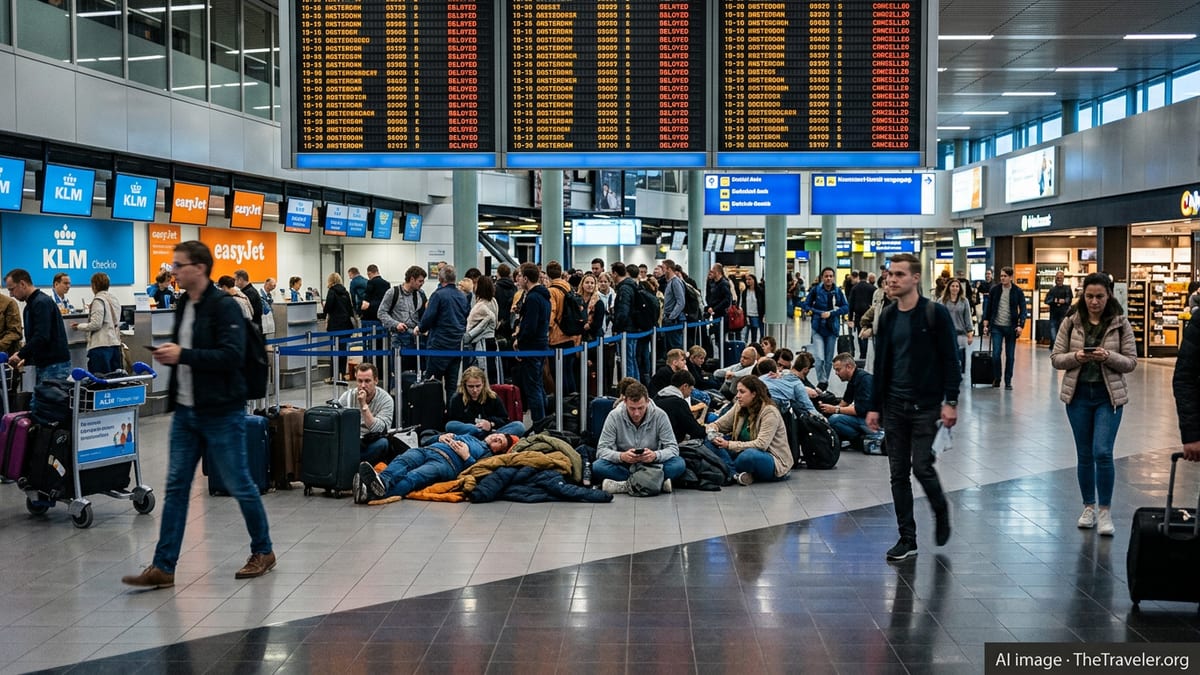
New security model stumbles on first major test
The turbulence follows Schiphol’s move this week to a new security structure that consolidates operations from five private contractors to three, with the airport taking a minority stake in the new companies. The reorganization, which took effect on Monday 18 May, was meant to give the hub greater control over its checkpoints after the headline-grabbing queues of summer 2022.
Instead, the rollout has been marked by extensive delays. According to Dutch media coverage, hundreds of passengers missed flights on Monday as queues at several departure halls stretched far beyond the check in areas, with waiting times spilling over normal buffer periods. Reports indicate that issues at the passenger screening points cascaded through the rest of the operation, affecting boarding and baggage handling.
Publicly available information shows that Schiphol has described the first day of the new regime as a difficult start, highlighting a combination of unexpected understaffing and technical problems in the early morning. Those disruptions reportedly left security lines struggling to recover through the rest of the day, despite efforts to increase staffing and keep more lanes open.
As operations continued into Tuesday 19 May, airport information channels continued to warn travelers of potentially long queues at security and urged passengers to arrive well ahead of departure for both European and intercontinental flights.
Thousands of security staff on the move
At the heart of the shake-up is a mass transfer of personnel. Around 4,000 of Schiphol’s roughly 5,000 security employees are changing employers under a 10 year, multi billion euro contract package intended to stabilize service levels and avoid repeated tender cycles. The change is one of the largest reorganizations of frontline staff in the airport’s recent history.
Under the new model, three firms take over passenger and hand luggage checks across the terminals, replacing a patchwork of five providers. The airport has argued in previous public documents that reducing the number of companies should create clearer lines of responsibility, more consistent working methods and better long term planning.
However, accounts from unions and workers collected in recent weeks point to deep unease on the ground. Survey data published by trade union FNV indicates that a large majority of security staff fear higher workloads and question whether there are enough colleagues to handle peak periods safely. Some respondents also raised concerns about roster changes and the risk of staff resignations if schedules become less predictable.
Analysts note that such large scale personnel transfers can be operationally fragile, particularly in environments where screening staff require specialized training and certifications. Even minor mismatches between planned and actual staffing levels, or delays in system access for transferred employees, can quickly translate into longer passenger queues.
Old problems resurface despite costly overhaul
The current disruption has revived memories of the 2022 crisis, when chronic security shortages produced queues stretching outside terminal buildings, forcing cancellations and capacity caps during the busy summer season. That episode prompted a series of reviews and a commitment by Schiphol and its partners to redesign how security is contracted and managed.
The latest contractor overhaul, reportedly worth around 6 billion euros over its 10 year lifespan, was framed as the structural answer to those earlier failings. By taking an ownership stake in the new security companies, Schiphol aimed to align incentives more closely with airport performance and to encourage long term investment in training and retention.
Early indications suggest that the promise of a smoother experience has yet to materialize. Coverage in Dutch and international aviation media describes scenes of confusion at checkpoints, where passengers struggled to understand queue layouts and staff grappled with new procedures and equipment configurations. While the airport has emphasized that sufficient staff were scheduled for the expected passenger numbers, the combination of IT issues and local understaffing at key points appears to have undercut those plans.
Observers point out that the timing of the transition, shortly after the busy May holiday period and ahead of the peak summer season, leaves little margin for extended teething problems. Persistent disruption in the coming weeks could undermine traveler confidence and airline schedules at one of Europe’s key transfer hubs.
Unions renew call for in-house security workforce
The rocky start has strengthened calls from labor groups for Schiphol to abandon the outsourcing model altogether. In statements published in recent days, FNV has argued that the airport should directly employ its security staff instead of relying on private contractors that change with each tender cycle.
Union representatives contend that repeated contract changes erode job security and make the sector less attractive, contributing to chronic understaffing. They also warn that transitional periods, such as the current shift between providers, are inherently risky times when experience can be lost and operational knowledge diluted.
Other unions have highlighted broader concerns about working conditions at the airport, citing sustained high workloads and frequent tension with frustrated passengers as factors that make it difficult to retain experienced staff. Against this backdrop, the current chaos is portrayed by labor groups as a symptom of deeper structural issues in how Schiphol organizes and finances its frontline operations.
Industry commentators note that Schiphol is not alone in facing these challenges. Large hub airports across Europe and beyond have struggled since the pandemic to rebuild security teams amid tight labor markets and rising wage expectations, making any major organizational change particularly sensitive.
Passengers advised to build in extra time
For travelers, the immediate impact is measured in hours spent in line and the risk of missed connections. Airport communications channels currently advise passengers to arrive significantly earlier than usual, especially during morning and late afternoon peaks when security demand is highest.
Travel and aviation outlets report that some airlines have begun proactively warning customers about potential disruption at Schiphol and recommending extended check in windows. Travel agents and online forums are also circulating practical advice, including using early time slots, traveling with carry on only where possible, and monitoring flight status closely on the day of departure.
While there are tentative signs that waiting times eased somewhat after the worst of Monday’s disruption, reports indicate that the situation remains fragile. Any additional strain, such as bad weather or technical failures elsewhere in the airport system, could quickly reignite the long lines seen at the start of the week.
How quickly Schiphol and its new security partners can stabilize operations will be closely watched by airlines, regulators and passengers across Europe. The contractor shake-up was designed to consign the chaos of 2022 to history; for now, it appears to have brought many of the same problems back into sharp focus.