


I arrived in Adjuntas just after eight on a bright, cool morning, the kind of mountain light that makes the painted balconies and tiled roofs around the plaza look newly washed. A few steps uphill from the central square, I found Casa Pueblo in a restored criollo house, its wooden shutters open, a sun emblem painted near the doorway. I had come to learn how this small organization had helped turn a coffee town into a laboratory for community forests and solar power, but what I discovered inside went much deeper than technology or tourism.
Get the latest updates straight to your inbox!
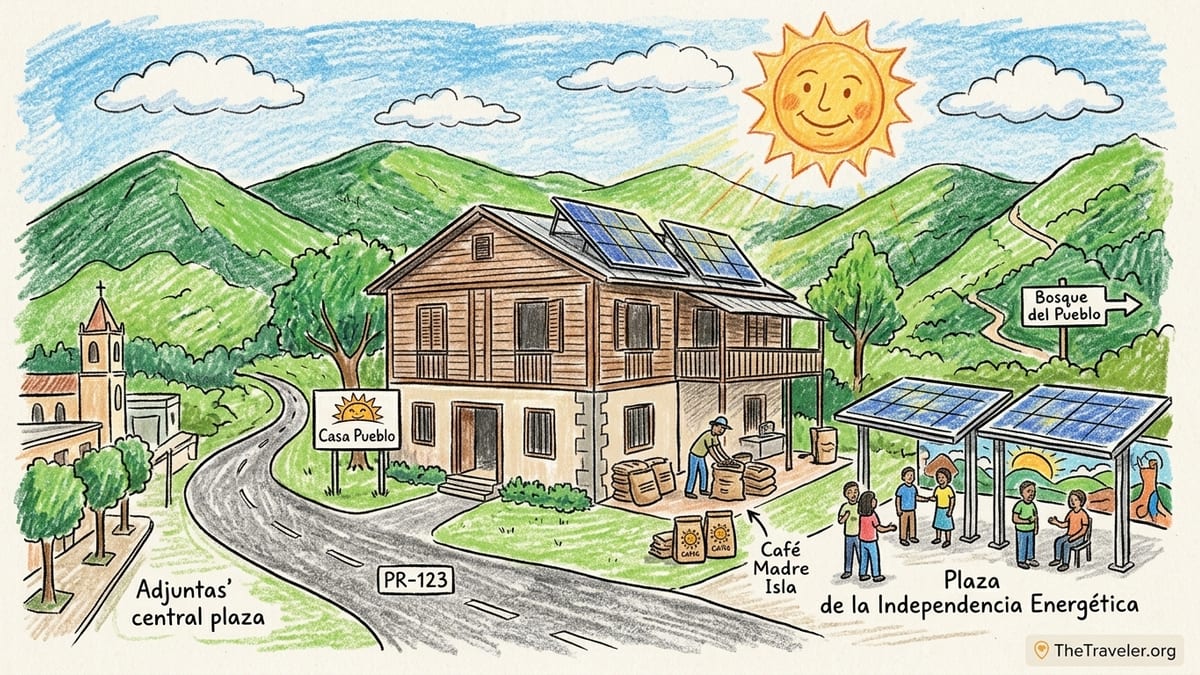
Arriving At A Historic House That Runs On Sunlight
Casa Pueblo’s main center sits just off Adjuntas’ central plaza, in a traditional two-story wooden and masonry house that looks, at first glance, like any other historic family home. A small sign with their sun logo and the words “Casa Pueblo” marks the entrance on PR‑123, only a few minutes’ walk from the church and town square. When I visited in October 2026, the front gate was open shortly after 8:30 a.m., in line with the posted hours of roughly 8:30 a.m. to 3:00 p.m. every day. Inside the foyer, a volunteer greeted me in Spanish, then easily switched to English when I hesitated over a verb tense.
There is no fixed admission fee to enter the center. Instead, a donations box sits on a small wooden table near the door, with a printed note explaining that visitor contributions help maintain the house, radio station and educational programs. When I asked what was customary, the volunteer mentioned that many independent travelers leave around two to five dollars per person. I dropped five dollars in cash into the box, signed the visitor book and asked whether any interpretive visit was scheduled that morning.
Because Casa Pueblo’s staff are a mix of core organizers and local volunteers, activities vary by day. On my visit, a short guided orientation was about to begin, led by a young woman from Adjuntas who introduced herself simply as Andrea. She explained that Casa Pueblo prefers small, conversational visits rather than scripted tours and invited me to follow her through the house. “We started as an art and culture workshop,” she said as we stepped into a high‑ceilinged hallway, “but the struggle to protect this mountain, and to keep the lights on for our people, took us further than we ever imagined.”
Only once I was standing under the wooden beams, the smell of roasted coffee drifting in from the back, did it fully sink in that this was both a museum and a working headquarters. Radios crackled from a studio on one side, a child walked past carrying laminated butterfly posters, and through a back window I could see solar panels tilted toward the morning sun.
Inside The Exhibitions: Birds, Memory And A Solar‑Powered House
Our first stop was a gallery space that Casa Pueblo currently dedicates to an exhibition on Puerto Rico’s endemic birds. On the wall, a panel described “Aves de Puerto Rico: Endemismo, territorio y memoria,” a collective show that brings together works from multiple local artists focused on the island’s 19 endemic species. Andrea pointed out a vivid painting of a Puerto Rican tody, almost fluorescent green, perched on a coffee branch. Next to it, a linocut of the Puerto Rican parrot was printed over a map of mining concessions that once threatened Adjuntas’ mountains. “For us, birds are sentinels,” she said. “If the forest is sick, they disappear first.”
The exhibition is not large, but the layering of art and environmental history creates a powerful narrative. Labels reference decades of resistance to open‑pit mining projects, and one corner is devoted to the story of Bosque del Pueblo, the former mining area that became a community forest under Casa Pueblo’s stewardship. A series of before‑and‑after photographs show denuded hillsides slowly returning to green. A timeline on the wall traces their journey from local protests to the passage of legislation that blocked large‑scale mining in the region.
As we moved deeper into the house, the spaces became more intimate. One room functions as a small museum of domestic life, with antique radios, wooden furniture and framed black‑and‑white photos of community assemblies and cultural workshops from the 1980s and 1990s. Across the hallway, a compact library is lined with shelves of books about forestry, energy policy, Puerto Rican history and environmental law. A handwritten sign by the door explains that locals can use the reading room freely, while visitors are welcome to browse respectfully as long as they do not remove materials.
In the middle of this historic interior, the presence of solar power is quietly evident rather than aggressively displayed. A monitor in one corridor shows the building’s current energy production and consumption, a simple bar graph that, on the sunny morning of my visit, showed generation comfortably exceeding use. LED lights, efficient appliances and carefully shaded windows all help, but it was still striking to realize that the entire building, including the radio station and small cinema room, runs primarily on rooftop solar panels rather than the central grid.
Café Madre Isla And The Taste Of Energy Independence
The smell that had greeted me at the entrance turned out to come from the back of the house, where Casa Pueblo operates its Café Madre Isla project. This is not a typical café with tables, but rather a roasting, grinding and packaging space connected to the artisan shop. On a metal shelf, neatly stacked brown bags of whole‑bean and ground coffee wore the Madre Isla label, featuring the sun motif I had seen at the door, this time rising behind the silhouette of the central mountains.
I asked another volunteer, Luis, about the coffee’s origins. He explained that Café Madre Isla sources beans from small growers in the Adjuntas area who adopt practices that Casa Pueblo considers environmentally and socially responsible. The idea, he said, is to keep more of the value of coffee in the community instead of sending green beans to distant corporations. On the wall, a poster mapped some of the farms that participate in the project, each one marked with its elevation and a short note about shade trees or agroforestry systems.
On the day of my visit they were selling 8‑ounce bags of roasted coffee for a price in the range of specialty coffees on the island, with larger 12‑ounce or 1‑pound bags also available. I bought a medium‑roast whole‑bean bag for just under ten dollars, paid in cash and watched as Luis stamped the roasting date on the back. “When Hurricane Maria hit,” he told me as he handed over my change, “it wasn’t only the electricity that we lost. Many farmers lost their harvests and even their trees. Projects like this are a way of saying we won’t abandon the countryside.”
Next to the coffee shelves, glass cabinets display locally made crafts: hand‑carved wooden birds, small paintings of Adjuntas landscapes, jewelry made with native seeds, and a line of natural soaps scented with citrus and herbs. The prices are clearly marked and, as staff reminded me, proceeds support both the artisans and Casa Pueblo’s community programs. It would be easy to treat this as just another tourist gift shop, but the context makes purchases feel closer to a direct investment in a specific territory and set of ideas.
Conversations About Hurricane Maria And The Need For Community Solar
The most candid part of my visit happened not in a formal exhibition, but sitting on a simple wooden bench near the back patio, under the partial shade of a breadfruit tree. When I asked Andrea how Hurricane Maria had changed Casa Pueblo, she answered without hesitation. “Maria did not change our mission,” she said. “It revealed why we had been preparing for years.”
Before the hurricane struck Puerto Rico in September 2017, Casa Pueblo had already installed solar panels on its roof and gradually reduced its reliance on the centralized grid. When the storm knocked out power to virtually the entire island, much of Adjuntas spent months without reliable electricity. Casa Pueblo, however, remained lit. Staff told me that in the immediate aftermath they opened their doors as a community energy hub: neighbors came to refrigerate medicine, charge phones, power small medical devices and simply sit for a few hours in light and relative cool.
Luis described how people lined up on the sidewalk with extension cords and power strips. “We had radios running to share information,” he said, “and we set up solar lamps and small panels in other parts of town. It was chaotic, but it showed that having even a modest local system can make a huge difference when the big infrastructure fails.” Over time, Casa Pueblo expanded those initial emergency measures into more structured projects: solar systems for small businesses, community centers and critical services in Adjuntas and nearby communities.
Listening to their stories, it became clear that for Casa Pueblo, renewable energy is not only about carbon emissions or technology; it is about power in the broader sense. Andrea put it bluntly: “If all the energy decisions are made far away, and all the money goes to imported fuel, then rural towns like ours are always at the mercy of someone else’s priorities. Solar on the roofs, owned by the people who live under them, begins to change that.” For a visitor used to thinking of solar panels as discrete, private investments, this broader social framing felt like a quiet reframing of what resilience means.
Plaza de la Independencia Energética: Public Art, Solar Power And Gathering
After finishing the indoor visit, I walked a short distance back toward the central square to see Plaza de la Independencia Energética, a public space that Casa Pueblo helped create as a physical expression of Adjuntas’ energy transition. Located just off the main plaza, this small but striking space combines solar technology, public art and everyday life. Rather than an enclosed museum, it is an open plaza where people sit, children play and solar panels quietly work overhead.
The most visible features are a series of solar canopies whose metal frames have been integrated with murals and sculptural elements. On the day I visited, a group of teenagers were clustered under one canopy, using the shade and a set of public charging outlets attached to a pillar. A plaque explained that the plaza’s solar installation supplies electricity to surrounding community facilities and reduces dependence on the central grid, especially during outages. Importantly, the explanatory text focuses less on kilowatts and more on the idea of “energía propia,” or “our own energy,” describing how decisions about placement, design and use were made through community meetings.
Nearby, a wall is covered with a bright mural that merges images of sunflowers, solar panels and coffee pickers. At one corner, a painted transmission tower dissolves into a tree whose roots encircle the silhouettes of local residents. A grandmother sitting on a bench told me she comes here in the afternoons to watch her grandchildren while she chats with neighbors. “This is not just about the panels,” she said. “It is about having a place that tells our story, where we can see that story every day.”
What struck me most about the plaza was how unceremonious it felt. There were no turnstiles or ticket counters, no sense that I was crossing into a separate, curated attraction. Instead, solar infrastructure, art and social life blended into a single space. Seeing schoolchildren eating snacks under panels that power parts of their town offered a very different image of technology than the sterile showrooms where many travelers first encounter renewable energy.
Understanding Bosque del Pueblo And Bosque Escuela La Olimpia
Casa Pueblo’s work extends far beyond the town center into the surrounding mountains, but accessing those landscapes as a visitor requires some planning. During my time in Adjuntas I made advance arrangements, several days before arriving, to join an educational visit linked to Bosque del Pueblo. Staff emphasized by phone that visits to this community forest are not open, unregulated hikes. Instead, they coordinate small groups for specific days, depending on guides’ availability and environmental conditions. They also clarified that Bosque del Pueblo and Bosque Escuela Olimpia Ariel Massol Deyá, often simply called Bosque Escuela La Olimpia, are two distinct spaces with different access rules.
Bosque del Pueblo is the forest that emerged from the struggle against open‑pit mining, a mix of secondary growth, waterways and reforested areas where Casa Pueblo developed interpretive trails and educational sites. Bosque Escuela La Olimpia, in contrast, functions as an outdoor classroom and camping area tailored to school groups, families and community activities. Casa Pueblo uses an online reservation system and telephone coordination for certain programs in La Olimpia, including day visits and overnight camping on Cerro Mágico, but again they ask visitors to arrange everything in advance instead of showing up unannounced with hiking boots and a selfie stick.
In the end, heavy rain the night before my planned Bosque del Pueblo visit triggered a change of plans. Casa Pueblo staff contacted our small group early that morning to explain that trail conditions in Bosque del Pueblo were too muddy and potentially unsafe, particularly on steep sections. They offered an alternative shortened walk at Bosque Escuela La Olimpia, which I accepted, but because this was a different site with its own educational focus, I chose not to present it as a stand‑in for Bosque del Pueblo. The story of how the forest was saved is well told in Casa Pueblo’s indoor exhibits and publications, but I cannot claim firsthand experience of walking those particular trails on this trip.
What I can report is that staff are serious about safety, conservation and respect for community management. They clearly distinguish between the protected forest and the educational campus, and they expect visitors to do the same. If you want to walk in Bosque del Pueblo specifically, you should coordinate by phone with enough lead time, remain flexible in case of weather changes and understand that the forest is managed primarily as a community conservation area, not as a high‑volume recreational park.
A Morning In Bosque Escuela La Olimpia
The alternative visit to Bosque Escuela La Olimpia started at a trailhead about a 20‑minute drive from downtown Adjuntas. I reached it in my rental car following directions provided by Casa Pueblo, winding past coffee farms and small houses until the pavement narrowed and the tree canopy closed in overhead. At a simple wooden gate, a staff member checked my name against a reservation list, collected a modest fee for the educational activity and offered a printed map along with a QR code for a self‑guided audio tour voiced by a well‑known Puerto Rican broadcaster.
The first section of the trail was a wide dirt path, reasonably even and accessible for anyone with good balance and basic fitness. Interpretive signs highlighted the forest’s role in capturing water, stabilizing soils and supporting bird and insect life. We stopped at a small clearing where young trees had been planted in memory of activists and community members who contributed to Casa Pueblo’s work. Here our guide, a soft‑spoken forestry technician, described how the area had once been degraded pasture and how careful planting, assisted natural regeneration and limits on vehicle access had allowed the canopy to close again.
As we continued, the path narrowed and became steeper, with exposed roots and occasional slippery patches from the previous night’s rain. This section would be challenging for travelers with reduced mobility or knee problems, and Casa Pueblo acknowledges those limits when describing the trails. At one bend we paused to listen: the guide pointed out the call of a Puerto Rican tanager and, further off, the harsher cry of a hawk. A pair of butterflies fluttered over a patch of wildflowers, landing briefly on a sign that explained the role of pollinators in coffee production and forest health.
By the time we reached a viewpoint known locally as Pico Libertad on another day hike option, the clouds had begun to lift, revealing ridges layered in shades of blue and green. Even on this shorter walk, the contrast with the urban energy hub in town was striking. In Adjuntas’ plaza, solar panels and murals spoke of human agency; here, what I felt most strongly was the patience of trees reclaiming slopes once destined for industrial extraction. The guide’s emphasis on community decisions, local governance and the forest’s legal status as a space co‑managed with public authorities echoed everything I had heard earlier in the Casa Pueblo house.
Accessibility, Atmosphere And How The Reality Matched My Expectations
Going into this visit, I half expected Casa Pueblo to feel like a conventional environmental center: earnest, worthy and perhaps a little didactic. Instead, the atmosphere in the house was more like that of a family home filled with books, art, tools and people constantly coming and going. Children wandered through on their way to workshops, elderly neighbors stopped in to chat with staff, and a couple from San Juan arrived just to buy coffee for relatives abroad. The line between visitor and participant felt unusually thin; within an hour, I was no longer just observing but carrying a box of brochures from one room to another at Andrea’s request.
In practical terms, the main center is accessible to a broad range of visitors. The entrance involves only a small step up from the sidewalk, and the primary exhibition rooms, shop and library are all located on the ground floor. Hallways are somewhat narrow, as you would expect in a historic house, but I saw one visitor with a compact wheelchair navigating the spaces with assistance from a companion. Restrooms are available for visitors, and while they are not purpose‑built accessible facilities, staff do their best to accommodate needs when informed in advance.
Outdoors, both Plaza de la Independencia Energética and Bosque Escuela La Olimpia require more mobility. The plaza itself is on level ground, easily reached from the town square, making it a pleasant and accessible place for people of all ages to sit under the solar canopies. The trails at La Olimpia, by contrast, involve uneven surfaces, mud after rains and notable elevation changes. For travelers with limited mobility, a satisfying visit to Casa Pueblo can still focus entirely on the main center and nearby plaza, perhaps complemented by scenic drives through the mountains rather than on‑foot forest walks.
Compared with my expectations, the overall experience felt less like “going on a tour” and more like visiting a working community project that happens to welcome travelers. There are interpretive elements and structured explanations, but schedules and content shift according to whoever is present and what the community is focused on that day. If your ideal trip is one where every minute is planned and timed, this flexibility might frustrate you. If you are willing to adapt, ask questions and accept a degree of improvisation, Casa Pueblo offers an unusually honest window into how environmental activism, cultural work and everyday life intersect in a small mountain town.
The Takeaway
As I walked back down toward Adjuntas’ plaza with a bag of Madre Isla coffee in my backpack and a few stray mud stains on my shoes, I kept returning to one simple idea that staff repeated in different ways: “La energía es del pueblo,” energy belongs to the people. At Casa Pueblo, that phrase is not a slogan on a brochure; it is a set of choices about who controls forests, who benefits from coffee, who decides how a plaza looks and who keeps the lights on when the official system goes dark.
This visit changed my view of what community tourism can be. Instead of inviting visitors to consume a polished product, Casa Pueblo invites them into an ongoing process. Buying coffee is not just tasting a local flavor; it is supporting farmers who choose shade trees over short‑term yields. Standing under solar canopies in the Plaza de la Independencia Energética is not simply admiring infrastructure; it is recognizing how public art, technology and gathering spaces can tell a story about dignity and self‑determination. Walking, when conditions allow, in forests that were once targeted for mining is not just a hike; it is a way of physically inhabiting a hard‑won victory.
For travelers considering a visit, there are a few practical points to keep in mind. First, Casa Pueblo’s main center operates daily in roughly the 8:30 a.m. to 3:00 p.m. window, but it is still wise to call ahead, especially if you are driving a long distance, because staffing depends on volunteers and community events. Second, guided visits to Bosque del Pueblo and structured activities at Bosque Escuela La Olimpia must be arranged in advance; do not assume you can arrive and head straight into the forest. Third, bring some cash for donations, coffee and crafts, even though the shop increasingly accepts cards.
Does Casa Pueblo deserve a dedicated morning in Adjuntas? In my experience, absolutely. Allow at least a few unhurried hours to explore the house, join whatever interpretive conversation is offered that day, sit for a while in the Plaza de la Independencia Energética and, if arranged beforehand, take part in a short forest activity. What you gain is not only a deeper understanding of Puerto Rico’s environmental struggles and innovations, but also a more nuanced sense of how small communities can claim their future one panel, one tree and one cup of coffee at a time.
FAQ
Q1. Where exactly is Casa Pueblo located in Adjuntas?
Casa Pueblo’s main center is in a restored criollo house on PR‑123, a short walk uphill from Adjuntas’ central plaza and church in the town’s historic core.
Q2. What are the current opening hours for visiting Casa Pueblo?
Recent information from local and tourism sources indicates that Casa Pueblo generally opens every day in roughly the 8:30 a.m. to 3:00 p.m. range, though visitors should call ahead to confirm.
Q3. Is there an entrance fee or required donation?
There is no fixed entrance fee for the main center. Casa Pueblo suggests a modest per‑person donation, and many visitors contribute a few dollars at the box inside the door.
Q4. How can I arrange a visit to Bosque del Pueblo?
Access to Bosque del Pueblo is organized through Casa Pueblo and must be arranged in advance by phone or through their official channels, subject to guide availability and weather conditions.
Q5. What is the difference between Bosque del Pueblo and Bosque Escuela La Olimpia?
Bosque del Pueblo is a community‑managed forest that emerged from anti‑mining struggles, while Bosque Escuela La Olimpia is an educational campus and camping area designed for guided activities and outdoor learning.
Q6. Is Casa Pueblo suitable for visitors with limited mobility?
The main house, exhibitions, artisan shop and nearby plaza are on generally level ground and can be navigated with some assistance, but forest trails involve uneven terrain and may not be accessible to everyone.
Q7. Can I buy Café Madre Isla coffee on site?
Yes. Casa Pueblo sells its Café Madre Isla coffee in bags at the main center’s shop, alongside local crafts and natural products, with proceeds supporting community projects.
Q8. Do I need a car to visit Casa Pueblo and the surrounding sites?
A rental car or private transport makes visiting much easier, especially for reaching Bosque Escuela La Olimpia and other rural areas. The main center itself is walkable once you are in Adjuntas town.
Q9. How did Hurricane Maria influence Casa Pueblo’s solar projects?
After Hurricane Maria, Casa Pueblo’s solar‑powered headquarters became a crucial hub where residents charged phones, refrigerated medicines and accessed information, reinforcing the push for locally controlled renewable energy.
Q10. How much time should I plan for a visit to Casa Pueblo?
Plan at least a full morning to explore the main center, spend time in the Plaza de la Independencia Energética and, if pre‑arranged, join an educational activity in the nearby forest.