


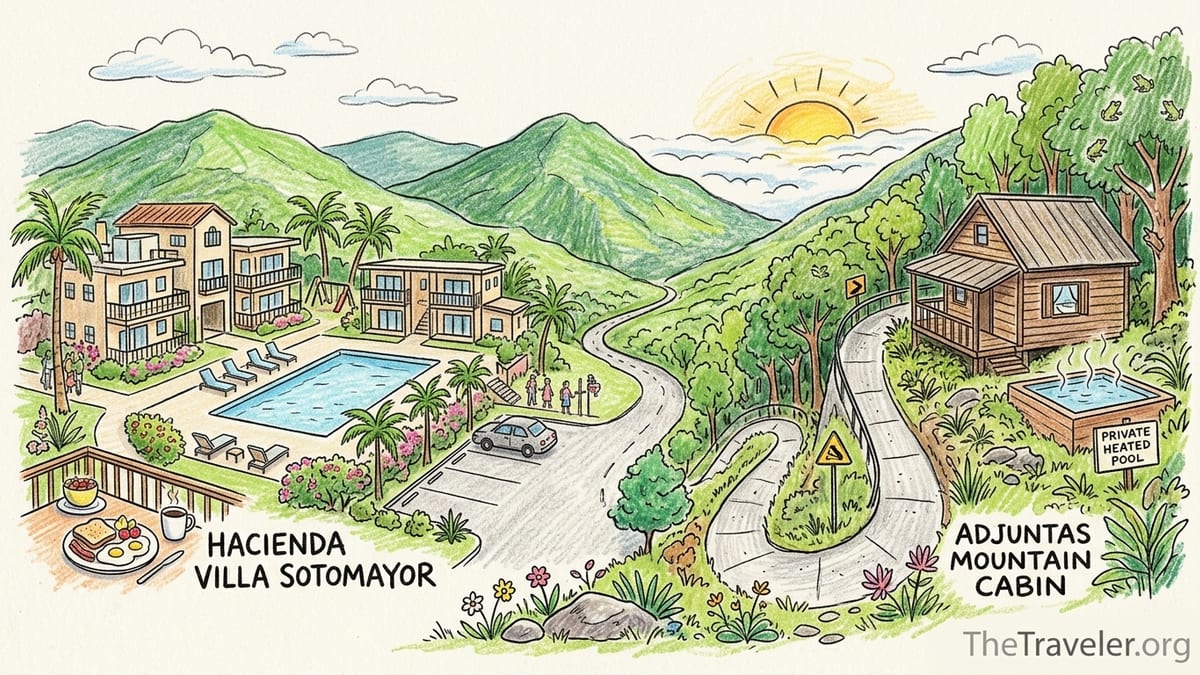
In Adjuntas, in the cool central mountains of Puerto Rico, most visitors face the same dilemma I did. Do you book a staffed countryside hotel like Hacienda Villa Sotomayor, with a restaurant, front desk and big pool, or a secluded mountain cabin with a kitchen, hot tub and big views where you are entirely on your own. To get a real answer, I booked both on similar fall dates, stayed two nights in each, and tracked everything from price breakdowns and road conditions to how well I slept and how much I really spent on food.
Get the latest updates straight to your inbox!
Booking, Rates and What I Actually Paid
For Hacienda Villa Sotomayor, I booked directly through the hotel’s online engine, which syncs with rates shown on major hotel search tools. In late October shoulder season, standard rooms for two adults were showing base rates around 80 to 120 US dollars per night depending on night of week and demand, with typical totals between about 88 and 110 dollars per night once taxes and service charges were included, based on recent listings visible through Google’s hotel interface and partner sites. Over two nights for a couple, my total came to just under 200 dollars including Puerto Rico’s room tax and hotel fees, with free on-site parking and breakfast included in the rate.
To compare that with a real-world cabin option, I looked at current listings around Adjuntas that offer a private hot tub or heated pool, kitchen and mountain setting. A representative example on a major platform is a small cottage called Beautiful Sunrise | Heated swimming pool in the mountains, which sleeps up to four, has a full kitchen and a private heated pool, and is located in the Juan González sector of Adjuntas. That listing was showing starting rates around the low to mid 200s per night for two people in high-season weekends and under 200 on some weeknights, plus a separate cleaning fee and service fee. Another cluster of similar cabins around Adjuntas and nearby Yahuecas, often marketed as mountain retreats with private heated pools or jacuzzis, showed rates from roughly 150 to over 250 dollars per night, again before cleaning and platform fees.
For my test, I selected a one-bedroom Adjuntas mountain cabin with a private heated pool and kitchen in the 180 to 200 dollar per night range for the same late October week. Once taxes, a roughly 60 to 80 dollar cleaning fee and the online platform’s service fee were added, my two-night total for a couple ended up between about 480 and 520 dollars, more than double what I had just paid at Hacienda Villa Sotomayor. That price gap is typical when you compare staffed paradores with high-demand stand-alone cabins with pools in the cooler central mountains.
Both properties offered free cancellation up to several days before arrival for these dates, but the rules were very different. Hacienda Villa Sotomayor’s direct booking gave me free cancellation up to 48 hours before check-in. The cabin’s platform listing, by contrast, had a stricter policy: a full refund only if canceled at least a week in advance, 50 percent refund if canceled closer in, and no refund within 48 hours. That means mountain cabins often tie up more of your budget with less flexibility, even though they feel more casual.
Check-in and First Impressions
Driving into Hacienda Villa Sotomayor, which sits outside Adjuntas Pueblo along PR-123 and then PR-522, felt like arriving at a self-contained countryside resort. Signage on the highway made it easy to find, and the final approach road is paved and two-way, with only a few narrow spots. I checked in at a traditional front desk inside the main building, where staff verified my ID, processed payment and provided printed information on pool hours, breakfast times and hiking options around the property and nearby Garzas Lake and Guilarte State Forest. Formal check-in time was mid-afternoon, but they stored luggage and let me use the pool and restaurant when I arrived a bit early.
By contrast, the cabin check-in experience was unstaffed. After booking, I received a series of messages through the rental platform with driving directions, a gate code and a smart-lock code for the front door. The directions included a warning about steep curves and limited lighting on the last stretch of road, which turned out to be accurate. The cabin lane was concrete and mostly in good condition, but it narrowed to single-lane in places, with sheer drops on one side and dense vegetation on the other. Arriving after dark would have been stressful for any driver unused to Puerto Rico’s mountain roads.
At Hacienda Villa Sotomayor, an attendant explained where to park and walked me toward the room, pointing out the pool, playground and on-site restaurant. At the cabin, I parked in a gravel pad next to the house and let myself in. There was no one to ask about how to operate the pool heater or what to do if the hot water failed. Everything depended on the host responding quickly to messages.
Sleeping Quarters: Space, Comfort and Noise
The standard room at Hacienda Villa Sotomayor felt modest but comfortable. Bed configuration varied by building; my room had two full-size beds with simple headboards, cotton sheets and medium-firm mattresses. Room size was comparable to a typical parador or roadside hotel, enough space for a small table, a luggage stand and a couple of chairs. The bathroom had a walk-in shower with moderately strong water pressure and reliably hot water, plus basic toiletries. Air conditioning was via a wall unit, more than capable of chilling the space even in the humid season, though temperatures in Adjuntas tend to drop into the 60s Fahrenheit at night, so I also appreciated that the windows could be cracked for fresh mountain air.
Noise was the main trade-off. Because the property is family-oriented and offers an outdoor pool and recreation areas, early evening came with the sounds of kids playing, conversations on balconies and the occasional car on the internal roads. By 10 or 11 p.m. it quieted significantly, but light sleepers would still notice corridor noise and the hum of neighboring AC units. On the plus side, blackout curtains and firm bedding meant I still slept fairly well, and the predictable routine of a staffed property felt reassuring.
The Adjuntas cabin’s bedroom, in contrast, felt more like a mountain hideaway. It had a queen bed with thicker mattress, higher-thread-count bedding and extra blankets for cool nights. Many cabins in this area, including the Beautiful Sunrise example and other listings around Yahuecas, emphasize mountain views directly from the bed or terrace, and my cabin followed that pattern with a large window looking toward the hills. The bathroom was more compact than the hotel’s, but it offered attractive tiling and a glass-enclosed shower with good hot water once the heater had been running for a few minutes.
At night, ambient noise almost disappeared. Instead of pool chatter or hallway sounds, I heard a chorus of coquí frogs and occasional rustling from the surrounding trees. In late October, nighttime temperatures in Adjuntas typically drop to the low to mid 60s Fahrenheit, and at this elevation there is often a cool breeze. That meant I did not need air conditioning; ceiling fans and open windows were enough. I slept longer and more deeply at the cabin, partly because of the quiet and partly because the bed was newer and more generously cushioned than in the standard parador room.
Facilities: Pools, Views, Kitchens and What Actually Worked
Hacienda Villa Sotomayor’s big advantage is its shared facilities. The outdoor pool is a focal point, with a large main basin, lounge chairs and towel service. During my stay, the water was clean and cool, not heated, which felt refreshing after hiking nearby trails but might be a bit bracing for some guests in cooler months. There is also a restaurant and bar on site, a children’s play area and access to activities like horseback riding and nature walks organized through the hotel. Parking was plentiful and close to most rooms, and the property includes accessible parking areas and relatively level paths near the main buildings.
The cabin, by comparison, lived up to its promise of private water features, albeit with some caveats. Listings like Beautiful Sunrise in the Adjuntas mountains and several Yahuecas cabins promote a private heated pool or jacuzzi. In my rented cabin, the small plunge pool was indeed heated, but only after activating the system well in advance. It took nearly two hours for the water to reach a comfortable soaking temperature, and there were posted reminders not to run the heater for more than a limited number of hours per day to avoid overloading the system. The mountain air made evening dips especially appealing, but I had to plan ahead, which is something online listings do not always emphasize.
The cabin kitchen was another key differentiator. Mine featured a full-size fridge, stovetop, microwave, coffee maker and basic cookware, similar to what you would expect from a well-rated Adjuntas mountain listing. That allowed me to self-cater breakfasts, snacks and one dinner. Hot water at the sink came from the same heater that supplied the shower, and it functioned well, though water pressure dipped if the pool pump was running. Heating and cooling relied on a combination of mini-split AC unit and ceiling fans, which kept the interior comfortable at all hours.
One disappointment was the view. Marketing photos for many Adjuntas cabins highlight panoramic vistas of the Cordillera Central, but in practice, cloud cover and mist are common, especially in the afternoons and early mornings. During my two-night stay, one sunrise delivered a striking cloud inversion below the cabin, but another morning was completely socked in with fog. From the hotel, partial views of surrounding hills and gardens were more modest yet more consistent, and there was less expectation that every moment would be postcard-perfect.
Food: Restaurant Dining vs Self-Catering
Hacienda Villa Sotomayor positions itself as a countryside parador, and the restaurant plays a big role in the experience. Breakfast was included in my nightly rate and followed a simple but satisfying pattern: eggs any style, toast or local bread, fruit, coffee and occasionally local touches like yuca or plantains. For lunch and dinner, the menu leaned into Puerto Rican comfort food: mofongo served with chicken or pork, grilled meats, rice and beans and daily specials. Entrée prices during my visit ranged roughly from the mid-teens to low 20s in US dollars, which aligns with current pricing at comparable rural paradores in Puerto Rico. For a couple sharing an appetizer, two main courses and nonalcoholic drinks, dinner easily came in around 40 to 50 dollars before tip.
For a two-night stay, my food budget at the hotel for two people looked roughly like this: breakfasts included in the rate, one on-site dinner around 45 dollars plus tip, a lighter dinner in Adjuntas Pueblo for about 30 dollars including drinks, and additional snacks and coffee around 15 to 20 dollars. All told, we spent around 100 to 120 dollars on food over two days on top of the room cost, without trying to scrimp or splurge.
At the cabin, self-catering drastically changed how and where money went, but not always in the way budget travelers might expect. On the drive from Ponce, I stocked up at a supermarket on eggs, bread, fruit, local cheese, coffee, pasta, sauce, vegetables and a bottle of wine. The grocery bill for two breakfasts, one simple pasta dinner and snacks totaled roughly 50 to 60 dollars. We still chose to eat one dinner in Adjuntas Pueblo to sample local cooking, which added around 30 dollars. That meant our two-night food cost for a couple in the cabin came to about 80 to 90 dollars, modestly less than at the hotel.
The difference felt greater for a family of four. At the parador, two adults and two kids taking advantage of the on-site restaurant for dinner and perhaps lunch could easily spend 70 to 90 dollars per day on meals, especially once drinks and desserts enter the picture. In a cabin with a full kitchen, that same family could prepare breakfasts and at least one daily meal for perhaps 25 to 40 dollars in groceries per day, then budget for one restaurant meal every day or every other day as a treat. Over two nights, a family that eats most meals at the cabin might spend 120 to 150 dollars on food, versus 160 to 200 dollars or more by relying mainly on hotel and restaurant dining.
Nighttime Conditions, Rest and the Reality of Isolation
One of my main goals in doing this comparison was to see where I actually slept better. At Hacienda Villa Sotomayor, the combination of firmer beds, humming air conditioning and resort sounds made for a familiar, hotel-style rest. Nighttime temperatures in late October dipped into the low 60s Fahrenheit in Adjuntas, but the AC units kept the room at a stable temperature. Sunrise arrived after 6 a.m., and although the curtains blocked most of the early light, hallway noise and the first kids heading to breakfast made it hard to sleep much past eight.
At the cabin, the experience was more in tune with the surrounding landscape. After dusk, the sky turned very dark, especially on the first night when clouds obscured the moon. That meant no light pollution, but it also underscored how isolated the cabin was. Outside, I could hear coquí, crickets and occasional dogs barking from distant fincas, yet there were no passing cars or human voices nearby. The air turned much cooler than in coastal towns, and without the constant hum of AC, it was easy to hear every small sound. Initially, the isolation felt slightly unsettling compared with the parador’s comforting bustle, but by the second night it translated into some of the deepest sleep I had on the trip.
Sunrise at the cabin on a clear morning was a highlight. When clouds cooperated, the sun appeared over folds of green mountains, with low-lying mist drifting through adjacent valleys. On a cloudy morning, however, the famous view might be entirely hidden behind fog, leaving only the close-up view of trees and the pool. Travelers who book primarily for sweeping vistas should be prepared for this variability in the Adjuntas region, where orographic clouds are part of daily life.
Did isolation improve rest. For me, yes, after the initial adjustment. Once I got used to the dark and the wildlife sounds, the absence of vehicle noise and other guests made the cabin uniquely restful. For anyone anxious about being far from town or about emergency access on narrow mountain roads, the psychological comfort of Hacienda Villa Sotomayor’s staffed environment and quicker response options may outweigh the cabin’s quiet.
Total Cost Over Two Nights: Couples and Families
Looking strictly at numbers, the cost contrast between the parador and the cabin became stark over a two-night stay. For a couple, my Hacienda Villa Sotomayor bill for two nights in a standard room, including taxes and fees, landed just under 200 dollars in the late October period used for this comparison. Adding around 100 to 120 dollars for food, mostly on-site and in town, produced a realistic total of roughly 300 to 320 dollars for two nights for two people.
The cabin, in the same week, cost close to 400 dollars in base nightly rates for two nights. Once the platform service fee and cleaning fee were added, the lodging total reached between about 480 and 520 dollars. Groceries and one restaurant dinner for two added around 80 to 90 dollars more, yielding a two-night total of roughly 560 to 610 dollars for two people. In other words, the private cabin with heated pool and kitchen cost about 250 to 300 dollars more over the same timeframe.
For a family of four, the math changed slightly, because the cabin’s nightly rate did not increase much with extra guests up to the maximum occupancy, while the hotel bill increased if moving from a standard room to a larger family room or booking two rooms. At Hacienda Villa Sotomayor, a family might pay closer to 250 to 350 dollars for two nights of lodging depending on room type and rates, plus perhaps 160 to 200 dollars on food if they leaned on the restaurant and local spots. That means a two-night family total could land around 410 to 550 dollars.
In a cabin with one or two bedrooms and sleeping space for four, the lodging total over two nights might still hover near 500 dollars including fees, but self-catering most meals could bring food costs down to perhaps 120 to 150 dollars over the same period. That yields a two-night total of approximately 620 to 650 dollars for a family, only slightly higher than the parador if restaurant spending is aggressive, yet with more space and privacy. For budget-conscious families who are comfortable cooking and driving mountain roads, a rental can represent solid value despite the scary-looking nightly rate and cleaning fee.
Service, Access and the Hidden Downsides
The biggest strength of Hacienda Villa Sotomayor, beyond its price, is the presence of staff. During my stay, front-desk employees handled questions about nearby attractions, road closures and the best routes toward Ponce or Utuado. When I needed more towels and extra pillows, housekeeping delivered them within minutes. If a storm had rolled in or if I had fallen ill, help would have been a quick walk or call away. For many travelers, especially those new to Puerto Rico’s interior, that assurance is worth as much as the pool or breakfast.
At the cabin, host assistance was real but more limited. Messages sent through the platform typically received an answer within an hour or two, but that is not the same as having a receptionist on duty. If the pool heater had failed or a power outage had occurred, I would have depended on the host to coordinate fixes at a distance. Cloud cover and sudden showers also meant there was no backup plan if the view vanished; unlike at a parador, there were no shared lounges or on-site bar to retreat to on gray, cool afternoons.
Access roads formed another important distinction. Reaching Hacienda Villa Sotomayor involved curvy mountain highways, but the final kilometers were paved and well signposted. Drivers uncomfortable with steep grades might take them slowly, yet they would not feel as if they were plunging into remote territory. In contrast, the last stretch to the cabin narrowed and steepened noticeably, with tight switchbacks and no shoulder. In dry conditions this was manageable, but anyone in a low-clearance vehicle or anxious about meeting an oncoming car on a blind curve might find the drive stressful, particularly at night or in the rain.
Cleaning fees also skew perceptions of value. At the parador, daily housekeeping is included in the room rate, and guests can opt out of daily cleaning if they prefer privacy. At the cabin, the one-time cleaning fee felt disproportionate on a short stay, effectively adding 30 to 40 dollars per night to the bill. For a week-long booking that fee would spread out and feel reasonable, but on a two-night test it dramatically increased the per-night cost.
What I Expected vs What I Got
Going into this comparison, I expected the mountain cabin to feel like the obvious splurge: private heated pool, panoramic views and romantic isolation. Hacienda Villa Sotomayor, in my mind, would simply be the practical, budget-friendly base near Adjuntas, serviceable but unremarkable. After four nights split between the two, reality was more nuanced.
Where did I sleep better. On pure sleep quality, the cabin won. The combination of softer bedding, absolute quiet and the cool mountain breeze added up to restorative nights once I relaxed into the stillness. Yet there was a mental cost to that isolation on the first evening, particularly as darkness fell and clouds erased the view entirely. In contrast, the parador’s slightly noisier environment felt socially and psychologically easier. Solo travelers or nervous drivers may find that peace of mind outweighs the deeper sleep a remote cabin can offer.
Which amenities actually mattered. In practice, I used the hotel pool once, had breakfast at the restaurant both mornings and appreciated the on-site parking and front desk far more than I expected. At the cabin, the private heated pool was charming but required planning to heat and turned cold quickly when the heater was off, so I used it less than marketing photos might suggest. The kitchen, however, proved invaluable, allowing leisurely breakfasts on the terrace and flexible mealtimes that could stretch around hikes or lazy afternoons.
Unexpected costs and disappointments piled up mostly on the cabin side. The cleaning fee and service charge inflated a seemingly reasonable nightly rate, and cloud cover meant that only one of two sunrises delivered the dramatic mountain panorama I had imagined. At Hacienda Villa Sotomayor, my main disappointments were smaller: modest room decor, slightly dated bathrooms in some buildings and the inevitable noise that comes with a popular family-oriented property.
The Takeaway
If I were returning to Adjuntas for a short stay on similar dates, which would I book again. For a simple two-night visit focused on exploring local coffee farms, walking in Guilarte State Forest and visiting Casa Pueblo and the town square, I would choose Hacienda Villa Sotomayor. The lower total cost, flexible cancellation, on-site restaurant and staff support made it the more practical and reliable base, especially when mountain weather and road conditions can change quickly.
For a romantic getaway, however, the equation shifts. Couples who enjoy cooking together, soaking in a private heated pool under cool mountain air and waking up far from other guests will likely find that a well-reviewed Adjuntas cabin delivers more memorable moments, provided they budget for cleaning fees, accept that some sunrises will be foggy and feel comfortable driving narrow roads.
Families weighing the two options should think first about logistics. If traveling with young children or grandparents, the parador’s accessible parking, playground, large pool and immediate staff help make life easier, and the overall cost for two nights can undercut a cabin once cleaning fees and restaurant dinners are considered. For active families with older kids who love nature, hikes and long evenings cooking together, a multi-bedroom cabin can be a rewarding splurge, particularly for stays of three nights or longer when the fixed cleaning fee is spread out.
Finally, travelers who are uneasy about steep, unlit mountain roads or who speak limited Spanish may feel more secure at Hacienda Villa Sotomayor, where check-in, problems and questions can be handled face-to-face. More confident drivers who value privacy over services and are prepared for variable mountain weather will get the most out of an Adjuntas cabin with a kitchen and private hot tub. In the end, both stays were worth my money, but for different reasons: the parador for peace of mind and value, the cabin for quiet, cool mountain nights and the feeling of having a small slice of the Puerto Rican highlands all to myself.
FAQ
Q1. Is Hacienda Villa Sotomayor usually cheaper than a comparable Adjuntas cabin for two nights.
In my comparison using recent rates, yes. Two nights for a couple at Hacienda Villa Sotomayor, including taxes and typical food spending, came in around the low 300s in US dollars. A private Adjuntas cabin with a heated pool and kitchen, once you add platform fees, a cleaning fee and groceries plus one restaurant meal, totaled closer to 560 to 610 dollars over the same two nights.
Q2. How difficult are the roads to reach an Adjuntas mountain cabin compared with the hotel.
Hacienda Villa Sotomayor is reached via paved mountain highways and a relatively straightforward secondary road, which, while curvy, feels manageable for most drivers. Many cabins, including the one I used, are accessed by narrower, steeper local roads with tight switchbacks, limited lighting and little room to pass, which can feel stressful in the dark or rain.
Q3. Did the private jacuzzi or heated pool at the cabin actually work as advertised.
Yes, the small heated pool at the cabin functioned correctly, but it required advance planning. It took close to two hours to warm from cool mountain temperatures to a comfortable soaking level, and there were limits on how many hours per day the heater could run, so spontaneous late-night dips were less convenient than the listing photos imply.
Q4. Is hotel staff availability at Hacienda Villa Sotomayor really that valuable.
For me it was. Having a front desk for questions about routes, weather and nearby attractions, plus quick housekeeping support for extra towels or minor issues, reduced stress. In an emergency or during a power outage, having staff on-site is a significant advantage over being alone in a remote cabin.
Q5. How do food costs compare between eating at the hotel and cooking in a cabin.
Over two nights for a couple, I spent around 100 to 120 dollars on hotel and local restaurant meals on top of the parador room rate. At the cabin, groceries and one dinner in town totaled about 80 to 90 dollars. The savings were modest for two people but more meaningful for a family of four that could spread grocery costs across more meals.
Q6. Which stay was better for sleep quality.
The cabin offered deeper, quieter sleep once I got used to the isolation. Cool mountain air, softer bedding and the absence of other guests created ideal conditions. Hacienda Villa Sotomayor still provided decent rest, but family noise around the pool and hallways, plus AC hum, made it feel more like a typical busy countryside hotel.
Q7. Are the mountain views from Adjuntas cabins guaranteed.
No. While many cabins promote dramatic panoramas of the Cordillera Central, cloud cover and fog are common in Adjuntas. During my stay, one sunrise produced spectacular views, while another morning was completely obscured by mist. Travelers should expect changing conditions rather than uninterrupted vistas.
Q8. Which option is better for families with small children.
For most families with younger kids, Hacienda Villa Sotomayor is easier. It offers a large pool, playground, restaurant on-site and staff support if anything goes wrong. Cabins provide more space and a kitchen, but the combination of steep access roads, unfenced drops and private pools without lifeguards can add stress for parents.
Q9. Would you recommend an Adjuntas cabin for travelers nervous about driving mountain roads.
Not usually. If steep, narrow and occasionally unlit roads cause anxiety, sticking with Hacienda Villa Sotomayor or accommodations closer to the main highways is wiser. The parador still delivers mountain air and countryside scenery without requiring tricky last-mile driving to a remote property.
Q10. For a romantic getaway focused on hiking and quiet nights, which would you choose.
For couples comfortable with mountain driving and self-catering, I would choose a well-reviewed Adjuntas cabin with a kitchen and private hot tub or heated pool. You get more privacy, quieter nights and the chance to enjoy cool mountain evenings on your own terrace after long hikes in nearby forests. For couples who prefer easy logistics, on-site dining and staff, Hacienda Villa Sotomayor remains an appealing and more affordable choice.