


Prepaid travel cards promise to protect you from nasty surprises when you spend abroad. Two of the most widely recognised names in this space are the Caxton Card and the Travelex Money Card. Both let you load money before you travel, spend in multiple currencies and withdraw cash from ATMs overseas. But once you look past the marketing, the real question is simple: which one is likely to save you more money on a real holiday?
Get the latest updates straight to your inbox!
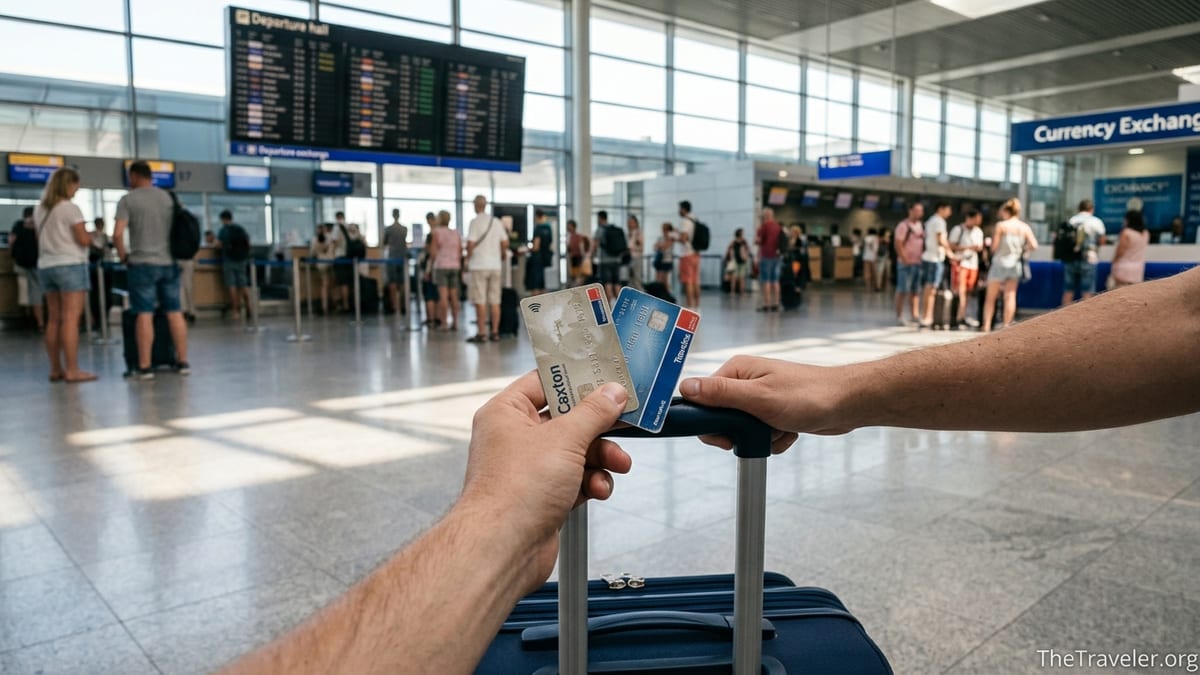
How Caxton and Travelex Money Cards Actually Work
Both Caxton and Travelex Money Card are prepaid cards that let you exchange money in advance into foreign currencies. Instead of your spending being billed to a bank account or credit line, you top up the card and then spend what is on it. This means you avoid interest charges and have tighter control over your travel budget.
With Caxton, you open an account online, add pounds from your UK bank card or transfer, then convert those pounds into one or more supported currencies. Once you arrive in the eurozone, the United States or elsewhere, you pay in stores and restaurants or withdraw cash from ATMs using those preloaded balances. Caxton cards are issued on familiar payment networks, so they work anywhere that accepts major cards, including most hotels, supermarkets and ticket machines.
The Travelex Money Card follows a similar pattern. You can buy and top it up online or in Travelex branches, typically at airports or major train stations. You choose from a basket of popular currencies, such as euros, US dollars or Australian dollars, and lock in an exchange rate offered by Travelex at the time of loading. On your trip, you spend directly from the relevant currency balance or, if that is empty, Travelex converts from another currency wallet at its own rate plus an extra margin.
On the surface, then, both cards look very similar: multi-currency wallets, no credit check, and the promise of “no fees” for overseas spending. The big differences emerge when you look closely at how each provider makes money on exchange rates, cash withdrawals and inactivity.
Headline Fees: Where Each Card Makes Its Money
Caxton markets its card on simple pricing. Recent reviews and Caxton’s own materials show no Caxton fee for using the card to pay for purchases or withdraw cash at ATMs overseas, as long as you spend in currencies you have preloaded. There is usually no issuance fee and no monthly fee. Instead, Caxton typically earns money through an exchange rate markup when you convert from pounds into foreign currencies, and through a dormancy fee if you leave the card unused for around a year or more.
Independent fee analysis sites that track travel cards in 2026 suggest Caxton’s foreign exchange markup on card spend sits at roughly 1.5 percent above the mid-market or card-network rate. In plain language, if the real, mid-market rate is 1 GBP = 1.15 EUR, Caxton might sell you euros at roughly 1 GBP = 1.133 EUR. You will not see a separate “foreign transaction fee” line, but the difference is embedded in the rate.
Travelex Money Card takes a more aggressive approach to FX margins. Product disclosure statements and recent guides to Travelex fees indicate that when you spend in a currency that has to be converted on the card, you can face a margin of close to 5.75 to 5.95 percent above the underlying Mastercard exchange rate. On top of this, Travelex charges an inactivity fee after 12 months without use, which is often around 2 to 4 units of the base currency per month depending on the region, and may add domestic usage fees if you use the card at home.
Neither Caxton nor Travelex typically charge their own fees for international ATM withdrawals in the local currency of your destination, although ATM operators themselves may levy a separate fee. Travelex can, however, charge a percentage-based fee if you use the card for cash withdrawals or purchases in your home country, such as withdrawing Australian dollars in Australia. In contrast, Caxton’s own overseas ATM and purchase fees are effectively zero, with any costs coming from third-party ATM operators or the initial exchange rate markup.
FX Markups in Practice: Real-World Holiday Scenarios
The easiest way to understand which card saves you more is to run the numbers on a realistic trip. Imagine a UK traveller heading to Spain for a week in the summer and planning to spend the equivalent of 1,000 pounds in euros on hotels, meals and transport. On the day they load the card, assume the mid-market rate is around 1 GBP = 1.16 EUR.
With Caxton, a 1.5 percent approximate FX markup might mean you effectively get a rate closer to 1 GBP = 1.143 EUR. If you load 1,000 pounds, you receive about 1,143 euros on your Caxton card. You then spend the full 1,143 euros during your trip, paying in local currency and avoiding additional Caxton fees. The real cost of your holiday spending, compared to the mid-market, ends up being around 15 pounds in hidden FX costs.
Now consider the same trip with a Travelex Money Card. For currencies you hold directly, the key cost is the rate at which Travelex sells you euros when you first load or convert money. Documentation for Travelex Money Card products shows examples where the total FX margin applied when sweeping across currencies is around 5.95 percent. If you assume a roughly similar margin on the original euro purchase, your effective rate might fall to around 1 GBP = 1.093 EUR. That same 1,000 pounds would buy roughly 1,093 euros. You still spend 1,000 pounds in sterling terms, but your holiday budget in euros is trimmed by about 50 euros compared with Caxton in this example.
Those 50 euros can be the difference between eating out one extra night in Barcelona or paying for a taxi from the airport. Over a bigger trip, say a two-week family holiday where you expect to run through 3,000 pounds in foreign spending, the FX difference could easily stretch to 150 euros or more. In straightforward euro or dollar trips where you pre-purchase the right currency, Caxton’s comparatively modest FX markup generally leaves more in your pocket than Travelex’s higher spreads.
ATM Withdrawals and Hidden Local Fees
Cash access is another crucial factor. Caxton states that it does not charge its own fee for overseas ATM withdrawals in foreign currencies, although it warns that the ATM owner may tack on a separate charge. Many recent user reports confirm this pattern: no extra fee from Caxton when withdrawing abroad, but variable local ATM charges depending on the bank and country. For example, in parts of Thailand and Spain it is common to see local ATM fees of 3 to 5 euros or the equivalent, regardless of which foreign card you use.
Travelex Money Card’s latest product disclosures for markets such as Australia and the United Kingdom show zero Travelex fee for international ATM withdrawals in foreign currencies, again with the caveat that some ATM operators may apply their own fees or set lower limits. For domestic withdrawals, however, Travelex can charge a percentage-based fee, such as around 2.95 percent of the transaction amount in some regions when you withdraw local currency at home. That makes it a poor choice as an everyday cash card once you have returned from your trip.
To see the impact, consider a traveller who withdraws the equivalent of 100 pounds in local currency from an ATM twice a week over a three-week trip, so six withdrawals total. With either Caxton or Travelex, you are not charged by the card provider for those withdrawals abroad, but local ATMs may add, say, 3 euros per withdrawal. Over the trip, you lose 18 euros in local fees on both cards, but you also face FX costs. On Caxton, with a lower FX margin, your total cost might be in the region of two to three percent of your spending including both FX and ATM charges. With Travelex, the same pattern of ATM fees on top of a roughly six percent FX margin can push the effective cost of your cash usage closer to eight or nine percent.
One hidden danger with both cards is dynamic currency conversion at ATMs and card terminals, where the machine offers to charge you in pounds instead of the local currency. The rate presented is often significantly worse than the standard card-network rate. If a Spanish ATM offers to convert 400 euros and quote you 360 pounds, while declining conversion results in your bank being charged only 348 pounds for the same amount, choosing the ATM’s conversion effectively adds another three or four percent fee. To keep either Caxton or Travelex costs under control, you should always choose to be charged in the local currency and let the card network handle the conversion at its standard rate.
Inactivity, Domestic Use and Other “Gotcha” Fees
FX markups get most of the attention, but non-spending fees can also eat into your travel budget if you are not careful. Caxton’s terms and independent reviews highlight a dormancy fee that kicks in if your card sits unused for a prolonged period, often around 12 months. The exact amount can vary, but it is usually a small monthly fee deducted from your remaining balance until it reaches zero. If you habitually load a card for a one-off holiday and then forget to clear the remaining funds, these charges can chip away at what is left over.
Travelex Money Card also applies inactivity fees. Public product disclosure statements show a monthly inactivity charge starting after 12 months of no transactions, commonly in the region of a few units of the base currency per month. For a UK cardholder, that might mean roughly 2 to 4 pounds per month. Leave 50 pounds on the card after a trip and return to find the card unused for two years and you could easily lose a substantial portion of that leftover balance to inactivity fees alone.
Both cards may also attach domestic usage fees. Caxton distinguishes between overseas and domestic ATM withdrawals, and in some cases charges a fee if you use your Caxton card to withdraw cash in your home country instead of abroad. Travelex can be even stricter: its schedules in some markets list a near-three-percent fee for domestic ATM withdrawals or purchases in the home currency when funds are loaded in that same currency. In other words, neither card is designed to be your everyday domestic debit card. They are travel tools, and using them at home can quickly erode any benefit you might have gained from fee-free overseas ATM use.
Card replacement charges are another small, but real, cost. Caxton typically offers one or two free replacement cards if yours is damaged, lost or stolen, then charges a modest fee for further replacements. Travelex can charge for additional cards as well. While these costs are minor next to FX markups, they matter if you are comparing cards for a long-term, multi-trip use case rather than a single holiday.
How They Compare to Modern Zero-Fee Bank Cards
One uncomfortable truth for prepaid travel card providers is that they increasingly compete with mainstream bank cards that offer near-zero FX fees. Several digital banks and specialist providers in the UK and Europe now issue debit cards that use the Visa or Mastercard exchange rate with no foreign transaction fee at all, plus a limited amount of free ATM withdrawals each month. In many comparisons, these modern bank cards beat both Caxton and Travelex for pure cost, especially in popular currencies such as euros and US dollars.
Recent reviews of Caxton by travel money comparison sites often point out that while Caxton’s zero-fee overseas usage sounds attractive, its roughly 1.5 percent FX markup still leaves it more expensive than cards that use the mid-market or card-network rate directly. Travelex’s much higher margin, pushing towards six percent in some examples, makes it even less competitive on price. Where Caxton and Travelex still appeal is for travellers who want to avoid linking their main bank account to payments abroad, or who prefer the psychological comfort of preloading a fixed travel budget.
If you already have a debit or credit card from a bank that offers zero or very low foreign transaction fees, you may find that simply using that card abroad is cheaper than either Caxton or Travelex. For example, a UK-based digital bank card that charges no FX fee and uses the standard Mastercard rate would typically convert 1,000 pounds into close to the full 1,160 euros at the assumed mid-market rate, versus the 1,143 euros on Caxton and roughly 1,093 euros on Travelex in our earlier scenario. That is a tangible saving without the friction of preloading and managing a separate card.
However, not everyone has access to such bank cards, and some travellers prefer to ring-fence their spending on a separate prepaid card. In those circumstances, it becomes more meaningful to compare Caxton and Travelex directly, accept that you are paying a premium for the prepaid structure, and then choose the card with lower FX markups and more forgiving fee mechanics.
When Caxton Makes More Sense Than Travelex
For most travellers comparing these two cards specifically, Caxton is usually the more economical choice. Its exchange rate markup is substantially lower than that of Travelex in typical scenarios, especially when you load and spend in the same currency. In straightforward trips to the eurozone, the United States or other major destinations where Caxton supports the local currency, the total cost of using Caxton is often within a couple of percentage points of the real FX rate, plus any unavoidable local ATM fees.
Imagine a family from Manchester taking a ten-day road trip in Italy. They estimate 2,000 pounds in total spending, half on card payments and half withdrawn as cash. Loading 2,000 pounds to Caxton and converting into euros could realistically cost them around 30 pounds in FX margin compared with the mid-market rate. They might pay another 20 to 30 euros in ATM operator fees over several withdrawals. The combined “cost of money” on their holiday is likely under three percent of their total spend.
The same family using a Travelex Money Card could see a very different picture. A six-percent FX margin on their initial 2,000-pound load into euros would effectively cost them around 120 pounds, even before local ATM charges. Their holiday budget in euros would be noticeably smaller, with no obvious extra benefits to justify the higher cost. Unless they have a very specific reason to use Travelex, such as already being at a Travelex counter in the airport with no time to research alternatives, Caxton almost always comes out ahead on value.
Caxton can also be convenient for frequent travellers who hop between several currencies across multiple trips. Its online interface lets you hold and move between different currency wallets, and if you pay attention to exchange rates and avoid leaving large idle balances for more than a year, you can keep inactivity fees to a minimum. For these multi-trip users, the combination of moderate FX markups and zero explicit overseas transaction fees makes Caxton an acceptable, if not market-leading, solution.
The Takeaway
When you strip away the marketing and work through concrete examples, Caxton Card is usually cheaper than Travelex Money Card for typical leisure travel. Caxton’s roughly 1.5 percent FX markup is not the lowest available in the wider market, but it compares favourably with the near-six-percent margin that Travelex can apply in some scenarios. Both cards advertise fee-free overseas purchases and ATM withdrawals in foreign currencies, yet the real cost difference sits in the exchange rate you receive when you load or convert money.
If a UK traveller spends 1,000 pounds in euros on holiday, Caxton might quietly cost them around 15 pounds in FX margin, while the same trip using a Travelex Money Card could cost about 60 pounds in hidden spreads. Add local ATM fees and potential inactivity charges after a year without use, and Travelex’s total cost of ownership typically ends up significantly higher than Caxton’s over time.
That does not mean Caxton is automatically the best option available. Travellers with access to modern bank debit cards that use the Visa or Mastercard rate with no foreign transaction fee will usually save even more by skipping prepaid travel cards altogether. However, for those who want a ring-fenced prepaid solution and are specifically torn between Caxton and Travelex Money Card, Caxton almost always wins on cost while offering similar convenience and acceptance abroad.
The most important step, whichever card you choose, is to read the latest fee schedule carefully, watch out for dynamic currency conversion prompts, and calculate the total cost of your trip using realistic numbers. A few percentage points of FX margin may sound small, but on a multi-thousand-pound holiday they can be the difference between stretching your budget comfortably and feeling short-changed before you even get home.
FAQ
Q1. Which card is generally cheaper to use abroad, Caxton or Travelex Money Card?
Caxton is usually cheaper because its foreign exchange markup is significantly lower than Travelex’s, especially when you load and spend in the same currency.
Q2. Do Caxton and Travelex charge fees for overseas ATM withdrawals?
Both generally advertise no provider fee for international ATM withdrawals in foreign currencies, but local ATM operators can still charge their own fixed fees.
Q3. How big is the FX markup on a Caxton Card?
Recent comparisons suggest Caxton’s markup is roughly 1 to 2 percent above the real or card-network rate, depending on currency and market conditions.
Q4. How big is the FX markup on a Travelex Money Card?
Product disclosures and worked examples indicate an FX margin that can approach 6 percent in some scenarios, especially when funds are swept between currencies.
Q5. Is either card a good choice for everyday spending at home?
Generally no. Both cards are designed for travel and can apply extra fees or poor value if you use them for domestic purchases or cash withdrawals.
Q6. What happens if I do not use my Caxton or Travelex card for a long time?
Both providers apply inactivity fees after around 12 months with no transactions, slowly deducting a small amount from any remaining balance until it is gone.
Q7. Can I save money by using a normal bank card instead of these prepaid cards?
Often yes. Many modern bank debit cards now offer no foreign transaction fee and use standard card-network rates, which can undercut both Caxton and Travelex.
Q8. Which card is better if I am visiting several countries on one trip?
Caxton usually works out better because of its lower FX markup, as long as you load the main currencies you need and avoid unnecessary conversions between wallets.
Q9. How can I minimise ATM and FX costs whichever card I choose?
Always withdraw in the local currency, decline dynamic currency conversion, make fewer larger ATM withdrawals and avoid leaving unused balances on the card long term.
Q10. If I can only choose between Caxton and Travelex at the airport, which should I pick?
If those are your only options and you want a prepaid travel card, Caxton will usually give you a better overall deal than Travelex on most standard holiday itineraries.