


Landing at Bogotá’s El Dorado International Airport and heading straight for La Candelaria is a classic arrival for travelers planning to stay in the city’s historic heart. The journey is not long in distance, but traffic patterns, elevation, security concerns and Bogotá’s complex transport network mean that choosing the right route can make a big difference to how your trip begins. This guide walks you through the main options from the airport to La Candelaria, with practical advice on costs, timetables, safety after dark, luggage handling and hotel arrival planning.
Get the latest updates straight to your inbox!
Understanding the Route from El Dorado to La Candelaria
El Dorado International Airport sits on Bogotá’s western edge, about 13 to 15 kilometers from the La Candelaria historic district in the city center. In light traffic, a direct drive can take as little as 25 minutes. At busier times, especially weekday rush hours roughly between 7:00 and 9:00 in the morning and 4:30 and 7:30 in the evening, the same trip can easily stretch to 45 minutes or more. The main corridor linking the airport to downtown is Avenida El Dorado, known locally as Calle 26, which runs straight east toward the financial district and the historic core.
La Candelaria itself is a compact area of steep, narrow colonial streets. Many hotels and guesthouses sit along or just off Calle 12, Calle 11 and Calle 9 between Carrera 2 and Carrera 7, close to landmarks such as Plaza de Bolívar, Museo del Oro and Monserrate. Vehicles can reach most properties’ front doors, but some streets are one-way or partially pedestrianized, so drivers may need to loop around short blocks or drop you at the nearest corner.
Most visitors choose between three main ways to get from El Dorado to La Candelaria: licensed airport taxis, app-based rides such as Uber, Cabify or DiDi, and Bogotá’s TransMilenio system using the airport-serving dual bus line M86 combined with the Eje Ambiental stations Museo del Oro or Universidades. Each route has different implications for budget, time, comfort, safety and luggage, and the best option for you will depend on your arrival hour, Spanish level and how much you are carrying.
For example, a solo backpacker arriving at 10:00 on a weekday morning with light luggage might reasonably opt for the M86 TransMilenio route and pay a fraction of the cost of a taxi. A couple landing on a late-night international flight with two checked suitcases each, however, will likely find that a door-to-door taxi or rideshare offers better security and far less stress on day one in Bogotá.
Airport Taxi: The Most Straightforward Door-to-Door Option
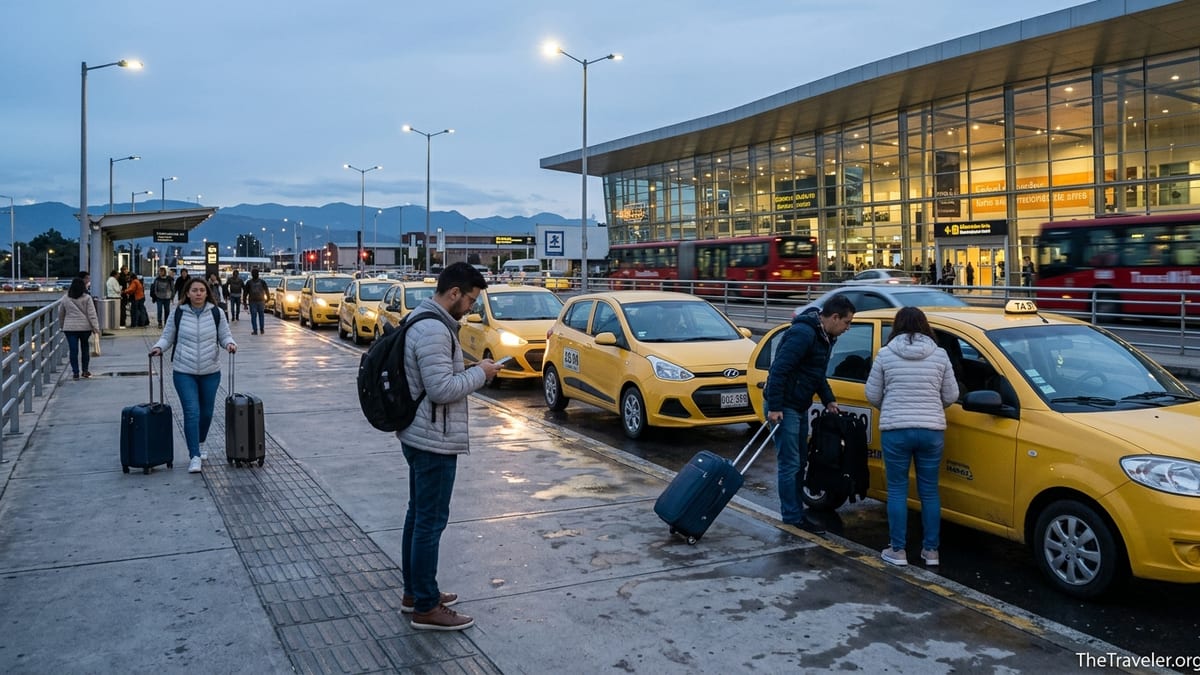
For first-time visitors, especially those arriving in the evening or at night, an official airport taxi is usually the most straightforward way to reach La Candelaria. Inside both Terminal 1 and the low-cost Terminal 2 you will find official taxi booths, usually near the arrivals exits. At these desks you tell the attendant your destination, for example “Hotel de la Opera, La Candelaria,” and they print a slip that shows the approximate fare and the taxi’s license details. This slip is then handed to the driver just outside the terminal.
Recent guidance from local institutions suggests that a typical licensed taxi fare from El Dorado to downtown Bogotá, including the La Candelaria area, often falls in a range somewhere around 35,000 to 45,000 Colombian pesos in normal traffic, depending on time of day and route taken. In very light traffic it may be a little lower; heavy congestion or late-night surcharges can push it higher. The meter inside the car runs based on distance and time, plus a fixed airport supplement. It is common to pay in cash, and many drivers cannot accept cards, so withdrawing pesos from an ATM inside the terminal before exiting is a good idea.
A real-world example: a mid-morning weekday taxi ride from El Dorado to a small guesthouse on Calle 12B in La Candelaria might take about 35 minutes and cost somewhere in the low-40,000-peso range. In contrast, the same ride starting at 6:30 in the evening in rush-hour rain could stretch close to an hour, with the meter ticking up toward the upper-40,000s. In both cases, the major advantage is that the driver navigates Avenida El Dorado, Avenida Caracas and the one-way colonial streets while you sit back with your luggage safely in the trunk.
To stay safe, ignore any individuals inside the terminal who approach you offering unofficial rides. Instead, follow the signs to the official taxi desk or to the clearly marked yellow taxis queued immediately outside. Check that the car is yellow, has municipal taxi markings and displays a control card with the driver’s details. Keep your luggage inside the vehicle rather than the trunk being left open at traffic lights. Tipping is not obligatory, but rounding up a small amount for good service, especially if the driver helps carry heavy bags up to a hotel door on a cobbled street, is appreciated.
Using Rideshare Apps: Uber, Cabify and DiDi
App-based rides such as Uber, Cabify and DiDi operate widely in Bogotá and are popular with both residents and visitors. Although the regulatory environment has been debated and investigated in recent years, travelers commonly use these platforms to move between the airport and La Candelaria. For many, the key advantage is price transparency and the ability to share trip details and location in real time with friends or family.
From El Dorado, pickup points for rideshare services are typically located at designated areas just outside the terminal. When you order a ride, the app will show where to meet your driver, often on the upper departures level or a specific lane. Prices fluctuate according to demand, but in practice fares from the airport to La Candelaria by rideshare often come out similar to or slightly below official taxis during off-peak hours, sometimes in the 30,000 to 40,000 peso range. During high demand or late night surges, prices can climb above that of regular taxis.
A realistic scenario: arriving on a Tuesday afternoon around 2:00 p.m., you open Uber in the arrivals hall and see an estimate of 34,000 pesos for a regular ride to a boutique hotel near Plaza de Bolívar. You wait about five minutes for pickup and reach your hotel in 35 to 40 minutes in moderate traffic. On another day, landing at midnight on a Saturday, demand is higher and the same trip may be quoted closer to 55,000 pesos. At that hour, many travelers still accept the premium for the convenience of cashless payment and integrated safety features.
To reduce friction, make sure your mobile data works or connect briefly to airport Wi-Fi before leaving the terminal. Enter the exact hotel name and address in La Candelaria, since some properties share similar names. When the car arrives, verify the plate number and driver details in the app before getting in. Although many rideshare drivers are used to picking up foreigners, having your destination pinned in the app and the name written down can help if you do not speak much Spanish. As in many cities, local taxi drivers can be skeptical of rideshare services, so it is best not to discuss app rides with traditional taxi drivers around the terminal.
TransMilenio and the M86 Route: Budget-Friendly but Demanding
Bogotá’s TransMilenio is a bus rapid transit system running on dedicated lanes along major corridors, including Avenida El Dorado. A dual-service route, M86 when departing the airport and K86 in the opposite direction, connects El Dorado with several central stations, allowing budget-conscious travelers to reach the historic center with one main bus ride and a short walk. The airport M86 typically runs from early morning to late evening, making it a realistic option in daytime hours for those comfortable navigating public transport.
To use TransMilenio, you first need a rechargeable fare card, usually a TuLlave card, which you can buy at airport or station ticket windows. There is a small one-time cost for the card itself plus the balance you load. A typical single TransMilenio ride costs only a few thousand pesos, so even with the card purchase, the total outlay is significantly lower than a taxi. Once you have the card, follow signs to the “Airport Satellite Bus” stops near the terminal exits and board an M86 bus toward the city.
For La Candelaria hotels, there are two especially useful stations: Museo del Oro and Universidades on the Eje Ambiental corridor. Both sit on the western and eastern edges of the historic center and are within walking distance of many popular accommodations. For example, getting off at Museo del Oro puts you steps from the Gold Museum and roughly a 10 to 15 minute walk up gradually rising streets to small guesthouses around Calle 12 and Carrera 3. Universidades lies closer to the base of Monserrate and some hostels and boutique hotels on the eastern side of La Candelaria.
In practice, the M86 route is best suited to travelers with light luggage and some Spanish, arriving during daylight hours. Morning rush hours can see very crowded buses, and boarding with large suitcases may be difficult. If you land at 9:00 a.m., pass immigration by 10:00 and catch an M86 by 10:30, you might reach Museo del Oro around 11:15, then walk or taxi the final few blocks. However, for arrivals after dark, when streets are quieter and first-time visitors may feel less comfortable walking with bags, many hotels and locals will suggest opting for a taxi or app-based ride instead.
Comparing Time, Cost and Comfort by Time of Day
When choosing your route from El Dorado to La Candelaria, it helps to think in terms of three variables: budget, time and comfort. During daylight off-peak hours, taxi, rideshare and TransMilenio times can be broadly similar, often in the 40 to 60 minute range door to door. The real differences lie in how much you carry, how much you want to spend and your tolerance for crowds and transfers.
Using approximate figures, a daytime taxi or rideshare typically costs the equivalent of a few US dollars more than public transport but buys you a private vehicle, a reserved seat, space for luggage and a direct drop-off outside your hotel. The M86 plus a short walk might cost only a small fraction of that, but you will stand on platforms, guard your bags in crowded spaces and potentially walk several blocks on uneven cobblestones at altitude. For a solo budget traveler, that trade-off can be worthwhile; for a family with children and heavy suitcases, the savings often do not justify the effort.
Time of day is critical. In very early morning hours, before the main commuter rush, a taxi or app ride can cruise along Avenida El Dorado and deliver you to La Candelaria in closer to 25 or 30 minutes. By contrast, if you arrive at 5:00 p.m. on a rainy weekday, both private cars and TransMilenio will face heavy congestion at key choke points near Avenida 68, Avenida NQS and Avenida Caracas. In such conditions, the difference in travel time between a taxi and M86 may be minimal, but you will experience that time differently depending on whether you are seated in a car or standing on a crowded bus.
Cost expectations should also factor in small extras. Official taxis from the airport include a supplement coded into the meter. App rides may charge modest airport access fees or surge pricing at busy times. TransMilenio fares can increase periodically with city-wide tariff changes, though they generally remain low. Because Bogotá’s inflation and fuel costs can vary over time, it is wise to treat any specific price examples as approximate and check the latest guidance on taxi and transit tariffs once you land.
Safety After Dark, Luggage and Personal Security
Security is a natural concern for visitors heading into a dense historic center at 2,600 meters above sea level, especially after dark. Overall, many travelers move between El Dorado and La Candelaria without incident every day, but a few practical habits can greatly reduce risk. The most important is to avoid flagging random taxis on the street outside the terminal and instead use official airport taxis, reputable app rides or clearly signed TransMilenio services.
After sunset, the balance of advice tilts more strongly toward door-to-door options. Walking with rolling suitcases on the narrow sidewalks of La Candelaria late at night can draw unwanted attention and may feel uncomfortable, particularly on quieter side streets. Choosing a taxi or rideshare that drops you at your hotel entrance shortens your exposure on foot. If you must use public transport at night, try to travel with others, keep valuables out of sight, and plan the exact walking route from Museo del Oro or Universidades station to your accommodation before you board.
With taxis and rideshares, put larger bags in the trunk and keep daypacks or camera bags on your lap rather than beside the door. On TransMilenio, keep backpacks in front of you instead of on your back and hold onto luggage handles at all times. Petty theft can occur in crowded vehicles and at busy stations, particularly during rush hours when movement is limited. Avoid using your phone near open bus doors or at the very edge of platforms, and step away from doorways while checking maps.
Within La Candelaria itself, security conditions vary street by street and hour by hour. Main arteries like Carrera 7 and the area around Plaza de Bolívar often feel busy and watched in daytime, with police and street vendors present. Narrower alleys uphill from the main squares can be quieter, especially late at night. Many hotels and guesthouses provide specific arrival instructions such as advising guests to take a taxi directly to the door after 9:00 p.m. Listening to those local recommendations, combining them with your own comfort level and avoiding walking alone along deserted streets is the best approach.
Hotel Arrival, Drop-off Spots and First Steps in La Candelaria
La Candelaria’s colonial layout, with its one-way streets and limited parking, means that clear communication with your driver is important when you get close to your hotel. Before leaving the airport, have your accommodation’s full address written down, including street (Calle or Carrera) and number, and ideally a nearby landmark such as “near Museo del Oro” or “one block from Plaza de Bolívar.” Hand this to your taxi driver or show your rideshare driver the location pinned in their app to reduce confusion around similar-sounding street names.
Some properties, particularly smaller guesthouses and hostels tucked into side streets, may be on alleys too narrow for cars to enter. In these cases, drivers will usually stop at the nearest corner. For instance, a driver might leave you at the junction of Carrera 3 and Calle 12, pointing up a short, cobbled lane where your hostel’s wooden door is visible a half block away. Have your luggage ready to roll or carry that final distance, and pause only briefly on the sidewalk to orient yourself rather than standing for long with open bags.
It is worth contacting your hotel in advance to ask whether they offer or recommend a specific airport transfer partner. Many mid-range and upscale hotels in La Candelaria work with trusted drivers or local taxi companies to provide pre-arranged pickups. These transfers often cost slightly more than hailing a taxi at the airport but can be reassuring, particularly for late-night arrivals or travelers with limited Spanish. In such cases, a driver will wait at arrivals with a sign showing your name and guide you directly to the car.
Once you arrive and check in, use your first short walk around the block in daylight to learn your immediate surroundings. Notice the nearest busy corner, small grocery store or café where staff can help with directions if you get turned around later. Identify the safest and most direct walking route from your hotel to main landmarks like Plaza de Bolívar, Museo del Oro or the closest TransMilenio station. That familiarity will pay off if you return to the area after a day of sightseeing or an evening out.
Choosing the Right Option for Different Traveler Profiles
Different kinds of travelers experience the airport-to-center route very differently, so matching the option to your profile is key. A solo backpacker in their twenties arriving at noon with a single carry-on backpack and fluent Spanish will often be perfectly comfortable buying a TuLlave card at the airport, catching the M86 to Museo del Oro, and walking the remaining ten minutes to a budget hostel just off Carrera 3. The same route allows them to get an early feel for the city’s transit system and save money for later excursions.
A family of four arriving from North America with two suitcases each and a stroller, however, will almost certainly be better served by arranging a taxi or hotel transfer. The extra cost per person is small compared with the stress of negotiating crowded buses, station stairs and cobbled streets with multiple pieces of luggage and tired children. They might choose an official taxi from the airport, show the driver the address of a family-friendly hotel near Plaza de Bolívar, and enjoy a direct ride with everyone seated and belted inside the car.
Business travelers staying in a restored colonial house that functions as a boutique hotel often prioritize reliability and the ability to work or take calls en route. For them, pre-booked hotel transfers or app-based rides like Uber or Cabify, where the car type and pick-up time are clearly confirmed, can be ideal. They can connect to mobile data as they leave the terminal, verify the driver’s license plate and arrive at a lobby check-in with minimal uncertainty about payment or routing.
Older travelers or those with mobility challenges should consider both step-free access and walking distances. Taxis and rideshares can usually pull up very close to hotel doors, but some streets in La Candelaria have uneven pavements and steps at building entrances. If climbing hills or managing cobblestones is difficult, consider booking accommodation on or near flatter streets closer to Carrera 7 or Eje Ambiental, and ask the property whether a car can stop directly outside. In these cases, the extra predictability of a taxi or pre-arranged transfer is often worth more than the cost savings of public transit.
The Takeaway
Getting from El Dorado International Airport to La Candelaria is a manageable journey that rewards a bit of planning. Official airport taxis and reliable rideshare apps offer the simplest door-to-door experience, particularly valuable after dark, when carrying heavy luggage or when traveling in groups. TransMilenio’s M86 route, connecting the airport to central stations like Museo del Oro and Universidades, provides a low-cost and efficient alternative for confident travelers with light bags arriving in daylight hours.
Whichever route you choose, grounding your decision in the realities of Bogotá’s traffic, elevation, safety patterns and historic-center street layout will help your first impressions be positive ones. Think about your arrival time, how much you are carrying, your comfort level with Spanish and crowds, and how you prefer to balance cost against convenience and security. With a realistic plan, your ride into La Candelaria can become an easy prologue to wandering its colonial streets, exploring its museums and settling into the rhythm of Bogotá’s historic heart.
FAQ
Q1. Is it safe to take a taxi from El Dorado Airport to La Candelaria at night?
It is generally considered safe if you use official airport taxis or reputable app-based rides and go directly to your hotel door. Avoid informal offers inside or outside the terminal, keep valuables out of sight and ask your hotel for any neighborhood-specific advice on late-night arrivals.
Q2. How much does a taxi from the airport to La Candelaria usually cost?
Fares vary with traffic and time of day, but many recent travelers report paying somewhere in the range of roughly 35,000 to 45,000 pesos, sometimes a bit more at night or in heavy congestion. Treat these figures as approximate and check the meter and printed slip from the airport taxi desk.
Q3. Can I use Uber, Cabify or DiDi from El Dorado to La Candelaria?
Yes, many visitors use ride-hailing apps between the airport and the historic center. The apps show pickup points at the terminal and estimated fares. Conditions and regulations evolve, so it is wise to keep a backup option such as the official taxi line in case an app ride takes too long to arrive.
Q4. How do I get from the airport to La Candelaria using TransMilenio?
Buy a TuLlave transit card at the airport or at a nearby station, then board the M86 bus toward the city on Avenida El Dorado. Get off at Museo del Oro or Universidades on the Eje Ambiental corridor and walk or take a short local taxi to your hotel in La Candelaria. This option suits daytime travel with light luggage.
Q5. Is it safe to walk from Museo del Oro or Universidades station to my hotel with luggage?
In daytime, many travelers walk the 10 to 15 minutes to La Candelaria hotels without issues, especially along busier streets. At night, or if you are carrying large or multiple bags, it may be more comfortable to switch to a short taxi or app-based ride from the station instead of walking with visible luggage.
Q6. Do taxis and rideshares accept credit cards for this route?
Some app-based rides allow in-app card or digital wallet payments, while most regular yellow taxis in Bogotá still operate primarily in cash. At the airport, assume you will need pesos to pay a taxi unless your hotel has arranged a pre-paid transfer. Using an ATM inside the terminal before exiting is recommended.
Q7. How long does the journey from El Dorado to La Candelaria take?
In light traffic, a direct drive can take around 25 to 35 minutes. During peak rush hours or in heavy rain, it may extend to 45 minutes or more. With TransMilenio, including walking and waiting times, plan on roughly 45 to 60 minutes door to door in daytime conditions.
Q8. Should I pre-book an airport transfer with my hotel in La Candelaria?
Pre-booking can be a good idea for late-night arrivals, for guests with limited Spanish or for those carrying a lot of luggage. Many hotels work with trusted drivers and can include the fare on your room bill or have you pay the driver directly. The cost is often slightly higher than a taxi from the rank but offers added peace of mind.
Q9. What if my flight is delayed and I arrive very late?
If you arrive much later than scheduled, prioritize simplicity and safety over saving a few pesos. Use an official airport taxi or a reputable rideshare, go directly to your hotel, and let the property know your updated arrival time so they can expect you. Late at night, avoid experimenting with new bus routes on your first day in the city.
Q10. Is La Candelaria a good area to stay in for first-time visitors?
La Candelaria is a popular choice for first-time visitors interested in history, museums and walkable streets, and it offers many characterful hotels and hostels. As in any historic center, it has a mix of busy and quieter streets, so choosing well-reviewed accommodation, following local safety advice and planning your arrival route from the airport will make your stay more comfortable.