

More news on this day
The U.S. Centers for Disease Control and Prevention has issued an urgent Level 2 travel health notice for 32 countries over circulating poliovirus, warning travelers that they should practice “enhanced precautions” and be fully vaccinated against the potentially paralyzing disease before heading abroad.
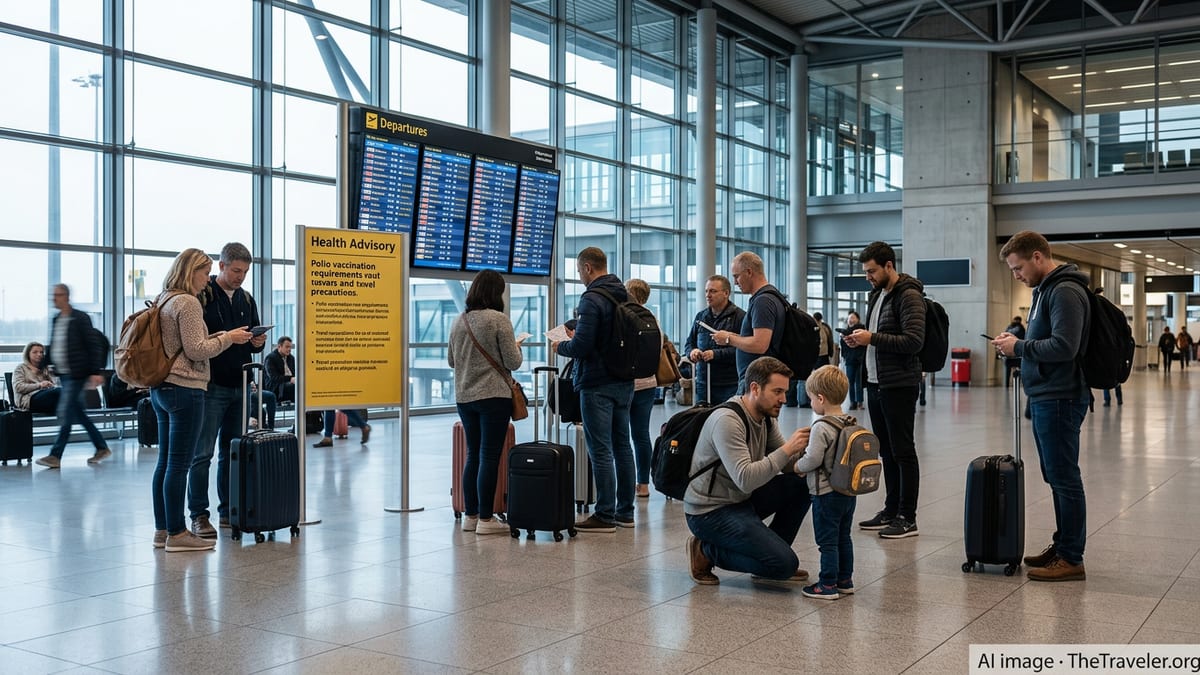
Level 2 Alert Targets Rising Global Polio Risk
The new advisory, listed by the CDC as a Global Polio Level 2 notice, reflects mounting concern over poliovirus circulation across parts of Europe, Africa and the Middle East. While polio remains eliminated in the United States, recent detections abroad and sporadic environmental findings in high-income countries have underscored how quickly the virus can resurface wherever immunity gaps exist.
Health officials stress that the alert does not mean travelers should cancel plans, but rather that they must pay closer attention to vaccination status and hygiene measures. A Level 2 notice signals that specific health risks are present at destinations and that travelers should take extra steps to protect themselves.
Polio, once a common childhood scourge, can cause lifelong paralysis and, in severe cases, death if respiratory muscles are affected. Although most infections are mild or asymptomatic, infected people can still shed the virus, enabling it to spread silently through communities with low immunization coverage.
The latest warning comes as global eradication efforts near their final stages, but circulation of both wild and vaccine-derived poliovirus continues in pockets where routine childhood immunization and sanitation infrastructure lag behind.
Thirty-Two Countries Named, From Europe to Africa
The CDC notice highlights 32 destinations where poliovirus has been detected in the past year, including several that are popular with U.S. vacationers and business travelers. The list spans conflict-affected nations, lower-income countries with strained health systems, and a handful of European states where wastewater surveillance has picked up poliovirus despite strong overall vaccination coverage.
According to the advisory, affected countries currently include Afghanistan, Algeria, Angola, Benin, Burkina Faso, Cameroon, Central African Republic, Chad, Côte d'Ivoire, Democratic Republic of the Congo, Djibouti, Ethiopia, Finland, Gaza, Germany, Ghana, Guinea, Israel, Niger, Nigeria, Pakistan, Papua New Guinea, Poland, Senegal, Somalia, South Sudan, Spain, Sudan, Tanzania, the United Kingdom, Yemen and Zimbabwe.
Experts say the inclusion of destinations such as Germany, Spain, Finland, Poland and the United Kingdom should not be seen as evidence of widespread outbreaks in those countries, but rather as a sign that poliovirus has been detected in sewage or in isolated cases. These findings are enough to trigger heightened vigilance, particularly for travelers who may be moving between regions with very different vaccination and sanitation profiles.
The geographic spread of the listed countries underscores how mobile the virus remains in an era of intense global travel. Health authorities warn that even a single infected traveler can seed new chains of transmission in under-immunized communities.
CDC Urges Travelers to Check Vaccines and Consider a Booster
Central to the CDC’s message is a straightforward plea: make sure polio vaccinations are up to date before departure. In the United States, children typically receive four doses of inactivated polio vaccine (IPV) in early childhood, a schedule that provides strong protection against paralysis.
For adults who completed a full childhood series, the agency notes that a one-time, lifetime IPV booster can be considered before travel to any of the 32 countries with circulating poliovirus, particularly for those who will be staying for extended periods, working in healthcare or refugee settings, or having close contact with local communities. Adults who were never vaccinated, or who are unsure of their vaccination history, are advised to start or complete an IPV series as soon as possible ahead of travel.
Travel medicine specialists emphasize that travelers should not wait until the week before departure to address polio protection. Some may need multiple doses spaced several weeks apart, and clinics may be busier than usual as spring and summer travel ramps up. Calling a primary care provider or dedicated travel clinic early can help ensure enough time for vaccination and any necessary documentation.
Officials also advise travelers to carry a written record of their polio vaccination, especially when visiting countries where proof of recent immunization may be requested upon exit or entry in line with international health regulations.
How Polio Spreads and What Travelers Can Do
Poliovirus is primarily spread via the fecal-oral route, meaning it passes through contact with contaminated hands, surfaces, food or water. In environments with unreliable sanitation or limited access to clean water, the virus can move rapidly, particularly among young children and unvaccinated adults.
Vaccination remains the single most effective form of protection against the most severe outcomes of infection, but the CDC also urges travelers to practice meticulous hand hygiene, especially after using the bathroom and before eating. Using alcohol-based hand sanitizer when soap and water are not available, and being selective about food and water sources, can further lower risk.
Public health experts note that the vast majority of travelers who are fully vaccinated and follow standard food, water and hygiene precautions are at very low risk of contracting paralytic polio. However, they warn that complacency could erode the hard-won gains of the global eradication campaign, particularly if declining vaccination coverage allows the virus to gain a foothold in new areas.
For families traveling with young children, pediatricians recommend reviewing routine immunizations well in advance of trips abroad. Ensuring that children are on schedule for all recommended vaccines, including polio, measles and other preventable diseases, helps reduce the risk of illness while traveling and curbs the chance of bringing infections back home.
What the Advisory Means for Upcoming Travel Plans
The polio travel notice lands just as many Americans finalize itineraries for spring and summer, from European city breaks to safaris and faith-based journeys. Travel industry analysts say they do not expect widespread cancellations as a result of the Level 2 alert, but they do anticipate a spike in inquiries about vaccination requirements and health precautions.
Major airlines and tour operators are reminding customers that health advisories can change quickly and that travelers share responsibility for monitoring official guidance in the weeks before departure. Some travel insurers are also flagging fine print that requires policyholders to follow destination health recommendations, including vaccination guidance, for coverage to remain valid.
For now, the CDC’s message is focused on preparation rather than restriction. Officials are encouraging travelers to view the advisory as an extra incentive to schedule checkups, talk with clinicians about boosters and build basic hygiene steps into their packing lists and daily routines abroad.
As public health agencies worldwide push toward the long-sought goal of global polio eradication, they stress that the final phase may be the most fragile. For travelers, that means being vigilant, not fearful: staying informed about evolving risks, following evidence-based advice, and ensuring that a once-devastating disease does not regain ground in an increasingly interconnected world.