


More news on this day
Chicago’s skyline disappeared behind a gray veil this week as thick smoke from Canadian and northern Minnesota wildfires pushed the city’s air quality index into hazardous territory, triggering alerts across the metropolitan area and disrupting summer routines for residents and visitors.
Get the latest news straight to your inbox!
Air Quality Index Surges to Hazardous Levels
Publicly available monitoring data on Friday, July 17, indicate that Chicago’s Air Quality Index (AQI) climbed above 400 overnight, placing the city in the “hazardous” category, the most severe designation on the federal scale. Reports from local broadcasters describe the city briefly ranking among the worst major urban areas in the world for air quality as the plume settled over northeastern Illinois.
An air quality alert remains in effect for much of the region, including Cook, Lake, DuPage, Will and several surrounding counties, as fine particulate pollution from the smoke lingers near the surface. Coverage from CBS Chicago notes that the alert extends through at least midnight Friday, with conditions expected to fluctuate between very unhealthy and hazardous in parts of the metro area.
Local reporting indicates that the hazardous readings built on a multi day deterioration in air quality that began earlier in the week, when ozone and heat first pushed pollution to unhealthy levels before the wildfire smoke arrived in force. By Thursday, images from across the city showed trains and high rises partly obscured by a milky haze and visibility significantly reduced along the lakefront and expressways.
While some gradual improvement is anticipated later Friday as winds begin to shift, forecasts suggest the smoke will remain a factor for at least another day, keeping air quality at unhealthy levels for sensitive groups even after the most severe readings ease.
Canadian and Minnesota Wildfires Drive the Smoke Plume
Analyses shared by meteorologists in Chicago attribute the episode to a large area of wildfires burning in Manitoba and Ontario, along with blazes in far northern Minnesota. Upper level winds have funneled smoke from these fires south and east across the Great Lakes, with a concentrated band settling over northern Illinois.
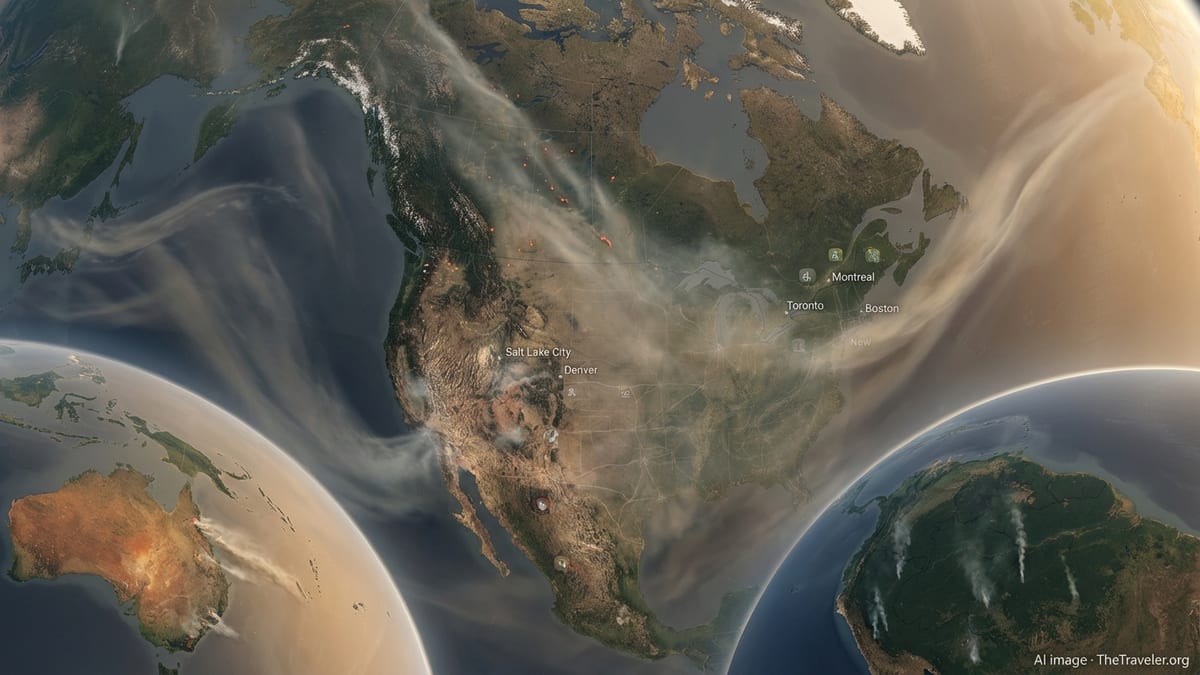
Satellite imagery and smoke modeling reviewed in local weather coverage show a dense corridor of fine particulate matter sweeping from central Canada into the upper Midwest, affecting cities from Minneapolis and Detroit to Chicago and parts of Indiana and Wisconsin. The same plume has contributed to air quality alerts in multiple states, with some communities across the region also recording unhealthy to hazardous readings on Thursday and Friday.
While this summer’s Canadian fire season has not matched the record breaking activity seen in 2023, environmental reporting notes that warmer, drier conditions and persistent northerly flow have still created favorable conditions for recurring smoke intrusions into the United States. The current event marks one of the most severe smoke driven pollution spikes for Chicago since the orange tinged skies of June 2023.
Climate researchers cited in recent national coverage point to wildfire smoke as an increasingly common driver of extreme short term pollution, warning that prolonged or repeated smoke episodes can offset years of gradual air quality gains in major metropolitan areas.
Impact on Travel, Outdoor Plans and City Life
The hazardous readings have had a swift impact on daily life and visitor experiences across Chicago, a city that typically relies heavily on outdoor activities, festivals and lakefront tourism in mid July. Local news outlets report that multiple outdoor events were canceled or scaled back on Thursday as organizers reacted to the spike in particulate pollution.
Beaches along Lake Michigan have experienced reduced attendance, with television footage showing largely empty stretches of sand and a hazy horizon in place of the usual sharp skyline views. Some recreation programs and youth sports activities have moved indoors or been paused, and guidance across the region urges those who must be outside to limit strenuous activity and consider high quality masks.
Travelers arriving through O’Hare and Midway airports have been greeted by diminished visibility and a distinctive smoky odor, though there have been no widespread reports of major flight disruptions directly tied to air quality. Within the city, the tops of iconic towers have periodically vanished into the haze, altering the usual postcard views from popular observation decks and riverfront vantage points.
Commuters on regional rail and express bus routes have shared images of trains moving through a filtered, yellow gray light. The unfamiliar conditions recall images from western U.S. wildfire seasons, highlighting how long range smoke transport now periodically reshapes the atmosphere over Midwestern cities far from the active fire lines.
Health Guidance for Residents and Visitors
Public health advisories summarized in local coverage emphasize that hazardous AQI readings represent emergency conditions for outdoor air. At those levels, exposure is considered risky for everyone, not only older adults, children and people with respiratory or cardiovascular conditions.
Standard guidance encourages staying indoors as much as possible with windows closed, using air conditioning on recirculation mode where available, and avoiding vigorous outdoor exercise. For travelers staying in hotels or short term rentals, experts recommend checking that indoor spaces are well sealed from outdoor smoke and, when possible, using portable air purifiers or high efficiency filters to reduce fine particle concentrations inside.
People who must work outside or move between locations are advised to take frequent breaks in cleaner indoor air and to make use of well fitting N95 or KN95 respirators when available, which can significantly reduce inhalation of the fine particles that dominate wildfire smoke plumes. Health information disseminated by state agencies notes that cloth or surgical masks provide limited protection against the smallest particles that most strongly affect the lungs and cardiovascular system.
Travelers with asthma, chronic obstructive pulmonary disease or heart conditions are urged to monitor symptoms closely, keep rescue inhalers and medications readily accessible, and consult telehealth or in person care promptly if breathing difficulties, chest pain, or unusual fatigue develop while pollution remains elevated.
What Travelers Should Know and How Long It May Last
Forecasts compiled by Chicago based meteorologists suggest that while air quality is expected to remain poor through Friday, a gradual improvement is likely into the weekend as winds veer and begin to push the thickest smoke northeast of the city. However, the outlook remains subject to change depending on wildfire behavior and regional weather patterns.
Visitors planning to arrive in Chicago over the next several days are being encouraged through local tourism advisories and media coverage to monitor real time AQI dashboards and local weather reports before finalizing outdoor itineraries. Indoor attractions including museums, theaters, restaurants and shopping districts remain open, offering alternatives to lakefront walks, river cruises and rooftop events that are more heavily affected by the particlerich air.
Travel news outlets note that this week’s episode underscores a broader shift in seasonal planning for U.S. and international travelers, with wildfire smoke now a recurring factor not only in the American West but also across parts of the Midwest and Northeast during the warm months. Flexible scheduling and backup indoor activities are increasingly recommended for trips during peak summer weeks.
For Chicago, a city known for its summertime festivals and outdoor skyline views, the hope is that changing wind patterns will restore clearer conditions in the coming days. Until then, both residents and visitors are being urged, through publicly available advisories and extensive local reporting, to treat the smoky air as a serious, if temporary, hazard and to adapt plans accordingly while the AQI remains at elevated levels.