

More news on this day
Thousands of air passengers across China are facing extensive disruption as major hubs including Beijing, Chengdu, Chongqing, Shanghai, Shenzhen, Hangzhou and Wuhan report 5,278 delayed flights and 429 cancellations, severely impacting operations at leading carriers such as Air China, China Eastern, China Southern, Shenzhen Airlines and XiamenAir.
Get the latest news straight to your inbox!
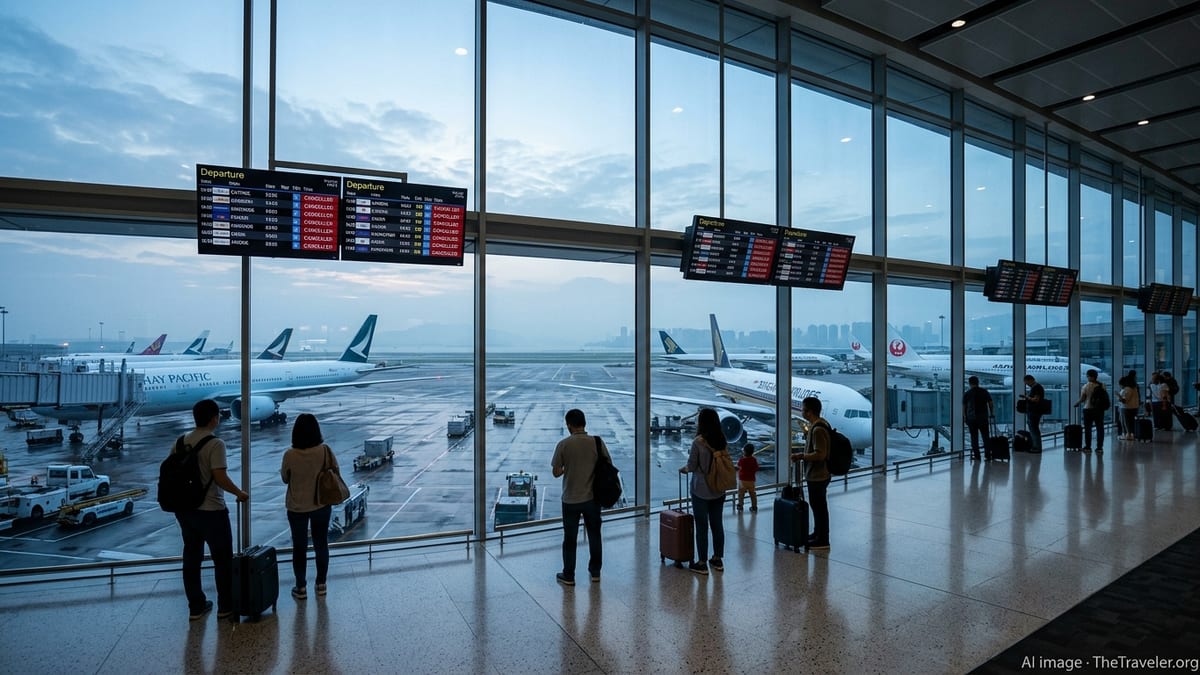
Major Chinese Hubs Grapple With Widespread Disruptions
The latest disruption wave is concentrated at the country’s busiest airports, with Beijing Capital, Shanghai Pudong, Chengdu Tianfu, Shenzhen Bao’an, Hangzhou Xiaoshan, Chongqing Jiangbei and Wuhan Tianhe all reporting elevated levels of delays. Publicly available aviation data for China shows several hundred disrupted movements across these hubs in a single operational window, adding up to 5,278 delays and 429 outright cancellations nationwide.
These hubs serve as critical domestic and international connectors, meaning schedule problems quickly ripple out beyond the immediate region. Passengers connecting through Beijing or Shanghai, in particular, are experiencing missed onward flights and forced rebookings as the knock-on effects build through the day’s rotations.
Published coverage of China’s aviation performance has long highlighted structural vulnerability to delay, with major mainland airports frequently ranking among the least punctual globally. The current numbers indicate a fresh spike that is sharply above typical daily disruption, placing additional strain on ground handling, customer service and crew scheduling systems.
While the precise mix of causes varies by airport and time of day, the pattern aligns with what analysts describe as a complex interplay of congestion, weather variability and tight scheduling that leaves little slack when operations begin to slip.
Flagship Carriers Bear The Brunt Of Operational Strain
The brunt of the disruption is falling on China’s largest network airlines. Air China, China Eastern and China Southern, together with Shenzhen Airlines and XiamenAir, all show elevated delay and cancellation counts on domestic and regional routes that funnel through key hubs such as Beijing, Shanghai, Guangzhou, Chengdu and Shenzhen.
Operational statistics compiled for the Chinese market indicate that these airlines account for a significant portion of daily movements at the affected airports. When irregular operations take hold, even a modest percentage of disrupted flights translates into thousands of passengers left waiting in terminals or seeking alternative transport.
As aircraft and crews fall out of their planned rotations, the impact extends far beyond the original problem flights. One late inbound aircraft can force downstream departure delays across multiple cities, escalating what begins as a localized issue into a broad network disruption. For hub-and-spoke carriers such as Air China and China Eastern, this cascading effect is especially pronounced, as missed banks of connecting flights undermine carefully timed schedules.
Available flight performance data for China also shows that secondary carriers and regional operators are not immune. However, the concentration of delays among the larger brands reflects their dominant market share and their role in connecting high-density trunk routes between Beijing, Shanghai, Chengdu, Shenzhen, Hangzhou, Wuhan and other major centers.
Passengers Face Long Queues, Misconnections And Limited Alternatives
For travelers on the ground, the numbers translate into long queues at check-in counters and transfer desks, crowded departure halls and mounting uncertainty over arrival times. Reports from recent disruption events in the Chinese market describe passengers queuing for hours to rebook, with some opting to purchase new tickets on alternative flights when re-accommodation options are limited.
Domestic rail provides a partial safety valve on certain corridors, particularly between Beijing, Shanghai, Hangzhou, Shenzhen and Wuhan, where high-speed services can offer comparable end-to-end journey times. Travel forums and trip reports frequently note that some passengers, when faced with extensive flight delays, pivot to high-speed rail for medium-range journeys. However, for longer sectors and international connections routed through Beijing and Shanghai, viable alternatives are often scarce on short notice.
Travel advisories and consumer guidance published in recent years consistently recommend that passengers transiting major Chinese hubs allow generous connection times due to elevated delay risk. The current level of disruption underscores that advice, particularly for those holding separate tickets or connecting to long-haul services, where missed departures can result in overnight stays and complex rebooking negotiations.
Travel planning resources also highlight the importance of monitoring airline apps and airport departure boards closely, as gate changes and rolling delays are common when airlines attempt to re-stabilize their schedules during a disruption of this scale.
Underlying Capacity And Weather Pressures Exposed Again
China’s civil aviation sector has expanded rapidly over the past decade, with passenger volumes and flight frequencies growing faster than infrastructure at many hubs. Academic studies and industry analyses of the mainland network point to constrained capacity in airspace and terminal areas, especially around dense clusters such as Beijing, Shanghai and the Chengdu–Chongqing region.
These bottlenecks mean even routine weather events, such as summer thunderstorms or low visibility, can trigger significant flow restrictions. When traffic demand is high, the imposition of spacing measures or temporary runway constraints quickly produces queues of arriving and departing aircraft, which then propagate delay throughout airline networks.
Historical performance data for airports including Beijing Capital, Shanghai Pudong, Shenzhen Bao’an, Hangzhou Xiaoshan, Chengdu Tianfu, Chongqing Jiangbei and Wuhan Tianhe shows that all have at times struggled with punctuality, particularly during peak travel periods. The present wave of 5,278 delays and 429 cancellations fits into that broader pattern of sensitivity to external shocks.
Policy research on on-time performance in China’s aviation system suggests that improvements in airspace management, runway capacity and collaborative decision-making between airlines and air traffic management can mitigate future disruption. However, implementation is gradual, and the latest statistics indicate that passengers remain exposed to significant variability in day-to-day operations.
What Travelers Should Expect In The Coming Days
Based on recent disruption patterns in China’s aviation market, recovery from a spike of this magnitude typically takes more than a single operational day. Even after weather or technical constraints ease, aircraft and crew rotations may remain misaligned, leaving residual delays and occasional cancellations in subsequent schedules.
Passenger-focused guidance commonly advises travelers booked on domestic or regional flights involving Beijing, Shanghai, Chengdu, Chongqing, Shenzhen, Hangzhou or Wuhan to check their flight status frequently, arrive at the airport early and be prepared for possible last-minute changes. Those with tight onward connections are often encouraged to explore options for rebooking onto earlier flights or adjusting itineraries to reduce the risk of missed long-haul departures.
Observers of China’s aviation sector note that while official punctuality metrics have improved in recent years, the combination of heavy traffic, complex airspace and variable weather continues to leave airlines and airports vulnerable to sudden spikes in disruption. The latest figures showing 5,278 delays and 429 cancellations across the network are a reminder that, for now, even well-planned trips through China’s busiest hubs can still be significantly affected by operational volatility.