


Nice Côte d’Azur Airport may be compact and scenic, but it catches an astonishing number of visitors off guard. From confusing tram tickets and last-minute terminal switches to missed security cut-off times on busy summer Saturdays, the same errors repeat day after day. Understanding how the airport actually works in 2026 will spare you wasted euros, frantic dashes between terminals and a rough start or finish to your Riviera trip.
Get the latest updates straight to your inbox!
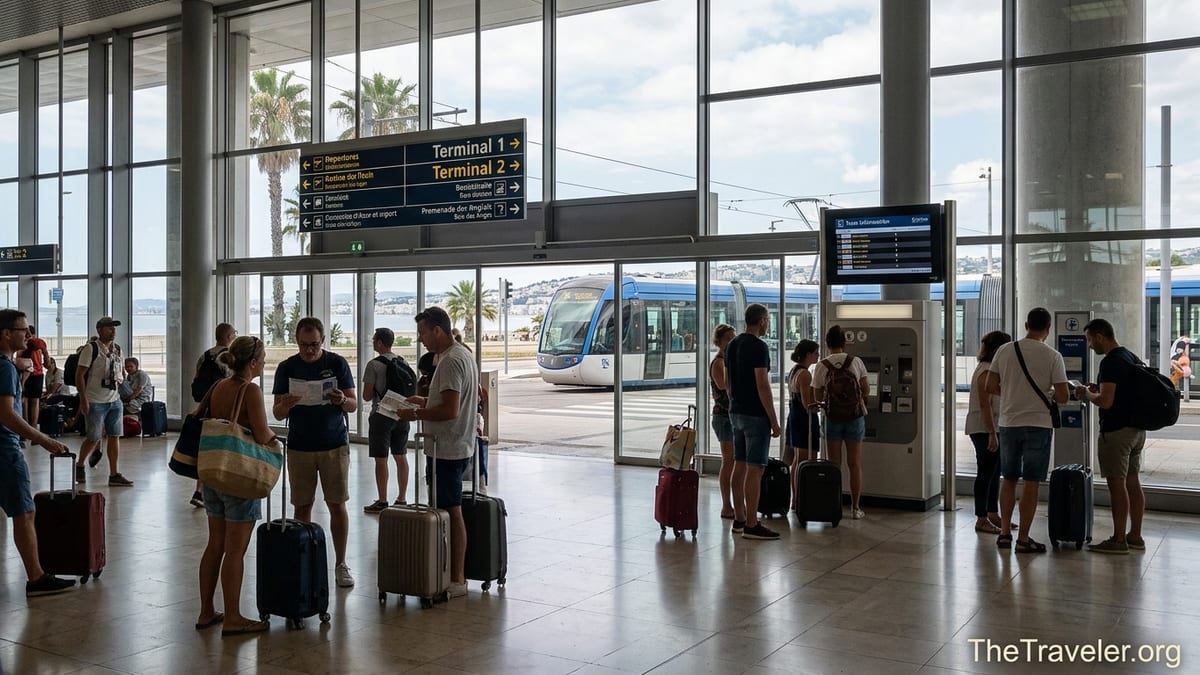
Misunderstanding the Two-Terminal Layout
One of the most common problems at Nice Airport starts before travelers even step inside: not realizing there are two separate passenger terminals, T1 and T2, which serve different airlines and are not right next to each other. Many first-time visitors see “Nice Côte d’Azur” on their boarding pass, assume there is a single building and tell their taxi or rideshare driver simply “the airport.” In practice, arriving at the wrong terminal can easily add 15 to 20 minutes of backtracking, especially at peak times when the internal shuttle and tram are crowded.
For example, most easyJet flights now use Terminal 2, while many legacy carriers and some Schengen flights depart from Terminal 1. A traveler flying Nice to Paris on Air France might instinctively head to Terminal 1, then discover at the departures screen that their flight leaves from T2. They must then wait for the free airport tram between terminals or follow the pedestrian route, often dragging luggage under the Mediterranean sun.
The simplest fix is to double-check your terminal before you leave your hotel or apartment. Airlines usually list it clearly in the booking app or on the mobile boarding pass. When you book transfers or instruct a taxi, say “Terminal 1” or “Terminal 2” instead of just “the airport.” If you do end up at the wrong building, look for the clearly marked free tram that links T1, T2 and the Grand Arénas transport hub; it is the fastest way to correct the mistake without paying for another vehicle.
On departure, also be aware that check-in and security areas are separate by terminal, so you cannot check in at T1 for a T2 flight or vice versa. Some travelers queue for ten minutes only to discover they are in the wrong terminal completely. Always verify the terminal on the overhead screens before joining the line.
Getting Caught Out by Airport Tram Tickets and Fares
Nice Airport is unusually close to the city, and the tram is the cheapest and most scenic way in. That convenience has led to a new and very specific mistake in 2026: confusion about the special airport fare and where to buy cheaper tickets. Line 2 of the tram links the airport with the city center and Port Lympia in under 30 minutes, but tapping the blue ticket machines on the airport platforms without preparation can cost you more than you expect.
Travelers frequently assume they can buy a standard 1.70 euro ticket for Line 2 directly at Terminal 1 or Terminal 2. In reality, the machines and validators at the airport stops are configured for a dedicated airport product that is significantly more expensive than a normal city ride and sometimes sold as a round-trip package. Recent visitors have reported paying around 10 euros per person when buying on the spot at the airport tram stop, then discovering the next morning that the same trip from just one stop away at Grand Arénas cost them 1.70 euros on the Lignes d’Azur app or a reloadable card.
If you want the local price, there are three practical options. First, download the Lignes d’Azur ticketing app before you land and purchase a standard single or day pass there, then validate it with your phone when you board the tram outside Terminal 2. Second, walk or take the free airport tram one stop to Grand Arénas / Nice Saint-Augustin, where normal ticket machines and tobacconists sell the rechargeable “La Carte” that locals use. Third, if you do not mind paying a premium for the sake of simplicity after a long flight, treat the airport-specific ticket as the cost of convenience and move on. The key is choosing consciously rather than tapping in a hurry and being shocked by the charge.
Another mistake on Tram 2 is boarding in the wrong direction. The line has two branches: one toward Port Lympia via the city center and the other toward the administrative zone at CADAM. Tired travelers sometimes jump on the first arriving tram at Terminal 2 assuming it all goes “to town,” then wonder why the sea disappears and office parks appear instead. Always check the destination displayed on the front of the tram. For central Nice, you want trams heading to “Port Lympia” and you will likely get off at “Jean Médecin” for the main shopping street or “Garibaldi” for the old town.
Overpaying for Taxis and Private Transfers
Despite the excellent tram, plenty of visitors still choose taxis or private transfers, especially late at night or with heavy luggage. The mistake is not the choice of taxi itself but failing to understand local pricing and how to identify official vehicles. The result can be a surprisingly high fare for a journey of only 7 kilometers into Nice or, worse, an outright scam by an unlicensed driver hovering just outside the arrivals hall.
Official Nice taxis line up outside both terminals at marked ranks. Licensed vehicles display a roof sign and a visible taxi meter. Typical daytime fares from the airport to central Nice fluctuate with traffic, luggage surcharges and time of day, but are usually in the rough range of 30 to 40 euros. Late evening, heavy traffic or public holidays may push this higher. Travelers who step into a vehicle without a meter, or let a “private driver” approach them inside the terminal, frequently report paying 60 or 70 euros for the same trip.
One real-world scenario: a couple arrives around 9 p.m. in July and is approached by a well-dressed man in the luggage hall asking if they need a taxi. He leads them directly to a black car parked in the drop-off lane, quotes “about 35” before departure and then claims the ride is 65 euros once they reach the Promenade des Anglais, citing “night tariff” and “extra luggage.” Because nothing was written and no meter was running, the passengers have little leverage. Had they walked a few meters further to the signed taxi rank, they would have had a metered ride and a clear receipt.
To avoid overpaying, follow two rules. First, ignore anyone who actively solicits you inside the terminal or at the curb: they are almost never official taxis. Walk straight to the signed taxi rank, where airport staff sometimes supervise the queue. Second, before the car sets off, confirm whether the fare will be metered or fixed and ask for an approximate total to central Nice. If the driver refuses to use the meter or quotes something far above the expected range, step away and choose another cab. If you prefer app-based rides, order them only through well-known platforms and meet them at the clearly marked pick-up points outside Terminal 1 or Terminal 2.
Underestimating Summer Crowds and Security Cut-Off Times
On paper, Nice Airport seems manageable: two terminals, relatively few long-haul flights and an airport that often feels more like a large regional hub than a global giant. In reality, peak season between late May and early October brings heavy waves of leisure travelers headed to the Riviera, Corsica and Italy. Saturday mornings in July and August are particularly busy as villa rentals flip and cruise passengers disembark. A major mistake is treating Nice as a small, sleepy airport and arriving too close to departure time.
Security lines at Terminal 2 can snake past the roped queues on summer weekends, especially during early morning waves between 6 and 9 a.m. Travelers with only hand luggage, used to breezing through smaller regional airports in 20 minutes, may show up 75 minutes before departure and find themselves staring at a sea of people. Airlines routinely close boarding around 20 to 30 minutes before departure, and if you are still in the security queue then, you are unlikely to make your flight even if it departs slightly late.
Nice Airport and many airlines recommend arriving around two hours before a European flight and at least three hours before a long-haul departure. In July and August, or during large events such as the Monaco Grand Prix or Cannes Lions, building in a half-hour buffer is wise. A traveler flying to London on a Sunday evening in June might find Terminal 2 calm and pass through in 20 minutes, yet the same flight on a Saturday morning after Bastille Day could require 70 minutes from entering the terminal to reaching the gate.
Another frequent miscalculation concerns check-in and baggage drop closing times. Many airlines shut their counters 40 to 60 minutes before departure. Passengers who arrive just as the line is being cleared sometimes plead with staff, pointing to the still-open security area, but agents rarely have the authority to reopen counters or override computer systems. When planning your departure, count backwards from the check-in deadline rather than the flight time, and give yourself extra margin if you are returning a rental car at the airport during busy hours.
Mishandling Luggage: Storage, Oversize Items and Beach Gear
Nice’s seaside setting encourages travelers to arrive with bulky beach umbrellas, surfboards or oversized checked bags, and to squeeze in one last swim before their flight home. Problems arise when people assume the airport works like a resort and will effortlessly store or check anything at the last minute. In practice, luggage rules at Nice Airport are quite strict and storage capacity is limited.
The airport operates a left-luggage office in Terminal 2 where bags can be stored for a fee that varies by size and duration. Space is not infinite, and there are clear restrictions on what can be accepted. Items such as gas canisters, large sports equipment with fuel residues, or visibly damaged suitcases may be refused. A common error is turning up with all carry-on bags at 9 a.m., hoping to leave them for a full day while visiting Monaco, only to find the facility already busy and queue times long, especially at the height of summer. Travelers who assume they can store luggage spontaneously may instead drag wheeled suitcases through crowded old town streets and along the Promenade.
Oversize sports gear is another recurring headache. Airlines serving Nice see a high volume of bikes, golf clubs and diving equipment between spring and autumn. Passengers sometimes show up at the airport with a bicycle in a soft bag or golf clubs wrapped only in plastic, believing they can pay a small fee and hand it over at any check-in desk. In reality, most carriers require advance booking for sports equipment, and the airport has a separate oversize baggage belt that may be in a different area from standard bag drop. Turning up at the last minute with unannounced oversize baggage can lead to additional fees or, in worst cases, refusal.
Finally, many visitors forget that local airlines enforce standard European carry-on liquid rules even if you are just hopping to Paris or Milan. Souvenir olive oils from the Cours Saleya market, large bottles of rosé from a Provence vineyard and 200 ml face creams from a Riviera pharmacy are routinely confiscated at Nice security checkpoints. If you are buying such items in town and flying with hand luggage only, ask shops to pack your purchases for checked baggage or consider shipping them home instead of assuming they will pass through screening.
Misjudging Ground Transport Options Beyond Nice
Nice Airport is well connected not only to the city itself but to the wider Riviera, and this abundance of choice can lead to confusion and costly mistakes. Many visitors heading to nearby destinations such as Antibes, Cannes or Monaco assume a direct taxi from the airport is the default, then are surprised by the bill. Others try to piece together local buses and trams without understanding how tickets and connections work.
Take Monaco as an example. A taxi from Nice Airport to Monte-Carlo can easily run well above 100 euros depending on traffic and time of day. Uninformed travelers accept this without realizing that trains from Nice Saint-Augustin or Nice-Ville stations are frequent and far cheaper. A more economical route is to take the airport tram to either Grand Arénas for regional trains or into the center for Nice-Ville, then continue by TER train to Monaco. The journey typically costs a fraction of the taxi fare, although it does involve stairs and crowded carriages at peak hours.
Cannes and Antibes present similar dilemmas. Express coach services and private shuttles link the airport to both towns, but their pricing competes with local trains that require only a short tram ride to the nearest station. Some travelers, overwhelmed after landing, buy tickets for the first branded shuttle desk they see in the arrivals hall, spending 25 to 30 euros per person. A more budget-conscious approach is to use Tram 2 to connect to the railway and travel by TER along the coast, accepting a slightly longer overall journey for a dramatic saving.
The opposite mistake occurs with travelers staying very close to the airport, in neighborhoods like Arenas or Saint-Laurent-du-Var. They often default to a taxi for the short hop to their hotel, unaware that the free airport tram between terminals and Grand Arénas, plus a short walk, might get them there in nearly the same time for no extra cost. Before you arrive, check your accommodation’s location relative to tram stops and train stations, and decide whether you genuinely need a taxi or private car.
Overlooking Food, Shopping and Practical Services
Nice Airport is not as sprawling as Paris Charles de Gaulle, but it still offers a wide range of services that many travelers miss or misunderstand. The error often lies in assuming that food and shops will stay open late, that duty-free is always the cheapest option, or that essentials like SIM cards and chargers will be easy to find at the last moment.
Food-wise, opening hours in both terminals generally mirror flight schedules, but outlets wind down earlier in quieter off-season months and on late-night weekdays. Passengers on the final departures of the day frequently discover that their preferred café in Terminal 1 has already closed by 9:30 p.m., leaving only vending machines and a single bar operating airside. If you are catching an evening flight outside high season, it is safer to eat in town or at least buy snacks at a supermarket near your accommodation before you head to the airport.
Shopping is another area where expectations and reality diverge. Relay convenience stores in both terminals stock French press titles, snacks and basic travel items, but prices reflect airport markups. Souvenirs such as lavender sachets, soaps or Côte d’Azur-branded magnets can often be found cheaper in Nice’s pedestrian streets or markets earlier in your trip. Travelers who delay all souvenir purchases to the airport, expecting a vast duty-free mall, sometimes face limited choice or out-of-stock items, especially at the end of holiday periods when popular products have been cleared out by departing crowds.
Practical services also deserve attention. The airport offers currency exchange, ATMs, pharmacies in season, and car hire desks, yet queues ebb and flow with flight waves. A common mistake is leaving tasks such as changing money, printing documents or buying a local SIM card until just before boarding. You may find the exchange desk temporarily closed, the printer at a business center occupied, or SIM offers far more expensive than equivalent packages bought in Nice city center. By planning for these needs a day earlier in town, you keep your time at the airport focused on check-in, security and boarding.
The Takeaway
Nice Côte d’Azur Airport is compact, efficient and blessed with an unbeatable seafront setting, but it is not immune to the classic mix-ups that plague modern air travel. Confusion about the two terminals, poorly understood tram fares, casual attitudes toward security timings and overreliance on last-minute airport services all contribute to unnecessary stress. The real-world consequences are missed flights, overpriced transfers and hurried goodbyes to the Riviera.
With a bit of homework, you can avoid almost all of these pitfalls. Check your terminal before you leave your hotel. Decide in advance whether you will pay the premium for airport tram tickets or use local fares via an app or nearby stop. Treat taxis with the same caution you would in any major tourist destination, and give yourself more time than you think you need for summer departures. If you do, Nice Airport becomes what it is capable of being: a smooth gateway between one of Europe’s most beautiful coastlines and the rest of the world, rather than the final challenge of your trip.
FAQ
Q1. How early should I arrive at Nice Airport before my flight?
For most European flights, aim to arrive about two hours before departure, and three hours for long-haul. In peak summer or during major events, add at least 30 minutes because security lines and check-in queues at Terminal 2 can be significantly longer than expected.
Q2. Which terminal does my airline use at Nice Airport?
Airlines are split between Terminal 1 and Terminal 2, and assignments can change, so always check your booking or mobile boarding pass. If you arrive at the wrong terminal, use the free airport tram that shuttles between T1, T2 and Grand Arénas rather than paying for another taxi.
Q3. Is the tram from Nice Airport to the city center really the cheapest option?
Yes, the tram is usually the cheapest way into central Nice, especially if you use regular Lignes d’Azur tickets or passes bought via the app or from non-airport stops. Tickets purchased directly at the airport tram platforms may be sold as a special airport product at a higher price, so decide in advance whether you want the convenience or prefer to save by buying standard tickets nearby.
Q4. How do I avoid taxi scams or overcharging at Nice Airport?
Only use official taxis from the signed ranks outside each terminal or reputable app-based services. Ignore anyone who approaches you inside the terminal, always check that the car has a taxi sign and meter, and confirm whether the ride will be metered or a roughly fixed fare before the driver sets off.
Q5. Can I store my luggage at Nice Airport for the day?
Yes, there is a left-luggage facility in Terminal 2 that accepts bags for a fee based on size and duration. Space is limited in high season and some items, such as gas canisters or certain sports equipment, cannot be stored, so avoid relying on last-minute plans and consider reserving extra time to drop off or collect bags.
Q6. What is the best way to get from Nice Airport to Monaco or Cannes?
A direct taxi is the simplest but also the most expensive option to Monaco or Cannes. Many travelers save money by taking the airport tram to a nearby train station, then continuing by regional TER train along the coast, accepting a slightly longer journey in exchange for a much lower fare.
Q7. Are there good food options at Nice Airport if my flight is late?
There are cafés, bars and snack outlets in both terminals, but opening hours follow flight schedules and can be limited late at night or outside peak season. If you have a late departure, it is safer to eat in Nice beforehand or bring snacks rather than assuming all restaurants airside will be open.
Q8. Can I buy a SIM card or eSIM at Nice Airport on arrival?
You may find SIM options at certain shops in the terminals, but selection and pricing are often less favorable than in Nice city center. Many travelers prefer to arrange an eSIM in advance online or buy a physical SIM from a supermarket or phone shop in town the same day they land.
Q9. What should I know about liquids and souvenirs at security?
Nice Airport enforces standard European liquid rules for hand luggage, so containers over 100 ml and bottles packed outside a one-liter plastic bag are likely to be confiscated. Plan to pack wine, olive oil and larger cosmetics in checked bags or ship them home instead of trying to carry them through security.
Q10. Is Nice Airport easy to navigate for a tight connection?
The airport is relatively compact, but connections between Terminal 1 and Terminal 2 still take time, especially if you must clear security again. If your itinerary involves self-booked separate tickets, allow a generous buffer between flights rather than assuming you can sprint between terminals in a few minutes.