


I thought I knew how to work an airport. I have navigated multi-terminal monsters like Paris Charles de Gaulle and New York JFK without breaking a sweat. So when I booked a tight connection through Nice Côte d’Azur Airport, it seemed like a reasonable gamble. Nice has only two terminals, a coastal tram line, and a famously compact footprint. What could possibly go wrong? Within an hour of landing, I had my answer: quite a lot.
Get the latest updates straight to your inbox!
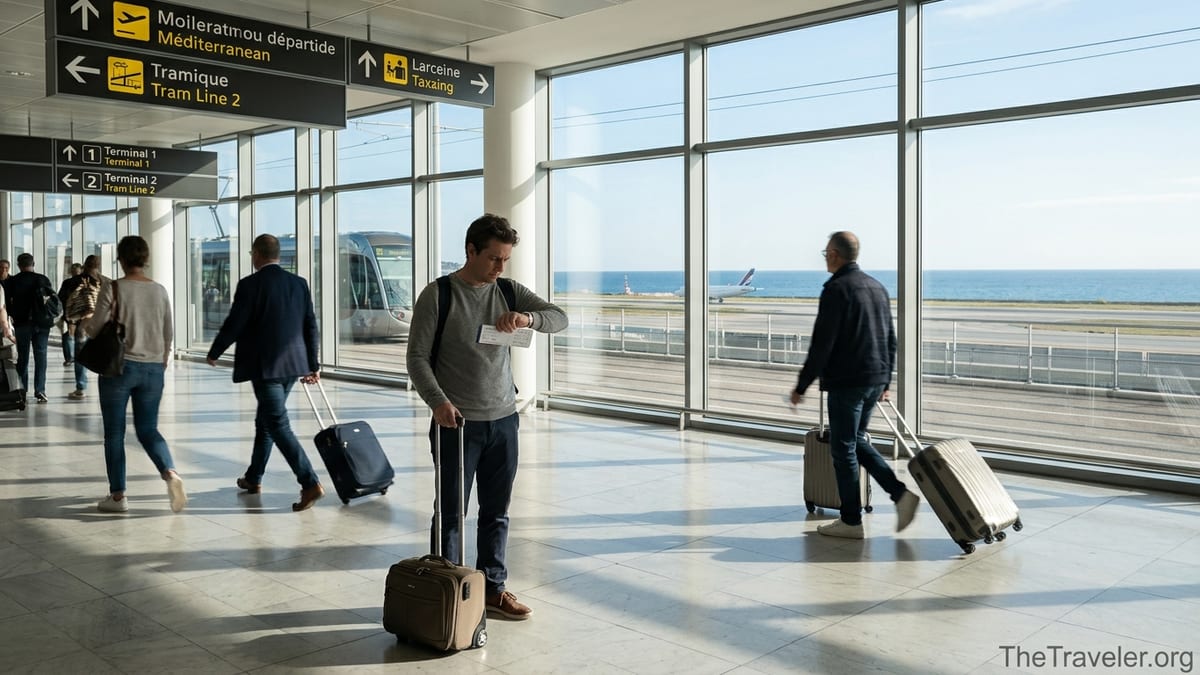
A Tight Connection That Was Never Really Possible
The trouble started long before I could see the turquoise curve of the Baie des Anges from the airplane window. When I booked my trip, I gave myself 55 minutes to connect at Nice. I was arriving on a low-cost carrier into Terminal 2 and continuing on a separate ticket with another airline from Terminal 1. On paper, it looked simple: a short hop between terminals and then a bus onward along the Côte d’Azur.
What I did not account for was that Nice’s two terminals, while close as the crow flies, behave like separate airports once you add queues, security, transport, and human error. The free shuttle between Terminal 1 and 2 usually takes around 5 to 15 minutes depending on traffic and stops, but that is only the ride itself. By the time you factor in waiting for the shuttle, walking to the stop, and finding your way around unfamiliar signage, that neat 55-minute window quickly shrinks.
My flight into Terminal 2 arrived almost on time, but the aircraft parked at a remote stand. We boarded a bus, squeezed shoulder-to-shoulder with beach bags and cabin trolleys, and crawled toward the terminal. By the time I reached the arrivals hall, my margin had already fallen to 30 minutes. I still had to find the shuttle or tram, get over to Terminal 1, and check in for a separate journey to Italy.
It was only then that I realized the real mistake had been made weeks earlier, at my kitchen table, when I assumed I could treat Nice like a small regional field instead of an international airport handling millions of passengers each year.
Understanding Nice Airport’s Layout Before You Land
Nice Côte d’Azur Airport stretches along the seafront west of the city, with Terminal 1 and Terminal 2 separated by runways, taxiways, roads, and parking areas. On a map, they look walkable, but in practice most travelers rely on the internal shuttle or the tram. Each terminal has its own bus station, check-in zones, and security lanes. Terminal 1 is home to many low-cost airlines such as easyJet and Transavia, while Terminal 2 generally handles Air France and a mix of traditional carriers like British Airways and Emirates.
The terminals are linked by a free shuttle bus that runs frequently from early morning to around half past midnight. In normal traffic, the ride can be as quick as 5 minutes from Terminal 2 to Terminal 1, but more often you should count on closer to 10 to 15 minutes once boarding, luggage storage, and intermediate stops such as car rentals and distant car parks are factored in. There is also the tram, which stops at both terminals and at Grand Arénas near the nearby Nice Saint-Augustin railway station.
What caught me out was that none of this is truly instantaneous. Even if everything runs smoothly, you still need to navigate out of arrivals, find the correct level and exit for the shuttle or tram, and then reorient yourself on the other side. For example, travelers catching trains at Nice Saint-Augustin often underestimate how long it takes to walk from Terminal 1 to the station via Grand Arénas. It is technically walkable, but with a suitcase in summer heat and airport crowds, a 10-minute stroll can drag out and eat into precious buffer time.
Before you land, it is worth opening an airport map and literally tracing your route: arrivals to shuttle or tram, transport between terminals, and then into departures. If you know you are landing at Terminal 2 and departing from Terminal 1, treat them as separate legs in your itinerary rather than two corners of the same hall.
The Tram, the Shuttle, and Why “Free” Still Costs You Time
Nice has one of the more convenient airport tram links in Europe. Tram line 2 runs from the airport terminals into the city center and on to the port, typically taking under 35 minutes to reach central stops like Jean Médecin. Services normally start around 5:20 in the morning and run until just after midnight, with trams every few minutes in peak periods. The section between Terminals 1, 2, and Grand Arénas is free, which is ideal if you are simply transferring between terminal and train or long-distance bus.
There is also the dedicated airport shuttle system that connects the terminals with outlying car parks such as P4, P6, P8, and P9. These shuttles are electric, frequent, and free, but they are designed primarily for parking access. The main inter-terminal movement for most travelers is either the tram or the internal shuttle bus that loops between the terminals and transport nodes like the bus stations and rental car center.
On my rushed transfer, the clock became my enemy. Arriving in Terminal 2, I had to decide: wait for the internal shuttle or jump on the tram for the very short ride to Terminal 1. The tram has the advantage of clear signage and platform-level boarding, but even a few extra minutes waiting can matter when your onward bus or train is not flexible. The shuttle, on the other hand, sometimes appears just when you need it but can also arrive crowded or make a slow circuit via multiple stops.
In the end, I chose the tram because the platform was easier to find from arrivals than the shuttle stop, and the next service was already visible in the distance. It felt efficient in the moment. In reality, between descending to the platform, waiting for the tram, riding just one stop to Terminal 1, and walking back up to departures, I lost a good 15 minutes. “Free” transport in Nice is genuinely helpful for your wallet, but it still exacts a price in minutes and mental bandwidth.
Separate Tickets, Separate Risks
The second major flaw in my plan was treating a self-constructed connection like a protected one. Airlines sometimes sell through-tickets where your bags are checked to your final destination and any delay is their responsibility. In Nice, that might mean arriving on an Air France flight into Terminal 2 and connecting to another Air France or partner flight in the same terminal. If things run late, the carrier can rebook you.
My itinerary was stitched together from separate tickets: one low-cost flight to Nice and an intercity bus onward to Sanremo in Italy. The bus, departing from the airport bus station at Terminal 1, was significantly cheaper than taking a taxi along the coast or a private transfer, which can easily cost upwards of 90 to 120 euros in high season for the 45 to 60-minute journey. The savings were real, but so were the risks. The moment my incoming flight parked at a remote stand, nobody was responsible for my missed bus but me.
I compounded the problem by relying on perfect conditions. I checked historical on-time performance for my flight but ignored variables like dense boarding queues, slow disembarkation, and the additional stops the shuttle might make. I assumed immigration would be minimal because I was arriving from within the Schengen zone, which turned out to be true, but I forgot that baggage collection, even for a small plane, can be unpredictable when belts are shared.
Travelers heading for popular Riviera destinations like Cannes, Antibes, or Monaco often make similar assumptions. They book the last reasonably priced airport bus of the day, cutting transfer times close because the timetable looks generous on screen. Then the unexpected happens: a short strike on regional trains, a traffic delay on the Promenade des Anglais, or a crowded tram full of cruise passengers. With separate tickets, every minute of delay carries financial and emotional weight.
If your onward leg is important, such as a ferry in Nice port, a nonrefundable hotel reservation in Menton, or a sporting event in Monaco, treat the Nice transfer like any other international layover. Build in a cushion that assumes at least 60 to 90 minutes from aircraft door opening to arriving at a different terminal’s bus bay or train platform, especially if you are unfamiliar with the airport.
Realistic Timing: From Plane Door to Next Departure
One of the most helpful habits I picked up from this experience is to break down the transfer into realistic time blocks rather than relying on a single guess. At Nice, disembarking from a full narrow-body aircraft, walking to arrivals, and clearing the terminal can easily take 20 to 30 minutes, even without checked baggage. If you have luggage to collect, add another 10 to 20 minutes, particularly during busy summer weekends when baggage belts are under pressure.
Once in the public arrivals area, factor in 5 to 10 minutes to orient yourself. You will need to read signs, perhaps glance at overhead boards, and locate the exit that leads either to the tram platforms, the shuttle bus stop, or the bus station. Travelers arriving into Terminal 2 and heading to Terminal 1 should assume at least 15 minutes from leaving baggage claim to stepping into the other terminal, assuming average waiting times for the shuttle or tram. With crowds, tired children, or mobility issues, those 15 minutes can easily stretch to 20 or more.
Then comes the second half of your transfer: moving from the terminal entrance to your onward departure point. For the bus stations outside each terminal, count on another 5 to 10 minutes to find your specific bay, read route numbers, and check any last-minute changes. If you are walking or taking the tram to Nice Saint-Augustin railway station for a regional train to Cannes, Ventimiglia, or Marseille, you should plan on 20 to 25 minutes from arrivals to the station platform, longer if you are not familiar with the signage through Grand Arénas.
When you layer these segments together, a tight 40-minute connection between an arriving flight in one terminal and a long-distance bus or train in or near the other terminal becomes clearly unrealistic. My own mad dash through Terminal 1 ended with me watching the taillights of my bus heading toward the A8 motorway, leaving me to queue at the ticket desk for the next available seat and do mental currency exchange on the extra cost I had just incurred.
How I Would Plan the Same Transfer Today
In the months since that misadventure, I have passed through Nice several times, treating it less like a scenic backdrop and more like a system to be understood. If I had to plan the same trip today, my strategy would be very different. First, I would avoid separate tickets with tight margins. If budget forced my hand, I would choose a much later bus or train, even if it meant a longer wait in the terminal or an extra coffee at an airport café.
Instead of a 55-minute gap, I would give myself at least two hours between scheduled landing and the next fixed departure when moving between terminals or between the airport and external transport like trains or regional buses. That two-hour window allows for moderate delays, queues, and even the occasional hiccup like a temporary suspension of part of the tram network, which has happened during maintenance and strikes in recent years.
I would also decide my transfer mode in advance. For a simple terminal change, I would stick with the free tram between Terminal 1, Terminal 2, and Grand Arénas, using it as a predictable link rather than a last-minute improvisation. If I needed to get to central Nice with luggage during regular hours, I would consider the standard tram fare, which is usually only a few euros, instead of special airport return tickets priced around ten euros that are marketed heavily at ticket machines. For a group or late-night arrival, I would compare the total cost of multiple tram tickets with the price of a metered taxi or reputable rideshare into town.
Perhaps most importantly, I would build in a psychological buffer. Knowing that I have ample time to change terminals or reach the city center changes the entire mood of the trip. Instead of sprinting past floor-to-ceiling windows framing the Mediterranean, I can pause to refill my water bottle, check updated bus information, and enjoy the small luxury of arriving on the Riviera without my heart hammering.
Practical Tips for Stress Free Transfers at Nice
For travelers planning upcoming trips through Nice, a few concrete habits can dramatically improve your chances of a smooth transfer. Start by confirming your arrival and departure terminals before you travel. Many airlines publish this information in booking confirmations, and it is worth double-checking a day or two before departure in case of changes. If your inbound and outbound legs use different terminals or different modes of transport, treat the move between them as a real connection, not a footnote.
Next, familiarize yourself with the tram network and airport shuttle options. Tram line 2 remains the backbone of public transport between the airport and the city, and the free section between Terminals 1, 2, and Grand Arénas is especially useful when pairing flights with regional trains from Nice Saint-Augustin. Learn which stops serve your accommodation or onward route. For example, visitors staying near the Old Town might aim for the Promenade des Arts area, while those catching hotel shuttles or tours could target closer stops on the Promenade des Anglais.
When deciding how much time to leave for a transfer, err firmly on the side of caution. If everything goes well, an extra 45 minutes in the terminal is an opportunity to pick up a coffee and watch aircraft glide in over the water. If things go badly, that same margin can be the difference between a calm stroll to the bus station and a frantic sprint across traffic lanes pulling a suitcase with a broken wheel.
Finally, remember that Nice is subject to the same disruptions that affect transport across Europe: seasonal crowds, industrial action, and weather-related delays. Trains along the Riviera line toward Cannes and Ventimiglia can be particularly sensitive to strikes and infrastructure issues. If your transfer relies on one of these trains immediately after landing, keep an eye on local news and transport apps. If anything looks uncertain, consider shifting to a bus route or sharing a taxi with fellow travelers going in the same direction.
The Takeaway
My chaotic morning at Nice taught me a simple but easily forgotten lesson: transfers are journeys in their own right, not incidental gaps between flights. Even at a relatively compact airport with helpful amenities and clear signage, moving between terminals or onto city transport demands time, attention, and a bit of humility.
Nice Côte d’Azur is more than a postcard-perfect runway beside the sea. It is a busy hub for the French Riviera, with low-cost and full-service airlines jostling for space, trams gliding toward the city, and buses fanning out along the coast toward Cannes, Monaco, and beyond. Those systems work remarkably well most of the time, but they do not bend to wishful thinking or tight itineraries built for screens rather than real bodies and bags.
If you are planning a trip through Nice, respect the transfer. Check which terminal you are using, study the trams and shuttles, and build generous buffers into your schedule, especially when separate tickets or important events are at stake. Plan early, pad your timings, and you will likely find that your first experience of the Riviera is not a breathless race between platforms, but a measured, even enjoyable arrival beside one of Europe’s most beautiful stretches of coastline.
FAQ
Q1. How long should I allow to transfer between Terminal 1 and Terminal 2 at Nice Airport?
For most travelers, it is wise to allow at least 45 to 60 minutes from exiting arrivals in one terminal to reaching departures in the other. This includes time to find the shuttle or tram, make the short journey, walk to check in, and handle any queues. If you are unfamiliar with the airport, traveling with children, or carrying heavy luggage, adding extra time is sensible.
Q2. What is the easiest way to move between the terminals at Nice?
The easiest option for most people is the combination of the free tram and the internal shuttle services. Tram line 2 connects Terminals 1 and 2 and Grand Arénas, and the airport also runs free electric shuttles that link the terminals with nearby car parks. Both options are well signposted, but you should still plan for waiting and walking times.
Q3. Is the tram from Nice Airport to the city center free?
The section of tram line 2 between Terminal 1, Terminal 2, and Grand Arénas is free, which is ideal for terminal changes or reaching the nearby railway station. Travel beyond this zone into central Nice typically requires a standard tram ticket, which is usually only a few euros. Special airport tickets and passes may also be available, but they are not required for the short free segment.
Q4. Can I realistically catch a regional train shortly after landing at Nice?
You can, but only if you give yourself enough buffer time. Plan on at least 60 to 90 minutes between scheduled landing and a train departure from Nice Saint-Augustin, especially if you need to move between terminals first. This allows for disembarking, baggage collection, walking or tramming to the station, and unexpected delays.
Q5. Are taxis from Nice Airport to nearby towns worth the cost?
Taxis and private transfers along the Riviera can be expensive, especially in high season, but they offer reliability and door to door convenience. A metered taxi from the airport to central Nice is usually much more affordable than one to Cannes, Antibes, or Monaco, where prices can climb into three figures. For groups or late night arrivals, sharing a taxi may be more practical than relying on reduced public transport services.
Q6. What happens if I miss my bus or train because of a tight transfer?
If your onward leg is on a separate ticket, the responsibility usually rests with you. Some bus and train operators will rebook you on a later service for a fee or subject to availability, while others may require purchasing a new ticket. Building in extra time at the planning stage is the best way to avoid unwanted expense and stress at the airport.
Q7. Is it safe and practical to walk between Nice Airport and the nearby train station?
It is physically possible to walk between Terminal 1 and Nice Saint-Augustin station via the Grand Arénas area, but it is not always the most comfortable option, especially with luggage or in hot weather. The free tram link covers most of this distance quickly and with level access, so it is generally more practical to use the tram rather than walking the entire way.
Q8. How does traveling with checked baggage change transfer planning at Nice?
Checked baggage introduces more uncertainty, as you must wait at the carousel before starting any transfer. At busy times, bags can take 20 minutes or more to appear. If you have a tight connection, this waiting period can quickly erode your buffer. Whenever possible, travel with only cabin baggage for tight transfers or build in generous extra time if you need to check a suitcase.
Q9. Do strikes or disruptions often affect transfers at Nice Airport?
Like much of Europe, the French Riviera occasionally experiences strikes and service disruptions affecting trains, trams, and buses. These events can significantly lengthen transfer times or require alternative routes. Checking transport apps and local news before you travel, and allowing for a fallback plan such as a taxi, is a smart precaution if your onward plans are time sensitive.
Q10. What is the single best piece of advice for planning a transfer at Nice?
The most valuable advice is to treat the transfer itself as a key part of your journey, not a minor gap between bookings. Confirm your terminals, understand your transport options, and add more buffer time than you think you need. If everything runs smoothly, you will simply arrive calmer and better able to enjoy your first glimpses of the Mediterranean.