


For many visitors, the Church of St Blaise is the moment Dubrovnik’s history suddenly feels alive. Set at the meeting point of the Old Town’s main streets, this Baroque church dedicated to the city’s patron saint is far more than a pretty façade. It is a working place of worship, the focal point of major festivals, and a landmark you will almost certainly pass several times during your stay. This guide walks you through its story, what to look for inside and out, and how to experience it with confidence as a first time visitor.
Get the latest updates straight to your inbox!
Why the Church of St Blaise Matters in Dubrovnik
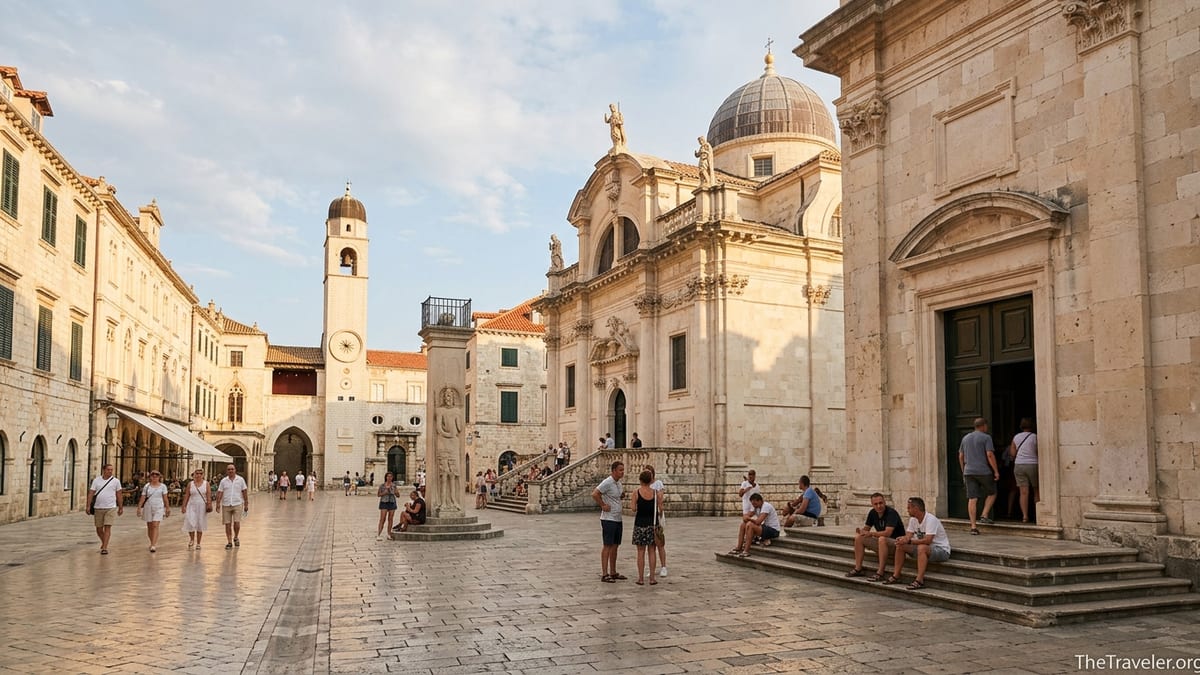
The Church of St Blaise sits on Luža Square, where the main promenade Stradun meets the space in front of the Rector’s Palace. In practical terms that means you cannot explore the Old Town without passing its steps or using its dome and statues as navigation points. Historically, though, the church is even more important. St Blaise, a 4th century bishop and martyr, is the patron saint of Dubrovnik and has been closely tied to the city’s identity for centuries.
Local tradition tells that St Blaise warned the citizens of Dubrovnik about a surprise attack from Venice in the 10th century, allowing them to prepare defenses in time. As a result he became the protector of the medieval Republic of Ragusa, the old name for Dubrovnik, and his image appears on city flags, carved above gates and standing atop the church itself. Each year on 3 February, the Festivity of Saint Blaise fills these streets with banners, folk costumes and religious processions, and the church becomes the heart of the celebration.
For first time visitors this means the building is much more than another tick on a sightseeing list. Pausing in front of the main entrance or stepping briefly inside gives you a window into how Dubrovnik sees itself. Even on an ordinary weekday you will likely see locals stopping to cross themselves or pop in for a quiet prayer while tour groups gather outside. Understanding that everyday connection helps you approach your visit with more respect and curiosity.
The modern Church of St Blaise dates from the early 18th century, replacing an older Romanesque church on the same spot that was badly damaged in a fire. Its Baroque architecture fits the wider look of the Old Town, most of which was rebuilt after the devastating 1667 earthquake, but the symbolism of the building runs much deeper. In many ways, to understand St Blaise is to understand Dubrovnik’s mixture of faith, resilience and civic pride.
A Brief History of the Church and Its Saint
St Blaise was a bishop in Sebastea, in what is now central Turkey, and was martyred around the year 316. Over time he became particularly associated with the healing of throat ailments, with legends describing him saving a boy who was choking on a fishbone. That is why in Catholic tradition he is still invoked against illnesses of the throat and why a special blessing of throats is part of his feast day in Dubrovnik each year.
In Dubrovnik, the cult of St Blaise took on a very local flavor. Historical records show that the Festivity of Saint Blaise has been celebrated in the city continuously since the year 972, making it one of the longest running civic-religious traditions in Europe. In 2009 UNESCO recognized the festivity as part of the Intangible Cultural Heritage of Humanity, acknowledging both its age and its continuing importance to residents today.
The original church dedicated to St Blaise on Luža Square was a Romanesque structure that stood for centuries. After suffering damage in the 1667 earthquake it was finally destroyed by fire in the early 1700s. The current church was built starting in 1706 in a rich Baroque style, with a central dome and an elegant staircase leading up from the square. Venetian architect Marino Gropelli is often credited with its design, which helps explain why its curves and decorative details feel very Italian when compared with some of Dubrovnik’s more austere stone buildings.
For a modern traveler this history is not just background. When you stand on the steps and look up at the statue of St Blaise holding a model of Dubrovnik in his hand, you are looking at a motif that has appeared on everything from medieval seals to modern city branding. Many souvenir shops around the Old Town stock small medallions, charms or postcards showing the same image, which can make a meaningful memento, especially if you have taken the time to visit the church itself.
Finding the Church and Planning Your Visit
The Church of St Blaise is in the very center of Dubrovnik’s Old Town. Once you walk through Pile Gate and down Stradun, the main limestone-paved street, you will reach the far end of the promenade in about ten minutes at a slow pace. The church stands slightly to your left as the street opens into Luža Square, opposite the Sponza Palace and near the tall city bell tower. First time visitors often use it as a mental marker for orienting themselves, because almost all guided walking routes pass this crossroads.
There is no large admission desk or ticket barrier for the church. At the time of writing, entry is free for casual visitors, though this can change if the parish introduces a small fee to help cover restoration or maintenance costs. In practice many travelers drop in for ten to fifteen minutes as part of a wider stroll that might also include the Rector’s Palace and the Cathedral of the Assumption a short distance away. If you are already paying to visit nearby museums, the Church of St Blaise becomes a welcome quiet stop that does not add to your budget.
Opening patterns for churches in Dubrovnik can vary by season and by parish needs, but you can generally expect St Blaise to be open around regular Mass times and for a period during the day for private prayer and visits. Local diocesan information currently lists weekday Mass in the late afternoon for much of the year, and an earlier Mass schedule in summer, with a couple of Sunday morning services. Time these with some flexibility. If you plan a visit around Mass, arrive fifteen to twenty minutes early to find a seat without disturbing others, or aim between services if you prefer a quieter look around.
On a very practical level, the square in front of the church is used for performances during the Dubrovnik Summer Festival and for stages or stands during public events. That can mean sound equipment or seating temporarily partially blocks the main façade. If photographing the exterior is a priority, plan to visit early in the morning before crews arrive or during shoulder season months like April, May, late September or October, when there are fewer large staged events.
Architecture and Art Highlights to Notice
You do not need a degree in art history to appreciate the Church of St Blaise. Start with the exterior: a broad Baroque staircase leads up to a façade rich with columns, niches and sculpted details. Above the main entrance doors stands a statue of St Blaise holding a detailed model of Dubrovnik, complete with its walls and towers. This visual shorthand is everywhere in the city, but its clearest expression is here on the church that carries his name.
Look closely at the façade from the square and you will notice how the curves of the balustrades and the rounded windows contrast with the more rigid Gothic lines of nearby buildings like Sponza Palace. The central dome, visible from several vantage points along Stradun and from the top of the city walls, helps orient you within the Old Town. Many visitors walking the walls use the dome as a reference point when pointing out Luža Square far below.
Inside, the church has a single nave with side altars and a bright, gently ornate interior. Light often filters in through the windows of the dome, catching on gilded details and polished stone. The main altar houses a particularly important statue of St Blaise dating from the 15th century. Remarkably, it survived both the earthquake that reshaped Dubrovnik in 1667 and the later fire that destroyed the earlier church. The statue shows the saint holding that same model of the city, one hand raised in blessing, tying the medieval devotion directly to the modern building.
Depending on ongoing conservation work, you may also see smaller relics, silver objects and votive offerings that speak to centuries of local faith. Many are only brought out in full for the Festivity of Saint Blaise in early February, when a large procession carries reliquaries from the church through the Old Town streets. Even if you visit at a quieter time, pausing in a pew and taking in the side chapels, paintings and carved details gives you a feel for the church as a living space rather than simply a backdrop for photos.
Experiencing Local Traditions and the Festivity of Saint Blaise
If your visit to Dubrovnik happens around the beginning of February, the Church of St Blaise becomes the focal point of one of Croatia’s most atmospheric celebrations. The Festivity of Saint Blaise officially takes place on 3 February each year, with events starting the day before. All the bells of the Old Town ring out, white doves are released in front of the church as symbols of peace, and banners from parishes across the region are brought into the city by people in traditional costumes.
On the feast day itself, a solemn Mass is followed by a grand procession that moves from the church along Stradun and back again. Parishioners carry reliquaries of the saint, many shining silver and gold, while bishops, civic officials and visiting dignitaries walk behind. Crowds line the route and gather on the church steps, and it is common for hotels and guesthouses throughout the city to be busy with domestic visitors and pilgrims. First time travelers who happen to be in town often describe it as an unexpectedly moving glimpse into the city’s spiritual life.
Part of the celebration involves a blessing of throats, reflecting St Blaise’s association with healing. Priests use two crossed candles, held near each person’s neck, and offer a short prayer. Even if you are not Catholic, you are generally welcome to join the line respectfully if you wish to participate. For many locals this ritual is as much about tradition and a sense of belonging as it is about personal piety, and the Church of St Blaise is where it resonates most powerfully.
Outside of February, you can still sense these traditions in smaller ways. Information boards and small brochures available in the Old Town often mention the festival, and some souvenir shops near Luža Square sell images showing the church draped in banners or crowded with worshippers. Asking a local guide about how they personally mark St Blaise’s day can lead to stories about childhood processions, family gatherings after Mass, or watching the doves take flight from the square.
Practical Tips: Dress Code, Etiquette and Photography
As an active parish church, St Blaise deserves the same respect you would show in any place of worship. Dress expectations are similar to those in other European churches. Shoulders should be covered and shorts or skirts should reach at least mid thigh; in high summer when many visitors wear beachwear, it is wise to carry a light scarf or linen shirt that you can slip on quickly before entering. Flip flops are common on the streets but more discreet footwear is appreciated inside, especially during Mass.
Once inside, keep voices low and move slowly, particularly if people are praying. If a service is underway, it is better to find a place at the back or along the side wall and wait until a natural pause before exploring side chapels. Flash photography is generally discouraged; even when not explicitly forbidden, it can feel intrusive in a dim sacred space. A good approach is to take a few wider shots without flash, then put your phone or camera away and spend some time simply looking.
If you want to attend Mass, aim to arrive at least ten minutes early. Locals tend to sit towards the front, leaving some space at the back where visitors can join without displacing regular parishioners. There is no expectation that non Catholics participate in communion, but you are welcome to stand or sit with the congregation. If you are unsure of the current Mass times, check with your hotel reception or at the local tourist information office, which often has the latest church schedules for visitors who wish to attend services across the city.
There is usually a donation box near the entrance or beside a stand of votive candles. While there is no pressure to contribute, leaving a small offering in local currency helps support the ongoing maintenance of the building. If you light a candle, take a moment of quiet reflection. It is a simple act that connects you with a long line of travelers and residents who have done the same over the centuries.
Combining the Church with Nearby Sights
Because of its central location, the Church of St Blaise fits naturally into almost any Old Town walking route. One popular loop for first time visitors begins at Pile Gate, strolls down Stradun to the Franciscan Monastery, continues past Orlando’s Column and arrives at Luža Square in front of the church. From there you can continue to the Rector’s Palace and the Cathedral of the Assumption, all within a few minutes’ walk. This route gives you a strong sense of how closely packed Dubrovnik’s major sights are and how central St Blaise is to that network.
Another realistic pairing combines the church with a walk on the city walls. Many travelers start the walls in the morning to avoid the strongest heat and then come down around lunchtime. Descending near the Old Port side leaves you only a short stroll to Luža Square, where the church steps provide a handy meeting point or a place to pause and catch your breath. In late afternoon and early evening, the lighting on the façade softens, which is helpful if you are looking to take photos without the harsh overhead glare of midday.
During the Dubrovnik Summer Festival, stages are sometimes built on or near the church steps for open air concerts and theater performances. If you happen to have tickets for an evening show in the square, plan to arrive a little early and slip into the church for a few minutes of calm before the event starts. It can be a striking contrast to step from the quiet interior out into a lively square filling with audiences and performers.
For travelers on a tight schedule, the church also works well as a quick stop between other commitments, such as a timed visit to the City Walls or a pre booked boat trip from the Old Port to Lokrum Island. Since you do not need a ticket or a specific time slot, you can simply step in whenever you find a free quarter of an hour nearby.
The Takeaway
For a first time visitor to Dubrovnik, the Church of St Blaise offers a compact but powerful introduction to the city’s character. It stands at the heart of the Old Town’s daily life, linking centuries of history with ongoing traditions that locals still cherish. Whether you stop for three minutes on the steps, spend half an hour exploring the interior, or time your trip to coincide with the February festival, the church helps make sense of the stone streets and stately palaces around it.
Because it is free to enter and easy to reach, there is no reason to miss it, yet many travelers remember it as much for the atmosphere as for any individual artwork or architectural feature. The sight of St Blaise holding a model of Dubrovnik in his hand, watching over crowds of visitors and residents passing below, captures a great deal about this city’s story in a single image. Building a visit here into your plans is one of the simplest ways to deepen your understanding of Dubrovnik beyond the postcard views.
FAQ
Q1. Where exactly is the Church of St Blaise in Dubrovnik?
The Church of St Blaise stands on Luža Square at the eastern end of Stradun in Dubrovnik’s Old Town, close to the Rector’s Palace and the city bell tower.
Q2. Is there an entrance fee to visit the Church of St Blaise?
At present there is no fixed admission fee for casual visitors and you can usually enter free of charge, although small voluntary donations inside are appreciated.
Q3. What are the usual opening hours of the church?
Opening times vary by season and parish schedule, but the church is generally open around daily Mass and for several hours during the day. Check locally for current times during your visit.
Q4. Can non Catholics attend Mass at the Church of St Blaise?
Yes. Visitors of any faith are welcome to attend Mass as long as they behave respectfully. Only practicing Catholics normally receive communion, but everyone may sit or stand with the congregation.
Q5. Is there a dress code for visiting the Church of St Blaise?
Modest dress is expected. Shoulders should be covered and shorts or skirts should be of a reasonable length. Bringing a light scarf or shirt to slip on works well in summer.
Q6. Are photos allowed inside the church?
Non flash photography is usually tolerated when no service is taking place, but visitors should avoid flash, be discreet, and prioritize the prayerful atmosphere over getting the perfect shot.
Q7. How long should I plan to spend at the Church of St Blaise?
Most first time visitors spend about ten to twenty minutes exploring the interior and exterior, though you may want longer if you attend Mass or enjoy studying the artwork in detail.
Q8. What is special about visiting on 3 February?
On 3 February Dubrovnik celebrates the Festivity of Saint Blaise with Mass, a major procession and traditional rituals. The church and surrounding streets are full of worshippers, banners and music.
Q9. Is the Church of St Blaise accessible for visitors with limited mobility?
There is a flight of steps up to the main entrance that can be challenging for some visitors. If mobility is a concern, it is worth asking a local guide or tourist office about current access options or assistance.
Q10. What other sights can I combine with a visit to the Church of St Blaise?
The church is only steps from the Rector’s Palace, Sponza Palace, Orlando’s Column, the Cathedral and the Old Port, making it easy to include in any central Old Town walking route.