


If you follow the natural flow of Dubrovnik’s Old Town, you will almost inevitably find yourself in front of the Church of St Blaise. Set where the Stradun opens into Luža Square, facing the clock tower, Orlando’s Column and Sponza Palace, this compact Baroque church is impossible to miss. The question many visitors quietly ask themselves is simple: is it actually worth stepping inside during a crowded Old Town walk, or is a quick photo from the square enough?
Get the latest updates straight to your inbox!
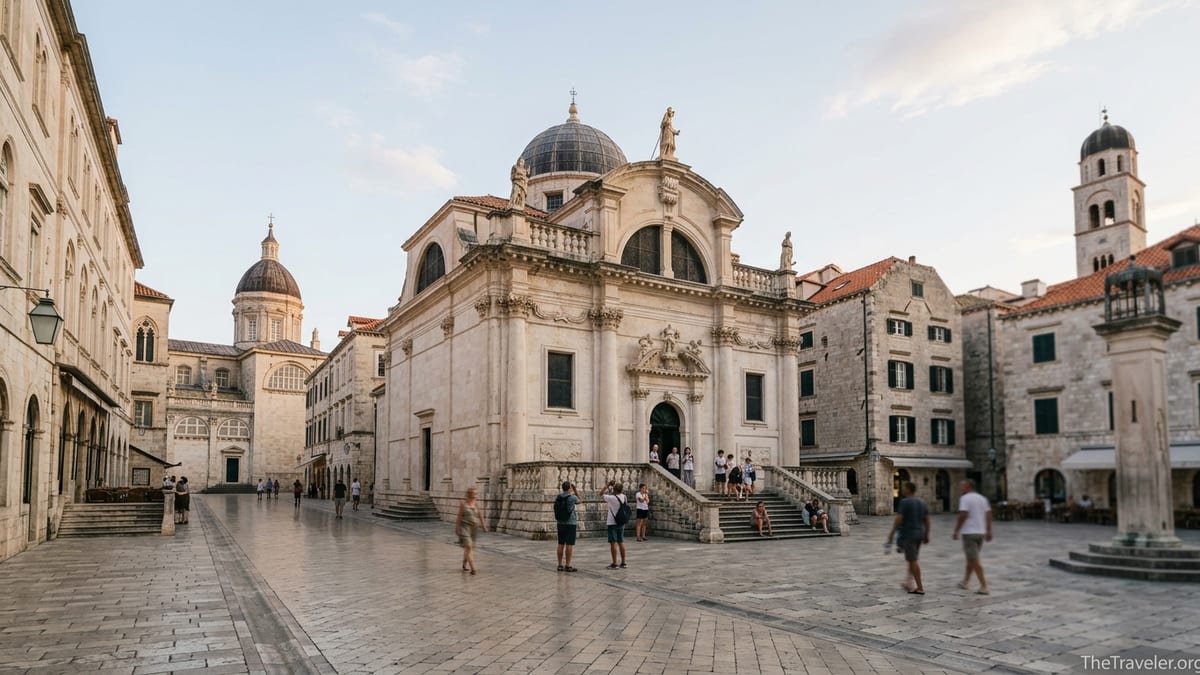
Where the Church of St Blaise Fits into an Old Town Walk
For most travelers, the Church of St Blaise is not a separate “trip” but a natural pause on a wider Old Town route. If you enter through Pile Gate and stroll the full length of the Stradun, the broad promenade that cuts through the heart of Dubrovnik, you will end your walk in Luža Square. Here the church sits slightly elevated above the paving stones, fronted by shallow steps and framed by Sponza Palace on one side and the clock tower and Orlando’s Column on the other. It is one of the Old Town’s busiest junctions, where walking tours cluster and street life seems to fold in around the church façade.
This location alone makes St Blaise almost impossible to skip. Even if you are mainly focused on the city walls or on ticketed attractions like Rector’s Palace and the cathedral treasury, you will likely pass through Luža Square several times in a day. From the church steps you can see the entrance to Rector’s Palace just a few meters away, the approach to the old harbor at the end of the square, and the continuation of smaller streets that lead toward the Dominican Monastery and the Ploče Gate side of town. In other words, the church is positioned exactly where many visitors pause to check their map, catch their breath or decide what to see next.
Because of this, the real decision is not whether you should go out of your way to find St Blaise. It is whether you should invest a short chunk of your limited Old Town time in stepping inside and taking a closer look, or simply photograph the exterior and keep moving. For most travelers who are already walking past, the time and effort required are minimal: you are looking at five to fifteen minutes, depending on how long you linger over the details.
History, Architecture and What You Will Actually See
The Church of St Blaise that you see today dates from the early 18th century and is an example of Venetian Baroque architecture, with a central dome, a richly decorated façade and a compact, cross-shaped plan. It replaced an earlier church that was badly damaged, and ultimately destroyed, in a fire. Local accounts often highlight one detail that locals still reference with pride: while much of the earlier church’s interior was lost, a silver-gilt Gothic statue of St Blaise survived the blaze. That same statue now dominates the main altar, giving the small building a direct link to Dubrovnik’s medieval past.
Approaching from the square, you notice the broad staircase that leads to the main entrance, the Corinthian columns that divide the façade, and niches holding statues of saints. The dome rises above the roofline, visible from many angles in the Old Town and especially striking if you later look back from the city walls. Photographers frequently use the church as a focal point for shots that take in Luža Square, with the clock tower in the background and café tables filling the space around it.
Inside, the church is unexpectedly ornate for its size. The nave is lined with marble altars, gilded decoration and religious paintings. The main altar, in particular, rewards a closer look: the polished white and colored marble, the sculpted details and the glowing silver-gilt figure of St Blaise holding a model of Dubrovnik. Even travelers who do not consider themselves especially religious often comment that the interior feels intimate rather than overwhelming, especially compared with some of Europe’s larger cathedrals. If you are walking in from the bright Mediterranean light on Stradun, the slightly dimmer, cool interior can also feel like a welcome sensory pause.
Cultural Meaning: Why St Blaise Matters to Dubrovnik
To understand whether the church is “worth it,” it helps to know that St Blaise is not just another saint here; he is woven into Dubrovnik’s identity. Local tradition holds that he warned the city of an impending attack in the medieval period, prompting the authorities to strengthen their defenses in time. From that point, he became the city’s patron, and his figure appears everywhere: carved above gates, sculpted on city walls, and carried on banners during civic processions. Walking through Old Town, you will see his likeness so often that stepping inside the church dedicated to him offers a neat way to tie those visual fragments together.
The most vivid expression of this connection happens each year on 3 February, during the Feast of St Blaise. If you happen to be in Dubrovnik around that date, Luža Square and the church transform into the heart of a multi-day celebration, with processions of locals in traditional costumes, flags, church bells, and a mix of solemn religious rites and public festivity. For visitors, it is an intense, very local experience that looks nothing like the standard summertime tourist flow. At other times of year, the church remains a working parish, hosting regular Mass as well as weddings, concerts and occasional cultural events, which explains why the doors may sometimes be closed briefly even in the middle of the day.
Even if you do not time your visit to any special event, simply knowing the role St Blaise plays in Dubrovnik’s story can shift how you experience the space. Instead of seeing “just another Baroque church,” you see the building that anchors the city’s patronal cult, that faces the main civic square, and that still serves as the backdrop for many official occasions. For travelers interested in how faith, politics and public space intertwine in historic cities, this is a compact, readable example.
Practical Visiting Experience: Time, Cost and Crowds
On a practical level, visiting the Church of St Blaise is about as easy as Old Town sightseeing gets. There is currently no entrance fee; you simply walk up the steps and, if the doors are open, step inside. For budget-conscious travelers already paying for the city walls, the Dubrovnik Pass, or entries to places like Rector’s Palace or the cathedral treasury, the fact that St Blaise is free can be appealing. It gives you access to a historic interior and a sense of local religious life without consuming any of your ticket budget.
In terms of time, most independent travelers spend roughly 5 to 20 minutes inside. If you are with a guided walking tour, your guide may pause outside to explain the history and symbolism of the church, perhaps point out the statue of St Blaise on the main altar through the open doorway, and then give you a few minutes of free time to explore or take photographs. Even at the upper end of that scale, it is a small investment compared with, say, an hour on the city walls or 60 to 90 minutes in Rector’s Palace. This makes it easy to fit between larger, more time-consuming stops.
Crowds can vary. In peak summer, Luža Square can feel dense with tour groups between late morning and mid-afternoon. Inside the church, though, people tend to circulate quickly. Unlike the city walls queue or the bottlenecks you sometimes find at the entrances to major museums, you rarely face a long wait to enter. Early morning and evening, when the stone of the square has cooled and cruise groups have thinned, can feel particularly atmospheric. Stepping inside at those times gives you a quieter, more reflective experience that contrasts nicely with the hum of the surrounding streets.
Accessibility, Dress Code and When to Prioritize Other Sites
Old Town Dubrovnik is inherently challenging for anyone with mobility issues, but within that context, the approach to the Church of St Blaise is relatively gentle. The Stradun itself is broad and flat, paved with polished stone. From there, a short stretch of Luža Square leads to the church steps. There is a small but noticeable flight of stairs up to the main entrance, which can be a barrier for some wheelchair users or travelers with limited mobility. Depending on current arrangements, you may find a side or service entrance sometimes used during services, but it is not consistently available as an official step-free visitor route.
Inside, the floor is mostly level, and the space is compact enough that you do not need to walk long distances to appreciate the interior. Benches provide a place to sit for a few minutes, which is particularly welcome on hot days or after time on the walls. If you or someone in your group uses a wheelchair, it can help to treat St Blaise as a “maybe” stop: enjoy the view from the square, and if you see staff or parishioners entering, you could politely ask whether there is an accessible way in at that moment, while being prepared that there may not be.
As with most active churches in Croatia, modest dress is expected. In practice, this means covering shoulders and avoiding very short shorts. Many summer visitors step in wearing T-shirts, sundresses or linen shirts paired with knee-length shorts and have no issue. If you have just come from the beach in swimwear or a bare torso, you should plan to return later. Because the church is actively used for worship, you may sometimes encounter a Mass or wedding taking place. In those cases, it is courteous not to wander in for sightseeing; instead, step back and enjoy the view from outside.
If your time in Dubrovnik is extremely short, you might reasonably prioritize other stops over going inside St Blaise. For example, if you only have a few hours and must choose between the city walls, Rector’s Palace, the Franciscan Monastery with its historic pharmacy, and the cathedral treasury, those paid attractions arguably offer more depth and require more time. In that scenario, treating St Blaise as a quick exterior photo stop rather than a full interior visit is a defensible choice, especially if churches are not a particular interest for you.
Photography, Atmosphere and Pairing with Nearby Highlights
For many travelers, the answer to whether St Blaise is worth it comes down to photography and atmosphere. The church façade, lit by late afternoon sun reflecting off the pale stone of Luža Square, makes a classic Dubrovnik image. From the steps, you can frame the square with Sponza Palace to one side and the clock tower rising above the crowd. In the blue hour after sunset, the church’s stone takes on a warm glow under streetlamps, while the dome is silhouetted against the darkening sky. Even a five-minute stop can yield some of your most memorable Old Town shots.
Inside, conditions are lower light, so you may need to steady your camera or phone to avoid blur. Wide shots that take in the dome, the main altar and side altars convey the richness of the Baroque interior. Detail-oriented photographers will find plenty of close-up subjects: the folds of sculpted drapery on statues, the gleam of the silver-gilt St Blaise figure, or the interplay of light and shadow on the marble surfaces. Because the space is small, it is easy to wait a moment for gaps in the flow of people, especially outside the busiest midday window.
In terms of itinerary planning, the church pairs naturally with several nearby highlights. A common pattern for first-time visitors is to start on the city walls early in the morning, descend back into Old Town around late morning, then follow Stradun to Luža Square. After a short visit to St Blaise, you can continue immediately to Rector’s Palace next door, then the cathedral and treasury a few steps further on. Alternatively, you might explore the Dominican Monastery and harbor area first, loop back into Luža Square, and then pause at the church before heading to a café or gelato shop just off the square.
If you prefer evening sightseeing to avoid the heat, St Blaise can be your anchor point for a twilight wander. As the day-tripping crowds recede, locals emerge to chat in front of Sponza Palace, children play in the square, and the cafés along the edges grow busier. Stepping into the softly lit church at this time gives you a striking contrast: the quiet, echoing interior framed by the distant conversations and clink of glasses outside. For travelers seeking not just “sights” but moods and moments, this combination can make the church feel very much worth the stop.
The Takeaway
So, is the Church of St Blaise in Dubrovnik worth visiting during your Old Town walk? For most travelers already passing through Luža Square, the answer is yes, with a few caveats. The church costs nothing to enter, sits directly on the main pedestrian route, and requires only a short time commitment. In return, it offers a richly decorated Baroque interior, a tangible connection to Dubrovnik’s patron saint, and a quieter, more reflective counterpoint to the busy square outside.
That said, the church is best understood as part of a cluster of experiences rather than a stand-alone headline attraction. If you are very short on time or completely uninterested in churches or religious history, a respectful look from the outside may be enough. But if you are curious about how Dubrovnik’s civic and spiritual life intersect, or if you simply appreciate fine architecture and atmospheric interiors, stepping through the doors for ten or fifteen minutes can add real depth to your impression of the Old Town.
In practical terms, treat St Blaise as a flexible component in your route: step inside if the doors are open and the timing feels right, pair it with nearby highlights like Rector’s Palace and the cathedral, and enjoy the vantage point it gives you on one of Dubrovnik’s most beautiful squares. For a small investment of time, it offers an outsized sense of place, making it a worthwhile stop for most visitors charting their walk through Dubrovnik’s walled city.
FAQ
Q1. Is there an entrance fee for the Church of St Blaise in Dubrovnik?
There is typically no entrance fee to visit the Church of St Blaise. You simply walk up the steps and, if the doors are open, you can enter without a ticket.
Q2. How much time should I plan for a visit to St Blaise during my Old Town walk?
Most visitors spend between 5 and 20 minutes inside. That is enough to look around the nave, admire the main altar and take a few photos before continuing.
Q3. What is the best time of day to visit the Church of St Blaise?
Early morning and evening tend to be calmer, both in Luža Square and inside the church. Midday and early afternoon can be busier, especially on days when cruise ships are in port.
Q4. Is the Church of St Blaise wheelchair accessible?
The approach along Stradun and Luža Square is flat, but there is a short flight of steps up to the main entrance. Step-free access is limited and not consistently available, so visitors with wheelchairs may find it difficult to enter.
Q5. Do I need to wear specific clothing to enter the Church of St Blaise?
Modest dress is recommended. Shoulders should be covered, and very short shorts or beachwear are best avoided. Casual summer clothing that covers shoulders and roughly knee-length shorts are generally acceptable.
Q6. Can I take photos inside the Church of St Blaise?
Photography without flash is usually tolerated, especially outside of services. Always check for any posted signs and avoid photographing during Mass or private ceremonies such as weddings.
Q7. Is the Church of St Blaise worth visiting if I am not religious?
Yes. Many visitors appreciate the church for its Baroque architecture, artwork, and sense of calm rather than for religious reasons. It also helps explain why the figure of St Blaise appears so often around Dubrovnik.
Q8. How does St Blaise compare to other churches in Dubrovnik?
St Blaise is smaller than the cathedral but has a more intimate, ornate Baroque interior. It is also more central to Dubrovnik’s civic identity than many other churches, given its location and dedication to the city’s patron saint.
Q9. Can I attend Mass at the Church of St Blaise?
Yes, it is an active parish church and holds regular Mass. Times may vary by season, so it is best to check locally once you arrive in Dubrovnik if you wish to attend a service.
Q10. How does the Church of St Blaise fit into a one-day Dubrovnik itinerary?
On a one-day visit, most people include St Blaise as a short stop after walking down Stradun and before or after visiting nearby attractions like Rector’s Palace and the cathedral, making it a convenient and logical part of an Old Town loop.