


Hong Kong International Airport is one of Asia’s busiest hubs and a common stop between North America, Europe and the rest of Asia. With the opening of its revamped Terminal 2 in May 2026 and frequent tweaks to transport and services, it helps to arrive with an up-to-date game plan. This guide walks you step by step through how the airport works today, with concrete examples of prices, timing and what to expect at each stage of your journey.
Get the latest updates straight to your inbox!
Getting Oriented: Terminals, Layout and Transfers
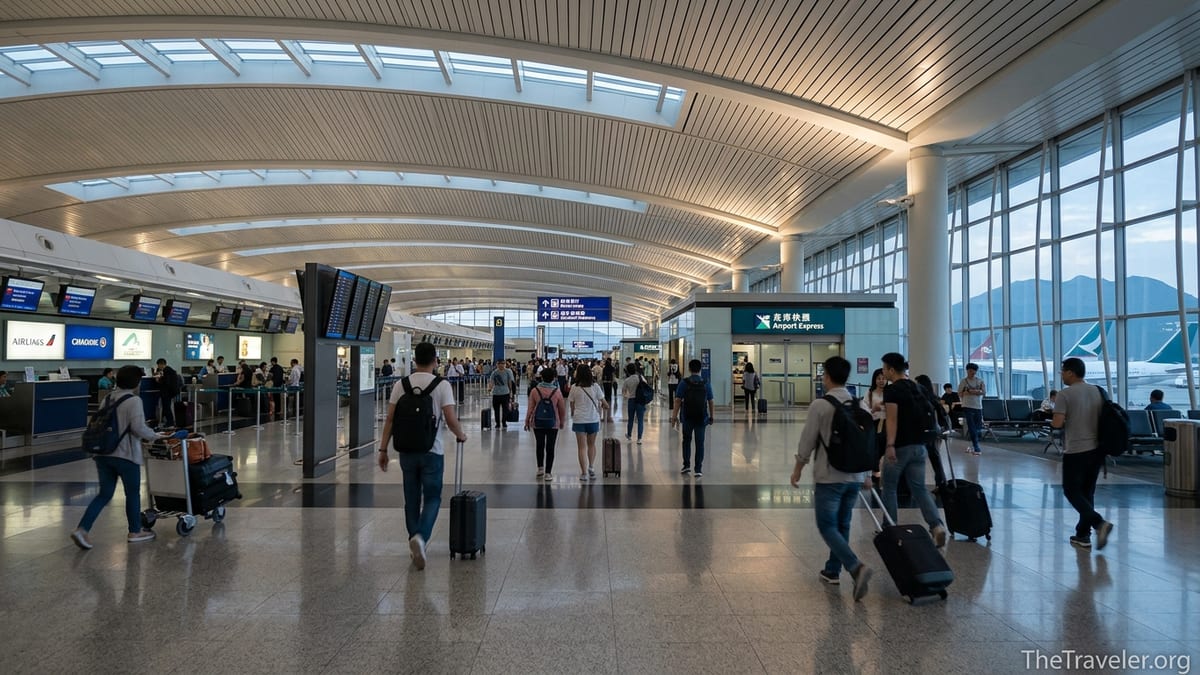
Hong Kong International Airport sits on reclaimed land at Chek Lap Kok and currently has two main passenger terminals in full use: Terminal 1 and the newly reopened, expanded Terminal 2. Most arrivals and many departures still operate from Terminal 1, which is vast but well signed, with long concourses and an internal Automated People Mover train linking different gate areas. Terminal 2, whose departure facilities reopened in late May 2026, now functions primarily as a departures and check in hall, connected to the Airport Express platforms and Terminal 1 rather than as a standalone arrivals terminal.
If you land at Terminal 1, you will usually follow standard signs for immigration, baggage claim and customs. The walk from a long-haul gate near the far end of the concourse to immigration can easily take 10 to 15 minutes at a normal pace, so factor this in if you have a tight onward connection. Once you clear customs, you emerge into the Arrivals Hall with clear signage to transport, including the Airport Express train, buses, taxis and hotel shuttles. Travelers connecting to Pearl River Delta ferries will see signs for SkyPier transfer counters before immigration, where staff can route you to ferries bound for destinations such as Macau, Zhuhai or Shenzhen without formally entering Hong Kong.
With Terminal 2 now open for departures, some airlines will direct you to check in there even if your flight uses a gate physically located in Terminal 1. In practice, this means you might arrive at T2 via bus, Airport Express or private car, check in and complete departure formalities, then follow signs through a connected corridor system and people mover to reach the main Terminal 1 gate areas. Staff and signage are currently geared toward guiding first-time users, but you should still budget extra time, particularly in the first months of operation while airlines and passengers adapt.
The airport is well suited for self-guided transfers, but walking distances and vertical changes can surprise those with mobility issues or heavy bags. Elevators and travelators are plentiful; if you need assistance, look for the Airport Care Ambassadors in teal uniforms or ask at information counters in both terminals. For longer connections of 4 hours or more, the integrated layout makes it easy to move between public and airside zones to access dining, lounges and even short local excursions if you are eligible to clear immigration.
Arrivals, Immigration and Customs: What to Expect
For most international arrivals, immigration is straightforward but can vary in timing depending on how many flights land simultaneously. Early morning long-haul banks and late evening arrivals from Europe can see longer lines than midday regional flights. As of mid 2026, many travelers, including visitors from visa-exempt countries such as the United States, Canada and most of Western Europe, can use e-channels if pre-enrolled or if their passports meet specific criteria, which typically shortens processing to just a few minutes. Standard manned counters remain available for visitors who need extra checks or are entering Hong Kong for the first time.
Once through immigration, baggage claim is arranged in wide halls with large, clearly numbered carousels. On a typical full widebody flight from North America or Europe, bags often start appearing 15 to 25 minutes after landing, although that can stretch longer during peak arrivals. Free trolleys are available directly on the carousel floor. Customs is usually a quick green or red channel walk-through; officers may randomly inspect, but most travelers simply stroll through without delay. Restricted items such as large amounts of tobacco, certain prescription drugs or high-value electronics may be subject to declaration or duty, so check the Hong Kong government’s latest guidance before flying.
Transit passengers who are not entering Hong Kong follow dedicated transfer signs and are routed directly from arrival gates through security and into the departures concourses. If your bags are checked through and you already have a boarding pass, this can be a smooth 20 to 40 minute process, even when moving between distant gates. However, if you need to change airlines on separate tickets, you may have to clear immigration, collect luggage and re-check at departures. For example, a traveler arriving on a US airline and connecting to a low-cost carrier that does not interline will almost always need to enter Hong Kong, pick up bags and head to the public check in halls before going back through security.
For standby passengers and those without confirmed seats, be aware that Hong Kong International Airport generally only allows you to proceed through outbound immigration once you hold a confirmed boarding pass with a seat assignment. If you are waiting for last-minute clearance, you may have to remain landside in the check in area or airline service desk zone until the airline can issue your boarding pass. This is especially relevant to airline staff travelers, non-revenue passengers and those trying to reroute during delays or cancellations.
Leaving the Airport: Trains, Buses, Taxis and Rides
One of the main reasons frequent travelers praise Hong Kong International Airport is its connectivity to the city. The flagship option is the Airport Express train, which runs between the airport and Hong Kong Station in Central with intermediate stops at AsiaWorld-Expo, Tsing Yi and Kowloon. Typical journey time from the airport to Hong Kong Station is around 24 minutes, and trains generally run every 10 to 12 minutes from early morning until after midnight. Fares vary by distance and ticket type, but as a ballpark example, an adult single ticket from the airport to Hong Kong Station usually costs around the equivalent of 20 to 25 US dollars when priced in Hong Kong dollars, with discounts available for round trips, groups and online purchases.
For many travelers, especially solo visitors heading to hotels in Central, Sheung Wan or Admiralty, the Airport Express is the fastest, most hassle-free choice. From Hong Kong Station, you can walk via air conditioned passages into the IFC complex, connect to the Island and Tung Chung MTR lines, or use airport-linked hotel shuttles and short taxi rides. If you are staying in Kowloon, disembarking at Kowloon Station allows similar easy access to Tsim Sha Tsui and Jordan via free or low-cost shuttles, taxis or a short hop on the MTR. If you are traveling during a promotional period, such as the 2026 all-day Morning Express extension where journeys from Kowloon or Tsing Yi to Hong Kong Station are discounted, local commuters may share your train, but there is typically still plenty of space for luggage.
Airport buses provide a more economical, if slower, alternative. Several Citybus and Long Win Bus routes connect the airport to major districts on Hong Kong Island, Kowloon and the New Territories. For instance, a typical airport bus from the airport to Central or Wan Chai might cost roughly a quarter to a third of the Airport Express fare, with travel times ranging from 45 minutes to over an hour depending on traffic. The trade-off is that buses can get crowded at peaks, involve climbing stairs for upper decks and leave you closer to street level rather than directly inside a mall or MTR interchange. Still, for budget conscious travelers or anyone whose hotel sits directly on a bus route like those serving Nathan Road, airport buses can be the most direct option.
Taxis queue at a dedicated rank outside the Arrivals Hall, separated into red, green and blue lines for urban, New Territories and Lantau Island services respectively. A typical red urban taxi fare from the airport to Central or Tsim Sha Tsui often lands in the equivalent of 40 to 60 US dollars, depending on traffic and tunnel tolls. This can be the most efficient door to door option for families with several large bags or groups of three passengers splitting the fare. Rideshare-style services are less formalized than in some cities, with many visitors instead using local taxi-hailing apps or arranging car services through hotels. Pre-booked private transfers are widely available and can be cost effective for larger groups, but you should confirm pickup locations and driver contact details in advance to avoid confusion amid the busy arrivals forecourt.
Check In, Security and Departures
On departure, your experience will differ slightly depending on whether you check in at Terminal 1, Terminal 2 or in-town. Terminal 1 remains the main check in hall, with airline counters arranged by zone and departure time. With the reopening of Terminal 2 as a departure hall connected to the Airport Express, some airlines are gradually moving check in desks there to relieve congestion, so always follow your airline’s latest instructions. Typical guidance is to arrive at the airport at least two hours before regional flights and three hours for long-haul services. During peak travel periods such as Lunar New Year, summer holidays and major trade fairs, many Hong Kong based travelers still arrive even earlier.
A signature Hong Kong convenience is in-town check in for the Airport Express at Hong Kong Station and, for some airlines, Kowloon Station. Eligible passengers can check in baggage and receive boarding passes in the city center several hours before flying, then travel to the airport with only personal items. As of March 2026, for example, carriers like China Airlines and Mandarin Airlines have been added to the roster offering check in at Hong Kong Station, while major regional and long-haul airlines such as Cathay Pacific typically maintain in-town services on core routes. In a practical scenario, a business traveler might finish afternoon meetings in Central at 4 pm, check in bags at Hong Kong Station immediately, enjoy early dinner in the IFC mall, and then board the Airport Express at 6 pm for a 9 pm long-haul flight, bypassing most airport counter lines entirely.
Security at Hong Kong International Airport is generally efficient but thorough. Liquids, aerosols and gels restrictions apply in line with common international standards: containers of 100 milliliters or less in a single transparent bag of limited capacity, with exemptions for items like baby food and certain medications. Laptops and larger electronics may need to be removed. During busy evening long-haul banks, queues can build at central security, but overflow lines and additional lanes are usually opened. Families and travelers with reduced mobility can request priority or assistance; staff members are used to handling strollers, wheelchairs and oversized carry-ons.
Once airside, departure gates radiate off concourses lined with shops and restaurants. Walking distances can be considerable, particularly for gates serving large aircraft. Local experience suggests that if your boarding pass lists a gate in the high 60s or 70s, you should ideally be at least in the general vicinity 30 to 40 minutes before boarding start, not still shopping at the opposite end of Terminal 1. Flight information displays are frequent, and gate changes are announced in both English and Chinese, but it pays to keep an eye on the screens, especially during adverse weather when typhoons or heavy rain can disrupt schedules.
Lounges, Wi‑Fi, Money and Practical Essentials
Hong Kong International Airport caters well to both premium and budget travelers seeking a comfortable pre-flight wait. Major airline lounges, including those of Cathay Pacific and other oneworld, Star Alliance and SkyTeam carriers, are clustered in various concourses and typically offer hot food, showers, quiet workspaces and panoramic runway views. Independent pay-per-use lounges and nap pods provide options for economy passengers, with fees usually in the range of what you might pay for an airport hotel day room in other cities, though with shorter maximum stays. If you are connecting on a long layover, booking one of these spaces in advance can be a sensible way to rest and shower without leaving the airport.
Free Wi‑Fi is available throughout terminals and is generally fast enough for streaming, remote work and video calls. To connect, you typically select the airport network, accept terms and may need to refresh or reconnect after a time limit. Many travelers also carry local eSIMs or physical SIM cards; Hong Kong’s telecommunications operators maintain kiosks and vending machines in arrivals halls selling tourist data packages valid for several days to a month. For instance, a short stay visitor might buy a local data-only eSIM providing several tens of gigabytes of data for the rough price of a couple of coffee shop drinks in the city.
Currency exchange counters and ATMs are scattered throughout both arrivals and departures. Hong Kong dollars are the standard cash currency, and while exchange rates at airport counters can be slightly less favorable than in the city, the convenience can outweigh the cost if you only need a small amount for initial transport or snacks. Many services, from Airport Express tickets to convenience stores, accept credit and debit cards, and contactless payments are increasingly common. However, the city still heavily uses the stored-value Octopus card for local transport and small purchases; visitors can buy or top up cards at machines and counters in the airport and then tap to pay on MTR, buses and in many shops.
For day-to-day practicalities, the airport offers luggage storage, shower facilities in some lounges and public rest areas, and a range of family services such as nursing rooms and children’s play zones. A real-world example is a family with a long midday layover storing heavy checked-style luggage at a landside storage counter, then taking only small backpacks into the city for a quick harbor-view lunch before returning in the evening. Information desks can advise on opening hours and fees, which are usually calculated per bag and per hour or per day.
Food, Shopping and What to Do on a Layover
The airport’s dining scene continues to evolve, especially with the reopening of Terminal 2’s expanded airside zone. Across Terminal 1 and Terminal 2, you will find everything from fast food to Hong Kong style cha chaan teng cafes and international chains. For a quick, familiar bite, outlets such as McDonald’s and Starbucks appear in multiple locations. Travelers looking to sample local flavors before departure can seek out places serving wonton noodles, roast meats or milk tea; even simple airport versions often earn better reviews than equivalents in some other hubs. In Terminal 2’s revamped area, new offerings described by local press include additional Japanese eateries and Asian comfort food options popular with regional travelers.
Food prices are on the higher side compared with downtown but in line with other major global airports. A basic fast food meal might cost the equivalent of 8 to 10 US dollars, while a sit-down restaurant main course could range from 15 to over 30 dollars depending on the concept. Coffee drinks in international chains are usually priced within a small margin of what you would pay at a branch in Central or Tsim Sha Tsui. One practical strategy if you are budget conscious is to eat a fuller meal in the city, using something like a congee shop near Hong Kong Station or a dim sum restaurant in Kowloon, and then rely on lighter snacks or drinks at the gate.
Shopping is extensive, with duty free outlets selling cosmetics, skincare, electronics, wine and spirits, as well as fashion boutiques and Hong Kong themed souvenir shops. Premium brands line the central airside avenues, while newsstands and convenience stores offer travel essentials such as chargers, travel pillows and over-the-counter medicines. Prices for luxury goods are usually aligned with the city’s high-end malls; visitors sometimes take advantage of promotions tied to flight boarding passes or tourist campaigns, such as small discounts or gifts-with-purchase for same-day travelers. If you are hoping to claim tax refunds, remember that Hong Kong does not operate a general VAT refund scheme like some other destinations, so you should evaluate purchases based on sticker prices rather than anticipated rebates.
On layovers of three to six hours, many travelers simply explore the shops, dine and enjoy the architecture. Large windows provide views of taxiways and runways, and there are occasional art installations and exhibition spaces sponsored by cultural institutions. For longer daytime layovers where you are eligible to enter Hong Kong, a popular real-world pattern is to ride the Airport Express into Central, walk through the IFC and along the harborfront, then return on an off-peak train, all within a six- to eight-hour window. With careful planning, this can include a quick tram ride to the Mid-Levels, a visit to a nearby temple or a meal in a neighborhood restaurant before heading back for your onward flight.
Health, Safety and Travel Formalities
Hong Kong maintains high standards of cleanliness and safety at its main airport. Following the acute phase of the COVID-19 pandemic, the city shifted to treating COVID-19 as an endemic respiratory disease, and most dedicated border restrictions and quarantine rules have been gradually removed. As of mid 2026, there are no broad quarantine requirements for typical short-stay visitors who are not arriving from designated high-risk zones, although airlines and authorities continue to adjust rules for individual regions as global health conditions evolve. Masks are generally optional in airport public spaces, though you may still see some passengers and staff choosing to wear them, especially during flu season.
Travelers are encouraged by local health authorities to keep vaccinations, including seasonal influenza and COVID-19 boosters, up to date according to age and risk profile. Temperature screening and health information posters remain in place in some parts of the airport, but day-to-day processes for most travelers closely resemble those in other major global hubs. It is still prudent to carry basic health supplies in your hand luggage, such as a few high-quality masks, travel-sized hand sanitizer and any personal medications, particularly if you will be in crowded immigration halls or shared transport.
From a security standpoint, Hong Kong International Airport has comprehensive CCTV coverage, visible police and aviation security staff, and routine screening checkpoints. Petty crime is relatively low compared with many airports globally, but unattended bags can still attract attention from security teams, and pickpockets may target distracted travelers in crowded areas. A practical safeguard is to keep passports, boarding passes and high-value electronics in a single small crossbody bag or under-clothing wallet rather than in a rolling suitcase that may leave your line of sight during check in and boarding.
Immigration rules remain distinct from those of Mainland China, so a visa or permit that allows entry to Shenzhen or Guangzhou does not automatically grant entry to Hong Kong, and vice versa. For example, a traveler flying from Europe to Hong Kong, then on to Shanghai, may be able to enter Hong Kong visa-free for a few days depending on nationality, but still need a separate visa or visa-free transit arrangement for Mainland China. Similarly, those using SkyPier ferries to reach Macau or Zhuhai directly from the airport must meet the entry requirements of the respective jurisdictions. Because regulations can change with relatively short notice, especially in response to public health or security events, always verify details with official government or consular sources shortly before travel.
The Takeaway
Hong Kong International Airport remains one of the most efficient and traveler-friendly hubs in Asia, and recent changes, including the reopening of an expanded Terminal 2 and new Airport Express platform arrangements, are aimed at supporting long-term growth. For visitors, the key to a smooth experience is understanding how the pieces fit together: fast rail into the city balanced against cheaper buses and taxis, in-town check in as a powerful time-saver, and a terminal layout that rewards those who budget generous walking time to gates.
By anchoring your plans to a few practical benchmarks, such as allowing at least an hour from hotel to gate when using the Airport Express from Central, or budgeting a similar window from touchdown to city center during normal operations, you can reduce stress and make room for the airport’s better touches, from skyline views to good food. Combined with Hong Kong’s compact urban core and extensive public transport, the airport serves not only as a transit node but as an efficient extension of the city itself.
Whether you are a first-time visitor navigating immigration and currency exchange, a frequent flyer maximizing lounge time between long-haul sectors, or a family plotting the simplest route with strollers and suitcases, the airport’s integrated systems and clear signage are designed to support you. Use the tools on offer, from Octopus cards and Airport Express discounts to in-town check in and smart layover planning, and you will likely find your journey through Hong Kong International Airport as memorable for its ease as for its scale.
FAQ
Q1. How long does it usually take to get from Hong Kong airport to Central by Airport Express?
In normal conditions, the Airport Express train ride from the airport to Hong Kong Station takes about 24 minutes, but you should allow 45 minutes total to factor in walking from your gate to the train and then from Hong Kong Station to your final transport link or hotel.
Q2. Is the Airport Express worth the price compared with airport buses?
The Airport Express is significantly faster and more comfortable, especially if you have heavy luggage or are arriving after a long flight, but it costs several times more than an airport bus. Solo business travelers and those staying near Hong Kong or Kowloon Station often find the time savings justify the fare, while budget travelers or those staying directly on a bus route may prefer the much cheaper bus options.
Q3. How early should I arrive at Hong Kong airport before my flight?
Most airlines recommend arriving at least two hours before regional departures within Asia and three hours before long-haul flights to Europe or North America. During busy holiday periods or if you are unfamiliar with the new Terminal 2 departure facilities, arriving 30 to 60 minutes earlier than the minimum guidelines provides an extra buffer for check in, security and walking time.
Q4. Can I check in for my flight in downtown Hong Kong?
Yes, many airlines allow in-town check in at Hong Kong Station and some at Kowloon Station for passengers using the Airport Express. You can drop checked baggage and receive your boarding pass hours before departure, then travel to the airport later with only carry-on items, which is particularly convenient if you have meetings or sightseeing planned on your last day.
Q5. Are there showers and places to rest at Hong Kong International Airport?
Yes, several airline and independent lounges offer shower facilities, and some paid lounges and nap zones accept passengers flying in economy. Public rest areas with comfortable seating are available throughout the terminals, though they lack beds; for true sleep on long layovers, some travelers book airport hotels or day rooms nearby on Lantau Island.
Q6. What is the best way to get from the airport to a hotel in Tsim Sha Tsui?
A common approach is to take the Airport Express to Kowloon Station, then connect by short taxi or shuttle to Tsim Sha Tsui, which balances speed and convenience. Budget travelers might instead choose a direct airport bus that runs along Nathan Road, accepting a longer journey in exchange for a much lower fare and a stop closer to many mid-range hotels.
Q7. Do I need local currency as soon as I land at Hong Kong airport?
Not necessarily. Many services at the airport, including Airport Express tickets and some shops and restaurants, accept international credit and debit cards, and contactless payments are common. However, having a small amount of Hong Kong dollars on hand is useful for buses, smaller purchases and any situations where card terminals are offline, so many travelers withdraw cash from ATMs or exchange a modest amount at arrivals.
Q8. Is free Wi‑Fi reliable throughout the airport?
Yes, free Wi‑Fi is available in both arrivals and departures areas and is generally reliable enough for browsing, messaging and even video calls. Connection quality can fluctuate in very crowded zones, but overall performance compares favorably with other major international hubs and is sufficient for remote work on a typical layover.
Q9. Can I leave the airport during a long layover to visit the city?
If your nationality allows visa-free entry to Hong Kong and your itinerary leaves a comfortable buffer before your onward flight, you can clear immigration and take the Airport Express or a taxi into the city. Many travelers with layovers of six to eight hours or more spend a few hours in Central or Tsim Sha Tsui for a meal and harbor views before returning to the airport, keeping in mind security and boarding times.
Q10. Are there still COVID-related checks or restrictions at Hong Kong airport in 2026?
Most of the intensive pandemic-era measures, such as mandatory quarantine for typical visitors, have been lifted, and processes now largely resemble those at other major airports. Health authorities continue to monitor conditions, and you may see informational signage or occasional mask use, but for most travelers the main recommendations are to stay up to date with vaccinations, monitor official advisories before departure and avoid traveling if you feel unwell.