


More news on this day
Europe’s long-planned shift to fully digital border checks is colliding with peak holiday traffic, leaving non-EU visitors in hours-long queues as the new Entry/Exit System struggles to cope.
Get the latest news straight to your inbox!
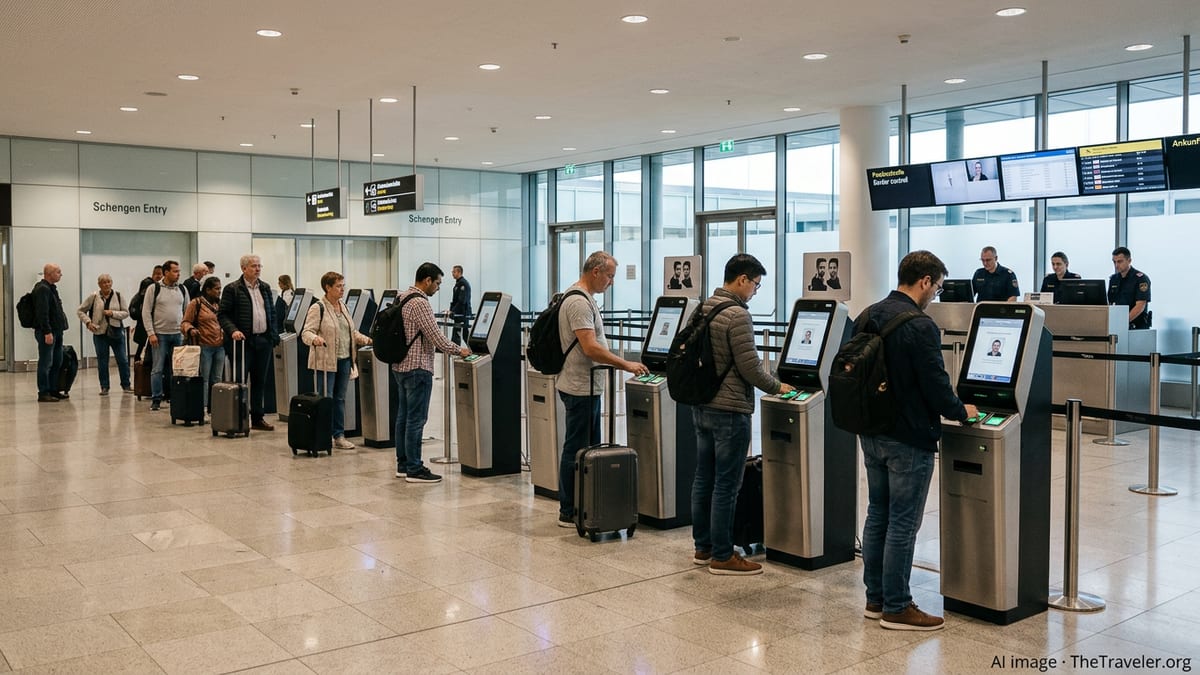
From passport stamps to biometrics, overnight
The European Union’s Entry/Exit System, or EES, became fully operational on 10 April 2026 after a phased rollout that began in October 2025. The system replaces manual passport stamping at Schengen external borders with automated registration of each traveller’s identity, biometrics and travel history.
Under EES, most non-EU nationals entering the Schengen area must now have a facial image and four fingerprints captured, alongside a scan of their travel document, the first time they cross an external border. That data is stored in a central EU database managed by the eu-LISA agency and used to calculate how long visitors may remain in the area under 90-day stay rules.
Officials designed the system to tighten security, reduce document fraud and eventually speed up crossings by enabling more use of automated e-gates. Early figures cited in public briefings indicate tens of millions of entries and exits already recorded, along with thousands of refusals of entry and some security alerts.
But the transition has moved the slowest part of the process from stamping a passport to capturing and verifying biometric data, creating a new bottleneck just as summer travel demand surges.
Queues stretching to four, five and even six hours
In the first weeks of full operation, accounts from airports, airlines and passengers point to severe congestion at many of Europe’s busiest gateways. Industry statements collected by aviation bodies describe waiting times of two to three hours at border control becoming common at peak times, even before the main summer holidays began.
More recent coverage from European media and national travel advisories reports delays of four to six hours at some airports, with travellers missing flights and connections while stuck in border queues. In several cases, planes have reportedly departed with empty seats because passengers were still being processed at passport control when boarding closed.
The impact is not limited to major hubs. Smaller airports that serve popular Mediterranean destinations have also struggled to cope with the increased processing time per traveller, especially when multiple flights from the United Kingdom and other non-EU countries arrive in short succession.
Warnings from Airports Council International Europe, Airlines for Europe and the International Air Transport Association highlight concerns that, without substantial short-term adjustments, queues could reach four hours or more at some checkpoints through the peak of July and August.
Why a digital system is slowing everything down
At the heart of the delays is the more complex registration demanded by EES, particularly for first-time users. Capturing a high-quality facial image and fingerprints, linking them correctly to a travel document, and checking that information against central databases all take longer than a simple passport stamp.
Reports indicate that some automated kiosks and e-gates have suffered technical glitches or struggled with high volumes of travellers, forcing border guards to revert to manual processing. Inconsistencies between countries, airports and even individual checkpoints mean passengers encounter different procedures from one journey to the next, adding confusion and slowing queues as staff explain the new steps.
Data-matching problems have also emerged. Travellers have described being asked to register again on subsequent trips because earlier records could not be located or correctly linked, undermining one of the key promises of the system: that the biometric process would be a one-time hurdle, not a recurring ordeal.
Operational capacity is another constraint. Many border posts were not originally designed to accommodate biometric kiosks alongside staffed booths, and staffing levels in some locations have not kept pace with the extra time required for each check. As a result, physical space and personnel are both being stretched at the same moment demand is highest.
Land and sea crossings face particular strain
While much attention has focused on crowded airport halls, the challenges at land and sea borders are even more complex. At ports serving cross-Channel ferries and Eurotunnel shuttles, the checks for travellers leaving the United Kingdom into the Schengen area now include full EES registration for many passengers before they even board.
Operators have warned that processing biometric data for car and coach passengers in confined port areas risks creating long tailbacks onto local roads. Reports from some Channel terminals describe vehicles being held while passengers step out for fingerprinting and facial scans, a process that can be difficult to manage safely and efficiently in heavy traffic.
Rail services such as Eurostar, where border checks take place before boarding, face similar constraints. Terminals built around quick passport stamping now have to accommodate kiosks, queues for first-time registrations and separate flows for those who have already been enrolled, all within limited space.
In response, some national authorities have made use of flexibilities built into the rules, temporarily prioritising manual passport checks at particularly busy moments or allowing partial registration to be completed in advance. However, publicly available information suggests that the scope for such measures is limited and may not be enough to absorb the summer peak.
What travellers can expect for the rest of 2026
European institutions maintain that EES is a long-term investment in more secure and ultimately more efficient borders, and that the current disruption reflects an inevitable teething phase. Briefings from the European Commission and the European Parliament’s research service emphasise that once most frequent visitors have completed their first registration, processing times should fall.
Industry voices are less optimistic about the short term. Joint statements from airport and airline groups have called for a review of how the system is applied during peak travel periods, including the option for countries to suspend or scale back EES checks temporarily where waiting times become excessive.
For travellers, the immediate implication is simple: allow substantially more time for border formalities when entering or leaving the Schengen area in 2026, particularly if it is the first trip since EES went live. Travel advice from several governments now recommends building in extra hours for potential queues, especially for those with tight connections or mobility issues.
Further change is still ahead. Later in 2026, the EU plans to add an additional layer in the form of the European Travel Information and Authorisation System, a pre-travel approval for visa-exempt visitors that will work alongside EES. While that system is intended to reduce risks before travellers arrive, its introduction while EES is still bedding in may prolong the period of adjustment at Europe’s digital borders.