


More news on this day
Operations at Montreal–Trudeau International Airport were heavily disrupted after an Air Canada jet veered off a taxiway and came to a stop on the grass, prompting an emergency response and forcing many flights to be delayed or rerouted.
Get the latest news straight to your inbox!
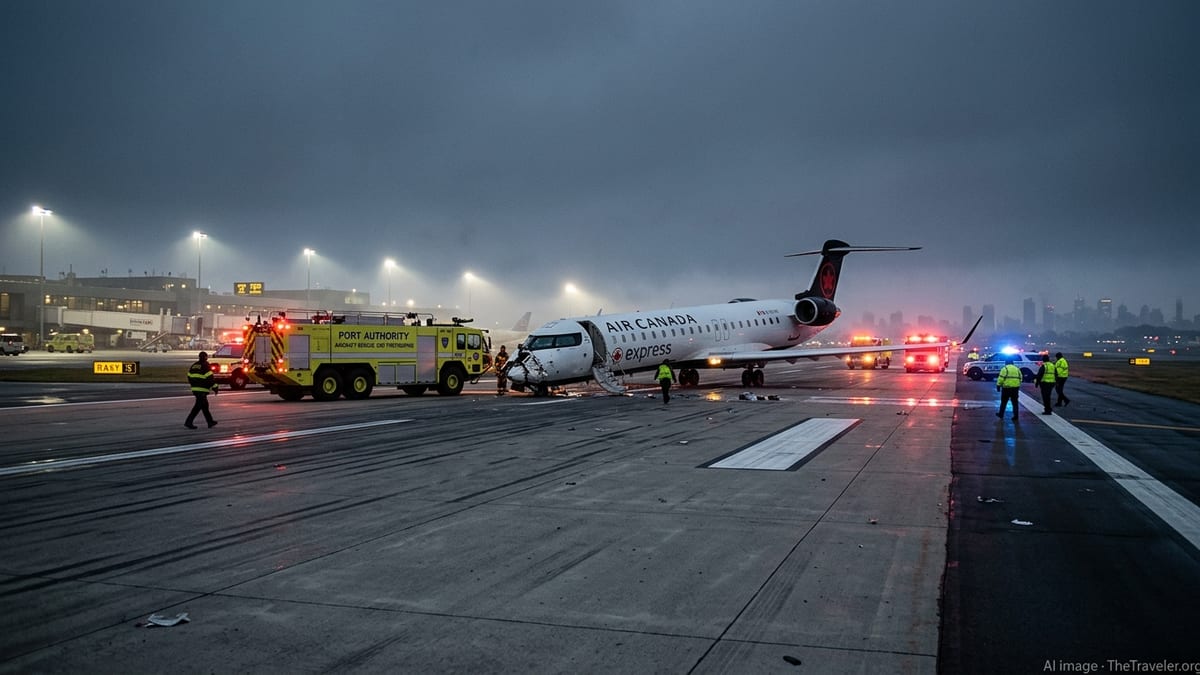
Incident on landing brings ground movements to a halt
Publicly available flight-tracking data and passenger accounts shared online indicate that the incident occurred shortly after the aircraft landed at Montreal–Trudeau on July 9. While exiting the runway via a high-speed taxiway, the jet appears to have failed to complete a right-hand turn, rolling off the paved surface and stopping with part or all of its landing gear on the grass.
Images circulating on social media show the aircraft stationary near the edge of the taxiway with emergency vehicles positioned nearby. The jet remained upright, and there were no immediate indications of fire or visible structural damage in the early images reviewed by TheTraveler.org.
Reports from passengers on nearby flights suggest that airport fire crews were dispatched to assess the situation and verify that there was no fuel leak or other safety hazard. The aircraft was not immediately moved, leaving a portion of the taxiway system blocked and limiting access to one of the airport’s main runways.
No injuries have been reported so far in publicly available coverage, and early reporting suggests the event is being treated as a runway or taxiway excursion rather than a crash. The exact aircraft type and flight number had not been formally confirmed at the time of writing.
Runway closure triggers cascading delays and diversions
The excursion led to the temporary closure of at least one runway at Montreal–Trudeau, according to flight-tracking boards and accounts from travelers waiting in terminals and aboard aircraft. With ground traffic flow reduced, departures and arrivals quickly backed up through the late afternoon and evening period, a typically busy window for domestic and transatlantic operations.
Passengers reported extended waits at gates and on taxiways as air traffic controllers rerouted movements onto the remaining available runway. Some departures toward major Canadian hubs such as Toronto, Calgary and Vancouver showed significant knock-on delays, while certain flights inbound to Montreal appeared to hold or divert as airport capacity fluctuated.
Travelers posting on aviation and airline discussion forums described a lack of precise information in the first hours after the incident, with only intermittent announcements that an aircraft was being inspected and that the airport was operating on reduced runway capacity. Several travelers recounted missing onward connections as departure times were repeatedly pushed back.
By late evening, live data suggested that operations were gradually stabilizing, though residual delays persisted across the Air Canada network and among other carriers using Montreal–Trudeau as a transatlantic and domestic gateway. Some passengers reported being advised to expect baggage delays as ground crews worked around the restricted area.
Air Canada and airport focus on passenger care and recovery
According to published coverage and posts shared on the airline’s official social media channels, Air Canada acknowledged the incident and confirmed that the aircraft had left the taxiway after landing at Montreal. Statements reviewed by TheTraveler.org emphasize that there were no reported injuries among customers or crew and that guests were being assisted in continuing their journeys.
The carrier began rebooking affected travelers on later departures and alternative routings once the scale of the disruption became clear. Passengers with missed connections or overnight delays described being offered hotel accommodation or reimbursement for reasonable expenses, in line with the airline’s standard disruption policies and applicable Canadian air passenger protection rules.
Montreal–Trudeau airport’s operator used social media and terminal screens to caution travelers about longer wait times, urging passengers to check the latest status of their flights before heading to the airport. Airport staff and ground handlers worked to maintain limited runway operations while coordinating the eventual removal of the immobilized aircraft.
As of early July 10, live schedules showed most flights operating again, though some early-morning services remained out of position as a result of the previous evening’s disruption. Travelers connecting through Montreal in the coming days are being advised, in public travel advisories, to allow extra time and to monitor itineraries closely.
Investigation expected to examine weather, surface conditions and crew actions
While it may take weeks or months for a full technical investigation to be completed, aviation specialists note that taxiway excursions typically involve a combination of factors, including runway or taxiway surface conditions, speed on rollout, aircraft weight and braking performance, as well as crew decision-making and situational awareness.
Weather data and eyewitness comments suggest that the incident occurred during wet conditions, which can significantly reduce friction on ungrooved runways and taxiways. Montreal–Trudeau’s runways are not grooved in the same way as many high-traffic U.S. airports, a difference that can affect how quickly standing water drains from the surface during heavy rain.
Experts also point to the configuration of high-speed exits, which are designed to let arriving aircraft vacate the runway quickly. If approach or landing speeds are higher than expected or if braking is less effective due to water or rubber buildup, an aircraft may find it more difficult to slow sufficiently for a sharp turn into a taxiway, increasing the risk of an overrun or side excursion.
Canada’s Transportation Safety Board typically reviews such occurrences to identify any safety lessons, even when there are no injuries. Investigators could examine cockpit voice and flight data recordings, airport ground radar logs and maintenance records to assess whether procedures, signage, surface maintenance or cockpit resource management played a role.
Renewed attention on ground safety at major Canadian hubs
The Montreal excursion adds to a broader conversation about ground safety at busy airports in Canada and abroad. In recent years, several high-profile events involving Air Canada aircraft, including taxiway overflights and runway incursions at foreign airports, have prompted regulators and airlines to revisit training, cockpit procedures and ground-movement technologies.
Industry analysts note that while runway and taxiway excursions are relatively rare compared with the volume of daily flights, they can have outsized operational impacts. Even minor incidents that leave an aircraft disabled on or near a runway can cause hours of disruption, tying up fire crews, ground handlers and towing equipment while reducing capacity at already congested hubs.
Emerging technologies such as enhanced airport moving maps, predictive braking performance tools and improved surface condition monitoring are being deployed at major airports to reduce the risk of such incidents. Montreal–Trudeau, which serves as Air Canada’s primary transatlantic gateway and a key domestic hub, has been investing in taxiway extensions and airfield upgrades aimed at improving both capacity and safety.
For now, travelers using Montreal–Trudeau in the coming days may experience only minor lingering effects. However, the episode serves as a reminder that even non-injury ground incidents can ripple across airline networks, underscoring the importance of resilient scheduling, rapid recovery planning and clear communication with passengers when the unexpected happens.