


More news on this day
Bulgaria’s railway system is facing a deepening crisis, as mounting debts, aging infrastructure and stalled investment projects converge to create bottlenecks, safety concerns and growing fiscal risks for the state.
Get the latest news straight to your inbox!
Mounting debts and fragile railway finances
Publicly available financial data and recent government briefings indicate that Bulgaria’s core rail companies are burdened with heavy liabilities and deteriorating balance sheets. The National Railway Infrastructure Company has accumulated obligations estimated at more than 760 million euro without secured funding, while the main passenger and freight subsidiaries of Bulgarian State Railways are also reporting negative results and growing arrears.
Reports from Bulgarian business media describe how Bulgarian State Railways’ passenger unit is carrying overdue liabilities of around 30 million euro, with the freight arm facing more than 60 million euro in debt, a large share of it overdue. Despite previous restructuring efforts and state support, the holding structure has struggled to restore profitability, prompting calls for a review of whether the current corporate model remains fit for purpose.
International institutions have also highlighted broader fiscal risks linked to state owned enterprises, including rail. Analysis by financial organizations such as the International Monetary Fund points to historically low profitability in several large Bulgarian state companies and warns that weak governance and high leverage can transmit liquidity pressures across the public sector, adding to overall sovereign risk even where headline public debt remains moderate.
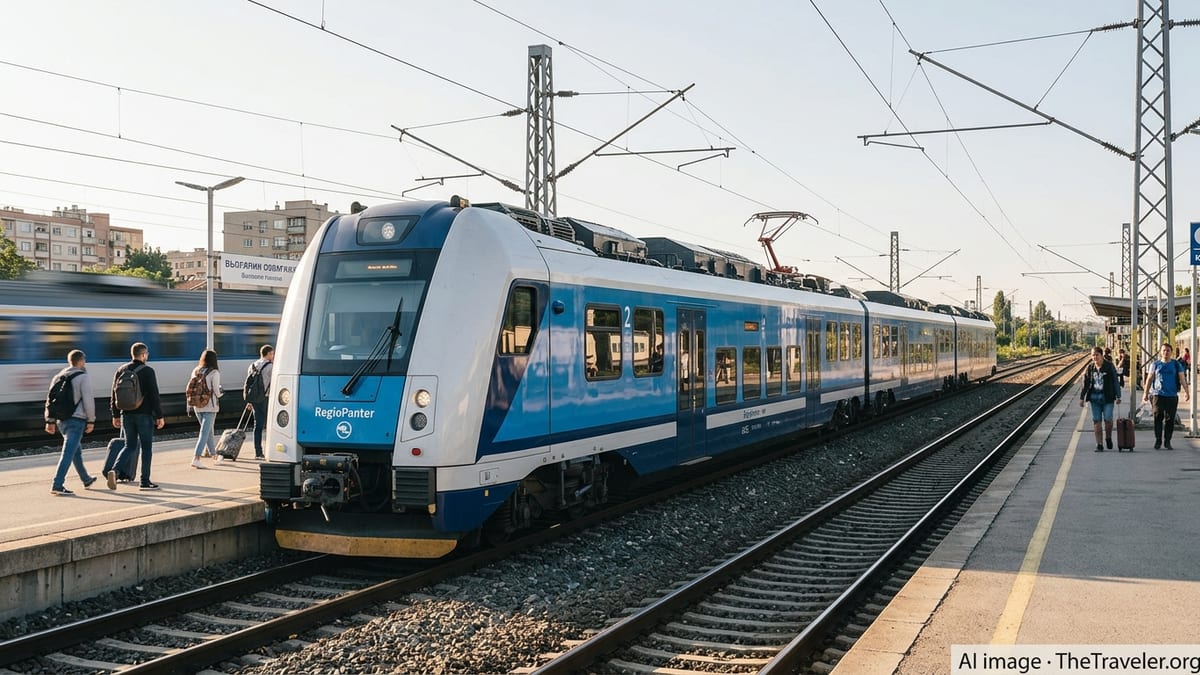
For travelers, the financial strain is visible in the age of rolling stock, reduced comfort and recurring service disruptions. A large number of carriages in regular use are several decades old, while the cost of maintaining modern electric multiple units has risen as contracts for spare parts and servicing have lagged behind actual needs.
Bottlenecks, speed restrictions and project delays
The financial difficulties are mirrored by serious infrastructure problems. Recent coverage by Bulgarian public broadcasters and news agencies notes that around half of the country’s railway network is currently operating under temporary or permanent speed restrictions, imposed because tracks and related installations are not in adequate condition. In many sections, trains are forced to run far below their design speed, lengthening journey times and undermining the competitiveness of rail against road transport.
Key modernization projects on the core Sofia to Plovdiv corridor illustrate the scale of the challenge. Sections such as Elin Pelin to Kostenets and Kostenets to Septemvri are part of the European Union’s Orient East Med core network, designated to carry high volumes of freight and passengers across the region. However, official project descriptions and local reporting show that construction has been repeatedly delayed, with issues ranging from incomplete expropriation procedures and missing archaeological and geological studies to contractual disputes and cost overruns.
Government briefings have acknowledged that, in some cases, advances worth tens of millions of euro have been paid to contractors even though no substantial physical works have been completed on the ground. This combination of technical obstacles and weak project preparation has left Bulgaria struggling to remove some of the most critical bottlenecks on its rail network, particularly near major urban centers where line capacity is already stretched.
For international travelers arriving in Bulgaria by train or using rail to connect between cities, the result is a patchwork of modern and outdated segments. Newer stretches with upgraded signaling and tracks can be followed immediately by single track sections with low speeds and frequent stops, creating uncertainty around timetables and limiting the potential for reliable high frequency services.
EU funds at risk and scrutiny from European bodies
The condition of Bulgaria’s railways now intersects directly with the country’s relationship with European institutions. According to information released at recent press briefings and summarized by Bulgarian and European media, the European Public Prosecutor’s Office and the EU’s anti fraud office are reviewing nearly twenty rail related contracts signed between 2019 and 2021, including major infrastructure tenders and procurements for new electric trains.
Transport ministry statements reported in national outlets warn that financial corrections from Brussels could reach up to 400 million euro if irregularities are confirmed. In addition, there are commitments for around 765 million euro in rail infrastructure projects that currently lack clear funding sources, leaving a significant gap between planned investments and available resources.
The Recovery and Resilience Facility and other cohesion policy programs have earmarked substantial support for sustainable transport, with rail modernization identified as a priority for reducing emissions and improving connectivity. However, implementation data shared by Bulgarian media suggest that while a high percentage of available EU funds for transport has been formally contracted, actual physical and financial progress on rail projects remains well below target.
This gap creates a dual risk. Bulgaria could lose parts of its allocated funding if milestones are not met within the agreed timeframes, while at the same time the state may be forced to assume greater financial responsibility for incomplete schemes. For the rail sector, this would further strain already fragile company finances and could limit resources for essential maintenance and safety upgrades.
New trains, old system: service and safety concerns
Amid these structural problems, Bulgaria has ordered new rolling stock from major European manufacturers under its recovery plan, with contracts for dozens of electric trainsets intended to improve comfort and reliability on key routes. According to coverage in Bulgarian news agencies, funding within the national recovery plan currently secures only a portion of the fleet, with financing for an additional batch of more than twenty trains still uncertain and dependent on future European mechanisms.
Officials have publicly underlined that, even once delivered, the new trains will not enter service immediately. They must first undergo licensing, certification, registration and staff training procedures, and will require new maintenance depots and specialized equipment. Without parallel investment in infrastructure, depots and signaling, there is a risk that modern trainsets could be introduced into a still underperforming system, limiting the benefits felt by passengers.
In the meantime, concerns persist over the reliability of existing services, particularly during peak summer travel periods. Media reports from recent years describe recurring problems with air conditioning failures, overcrowded carriages and breakdowns involving older locomotives and coaches. The reliance on aging rolling stock increases the likelihood of incidents and unplanned disruptions, particularly in extreme weather conditions.
These service quality issues feed into a broader safety debate. While Bulgaria’s rail accident record has not seen a recent large scale disaster, transport analysts and sector unions have repeatedly argued that chronic underinvestment in track, signaling and rolling stock maintenance heightens long term risk. The widespread use of speed restrictions mitigates some dangers but also signals how far the network has drifted from modern standards.
Systemic risks for Bulgaria’s economy and connectivity
The difficulties in Bulgaria’s rail sector have implications that extend beyond daily inconvenience for passengers. Railways remain central to the country’s role as a transit route between Europe, Turkey and the Eastern Mediterranean, and are a key component of European Union strategies to shift freight from road to more sustainable modes. Persistent bottlenecks and unreliable services risk diverting traffic to highways, increasing emissions and eroding the competitiveness of Bulgarian logistics corridors.
Fiscal risks are also drawing attention. Analyses by international financial institutions on Bulgaria’s state owned enterprises emphasize that large, underperforming companies with significant debt can pose contingent liabilities for public finances. If rail companies are unable to service obligations or deliver contracted EU projects, the central government may be required to step in more forcefully, adding pressure at a time when overall deficits are already under scrutiny at the European level.
For regional development, the stakes are high. Many smaller Bulgarian towns and rural areas rely on rail for basic connectivity, including access to jobs, education and tourism flows. Continued deterioration or rationalization of services would deepen existing disparities between the capital region and the rest of the country, undercutting goals embedded in Bulgaria’s recovery and cohesion strategies.
Policy discussions now focus on whether a comprehensive rail reform, combining governance changes, realistic project pipelines and tighter controls over public procurement, can be implemented quickly enough to stabilize the system. Without a credible plan that restores investor confidence, accelerates priority upgrades and safeguards EU funding, Bulgaria’s railway crisis risks becoming a long term structural drag on both mobility and economic growth.