


More news on this day
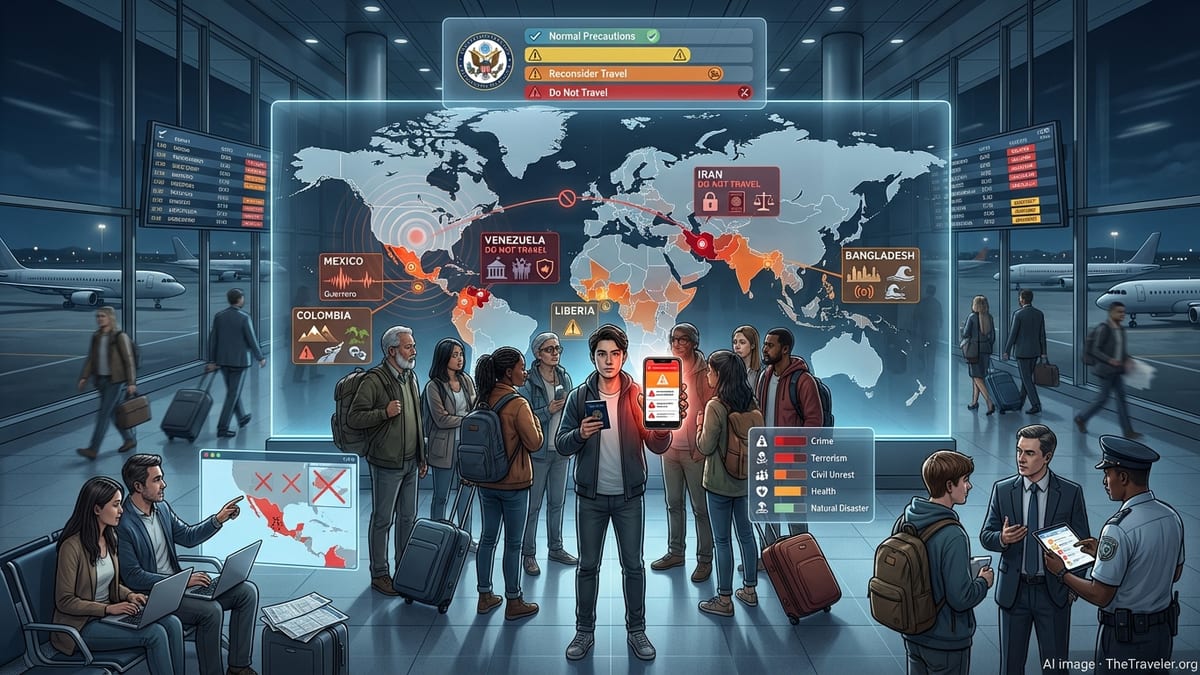
A wave of newly issued and reissued government travel advisories in late 2026 is drawing renewed attention to life threatening risks in 13 countries, as conflict, crime, disease outbreaks and political turmoil converge to reshape the global safety map for international travelers.
Get the latest news straight to your inbox!
Rapid Shifts in Official Risk Ratings
Publicly available data from the United States Department of State shows that the Level 4 “Do Not Travel” category, the highest warning level, now applies to more than 20 destinations, with several advisories revised in October 2026 alone. Independent trackers that mirror the State Department feed indicate that countries under Level 4 advisories face threats ranging from war and terrorism to kidnapping and severe health system strain.
Recent advisory updates highlight renewed concern in parts of the Middle East and Central Africa. Open-source summary feeds document that Syria and Yemen had Level 4 notices reissued in October 2026, while the Democratic Republic of the Congo retained a Level 4 rating after security and health information was refreshed in September. These moves underscore that, even when the overall warning level does not change, officials are updating underlying risk narratives as conditions evolve.
Additional government guidance from partners such as Global Affairs Canada and European foreign ministries reinforces the pattern. Comparative advisory tools that aggregate positions from five major governments list multiple overlapping Level 4 or equivalent warnings for conflict-affected states including Afghanistan, Mali and Sudan. The convergence of several foreign ministries on the highest risk tier is one factor that risk consultancies now use when flagging countries as presenting deadly hazards for civilian travelers.
While criteria vary slightly by country, Level 4 and comparable designations generally reflect a combination of sustained armed conflict, widespread violent crime, terrorism, or a breakdown in basic services such as emergency healthcare. Policy documents explain that in such environments, consular assistance may be severely limited and commercial flight options can disappear with little notice.
Thirteen Countries Under Intensified Scrutiny
Data visualizations and analytic reports released in October 2026 identify a subset of 13 countries that have experienced particularly sharp or sustained deterioration in official risk ratings since 2018. These analyses, based on archived advisory feeds, highlight destinations where warnings have escalated into the highest categories and remained there due to persistent deadly threats.
Central to this group are conflict zones such as Afghanistan, Syria, Yemen and Sudan, where public databases of travel advisories and security indexes align around extreme levels of violence, terrorism and state fragility. Reports summarizing changes to advisories point to incidents including intensified fighting, cross-border attacks, drone strikes affecting airspace reliability and documented patterns of kidnapping or wrongful detention targeting foreigners.
Several African states, including the Democratic Republic of the Congo, South Sudan and parts of the Sahel, are also consistently flagged. Health surveillance bulletins and outbreak tracking for 2026 note severe disease events layered onto already fragile security conditions in some of these countries, reinforcing decisions by multiple governments to sustain their highest travel-warning levels.
In other cases, such as Iran, Iraq, Lebanon and Russia, publicly accessible commentary on recent advisory updates references elevated risks tied to regional tensions, domestic repression or the destination’s response to major international disputes. Analysts who compare travel warnings across time periods note that for many of these 13 countries, the shift from moderate to severe advisories has been less about isolated incidents and more about a structural slide into chronic instability that directly affects visitor safety.
How Travel Advisories Are Built and Updated
Government guidance platforms describe a structured system behind each warning. The United States, for example, classifies destinations into four levels, from “Exercise normal precautions” to “Do not travel,” and applies standardized risk indicators for crime, civil unrest, terrorism, health, natural disaster, kidnapping and wrongful detention. Background materials explain that Level 4 is reserved for places where there is a greater likelihood of life threatening risks and where evacuation, medical care or consular help may be extremely hard to obtain in an emergency.
Other foreign ministries apply different labels but similar logic. Aggregation tools that compare advisories from the United States, Canada, the United Kingdom, Germany and France show that when several governments independently reach their highest warning tier for the same country, underlying threat assessments tend to mention overlapping concerns such as armed conflict, terrorism or systemic collapse of the rule of law.
Specialist services have emerged to track this information in near real time. Some advisory dashboards ingest data from official feeds several times a day and present color coded maps of risk levels by country, including the current list of Level 4 destinations. Additional platforms combine travel advisories with alerts from the World Health Organization, the United States Centers for Disease Control and Prevention and global disaster monitoring systems to provide a consolidated view of outbreaks, natural hazards and security incidents relevant to travelers.
Policy documents and university travel policies published in 2026 indicate that Level 4 designations now carry concrete consequences for organizations. Many institutions state that they will not sponsor or insure trips to destinations under the highest warning category, citing guidance that strongly urges citizens to avoid entering or, if already present, to depart as soon as safety permits.
Practical Implications for Travelers and the Industry
The concentration of deadly risks in a cluster of 13 countries is reshaping how both travelers and the travel industry operate. Airline and tour operators monitor advisory changes because abrupt shifts in risk ratings can trigger insurance exclusions, cancellations or rerouting. When warnings for a destination escalate, scheduled services are sometimes reduced or suspended, complicating exit options for those already on the ground.
For individual travelers, advisory information now intersects with a wider ecosystem of tools and rules. Official guidance encourages citizens to register trips abroad with consular services so they can receive security alerts and be counted in an emergency. Advisory pages also link to security reports and crisis planning resources that outline what to do if violence, natural disasters or infrastructure outages occur while in a high risk country.
Insurance and corporate travel policies increasingly reference Level 3 and Level 4 classifications when defining permitted destinations or coverage limits. Brokers and risk managers use publicly available advisory feeds as inputs when recommending whether business travel, study abroad programs or project deployments should proceed, be postponed or be relocated to alternative hubs judged less volatile.
Despite their influence, travel advisories are not binding bans, and travelers maintain legal discretion over their movements in most jurisdictions. However, the growing alignment of multiple governments and private risk assessors around a set of 13 countries with particularly acute, life threatening hazards means that decisions to visit those destinations now carry higher personal responsibility and, in many cases, reduced institutional support.
Reading the Warnings in a Changing Risk Landscape
Analysts who chart advisory levels over time note that the number of countries at the highest risk tier is still far below the peak seen during the global health crisis earlier in the decade, when pandemic specific triggers temporarily pushed many destinations into Level 4. The current pattern, they say, is less about global blanket restrictions and more about localized conflicts and governance failures concentrating extreme danger in specific states.
At the same time, background security and terrorism indexes for 2026 point to a wider environment of elevated volatility, even in countries with mid level advisories. Mapping projects that combine terrorism data with travel warnings show that threats can spill across borders and that regional shocks can quickly prompt advisory revisions, as seen in several Middle Eastern and African states during the past year.
For travelers considering routes that skirt or transit near the 13 most heavily warned countries, publicly accessible guidance emphasizes close monitoring of advisories up to the day of departure, attention to airline notices regarding airspace restrictions and contingency plans for sudden closures of land borders or airports. Government platforms caution that conditions may change at any time and that updates to advisories can occur without long lead times.
As 2026 draws to a close, the clustering of Level 4 and equivalent warnings serves as a map of where deadly risks for visitors are currently most acute. For now, the clearest message from the advisory systems is that while much of the world is open for travel, a small group of countries presents dangers grave enough that multiple governments are formally urging people not to go.