


More news on this day
Travelers at Bahrain International Airport on May 14 are facing mounting disruption as more than 20 delayed departures and at least four cancellations ripple across busy regional routes linking Bahrain with Dubai, Riyadh, Jeddah, Muscat and Doha.
Get the latest news straight to your inbox!
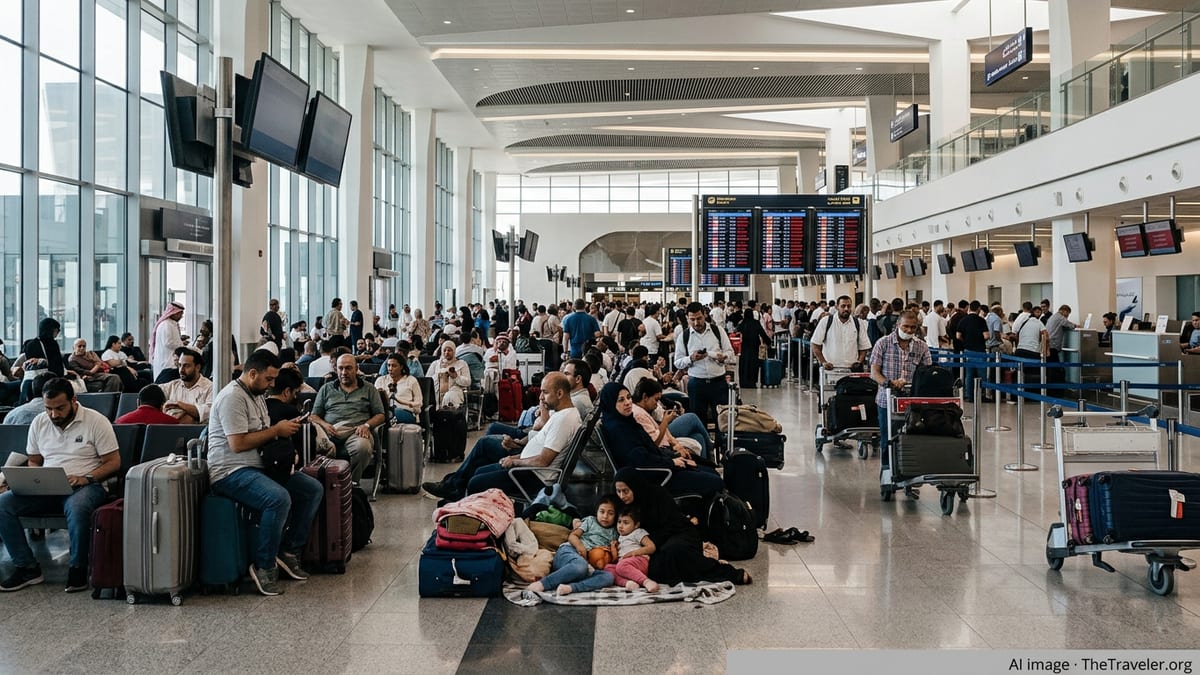
Cluster of Disruptions Hits Key Gulf Connections
Publicly available airport departure boards and flight status portals on May 14 indicate a concentrated wave of delays and cancellations affecting short haul services from Bahrain to neighboring Gulf hubs. The pattern shows particular strain on links to Dubai, Riyadh, Jeddah, Muscat and Doha, which rank among Bahrain International Airport’s most heavily used routes for both point to point traffic and onward long haul connections.
Operational data suggests that more than 20 flights have been pushed back from their scheduled departure times, with delays ranging from modest schedule slips to multi hour hold ups. At least four flights have been marked as canceled, affecting itineraries on carriers including Gulf Air, flydubai, Air Arabia and other regional operators that normally maintain dense frequencies on these corridors.
These latest snags come after a period of constrained operations in Bahrain’s airspace earlier in 2026, when regional tensions led to temporary closures and forced airlines to thin schedules or reroute aircraft. Recent analysis from travel industry outlets notes that while Bahrain’s airport has reopened, services remain vulnerable to rolling adjustments as airlines rebuild their networks and ground handling capacity catches up with demand.
The impact is magnified on busy links such as Bahrain to Dubai and Bahrain to Doha, where multiple daily services typically funnel passengers into global networks. Flight tracking snapshots today show a mix of active, delayed and canceled rotations on these routes, signaling that the disruption is not isolated to a single carrier or departure wave.
Gulf Air, flydubai and Air Arabia Among Affected Carriers
Schedule data and third party flight trackers show that Bahrain based Gulf Air is among the airlines experiencing irregular operations on May 14, with several departures from its home hub subject to delays and selected rotations withdrawn from the timetable. Services touching Dubai, Riyadh and Doha appear prominently in the list of affected departures, underscoring the fragility of some of the carrier’s most important regional links.
Low cost operators flydubai and Air Arabia, which provide competitive alternatives on Bahrain’s Gulf routes, are also listed with disrupted services. Flights connecting Bahrain with Dubai and Sharjah are central to these airlines’ networks, feeding broader connections to South Asia, East Africa and beyond. When departures from Bahrain are delayed or canceled, passengers relying on tight connections at these transit hubs can quickly find themselves misaligned with onward flights.
According to aggregated aviation and travel reports, these carriers have been recalibrating schedules across the Gulf in recent weeks in response to shifting demand patterns and airspace constraints. The result is a patchwork of flight options that can change at short notice, leaving travelers at Bahrain International Airport particularly exposed when a cluster of irregular operations occurs on the same day.
While some flights are being operated with adjusted timings, others are vanishing from departure boards with only narrow windows for rebooking. This creates a knock on effect across airline networks, as aircraft and crews fall out of their planned rotations and must be repositioned or rescheduled.
Passengers Face Long Waits and Missed Connections
The immediate consequence for travelers at Bahrain International Airport is a day of uncertainty, with long waits in departure halls and a scramble for alternative options. Independently compiled travel accounts from the region in recent weeks indicate that when similar disruption clusters have occurred, passengers have frequently faced overnight delays, missed connections and rebookings routed through alternative Gulf gateways.
Many of the affected Bahrain departures on May 14 are short haul hops that feed into major global banks of flights in Dubai, Riyadh, Jeddah, Muscat and Doha. Even a delay of one or two hours can cause passengers to miss tightly timed long haul departures to Europe, Asia or North America, forcing them onto later services that may already be heavily booked after months of earlier disruptions.
Public information from airport advisories across the Gulf in early May has emphasized that schedules remain subject to late changes and that passengers should not travel to airports without confirmed, up to date departure times from their airlines. For those already at Bahrain International Airport today, the cluster of irregular operations is likely reinforcing the importance of real time monitoring of flight status screens and airline notifications.
Travel forums and consumer advice sites continue to highlight the value of documenting delays, retaining receipts and being familiar with each carrier’s rebooking and care policies, particularly for itineraries that combine separate tickets or involve self arranged onward connections from Gulf hubs.
Ongoing Recovery from Earlier Regional Disruptions
The operational turbulence at Bahrain International Airport on May 14 is unfolding against a broader backdrop of Middle East aviation still recovering from airspace closures and security related adjustments earlier this year. Industry analyses describe how Bahrain’s airspace reopened with limited services, and how carriers such as Gulf Air, flydubai, Air Arabia and others have been progressively restoring frequencies while managing capacity constraints and rerouted traffic flows.
Some airlines have temporarily shifted aircraft and crew to alternative regional gateways, including airports in Saudi Arabia and Qatar, to protect core routes while Bahrain’s schedule stabilizes. These strategic moves have helped maintain a baseline of connectivity for the region but have also reduced the operational slack available when new disruptions, such as today’s spate of delays and cancellations, occur at Bahrain.
Observers point out that the Gulf’s highly interconnected network model, which relies on frequent short haul sectors to feed large hub operations, can amplify the impact of irregular operations at a single airport. When Bahrain experiences a spike in delays and cancellations, the repercussions can quickly extend to aircraft rotations and crew scheduling on routes far beyond the immediate Bahrain to Gulf city pairs.
For now, publicly available information portrays Bahrain International Airport as operational but fragile, with carriers managing a careful balance between restoring normal timetables and retaining enough flexibility to cope with sudden changes in airspace, demand or ground handling capacity. The disruption wave seen on May 14 serves as a reminder that travelers using Bahrain as a gateway to Dubai, Riyadh, Jeddah, Muscat and Doha may continue to face unpredictable conditions in the near term.