


More news on this day
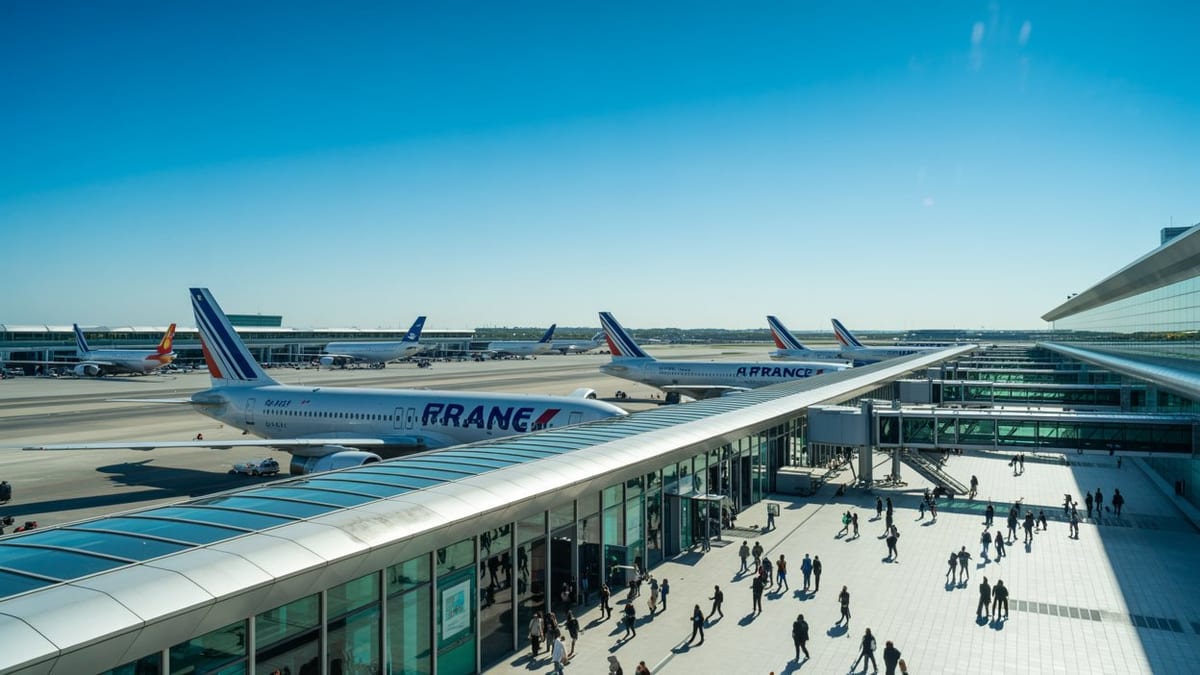
Summer travel across Europe and the Middle East is facing fresh turbulence as a wave of disruptions at Paris Charles de Gaulle triggers at least 172 delays and four cancellations for Air France, Lufthansa and Qatar Airways, snarling traffic on key routes linking Paris with Frankfurt, Doha and other major hubs.
Get the latest news straight to your inbox!
Ripple effects across Europe and the Gulf
Operational data from flight-tracking and schedule services on 16 June indicate an unusually high volume of delayed departures and arrivals at Paris Charles de Gaulle, with knock-on effects visible at Frankfurt and Doha. The pattern points to a combination of congested airspace, tight turnarounds and ongoing network adjustments that have left airlines with limited slack during the first major peak of the summer season.
Air France, which uses Charles de Gaulle as its primary hub, appears to account for the majority of delayed movements, particularly on short haul routes feeding into Germany and other European markets. Lufthansa’s Paris–Frankfurt rotations and Qatar Airways’ Paris–Doha services are also experiencing extended ground times and retimed departures, compounding disruption for connecting passengers on both sides of the continent.
While only a small number of flights have been fully cancelled compared with the wider schedule at Charles de Gaulle, the scale of knock-on delays is significant. Even relatively modest timetable shifts of 30 to 60 minutes are creating missed connections and missed crew and aircraft positioning windows, which then echo through later departures.
Air France bears the brunt at its home hub
Publicly available flight listings for Air France on 16 June show a dense bank of early morning and mid-morning departures from Paris Charles de Gaulle to key European cities such as Berlin and Frankfurt, alongside a heavy long haul operation to North America, Africa and Asia. Within that structure, a higher-than-normal share of flights are flagged as delayed, with some pushed back repeatedly as aircraft await inbound connections or ground handling slots.
In the days leading up to the current disruptions, passenger-rights platforms tracking Air France operations had already logged an uptick in schedule changes and occasional cancellations on French domestic and intra-European sectors. Those earlier adjustments, although relatively contained, underscored how closely the carrier’s summer operations are running to capacity at Charles de Gaulle, leaving little room to absorb weather or air traffic control constraints.
At the same time, the complexity of managing long haul connections through Paris adds further pressure. Flights from North America and Africa arriving behind schedule can cascade directly into late departures on European feeder routes. The result is that a single weather, staffing or airspace issue early in the operating day can translate into missed onward flights hours later for passengers heading to destinations such as Frankfurt or Doha.
Lufthansa connections through Frankfurt under strain
The disruption in Paris is being sharply felt on the high-frequency corridor between Charles de Gaulle and Frankfurt, an essential link in Lufthansa’s network. Recent timetable data and flight-status records highlight that services on this route have been susceptible to both delays and selective cancellations throughout the spring, particularly around periods of industrial action and schedule reshuffles.
Earlier this year, a pilots’ walkout at Lufthansa and its affiliates had already led to widespread cancellations of Germany–France services, including Paris, Lyon and Nice. Although those strike days are now past, the carrier is still fine-tuning its summer schedule, and short haul sectors linking Frankfurt to Paris remain vulnerable whenever upstream flights run late or aircraft and crews are repositioned at short notice.
Today’s disruption at Charles de Gaulle is amplifying that vulnerability. When departures from Paris are retimed, even by modest margins, inbound Lufthansa flights to Frankfurt can miss carefully planned connection waves for long haul departures to Asia, Africa and the Americas. Passengers who had built itineraries around tight minimum connection times are particularly affected, often finding themselves rebooked onto later flights or rerouted via alternative hubs.
Qatar Airways links through Doha feel knock-on delays
Qatar Airways’ Paris–Doha operation, a core link between Western Europe and the Gulf, is also feeling the strain from the Charles de Gaulle bottlenecks. Recent travel alerts and schedule updates from the airline highlight an ongoing programme of network adjustments through mid-September, reflecting both evolving demand patterns and earlier regional airspace constraints that required rerouting on some Middle East services.
Within this environment, delays on Paris departures can be especially disruptive. Many passengers on the Paris–Doha leg travel onward to Asia-Pacific or Africa with relatively short connection windows. When the initial departure from Charles de Gaulle pushes back, those onward segments can be missed, forcing rebookings onto later services and tightening seat availability across Doha’s hub banks.
Reports from passenger forums in recent months describe a mix of last-minute cancellations, rerouting through alternative European gateways such as Frankfurt, and reissued itineraries that keep travellers within Qatar Airways’ own network. While these individual accounts vary, taken together they point to a system operating near capacity, where even a small cluster of delayed flights in Paris can have repercussions stretching as far as Southeast Asia and Australia.
Travellers advised to build in buffer time
The latest wave of disruption at Charles de Gaulle underscores a broader challenge facing global aviation in mid-2026. Schedules have ramped up sharply for the summer, yet airlines and airports are still navigating staffing constraints, evolving airspace restrictions in parts of the Middle East, and infrastructure limits at busy hubs like Paris and Frankfurt.
Publicly available route maps and airline advisories suggest that carriers are relying heavily on dense connecting banks through a handful of mega-hubs. This can be efficient when operations run smoothly but leaves limited resilience when multiple factors converge, as appears to be the case today in Paris. Once a critical mass of flights is delayed, the entire system becomes more prone to missed connections and overnight stays.
Travel experts commonly recommend that passengers using hubs such as Charles de Gaulle, Frankfurt and Doha build extra buffer time into itineraries during peak seasons, particularly when self-connecting between airlines or ticket types. In the current environment, itineraries with longer connection windows, flexible tickets, and real-time monitoring via airline apps or airport information pages may offer a better chance of navigating days when disruptions at one hub ripple across multiple continents.