


More news on this day
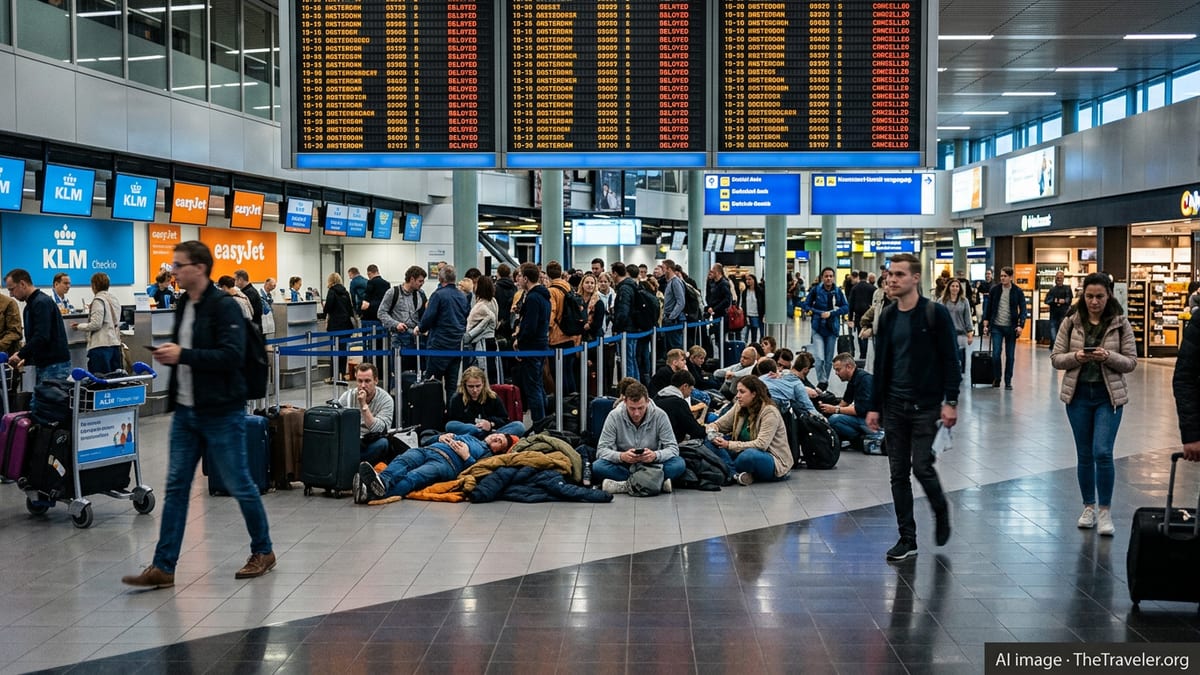
Amsterdam Airport Schiphol has been plunged into fresh travel turmoil as a new wave of disruptions affecting around 160 flights ripples through the global networks of KLM, Delta Air Lines and British Airways, leaving passengers stranded from North America to Asia.
Get the latest news straight to your inbox!
System Shock at One of Europe’s Busiest Hubs
Publicly available operational data and aviation tracking suggest that Schiphol, one of Europe’s key transfer hubs, is again under severe strain, with around 160 to 170 flights cancelled or heavily delayed within a short window. The cascading effect is being felt far beyond the Netherlands, as long-haul and European feeder services operated by KLM and its SkyTeam partners intersect with British Airways services linking Amsterdam to London Heathrow and onward global routes.
Recent travel alerts from KLM and aggregated disruption dashboards show Schiphol listed among airports experiencing “operational disruptions,” with passengers urged to verify departures in airline apps before travelling to the airport. These alerts coincide with reports of mass schedule adjustments and proactive cancellations designed to ease pressure on overstretched ground operations and airside capacity.
Although the precise mix of causes varies by route, aviation analysts point to a combination of tight turnaround schedules, crew and aircraft rotation constraints, and knock-on effects from previous weather and infrastructure issues. Schiphol’s role as a tightly banked connecting hub means any spike in delays or cancellations can quickly multiply across multiple waves of departures and arrivals.
The latest disruption follows a year in which Schiphol has frequently appeared in news coverage of operational bottlenecks and weather-related stoppages. Earlier episodes, including significant cancellations during winter storms, have underscored the vulnerability of hub operations when slots, staffing and de-icing or ground-handling capacity are all under simultaneous strain.
KLM, Delta and British Airways Network Impact
According to flight-tracking snapshots and airline schedule data, KLM is bearing the brunt of the current disruption, with dozens of short-haul and medium-haul departures to European cities removed from schedules or retimed. Many of these flights serve as feeders into long-haul services to North America, Africa and Asia, magnifying the effect for connecting passengers whose journeys start far from the Netherlands.
Delta Air Lines, which operates transatlantic services from Schiphol under its joint venture with Air France-KLM, is seeing ripple effects where Amsterdam functions as a primary European gateway. Disrupted feeder flights into Schiphol risk misconnecting passengers onto Delta-operated services to major U.S. hubs, prompting rebookings, overnight stays or rerouting via alternative gateways such as Paris Charles de Gaulle.
British Airways, which links Amsterdam and London Heathrow with multiple daily flights, is also caught in the crossfire. When Schiphol-based departures or arrivals are curtailed, passengers expecting seamless same-day transfers at Heathrow to long-haul destinations, including North America, Africa and Asia-Pacific, may find themselves rebooked onto later services or entirely different routings.
Online customer reports and airline guidance suggest that while some long-haul flights are still operating, they are doing so with rearranged passenger loads, substituted aircraft and altered connection patterns. Where possible, carriers are using alliance and codeshare partners to move disrupted travellers, but high summer-season load factors limit spare capacity.
Passenger Experience: Long Queues, Missed Connections and Rebooking Battles
Accounts shared on public forums and social media describe long queues at transfer desks in Amsterdam and at outstations served by disrupted Schiphol flights. Travellers report missed connections, last-minute gate changes and difficulty securing alternative routings on already crowded services, particularly on transatlantic and intra-European business routes.
Many stranded passengers are turning to airline mobile apps and websites as primary tools for rebooking, reflecting the strong emphasis on self-service embedded in KLM’s and Delta’s current disruption policies. However, when entire waves of flights are cancelled, seats on later services quickly disappear, leaving some travellers facing delays of 24 hours or more before the next available itinerary.
For British Airways customers, disrupted Amsterdam–London legs can unravel carefully constructed long-haul itineraries. Passengers connecting through Heathrow to destinations in North America or Asia may find that a relatively short intra-European cancellation forces a complete re-plan of their journey, including overnight accommodation and revised ground transport at their final destination.
In parallel, baggage handling has emerged as a persistent pain point. During previous disruption episodes at Schiphol, large backlogs of unaccompanied bags accumulated airside. Current reports indicate renewed concern that tight connection windows and frequent retimings are increasing the risk of luggage being misrouted or delayed even when passengers manage to board alternative flights.
Rights, Compensation and What Travellers Can Do Now
Under European air passenger protection rules, travellers departing from Schiphol generally benefit from defined rights to care, rerouting and, in many cases, financial compensation when flights are cancelled at short notice or suffer long delays. Recent coverage of EU negotiations confirms that the core framework, including compensation for multi-hour delays and cancellations in many circumstances, remains in force.
Publicly available airline policies indicate that KLM, Delta and British Airways are all offering rebooking options within certain date ranges and fare conditions for customers affected by the current disruption wave. Passengers are typically encouraged to manage changes via apps or booking portals first, with airport desks and call centres acting as back-up routes for complex cases or multi-ticket itineraries.
Consumer advocates recommend that travellers keep detailed records of boarding passes, booking confirmations, receipts for meals and accommodation, and any written communication from airlines about cancellations or significant delays. This documentation can be important later when submitting claims for reimbursement or statutory compensation under European or U.K. regulations.
Those yet to start their journey are being urged, in public advisories and airline alerts, to check flight status repeatedly in the hours before heading to the airport and to allow extra time at Schiphol and other major hubs. Where travel is not essential, some airlines are offering limited-fee or fee-free changes, giving passengers the option to postpone trips until operations stabilise.
Broader Questions Over Schiphol’s Resilience
The latest 163-flight disruption at Schiphol is reviving debate about the resilience of one of Europe’s most important hubs. Aviation commentators note that the airport sits at the intersection of multiple global networks, serving as a primary base for KLM, a key node for Delta’s transatlantic operations and a significant destination for British Airways and other legacy carriers.
Earlier this year, severe winter weather and infrastructure constraints triggered extensive cancellations and delays at Schiphol, with knock-on effects lasting days. Subsequent schedule reductions by KLM and other airlines were framed as measures to avoid terminal gridlock and staffing overload, yet the recurrence of large-scale disruption highlights the continuing fragility of the system.
Industry observers argue that a combination of high utilisation, staffing challenges and tight coordination between airlines, ground handlers and air traffic services leaves little margin for error. When disruptions occur, the result is often a rapid escalation from localised delays to widespread cancellations across multiple waves of flights.
As peak summer demand builds, the current crisis is likely to intensify pressure on airport operators and airlines to demonstrate that lessons have been learned from previous meltdowns. Travellers, meanwhile, are left weighing the convenience of Schiphol’s extensive route network against the growing perception that even a single disruption event can have global consequences for their plans.