

More news on this day
Delta Air Lines passengers across the United States are facing another day of operational turbulence on Monday, as a cluster of cancellations and more than a hundred delays tied to schedule instability ripple outward from the carrier’s Atlanta mega-hub.
Get the latest news straight to your inbox!
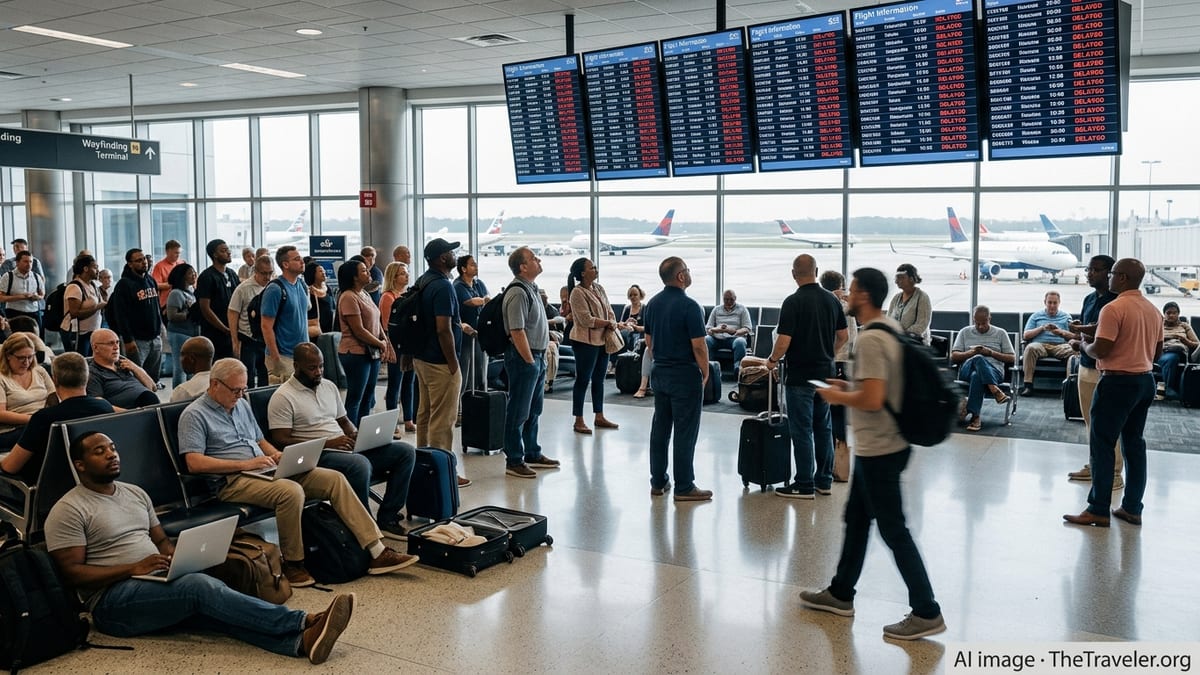
Atlanta Hub Strain Drives Network-Wide Knock-On Effects
Operational data for Monday indicates that around 20 Delta-operated flights have been canceled and approximately 125 services delayed across the carrier’s domestic network, with Atlanta Hartsfield–Jackson International Airport again emerging as the primary pressure point. The figures represent a smaller disruption than the large-scale meltdowns seen in recent months but still translate into thousands of travelers starting the week with missed connections, rolled-over itineraries, and extended time in terminals.
Publicly available flight trackers show that departures and arrivals into and out of Atlanta are disproportionately represented within the delay statistics, confirming the outsized role that the hub plays in propagating schedule issues. When aircraft or crews arrive late into Atlanta, the effect often cascades into subsequent round-trips, pushing back departure times on services to major markets such as New York, Chicago, Los Angeles, and Seattle.
Recent travel commentary has highlighted how even modest schedule strains at Atlanta can quickly spread across Delta’s domestic network. Online discussions among frequent flyers describe a pattern where localized problems in the Southeast, including ground stops or fueling constraints, contribute to rolling delays that are still visible in flight status boards days later across distant airports.
For Monday’s operations, the combination of residual knock-on effects from the weekend and tight aircraft utilization appears to be fueling the imbalance between scheduled and actual departure times. In practical terms, that means some Delta flights are still leaving close to on time, while others on the same route family are pushed back by one to several hours as the carrier works aircraft and crews back into position.
Recent Pattern of Schedule Instability Adds Context
The latest wave of disruptions is unfolding against a backdrop of heightened scrutiny of Delta’s operational reliability since early 2026. Publicly accessible airline performance trackers and passenger forums have chronicled multiple instances this year where clusters of cancellations and widespread delays have appeared across the Delta network, often concentrated on peak travel days or following challenging weather patterns.
In March and again in June, travelers passing through Atlanta reported what they described as localized meltdowns, citing multiple rolling delays, missed connections, and unplanned overnight stays. Some accounts referenced hours-long waits for rebooking and long lines at customer service desks, underscoring how quickly operational strain at the hub can erode the travel experience even when the total number of canceled flights is relatively limited.
Industry-facing guides analyzing Delta’s 2026 performance have also pointed to a mix of contributing factors behind the airline’s volatility. These range from weather and air traffic control initiatives in the busy Eastern corridors to tight crew scheduling and high aircraft utilization, which leave less slack in the system when an earlier flight segment runs significantly late.
Commentary from aviation analysts suggests that Monday’s 20 cancellations and triple-digit delay count are better understood as the visible tip of a broader pattern of schedule fragility. While the raw numbers fall far below the worst days logged over the past two years, the concentration of delays on key trunk routes again highlights the challenge of maintaining on-time performance when a hub-centric network comes under stress.
Impact on Travelers: Missed Connections and Scrambled Plans
For travelers, the operational statistics translate into concrete challenges that can be especially difficult at the start of the workweek. Delays on Monday morning and midday departures from Atlanta and other major Delta stations have a significant effect on passengers with tight connections, particularly those headed to the West Coast, international gateways, or smaller regional airports that offer only a few daily departures.
Reports from recent disruption days detail situations in which a late inbound aircraft into Atlanta caused a domino effect on onward services to cities such as Denver, Salt Lake City, Seattle, and Los Angeles. In several cases, passengers recounted being rebooked onto later departures or even rerouted through alternate hubs when their connecting flight pushed beyond the minimum connection time.
Travelers stranded overnight in previous episodes have described scrambling to secure last-minute hotel rooms near the airport as demand spiked and rates climbed, along with long waits for shuttle buses and limited availability of alternative seats on other carriers. Even when Monday’s disruption level remains below those earlier peaks, similar patterns are likely to reappear for those whose itineraries intersect the most heavily delayed routes.
Consumer advocacy materials circulating online continue to remind Delta customers of their options when faced with significant delays or cancellations, including the possibility of rebooking on later flights, adjusting routings, or requesting refunds when schedules are substantially changed. The effectiveness of those remedies, however, often depends on remaining seat availability and the timing of rebooked departures relative to travelers’ original plans.
Operational Drivers: Weather, Resources and Tight Turnarounds
Operational reports and aviation analyses point to a combination of drivers behind Delta’s current schedule instability. Adverse or rapidly changing weather conditions in and around Atlanta and other East Coast hubs can force ground delay programs or temporary capacity limits, which in turn ripple through departure banks and connection windows. Even when skies clear, the backlog of aircraft and crews needing to get back into position can persist for multiple days.
Separate industry guidance on Delta’s 2026 performance also highlights how closely the airline has been running its system, with tight turnarounds and high aircraft utilization that allow limited room for recovery when an earlier flight runs significantly late. In such an environment, a delay of 45 minutes in the morning can propagate into multi-hour disruptions by late afternoon as subsequent segments are pushed back.
Resource constraints, including crew duty limits and maintenance windows, add another layer of complexity. If a flight is substantially delayed, its crew may time out before operating the next leg, forcing last-minute substitutions or cancellations when no reserve crews are immediately available. Over time, repeated instances of such disruptions can erode schedule reliability and contribute to the perception among frequent travelers that delays have become more common.
Alongside these operational factors, the ongoing peak summer travel season means aircraft are flying close to full, which complicates efforts to re-accommodate passengers when things go wrong. Even when an alternative flight exists on paper, limited seat availability can leave some customers facing lengthy waits for the next open option, particularly on popular leisure routes and transcontinental services.
What Monday’s Numbers Signal for the Weeks Ahead
While Monday’s tally of roughly 20 cancellations and 125 delays represents only a fraction of Delta’s total daily schedule, it serves as another indication that the airline’s network remains vulnerable to pockets of instability, especially around Atlanta. For travelers planning trips in the coming weeks, the pattern underscores the importance of building extra time into connections, monitoring flight status closely, and considering earlier departures when schedules allow.
Travel planners and corporate travel managers are watching these developments closely as they assess the reliability of preferred carriers for the remainder of the peak season. Some are advising travelers to favor longer connection windows at major hubs and to keep contingency options in mind, particularly for trips linked to important events or tight onward commitments.
Published operational data and traveler accounts suggest that Delta has been able to gradually restore normal flow after recent disruption spikes, typically bringing daily cancellation numbers back into low double digits after several days of elevated strain. Whether that pattern holds through the rest of July will depend on a complex mix of weather, air traffic conditions, and the airline’s ability to manage crew and fleet resources across its extensive U.S. and international network.
For now, Monday’s disruptions serve as another reminder of how sensitive large hub-and-spoke systems remain to relatively modest operational shocks. With Atlanta once again at the center of the turbulence, Delta customers starting their week in the skies are being urged by travel advisers and consumer advocates alike to check their flight status frequently and be prepared for potential last-minute changes.