


More news on this day
Back-to-back cancellations on Delta Air Lines’ Lagos to Atlanta service in late August have left scores of travelers stranded for days, highlighting ongoing reliability concerns on one of West Africa’s key long-haul routes.
Get the latest news straight to your inbox!
Back-to-back disruptions on Lagos–Atlanta route
Publicly available flight data and local media reports indicate that a Delta service from Lagos’ Murtala Muhammed International Airport to Hartsfield-Jackson Atlanta International Airport, operating as flight DL9895, was first cancelled on Sunday, August 23, 2026. The flight, which connects Nigeria’s commercial hub with one of Delta’s largest U.S. hubs, is a critical link for business travelers, diaspora passengers and those connecting onward across North America.
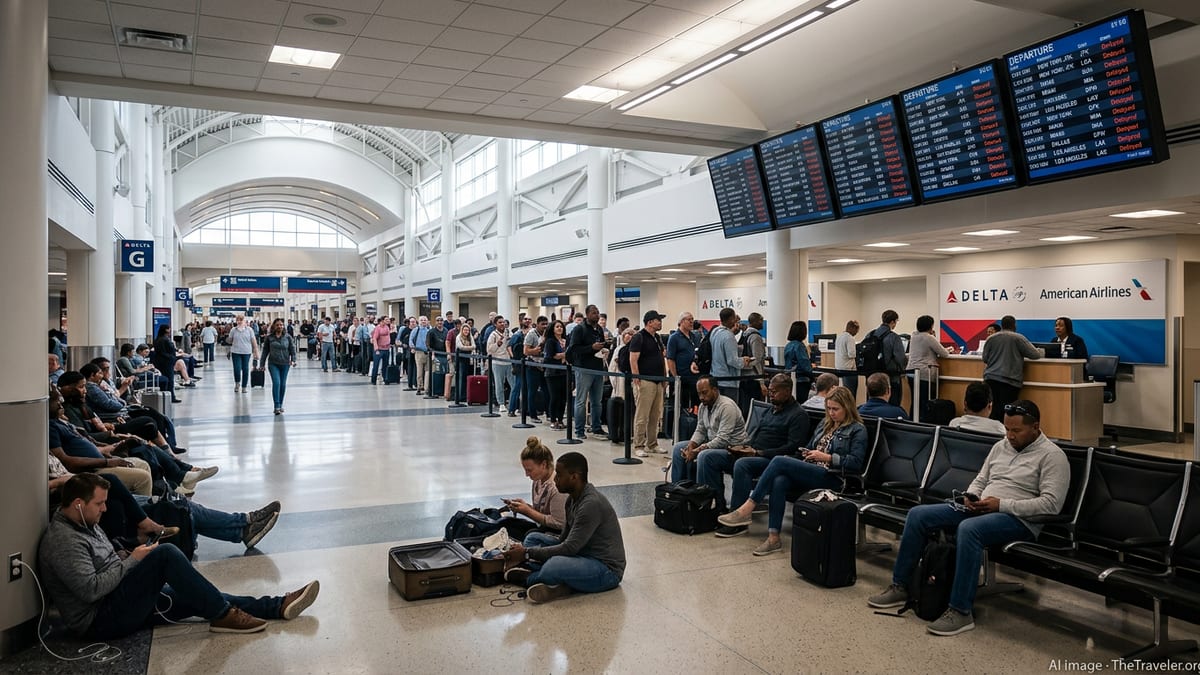
Passengers were rebooked for a rescheduled departure on Tuesday, August 25, 2026, but reports indicate that this second service was also disrupted, leaving many travelers stranded in Lagos for several days. Coverage from Nigerian outlets describes a multi-day ordeal in which affected customers navigated repeated schedule changes, uncertainty over rebooking options and added accommodation costs while they waited for a reliable onward connection to Atlanta.
Separate tracking of Delta’s regular DL55 rotation on the Lagos–Atlanta corridor shows that the August 23 operation was cancelled, while the August 25 service departed late after maintenance checks, underscoring a period of instability on the route even beyond the specific DL9895 cancellations. The combination of a full flight, a limited number of long-haul departures and few alternative nonstop options has amplified the impact on those caught in the disruption.
Mechanical and crew constraints cited
According to published coverage, initial communications to passengers attributed the August 23 cancellation of the Lagos–Atlanta service to an operational or mechanical problem identified before departure. Subsequent updates for the rescheduled August 25 departure referenced separate constraints related to crew availability, suggesting that multiple operational factors converged to disrupt the service twice within three days.
Information shared in Nigerian media reports and passenger notifications points to a cascading effect: a technical or maintenance issue triggered the first cancellation, while crew scheduling rules and availability then complicated efforts to recover the operation in time for the second attempt. This pattern is consistent with broader global airline operations, where a single long-haul cancellation can leave aircraft and crew out of position for days, especially on non-hub routes with limited daily frequencies.
Delta has publicly emphasized in past disruptions that safety and regulatory compliance, including maintenance checks and crew duty-time limits, take priority over schedule integrity. The Lagos–Atlanta case appears to follow that framework, with the airline cancelling or delaying flights rather than dispatching an aircraft or crew that did not meet internal or regulatory standards. Nonetheless, for affected passengers, the result was a prolonged wait and uncertainty around when they would finally depart.
Stranded passengers face mounting costs and missed connections
Accounts compiled by Nigerian news outlets describe travelers spending nights in Lagos hotels and incurring unplanned expenses while they waited for reliable re-accommodation following the twin cancellations. Some passengers reportedly missed onward U.S. domestic connections, business meetings and family events as they attempted to secure replacement itineraries from Lagos to Atlanta and beyond.
Passenger rights and consumer advocates note that international long-haul cancellations can be particularly disruptive, as rebooking options are limited by aircraft availability, visa requirements for transit points and the small number of carriers operating nonstop or one-stop itineraries on specific city pairs. On the Lagos–Atlanta route, alternatives may involve complex routings via European or Middle Eastern hubs, often at higher last-minute fares and with limited seat availability in peak travel periods.
Reports from this latest disruption indicate that some travelers turned to third-party tools that track flight history and status for confirmation that their flights had in fact been cancelled or heavily delayed, using this information to press for rebooking or refunds. The reliance on independent tracking and news coverage illustrates how passengers now increasingly cross-check airline communications against public data when their trips go off schedule.
Spotlight on reliability after previous disruption cycles
The Lagos–Atlanta cancellations arrive against a backdrop of heightened scrutiny of airline reliability, including for Delta. The carrier was among the most affected airlines during the global IT disruption linked to software provider CrowdStrike in July 2024, when it cancelled thousands of flights and left large numbers of passengers stranded at hubs such as Atlanta. That event prompted regulators to classify many of the delays and cancellations as controllable by the airline and fueled wider calls for stronger passenger protections.
While the current Lagos incident is far narrower in scope, industry observers note that even localised breakdowns on high-profile long-haul routes can erode traveler confidence, especially in markets where alternatives are limited. Frequent flyers in Nigeria and across West Africa have long regarded the Lagos–Atlanta corridor as a strategic link for U.S.-bound traffic, and repeated disruptions may encourage some to consider competing routings via other carriers and hubs.
Analysts also point out that long-haul operations are highly asset-intensive and vulnerable to knock-on effects. A single out-of-service widebody aircraft, combined with crew duty-time constraints, can reverberate across multiple days of schedules. The DL9895 and DL55 disruptions documented in public data and news reports appear to reflect these structural pressures, particularly when they occur during busy travel periods.
What travelers can do when long-haul flights are cancelled
Travel experts recommend that passengers facing repeated cancellations on long-haul routes first document all communications from the airline, including cancellation notices, boarding passes and receipts for hotels, meals and transportation. This documentation can be important when seeking reimbursement or claiming compensation where applicable under airline policies or local regulatory frameworks.
Published guidance from consumer groups and regulators also suggests that stranded travelers should check real-time flight trackers and official airline status pages to understand whether later services on the same route are operating, and to assess whether alternative routings via partner airlines or different hubs are available. In practice, acting quickly often improves the chances of securing scarce seats after a mass disruption.
As airlines and regulators continue to debate the contours of passenger protection rules, incidents such as the twice-cancelled Lagos–Atlanta service highlight the stakes for travelers who rely on long-haul links for work, study and family connections. For those stranded in Lagos in August 2026, the episode has become a case study in how operational glitches and crew constraints can cascade into days of disruption on a route where every cancelled flight leaves hundreds of people searching for a way home.