


More news on this day
Rail passengers in East London and Essex faced major disruption after a track obstruction near Ilford brought Greater Anglia services to a crawl, triggering cancellations, diversions and long delays on one of the UK’s busiest commuter corridors.
Get the latest news straight to your inbox!
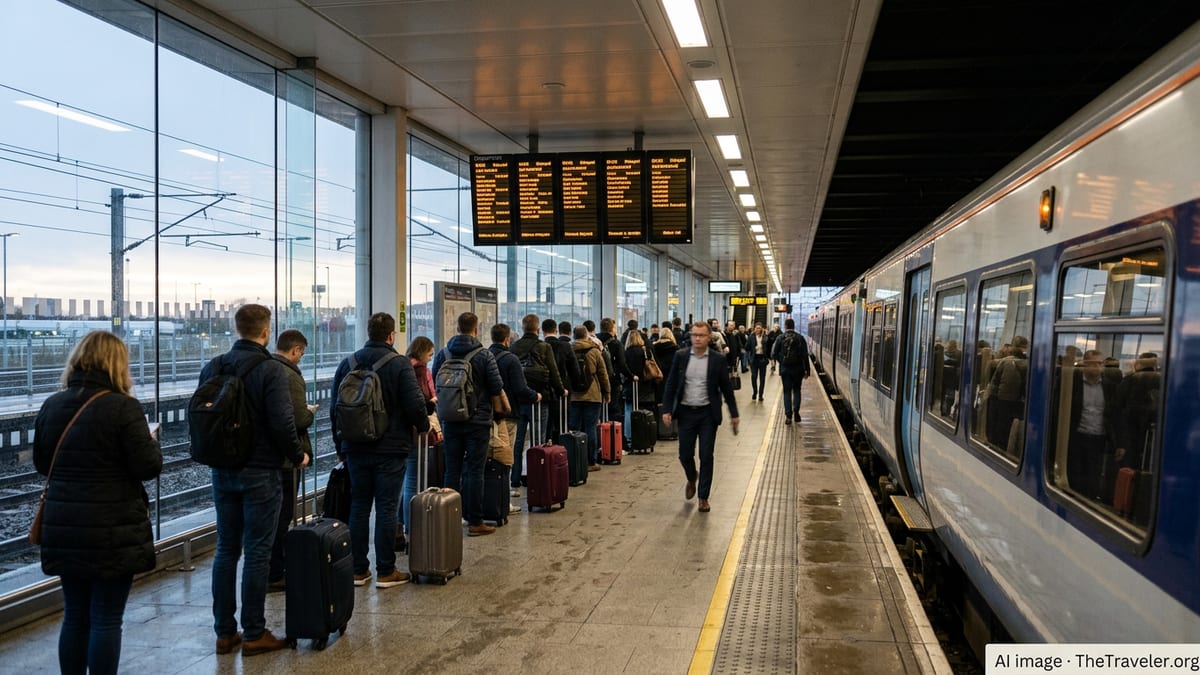
Obstruction Near Ilford Hits Key Commuter Route
According to live journey information and operator updates, a blockage on the tracks in the Ilford area affected services running between London Liverpool Street, Shenfield and destinations across Essex on the Great Eastern Main Line. Publicly available data shows that trains were held outside the station and some were terminated short of their destinations while the line was inspected and made safe for use.
National rail journey planners and disruption feeds indicated that the incident caused widespread knock-on delays to Greater Anglia services, with some trains cancelled at short notice and others running with significantly extended journey times. Similar events in the Anglia region have previously resulted in trains diverting or operating at reduced speed while engineers assessed the infrastructure and cleared any obstruction from the line, a pattern reflected in current disruption reports for the operator.
Ilford sits on the core section of the Great Eastern Main Line between London and East Anglia, a corridor that carries dense commuter traffic alongside regional and airport services. Because of this strategic position, disruption at or near Ilford can quickly cascade along the route to affect journeys across Essex and into Suffolk and Norfolk, magnifying the impact for passengers far beyond the immediate area.
The station also lies close to important depot and stabling facilities, meaning operational changes around Ilford can influence how quickly trains are repositioned, checked and returned to service. Historical performance reports for the route highlight that asset issues in this area have in the past led to significant service-management challenges for the Anglia network.
Services Delayed, Diverted and Shortened
Real-time information systems showed a mixture of delays, short-notice cancellations and part-route services on Greater Anglia trains passing through Ilford following the obstruction. In some cases, trains were reported as starting or terminating at alternative locations away from the affected stretch, a standard measure used on the network to keep as many services running as possible during infrastructure problems.
Network route information for the Anglia region outlines that, when obstructions or track defects are identified, immediate speed restrictions or temporary line closures are often imposed to allow investigations and repairs. Recent published notices for other parts of the Anglia route describe how emergency speed limits have been used where the track condition requires closer monitoring, resulting in extended journey times and the need for revised timetables on short notice.
Journey-checking platforms for Greater Anglia also illustrate how disruption near key junctions can lead to trains being diverted, particularly where alternative paths are available into London termini. The wider Anglia network has in the past routed some services over different lines or adjusted stopping patterns to keep essential connections moving during incidents involving track faults, overhead line problems or damaged infrastructure.
While the specific duration of the Ilford obstruction incident varied between services, residual delays typically continued even after the immediate problem was cleared, as displaced trains and crews were moved back into position. Public information sources on delay management note that it can take several hours for a complex, high-frequency route to recover its usual timetable once a critical section has been blocked.
Passenger Experience and Compensation Rights
For passengers, the disruption translated into long waits on platforms, busier trains on alternative routes and missed connections across the wider rail network. Customer-facing information highlighted the importance of checking live updates before travelling, with operators pointing travellers to real-time departure boards, journey planners and social media channels to track changes.
Greater Anglia’s published guidance on disruption and contingency planning explains that replacement road transport, ticket acceptance on other operators and revised train services can all be deployed, depending on the location and severity of any incident. These arrangements are designed to maintain some level of connectivity for affected communities when parts of the railway are temporarily unavailable.
Under the national Delay Repay scheme, passengers whose journeys are heavily disrupted can claim compensation once they reach a defined delay threshold compared with the timetable. Greater Anglia’s performance and compensation pages outline the process for submitting claims online, including the need for proof of travel and details of the planned and actual journey times.
Information from independent travel and rail-advocacy channels reiterates that passengers do not need services to be fully cancelled to be eligible for compensation; significant extended journey times on delayed trains can also qualify. Travellers impacted by the Ilford obstruction are therefore being encouraged to retain tickets, electronic confirmations or smartcard records as evidence for any claim.
Operational and Infrastructure Pressures in the Anglia Region
The incident near Ilford comes against a backdrop of wider operational pressures on the Anglia railway, where track, signalling and overhead line assets face intense use from dense commuter and regional traffic. Recent technical briefings for the route have described how prolonged periods of hot, dry weather can affect the stability of the ground beneath sections of track, prompting speed restrictions and targeted maintenance works.
Network Rail’s regional updates for Anglia highlight ongoing programmes to manage soil shrinkage, uneven track and other climate-related stresses on the infrastructure. These measures include more frequent inspections, the installation of monitoring equipment and the re-timing of services where necessary to ensure safe operation when conditions place additional strain on the railway.
Publicly available planning documents and performance reports also show that contingency frameworks are in place across Anglia to respond to major incidents, ranging from infrastructure faults to severe weather. These plans set out how signallers, controllers and operators coordinate to protect safety, restore services and communicate with passengers when unexpected problems arise, such as an obstruction on a critical section of line.
Industry analysis of recent disruption events in the region suggests that while infrastructure incidents cannot be eliminated entirely on such a busy network, improved monitoring, faster fault detection and enhanced passenger information tools can help to reduce their overall impact. Greater Anglia has previously promoted live route maps and online dashboards intended to give travellers clearer visibility of train movements and disruption patterns during incidents.
Advice for Travellers in the Coming Days
Although the immediate obstruction at Ilford has been addressed, journey planners indicate that some short-term adjustments and minor timing changes may continue as the timetable settles back into its usual pattern. Commuters using Greater Anglia services between London Liverpool Street, Ilford, Shenfield and stations further east are being advised, through public information channels, to confirm train times shortly before departure.
Rail travel tools covering the Anglia route recommend that passengers allow extra time for connections and consider earlier trains where possible if they are heading to fixed-time commitments such as flights, long-distance services or events. Travellers who experienced substantial disruption during the Ilford incident are also encouraged by published guidance to check their eligibility for compensation under Delay Repay.
For those planning future journeys, keeping an eye on operator websites, journey-checking services and national rail alerts remains the most reliable way to track any renewed disruption in the Ilford area or along the Great Eastern Main Line. As maintenance and resilience programmes continue across the Anglia network, occasional short-notice changes remain possible, particularly during periods of extreme weather or when infrastructure faults emerge unexpectedly.
Overall, publicly available information suggests that the Ilford obstruction has underscored how sensitive the wider Anglia timetable is to disruption at key pinch points near London. Continued focus on infrastructure resilience, clear communication and robust contingency planning is likely to remain central to efforts to keep trains moving smoothly for the thousands of passengers who rely on this route every day.
Greater Anglia service disruptions
National Rail service disruption updates