


More news on this day
Repeated disruptions on Delta Air Lines’ Lagos–Atlanta service have left Nigeria–US travelers stranded for days in Lagos and at U.S. hubs, exposing how vulnerable long-haul passengers remain when one of West Africa’s few nonstop transatlantic links suddenly disappears from the schedule.
Get the latest news straight to your inbox!
Back-to-Back Cancellations Hit a Key Transatlantic Link
Reports from Nigerian and international outlets indicate that Delta’s nonstop Lagos–Atlanta flight experienced closely spaced cancellations in late August 2026, affecting passengers originally booked to depart Murtala Muhammed International Airport for Hartsfield-Jackson Atlanta International Airport on August 23 and subsequent days. According to local legal and travel coverage, travelers arriving at the airport expecting a routine overnight departure instead encountered abrupt schedule changes and prolonged uncertainty over when a replacement flight would operate.
Publicly available information shows that one affected service, identified in Nigerian reporting as DL9895, was withdrawn from the schedule with little same-day rebooking capacity available on alternative Delta or partner flights. With the Lagos–Atlanta route operating only a limited number of times per week, the cancellation immediately translated into multiday delays for many travelers, particularly those relying on onward connections in Atlanta to reach destinations across the United States.
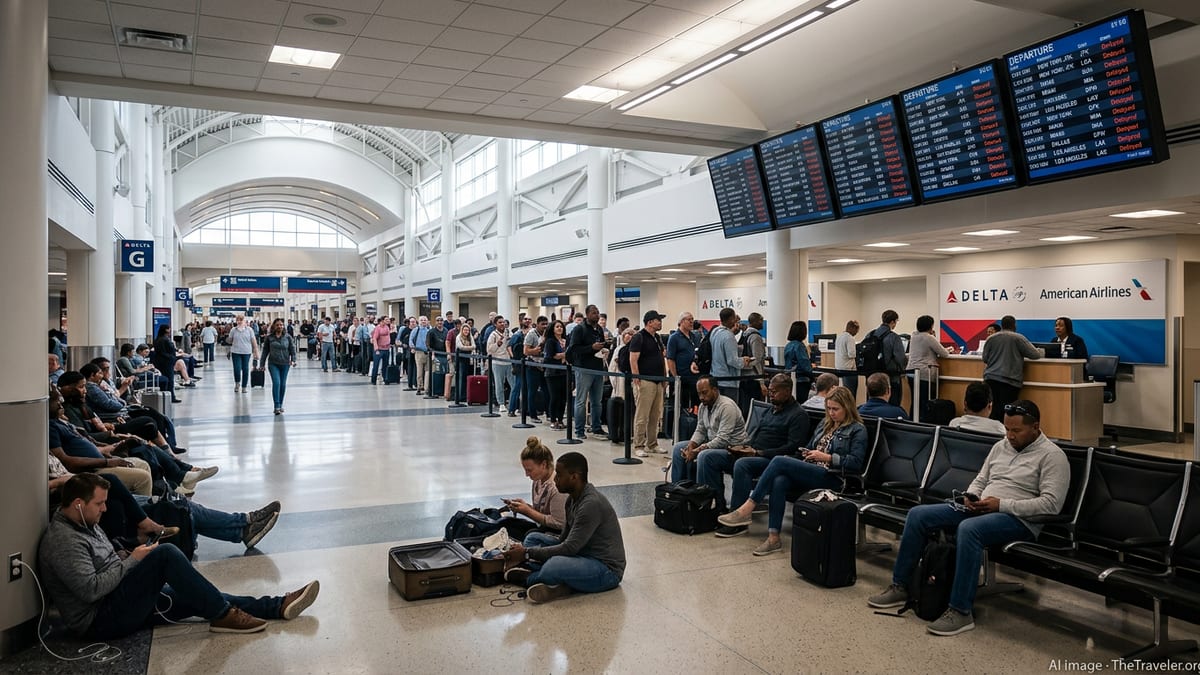
Accounts cited in regional media describe passengers sleeping in airport seating areas and nearby hotels while waiting for clarification. Many travelers reportedly faced unexpected expenses for accommodation, meals, and local transport, while others risked missing work, school, or time-sensitive events in the United States as the disruption stretched from hours into days.
Mechanical, Crew and Operational Issues Cited
Coverage from Nigerian legal and aviation-focused outlets notes that Delta communications to affected customers referenced a mix of mechanical issues, crew availability constraints, and broader operational challenges as reasons for the repeated disruptions on the Lagos–Atlanta leg.
Such language is consistent with standard airline explanations when an aircraft requires unscheduled maintenance or when a carrier cannot assemble a legal flight crew within duty-time and rest regulations. However, for long-haul routes like Lagos–Atlanta, where spare aircraft and crews are not always readily available in the region, even a single cancellation can cascade into days of limited capacity and difficult rebooking.
Travel-industry commentary points out that these operational justifications matter for passengers not only in understanding what went wrong, but also in determining what assistance or reimbursement may be available. In many jurisdictions, compensation rules differ depending on whether a disruption is categorized as within the carrier’s control or the result of extraordinary circumstances.
Stranded in Lagos and Atlanta With Few Alternatives
The impact of the Lagos–Atlanta cancellations has been amplified by the route’s importance as a gateway for Nigeria–US travel and the limited number of comparable nonstop options. When the Delta flight drops from the schedule, many passengers are left to compete for scarce seats on indirect routings via European, Middle Eastern, or other African hubs, often at higher last-minute fares or with significant detours.
Atlanta’s role as Delta’s largest hub also means disruptions on the Lagos end quickly reverberate across the network. Passengers who eventually reach Atlanta after days of delay may find that onward domestic or transborder connections sold on a single ticket have long since departed, triggering a second round of rebooking, extended airport stays, and additional nights in hotels near Hartsfield-Jackson.
Recent history illustrates how quickly conditions in Atlanta can deteriorate when Delta’s operation is under stress. During the CrowdStrike-related IT outage in July 2024, Delta canceled thousands of flights globally, with Hartsfield-Jackson absorbing a disproportionate share of delays and cancellations. Published accounts from that period described passengers sleeping in airport corridors, long queues for rebooking, and travelers waiting days for available seats out of Atlanta as backlogs built on already full summer schedules.
Passenger Rights and Reimbursement Questions Resurface
The Lagos–Atlanta episode has renewed scrutiny of how Delta and other major airlines handle passenger care in prolonged disruptions, particularly on long-haul routes where travelers are far from home and often have limited local support. Legal and consumer reports in Nigeria emphasize that, depending on the governing contract of carriage and any applicable local or bilateral rules, stranded passengers may be entitled to assistance such as hotel accommodation, meals, and ground transport when an airline-controlled disruption forces an overnight stay.
In the United States, regulators have already focused on Delta’s handling of large-scale disruptions. Following the 2024 IT meltdown, U.S. Department of Transportation officials opened an investigation into whether the airline complied with federal refund and passenger-protection rules as thousands of flights were canceled over several days. Separate civil litigation filed by passengers has alleged that some customers were denied timely refunds after cancellations and were left in airport lines or on customer-service phone queues for extended periods while trying to salvage their trips.
Consumer advocates argue that the Lagos–Atlanta cancellations highlight an ongoing disconnect between formal policy commitments and real-world outcomes. While carriers often publicize customer-care promises during severe operational events, travelers on limited-frequency long-haul routes may still face significant out-of-pocket costs and uncertainty when disruptions occur, especially where clear written guarantees or statutory protections are lacking.
What the Lagos–Atlanta Turmoil Means for Future Travelers
For travelers planning future Nigeria–US journeys, the recent Lagos–Atlanta chaos underscores the importance of building contingency time into itineraries, particularly where critical events such as weddings, conferences, or university start dates are involved. Travel professionals frequently recommend at least one buffer day between an intercontinental arrival and any nonrefundable commitments, a margin that can prove decisive when long-haul cancellations trigger multiday delays.
Analysts also note that passengers booking routes with few weekly frequencies or limited competition should pay close attention to ticket conditions, including refund rules, reaccommodation options on partner airlines, and coverage terms for travel insurance policies. Some comprehensive plans may reimburse hotel and meal expenses in the case of extended disruptions, although coverage varies widely and often requires detailed documentation.
At the same time, recurring reports of stranded Lagos–Atlanta passengers suggest a broader reliability challenge for a corridor that serves substantial business, diaspora, and student traffic between West Africa and the United States. Observers say the pattern of cancellations and difficult recoveries points to the need for more resilient contingency planning on long-haul routes, clearer communication around passenger entitlements, and closer alignment between public commitments and the lived experience of travelers caught in days-long disruption cycles.
Delta Lagos–Atlanta Passengers Stranded – TheNigeriaLawyer
Delta cancels Lagos–Atlanta flights twice, stranding travelers – TheTraveler.org