


More news on this day
Severe disruption at Hartsfield-Jackson Atlanta International Airport has rippled across the global aviation system after Delta Air Lines suffered extensive flight cancellations and delays, snarling travel for hundreds of thousands of passengers and renewing scrutiny of the industry’s dependence on fragile IT infrastructure.
Get the latest news straight to your inbox!
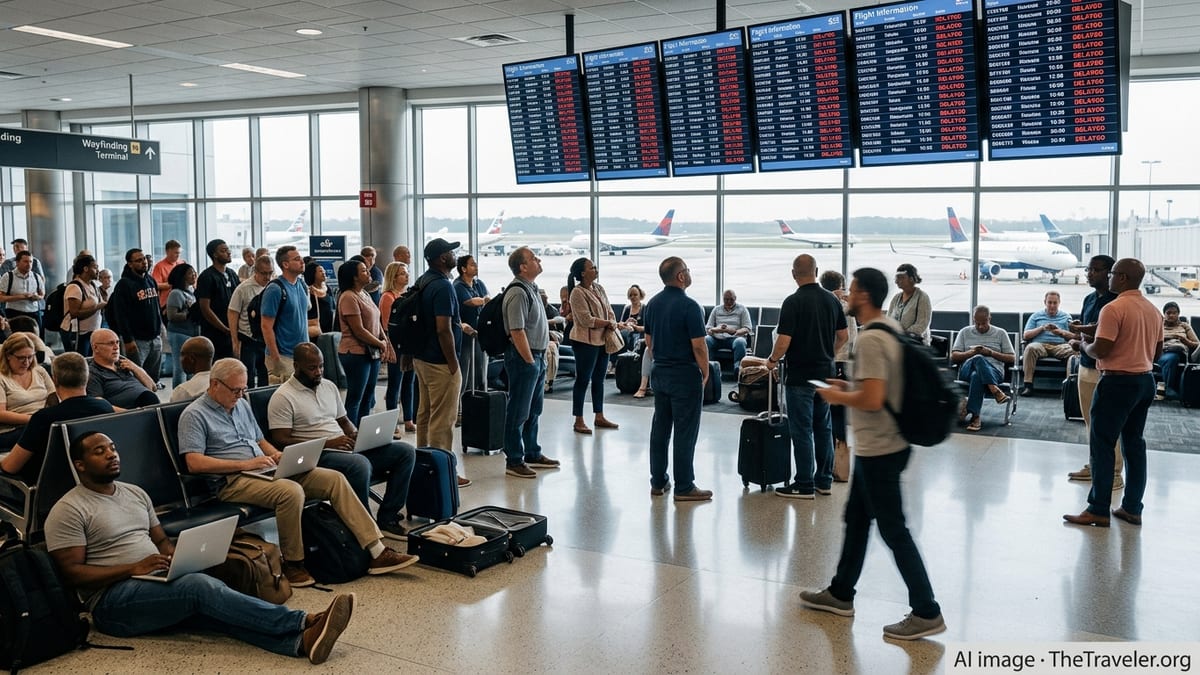
Atlanta Hub Gridlocked as Delta Schedule Buckles
Atlanta’s Hartsfield-Jackson, the world’s busiest passenger hub, became the focal point of the latest Delta Air Lines operational meltdown as large portions of the carrier’s schedule collapsed. Publicly available data from recent disruptions show Delta has been forced to ground or delay significant parts of its network when its core systems fail, turning its primary hub into a chokepoint for both domestic and international traffic.
Reports from recent events indicate that hundreds of flights tied to Atlanta were affected in a matter of hours, with gate areas filling beyond capacity and security lines backing up as passengers tried to rebook. As aircraft and crews fell out of position, knock-on cancellations cascaded throughout the day, leaving a relatively contained technical issue to grow into a network-wide operational crisis.
The impact extended beyond Delta’s own passengers. Because Atlanta is a key connecting point for numerous codeshare and alliance partners, misaligned schedules and missed connections contributed to disruption on other carriers’ long-haul routes. Regional airports that rely on Atlanta as a primary feed reported inbound and outbound delays, underscoring how quickly a problem at one major hub can spread through the wider air transport system.
Local services around the airport also came under strain. Hotel capacity near Hartsfield-Jackson was quickly exhausted, ride-hailing wait times lengthened and rental car queues ballooned as stranded travelers sought alternative ways to complete their journeys. The scenes echoed those from previous large-scale outages, in which Atlanta’s role as a mega-hub magnified the effects of a single airline’s operational problems.
From IT Outage to Global Shockwave
According to recent published coverage examining Delta’s 2024 technology failure, the airline’s vulnerability is closely tied to a critical dependence on complex IT systems for crew scheduling, aircraft routing and check-in operations. When an underlying technology provider experiences a malfunction, cascading failures can quickly make it difficult to track aircraft and staff, leaving planners without accurate information to restore normal operations efficiently.
The crowded summer travel season and tightly packed flight schedules further intensified the disruption. With aircraft operating near full utilization and minimal slack built into daily rotations, there was limited room to absorb delays or reposition aircraft. Once early flights were cancelled or heavily delayed, the backlog of passengers and the shortage of available seats made same-day reaccommodation difficult, leaving travelers stranded at hubs from Europe to Asia.
Global aviation bodies have highlighted how quickly such disruptions propagate through international networks. When a major carrier with an extensive global footprint falters, the effect is often visible at far-flung airports as aircraft arrive late, depart out of sequence or fail to show up at all. Airline operations depend on a finely tuned chain of handoffs between ground crews, air traffic control, maintenance and security screening, any of which can be thrown off by upstream failures.
Analysts note that Atlanta’s central role in Delta’s network means problems there reverberate widely. With a large share of the airline’s domestic and international flights funneled through the hub, a disruption that starts as a localized IT failure can rapidly grow into a global event, affecting travelers who never set foot in Georgia but rely on smooth connections through the carrier’s largest base.
Passenger Fallout and Mounting Consumer Frustration
For travelers, the operational meltdown translated into long queues, missed holidays and unexpected expenses for hotels, meals and alternate transport. Public complaints documented after Delta’s previous large-scale disruption referenced passengers sleeping on terminal floors, separated from checked luggage and facing multi-day waits for available seats on replacement flights.
Recent regulatory filings and news reports indicate that the financial impact on Delta from its last large-scale outage ran into the hundreds of millions of dollars, driven not only by the direct cost of cancellations but also by customer compensation, overtime and recovery operations. Industry observers suggest that each new episode of severe disruption risks eroding hard-won brand loyalty, particularly among business travelers and premium customers accustomed to high reliability.
Passenger rights have also become a more prominent part of the discussion. In the United States and other major aviation markets, updated refund and compensation rules are designed to clarify when travelers are entitled to cash back for cancellations and significant delays. Consumer advocates argue that recurring meltdowns at major carriers underscore the importance of clear, enforceable standards that prevent customers from bearing the brunt of airlines’ operational vulnerabilities.
At the same time, the latest chaos has fueled frustration over communication practices. Travelers caught in earlier disruptions described inconsistent information between mobile apps, gate agents and call centers, as well as difficulty accessing timely rebooking options. Aviation analysts point out that while airlines have invested heavily in digital tools, those systems are only as effective as the underlying operational data feeding them, which can quickly become unreliable during an IT crisis.
Regulators Close One Chapter as Questions Persist
The latest turmoil comes as U.S. regulators move to close the book on a high-profile investigation into Delta’s 2024 meltdown tied to a global IT outage. According to recent coverage from multiple business outlets, the Department of Transportation has ended its probe without imposing financial penalties, despite earlier scrutiny of the airline’s slower recovery compared with competitors and a high volume of consumer complaints.
Public documents summarizing the investigation describe a complex interaction between third-party technology providers, airline systems and operational decision-making. While regulators ultimately chose not to levy fines, the episode has amplified debate over how responsibility should be apportioned when external technology failures trigger massive service disruptions at essential transport providers.
Legal action between Delta and its technology partners continues to play out in the background, reflecting the financial stakes involved when outages ground thousands of flights. Court filings and corporate disclosures outline claims and counterclaims over the robustness of software updates, testing procedures and contractual obligations to ensure continuity for critical infrastructure clients such as airlines.
Policy specialists suggest that, regardless of the outcome of specific disputes, the regulatory environment is shifting toward closer scrutiny of airline contingency planning. Future investigations are likely to examine not just the root technical cause of an outage but also how quickly carriers restore basic service, communicate with passengers and honor refund obligations when operations break down.
Pressure Builds for Deeper Resilience Investments
The scale of the latest disruption has renewed calls for airlines, airports and technology providers to invest more heavily in resilience. Industry consultants note that some carriers have made substantial progress in modernizing their IT architectures and creating redundant systems capable of isolating failures before they spread across an entire network. Others, they say, still rely on legacy technology and workarounds that make rapid recovery far more difficult.
Delta’s recent experience in Atlanta is being viewed by analysts as a case study in how operational concentration can amplify risk. By channeling such a large share of flights through a single mega-hub, the airline benefits from efficiencies in staffing, maintenance and connectivity but also increases exposure when things go wrong. Some experts argue for more distributed scheduling strategies, with greater use of secondary hubs to provide redundancy during crises.
Airport operators are also reviewing their own crisis-management playbooks. Scenes of overflowing terminals and long, static lines at check-in and security areas have prompted discussions about more flexible crowd management, better real-time information displays and closer coordination with airlines to triage passengers by urgency of travel needs during multi-day disruptions.
For travelers, the immediate focus remains on getting home or to long-delayed destinations. For the industry, however, the Atlanta-centered chaos at Delta serves as another warning that incremental fixes may not be enough. As airlines lean ever more heavily on complex digital systems to run dense global networks, the cost of underinvesting in resilience is measured not just in balance sheets but in trust from passengers who expect the planes to run on time.