


I pulled into Cades Cove telling myself I would “just do the loop” before lunch. An hour, maybe ninety minutes if the views were really good. Eleven miles and a few historic cabins later, I was still there near sunset, shoes dusty from an unplanned hike, cooler empty, phone full of wildlife photos, and a new understanding of why this valley seduces day-trippers into spending the whole day.
Get the latest updates straight to your inbox!
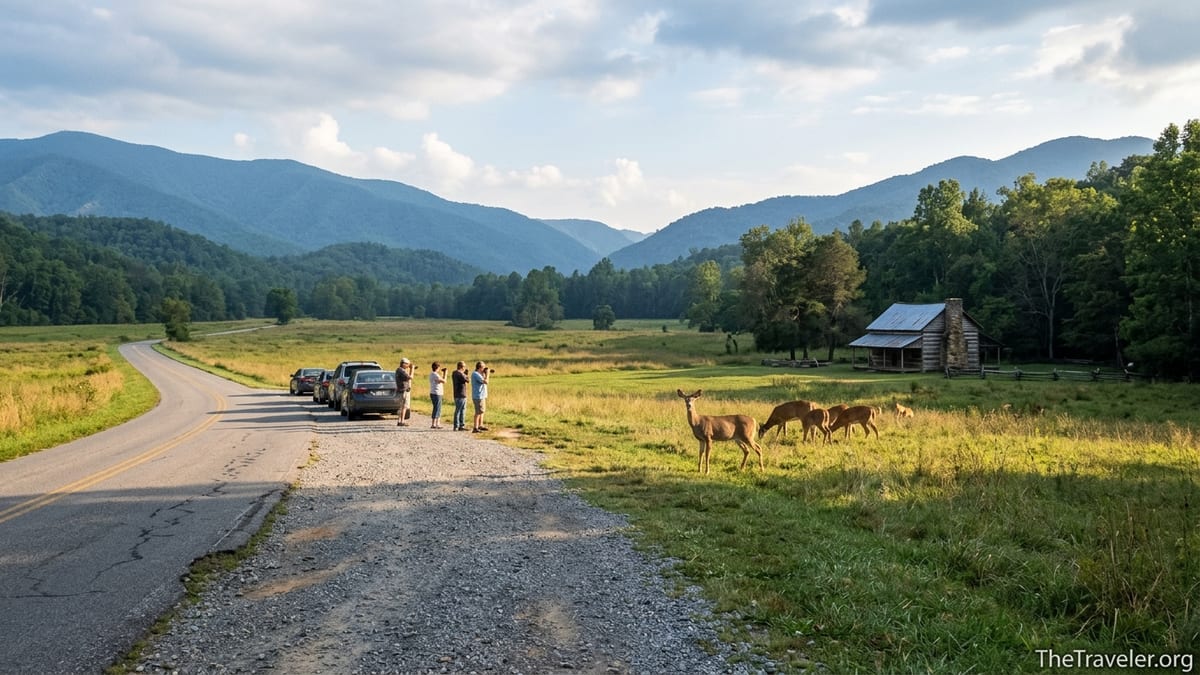
Arriving Expecting a Quick Scenic Drive
The plan was simple: roll in from Townsend, Tennessee, cruise the 11 mile Cades Cove Loop Road, snap a few photos of the mountains, and be back on Little River Road before the afternoon crowds arrived. Most guidebooks describe the loop as a couple of hours at most, and on paper that is accurate. The paved, one way road has a 35 mile per hour speed limit, and plenty of visitors assume it is just another scenic byway inside Great Smoky Mountains National Park.
Reality starts to bend even before you reach the entrance. The drive along Laurel Creek Road from Townsend twists beside cold, clear water and cliff walls that make you want to pull off every half mile. By the time the forest opens into the broad, surprising bowl of Cades Cove, the pace of modern life has already slowed. Peaks of the Smokies ring the valley, with fields that catch the morning mist or late light in a way that makes your “quick stop” feel immediately negotiable.
I eased past the entrance sign, noting the turnoff toward the campground and picnic area and the cluster of cars already angling for parking. A parking tag is required for most vehicles that plan to park anywhere in Great Smoky Mountains National Park, but there is no general entrance fee. That combination makes Cades Cove both easy to access and wildly popular, which is the first clue that an hour might not be enough.
Traffic was already moving at a casual, sometimes glacial pace. At first it was frustrating to creep along at less than ten miles per hour. Then I noticed that every slowdown coincided with a white tailed deer in a field, a wild turkey crossing the road, or a cluster of people pointing cameras toward the tree line, hoping for a black bear sighting. Suddenly, there was no rush to get out.
First Stops: Cabins, Churches, and the Time Warp Effect
The first real delay came at the John Oliver Cabin, one of the earliest homesteads along the loop. What looked like a simple log house from the road turned into thirty unplanned minutes once I pulled off. A short walk led past split rail fences and knee high grass to the cabin, where the thick, hand hewn logs and stone chimney still hold the feel of 19th century frontier life. Families posed for photos on the front steps, while others just leaned on the fence, taking in the cleared pastures and distant mountains.
Once you have stopped once, the loop begins to feel less like a drive and more like a corridor of possibilities. The next pullouts arrive quickly: the Primitive Baptist Church with its small cemetery, the Methodist and Missionary Baptist churches with white clapboard siding that stands out against the green fields. I told myself each stop would be five minutes, but reading inscriptions on gravestones that date back more than a century does not lend itself to rushing.
At each church, the wooden pews and simple pulpits give you a sense of how self contained life once was in this valley. Outside, informational signs explain that before the area became part of Great Smoky Mountains National Park in the 1930s, Cades Cove was a farming community with dozens of families, schools, and a mill. It is one thing to read that in a brochure. It is another to look from the church door out across the same valley the original congregation saw.
By the time I returned to the car after exploring the churches, more than an hour had already passed. I had barely covered a third of the loop, and the idea of leaving felt premature. The slow pace of traffic was no longer an obstacle; it had become part of the experience, an enforced invitation to notice details instead of mile markers.
Midday Detour: The Cable Mill and Visitor Center Gravity
Roughly halfway around the loop, a small sign points toward the Cades Cove Visitor Center and the Cable Mill Historic Area. This junction is the gravitational center of the valley. Even if you intend to drive straight through, the cluster of buildings, restrooms, and people with ice cream cups from the nearby campground store make the turnoff almost irresistible.
Parking may require a bit of patience by late morning, but leaving the car is worth it. The John P. Cable grist mill stands over a raceway that channels water to turn the big wooden wheel, and on many days you can see it in operation. Here, interpreters mill cornmeal and talk about how the mill once served as both a community gathering point and essential infrastructure. Nearby, a blacksmith shop, barns, and other log structures create a small outdoor museum that can easily fill an hour on its own.
The visitor center offers exhibits on Cades Cove history and a small bookstore with maps and local guides. This is where many visitors realize they have underestimated the area. Trail signs point toward Abrams Falls, one of the most popular hikes in the Smokies, and toward the Elijah Oliver Place. People who arrived intending to stay in their car are suddenly calculating whether they have enough water and time to add a hike.
I checked the time and realized that my planned single hour in the cove had stretched to nearly three. The sun was high, and the fields were shimmering under early afternoon warmth. Yet instead of heading for the exit, I found myself tightening my shoelaces in the gravel lot at the Abrams Falls trailhead, drawn in by the promise of a waterfall just 2.5 miles away.
The Hike That Resets Your Schedule
The Abrams Falls Trail begins just off the loop road near the visitor center area. The sign warns that the hike is 5 miles round trip and that swimming near the falls is dangerous due to strong currents. Even knowing the distance, many people underestimate the time and effort, especially in summer heat or with young children. Most hikers should plan at least three hours for the round trip, longer if you are stopping for photos or frequent breaks.
The trail winds alongside Abrams Creek, crossing sturdy log bridges and passing through a mix of hemlock and hardwood forest. In sections, the path climbs and dips enough to remind your legs that this is more than a stroll. Along the way there are glimpses of mossy boulders, side streams, and clear pools that tempt you to sit and listen to the water for a while. Conversations on the trail often revolve around where people have driven from, how long the loop drive took, and whether anyone has seen bears that day.
When Abrams Falls finally comes into view, the sound arrives first. The waterfall is not particularly tall by national park standards, but its volume is impressive, pouring into a wide pool surrounded by jagged rocks and downed logs. Visitors fan out across the rocks with trail snacks and cameras, careful to stay back from the slippery edges. It is one of those places that looks exactly like the photos you have seen and yet still surprises you in person.
By the time I made the return hike and dragged my pleasantly tired body back to the car, my day was effectively reset. Any thought of squeezing Cades Cove between other plans had evaporated. The waterfall, the lingering conversations at trail junctions, and the sense of being enveloped by forest made leaving feel like cutting a story short. I still had another half of the loop to drive and had not yet taken advantage of the large picnic area near the entrance.
Picnics, Wildlife, and the Slow Art of the Loop
Back near the beginning and end of the loop, a side road leads to the Cades Cove picnic area, a shaded stretch of tables along Abrams Creek. The national park maintains more than 80 picnic sites here, each with a table and grill, and the area is open most of the year from sunrise until evening. On busy days in late spring and summer you will see everything from multi generation family cookouts with folding camp stoves to couples quietly splitting deli sandwiches from Townsend while their feet dangle over the rocks at the creek’s edge.
This is where the one hour plan truly unravels for many visitors. Once the cooler is open and the camp chairs are unfolded, the urgency of seeing every log cabin or church fades. Kids wade carefully in the shallows under watchful eyes, anglers with valid Tennessee or North Carolina fishing licenses cast into current breaks, and everyone seems to glance upstream occasionally in case a black bear appears on the far bank. The park posts reminders that all food and trash must be secured to protect bears, and bear proof trash cans make it easier to do the right thing.
In the late afternoon, the loop road itself becomes a slow moving observation deck. Deer step cautiously from tree lines into the fields, wild turkeys graze along fence lines, and on lucky evenings black bears may be seen foraging at the edges of the woods. Traffic frequently stops or crawls when someone spots wildlife, and rangers emphasize keeping a safe distance and staying inside vehicles. The new reality of the loop is that it can take several hours to fully circle the cove, especially in high visitation months when even the National Park Service notes that three hours is a reasonable expectation.
Sitting at a pullout facing the mountains, I realized I had entered sometime after 9 in the morning and was now watching the light tilt toward evening. The day had not been filled with any single dramatic event, but rather a series of quiet moments strung together: the creak of a cabin floorboard, the roar of Abrams Falls, the laughter from a nearby picnic table, the stillness of a field where everyone waited silently for a bear that never appeared.
Practical Tips So Your “Quick Stop” Feels Intentional
Spending an entire day in Cades Cove feels less like a problem and more like a privilege when you plan for the possibility. The national park does not charge an entrance fee, but most visitors who intend to park will need to purchase a parking tag, which is valid throughout Great Smoky Mountains National Park for a set period. Having it squared away before you arrive at the loop helps avoid scrambling for cash or card at a kiosk when you would rather be looking at mountains.
Because traffic into and around the cove can be heavy, especially from late spring through fall and on weekends, timing your arrival matters. Many locals recommend getting to the loop soon after sunrise for the best chance of lighter traffic and more active wildlife. Others prefer late afternoon, arriving after 4 p.m. so they can enjoy the softer light and usually thinner crowds during the last few hours before sunset. Both approaches can turn a planned hour into several, so it helps to keep the rest of the day flexible.
For food, treat Cades Cove more like a full day excursion than a roadside overlook. Pack a cooler with sandwiches, fruit, and plenty of water, or plan to stock up in Townsend or Gatlinburg beforehand. While there is a small campground store near the cove with basics such as snacks, cold drinks, and simple picnic supplies, relying on it for full meals can add unnecessary time and cost. Comfortable walking shoes are essential if you plan to explore historic structures or attempt any of the hikes; flip flops quickly feel like a poor choice on uneven, root knotted paths.
Finally, be realistic about how long each activity takes. Driving the loop without stopping might be possible in under two hours on a quiet winter weekday, but in the busier seasons most visitors should expect to spend three to four hours or more if they plan to stop at multiple historic sites, walk short trails, or simply pull over often for photos. Add an Abrams Falls hike or a relaxed picnic and the day stretches toward sunset almost effortlessly.
Beyond the Windshield: Bikes, Vehicle Free Days, and Accessibility
Cades Cove is famous for its scenic drive, but not every visit has to be behind a windshield. On scheduled vehicle free days during the warmer months, the National Park Service closes the loop road to cars for part of the day, allowing cyclists and walkers to reclaim the pavement. These mornings feel completely different from a typical drive: the road becomes quiet except for the whir of bicycle chains and the echo of voices bouncing off the valley walls.
Many visitors bring their own bikes and arrive early to secure parking near the entrance, while others rent bicycles near the campground on days when rentals are offered. The 11 mile distance is manageable for most moderately fit riders, but the rolling hills and occasional long grades can make it feel more challenging than it looks on a map. Even walking a shorter stretch of the loop during vehicle free hours offers a peaceful way to absorb the scenery without the pressure of traffic behind you.
For travelers with limited mobility, Cades Cove offers more options than first impressions might suggest. The picnic area has accessible sites and restrooms, and several of the major historic stops, including the visitor center area near Cable Mill, have relatively level paths from the parking areas. While many cabins sit at the end of uneven dirt footpaths that may be difficult for wheelchairs or walkers, it is still possible to enjoy wide open views of the valley and mountain backdrop from roadside pullouts and designated accessible parking spots.
Families with small children or older relatives often find that alternating between short walks and scenic driving works well. For example, you might drive a few miles, stop at a church where those who want to explore can take a quick look inside while others rest in the shade, then continue to the visitor center where everyone can regroup at the exhibits or sit on the porch of the mill. The key is to treat the day as flexible and to let the group’s energy rather than the clock dictate how long you stay.
The Takeaway
When I finally rolled back onto Laurel Creek Road and left Cades Cove behind for the day, the sun was low and my original schedule had been completely abandoned. That one planned hour had grown into a full day of unhurried exploration, shaped less by a checklist of sights and more by how the valley itself unfolded. The slow moving traffic, the surprise of a cabin tucked under trees, the sound of water on the Abrams Falls trail, and the quiet of the picnic area had all conspired in the best possible way.
If you are planning your own visit, it is wise to accept that Cades Cove resists being squeezed into a small window between other obligations. Give it room on your itinerary, pack like you might stay longer than you intend, and be open to following whatever catches your eye, whether it is a side road to a picnic table, a footpath to a gravestone, or a turnoff toward a waterfall that was not in your original plan.
In a national park as busy as the Smokies, where crowds can sometimes make even scenic overlooks feel hurried, Cades Cove offers something different. It slows you down, not with spectacle, but with layers: history, landscape, wildlife, and small human stories that ask for more than a drive by glance. Plan an hour if you must, but do not be surprised if you find yourself, as I did, still there as the last light grazes the fields and the mountains turn blue around you.
FAQ
Q1. How long does it really take to drive the Cades Cove Loop Road?
Most visitors should expect the 11 mile loop to take at least two to three hours with normal traffic, and longer in peak seasons or if you stop often.
Q2. Do I need a reservation or timed entry for Cades Cove?
There is no timed entry reservation system for Cades Cove, but most visitors who plan to park will need a valid Great Smoky Mountains National Park parking tag.
Q3. What is the best time of day to see wildlife in Cades Cove?
Wildlife such as deer and black bears is often more active around dawn and dusk, especially during cooler months, though sightings are never guaranteed.
Q4. Is Abrams Falls a suitable hike for families?
Abrams Falls is a roughly 5 mile round trip hike with some ups and downs. Many families complete it, but it requires sturdy shoes, water, and realistic time planning.
Q5. Are there places to buy food and drinks in Cades Cove?
There is a small campground store near the cove that sells drinks and snacks, but most visitors prefer to bring picnic supplies or buy groceries in nearby towns beforehand.
Q6. Can I bike the Cades Cove Loop Road?
Yes, you can bike the loop, and on designated vehicle free days in the warmer months the road is closed to cars for several hours, creating ideal conditions for cyclists.
Q7. Is Cades Cove accessible for visitors with limited mobility?
Several key areas, including the picnic area and visitor center, have accessible parking and restrooms, and there are viewpoints where you can enjoy the valley without long walks.
Q8. When is Cades Cove the least crowded?
Winter weekdays and early mornings in the shoulder seasons generally see lighter traffic, though weather and school holidays can influence crowd levels.
Q9. Are pets allowed in Cades Cove?
Pets are allowed in the picnic area and along roads if leashed, but they are not permitted on most trails, including Abrams Falls, so plan accordingly.
Q10. What should I bring if I might end up spending the whole day in Cades Cove?
Bring water, snacks or picnic food, sturdy walking shoes, layers for changing weather, sun protection, a camera, and patience for slow traffic and frequent stops.