


More news on this day
Delta Air Lines is facing heavy disruption across its international network after a halt in check-in operations triggered widespread delays, diversions and rolling schedule issues at several of its largest hubs.
Get the latest news straight to your inbox!
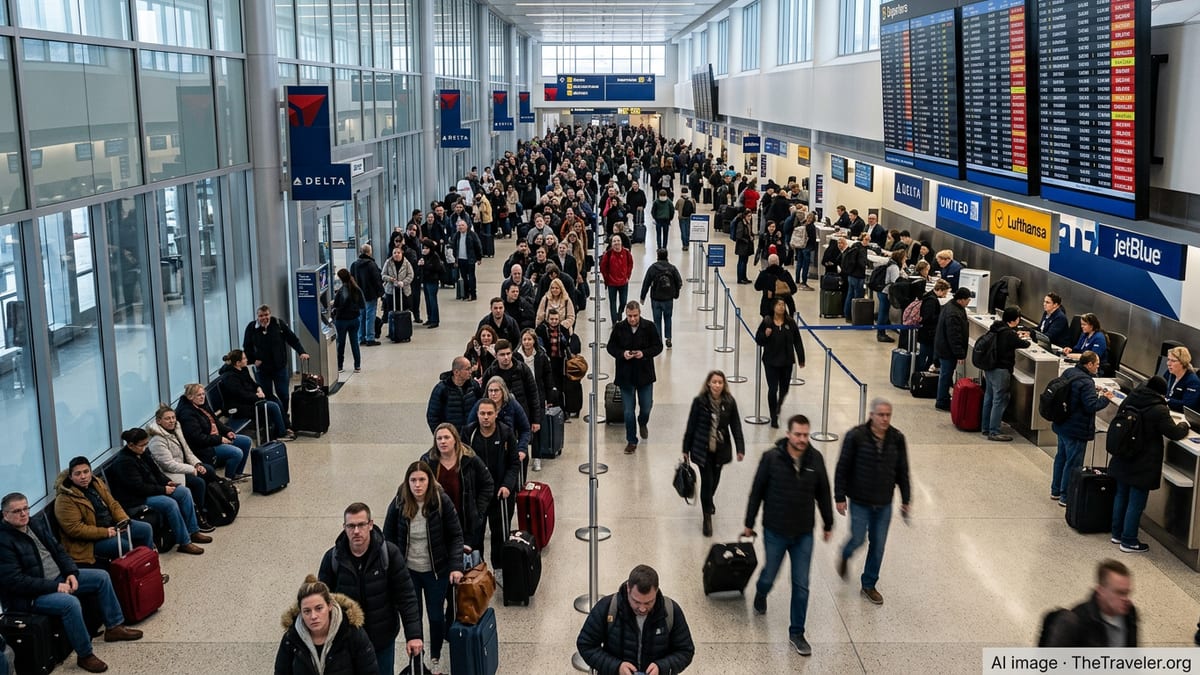
System Disruption Sends Delays Soaring Across the Network
Publicly available flight-tracking and disruption data indicate that Delta’s international hubs in Atlanta, New York JFK, Detroit, Minneapolis and Seattle have all been affected by a wave of delays that has reached four-figure levels when measured in total minutes. Aggregated same-day statistics from multiple tracking platforms show departure and arrival times slipping by well over an hour on many long haul routes, with late-running aircraft creating a chain reaction across onward services.
The current disruption follows a pattern seen earlier in 2026, when a technical issue with Delta’s check-in and boarding systems led to widespread departure delays during a winter storm on the US East Coast. At that time, national coverage described a mix of weather and technology problems combining to slow operations throughout the carrier’s domestic and international network, particularly at major hubs.
Today’s disruption is once again concentrated at large connecting airports that serve as gateways for transatlantic and transpacific traffic. Flight-status boards at these hubs show clusters of delayed services to Europe and Asia, along with a noticeable rise in late evening and overnight departures that are now scheduled to leave well behind their original times.
Operational data from independent trackers also points to pressure on inbound traffic. Aircraft arriving late from overseas are turning around for their next legs with reduced buffers, making it harder for schedulers to absorb even minor additional delays. That dynamic is particularly visible at airports where Delta banks multiple international arrivals and departures in tightly packed waves.
Check-In Halt Triggers Bottlenecks At International Gateways
Reports from passengers and airport information feeds indicate that a temporary halt or slowdown in Delta’s check-in processes played a central role in the latest disruption. When airport check-in and bag-drop counters stop processing travelers at scale, boarding times lengthen, boarding queues spill into terminal corridors and departure slots are missed, forcing aircraft to wait for new clearances.
At international hubs, where flights typically depart with high load factors and extensive checked luggage, even a brief interruption at the front end of the process can ripple quickly. Travelers on long haul routes often require additional document checks for visas, onward connections and entry requirements, which further amplifies the impact when automated systems or staffed counters are not functioning normally.
According to published travel-advisory material, Delta already encourages passengers on international services to arrive early and complete as much of the process as possible via its app, particularly at crowded hubs. When those digital tools or their supporting back-end systems experience issues, the fallback to manual processing can overwhelm airport infrastructure during peak periods, especially in terminals that also host partner airlines.
Self-service bag-drop technology and touchless identification systems, which Delta has promoted as a way to ease congestion, are designed to prevent precisely this kind of logjam. However, the latest disruption shows that if the core reservation and check-in backbone is interrupted, these tools cannot fully compensate, and the result is a sharp, network-wide slowdown.
Flights Diverted As Crews Time Out And Weather Compounds Delays
As delays accumulate into the evening bank of departures, some long haul flights are forced into diversions or unscheduled stops. Public incident reports over recent weeks have highlighted several Delta services that diverted within the United States due to a mix of operational and safety-related issues, including cockpit odour reports that required precautionary landings before continuing to their destination.
In parallel, severe weather across parts of the US has periodically narrowed available airspace and approach windows around major hubs, further complicating recovery efforts. When aircraft miss their departure slots because of slow check-in or boarding, they can be pushed into already congested weather-related holding patterns. The resulting extra flying time can bring flight crews close to or beyond their duty limits, forcing last-minute diversions so that pilots and cabin staff do not exceed regulated work hours.
Once a diverted aircraft lands at an alternate airport, the disruption tends to cascade. Passengers may need to clear customs at an unexpected location, rebook onward connections and wait for replacement crews or equipment. That activity pulls aircraft and staff away from their planned rotations, making it more difficult for the airline to stabilize the schedule at its primary hubs the following day.
Recent consumer-rights analyses of US airline disruption patterns underscore how quickly these situations can escalate. A single day of heavy delays at a primary hub can lead to hundreds of off-schedule flights, creating what some analysts describe as four-figure delay totals in minutes and affecting tens of thousands of travelers across several continents.
Impact Felt Most Strongly At Delta’s Largest International Hubs
Delta operates a multi-hub model centered on Atlanta, New York JFK, Detroit, Minneapolis, Salt Lake City, Seattle, Los Angeles and additional focus cities. Among these, Atlanta, JFK, Detroit, Minneapolis and Seattle function as key international gateways, handling a large share of the airline’s transatlantic and transpacific departures as well as connections to Latin America and Africa.
In the current disruption, schedule data shows that long haul flights from these hubs to European cities such as London, Paris, Amsterdam and Dublin, as well as Asian destinations including Tokyo and Seoul, have been particularly vulnerable. Many of these services depart in narrow evening windows, so any delay at check-in can mean that a full wave of departures leaves late together, rather than being spaced out through the day.
Travel forums and real-time tracking tools suggest that passengers connecting from smaller US cities into these international banks are also feeling the impact. When incoming domestic flights arrive behind schedule, travelers have less time to clear international transfer checkpoints and may miss flights that themselves are already delayed. That combination contributes to crowded rebooking lines, pressure on hotel capacity around major hubs and heavier loads on subsequent departures.
Airline-performance enthusiasts tracking Delta’s on-time record across hubs note that some gateways have historically been more resilient than others. However, a disruption that originates with a network-wide process like check-in makes it far more difficult for any single hub to outperform the rest, since all rely on the same central systems.
What Travelers Can Do As Delta Works To Restore Normal Operations
Public guidance from travel-compensation platforms and airport advisories emphasizes several steps passengers can take while disruptions unfold. The most consistent recommendation is to monitor flight status closely through the airline’s app and airport displays, as departure times may change repeatedly throughout the day as operations teams reshuffle aircraft and crews.
International travelers are also encouraged to build extra time into their journeys. That includes arriving at the airport well ahead of standard check-in cutoffs, especially when departing from busy hubs or when connecting from domestic feeders to long haul flights. Having all required documents and travel authorizations ready can help reduce individual processing times at counters that are already under strain.
Consumer-rights organizations advise passengers to keep records of boarding passes, delay notifications and any additional expenses such as meals or overnight accommodation, as these can be relevant when seeking reimbursement or compensation under airline policies or applicable regulations. The level of support available often depends on whether the disruption is linked to factors within the airline’s control, such as internal system failures, or to external events like extreme weather and air-traffic control restrictions.
For its part, Delta’s publicly available customer information highlights ongoing investments in airport technology, automated baggage handling and digital check-in tools intended to reduce friction at the start of the journey. As the airline works to bring its international hubs back to normal throughput following the latest check-in halt and resulting diversions, travelers across the network are watching to see how quickly those systems and contingency plans can restore the reliability on which the carrier has built much of its global reputation.