


More news on this day
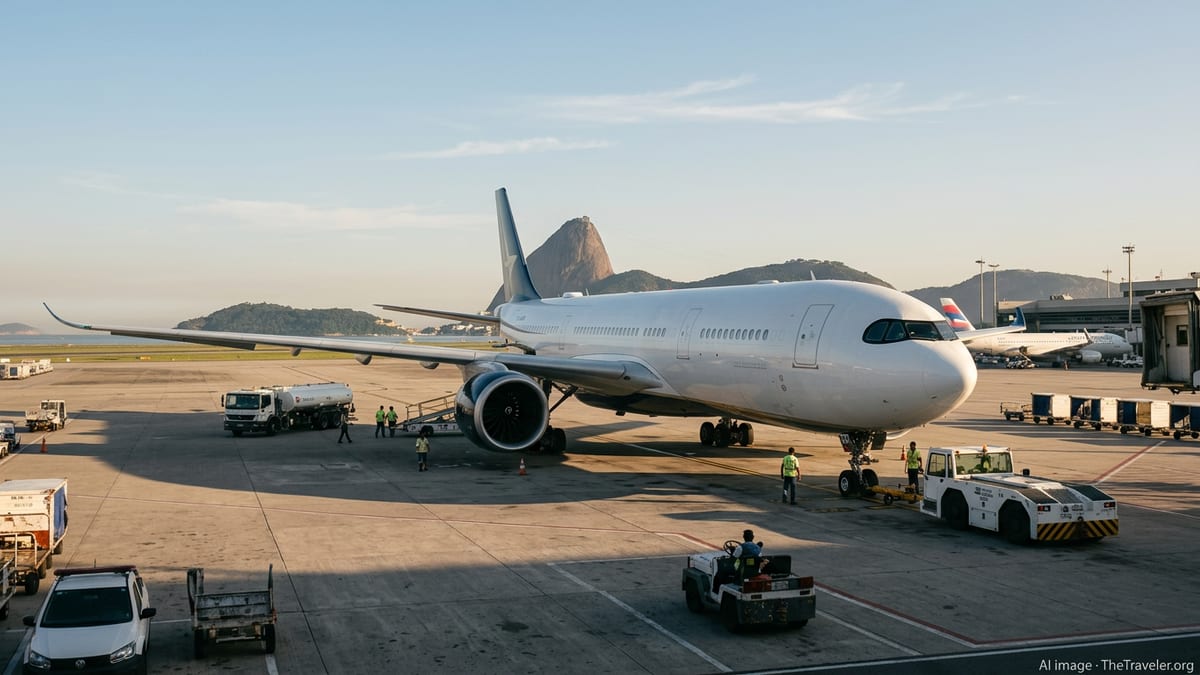
Delta Air Lines is pushing deeper into the Brazil market as its Airbus A330-900 service on the São Paulo to Atlanta route approaches a reported 99 percent capacity, highlighting robust two-way demand and a broader strategic bet on premium long-haul travel between North and South America.
Get the latest news straight to your inbox!
High Load Factors Signal Surging Brazil–U.S. Demand
Publicly available scheduling and ticketing data indicate that Delta’s DL104 service linking São Paulo’s Guarulhos International Airport with Atlanta is operating with load factors near 99 percent, effectively filling almost every seat on peak departure days. The performance places the route among Delta’s strongest transcontinental services by occupancy, according to industry analytics referenced in recent aviation commentary.
The near-full flights reflect a wider rebound in Brazil’s outbound and inbound travel, with business, trade, and leisure traffic all contributing to higher demand. Capacity on key U.S.–Brazil city pairs has tightened as airlines consolidate frequencies into high-volume hubs, making the São Paulo–Atlanta corridor a critical gateway for connections deeper into both continents.
Industry observers note that the high loads are being sustained beyond traditional holiday peaks, suggesting structural demand rather than a short-term spike. Travel agencies and fare trackers report firm pricing on many DL104 departure dates, a typical sign that airlines are confident in both demand and yield on the route.
For Delta, the strong performance on São Paulo–Atlanta supports its long-haul network strategy, which emphasizes feeding traffic through large hubs where connecting flows can stabilize load factors and justify the deployment of fuel-efficient widebody aircraft.
A330-900 Becomes a Workhorse for South America
The choice of the Airbus A330-900 on DL104 aligns with Delta’s ongoing widebody renewal. The A330neo family combines lower fuel burn with a modern cabin and increased range, attributes that are particularly valuable on overnight, high-density routes linking South and North America. Fleet information published by Delta and Airbus shows the carrier steadily growing its A330-900 portfolio as it phases out older models.
Onboard, the A330-900 typically offers Delta One suites, a premium economy cabin, and an updated main cabin product, positioning the airline to capture high-yield corporate and long-haul leisure travelers between Brazil and the United States. Aviation analysts point out that such cabin configurations allow carriers to convert strong demand into higher revenue per seat, especially on routes where business travel and affluent leisure segments overlap.
Operational data released in recent years highlight Delta’s efforts to pair newer, more reliable aircraft with intensive international schedules. Deploying the A330-900 on São Paulo–Atlanta gives the airline a balance between capacity and efficiency, while also standardizing the passenger experience across many of its flagship international routes.
As additional A330-900s join the fleet over the coming years, industry forecasts suggest that more South American routes will see the type, especially from major hubs such as Atlanta and New York, where connectivity and aircraft utilization can be maximized.
Joint Venture and Network Effects Drive Brazil Growth
Delta’s push in Brazil is not happening in isolation. The carrier’s trans-American joint venture with LATAM Airlines Group has reshaped connectivity in the region, with both partners coordinating schedules and networks to feed long-haul services across key hubs. Published corporate and regulatory filings describe the joint venture as a driver of increased frequencies and new route combinations between the Americas.
Within this framework, the São Paulo–Atlanta flight functions as both a point-to-point trunk route and a key connection bank. Passengers originating in Brazil can connect in Atlanta to domestic U.S. destinations and onward to Canada, Europe, and Asia, while U.S. travelers gain easier access to Brazil and other South American markets through São Paulo. This network effect helps sustain the high load factors reported on DL104.
Analysts following the Brazil market note that São Paulo’s role as a financial and industrial hub generates consistent business traffic, while a softer currency and expanding tourism offerings draw U.S. leisure visitors. When combined with improved connectivity under the joint venture, these dynamics have supported a steady rise in premium-cabin bookings, particularly on overnight northbound services.
The strong performance on São Paulo–Atlanta also underscores how global alliances and joint ventures are reshaping traffic patterns in South America, concentrating capacity around a few powerful hubs that can support modern widebody fleets.
Infrastructure Constraints and Capacity Planning in São Paulo
The sharp rise in demand on routes like DL104 is unfolding against a backdrop of infrastructure constraints at São Paulo’s main airports. Academic and policy studies examining the São Paulo air network have highlighted capacity pressures at Guarulhos, Congonhas, and Viracopos, noting that runway, gate, and terminal resources are under strain during peak periods.
As Guarulhos absorbs more long-haul flying, including widebody services to North America and Europe, slot availability and operational performance become crucial for airlines seeking to grow. High load factors on existing flights such as the A330-900-operated São Paulo–Atlanta route suggest that demand is outpacing the ability to simply add frequencies, prompting carriers to focus on upgauging aircraft, optimizing schedules, and refining connections.
Industry research on Brazil’s aviation sector indicates that carriers have strong incentives to deploy more fuel-efficient and higher-capacity aircraft into slot-constrained airports. The A330-900’s combination of range, seat count, and operational efficiency fits this pattern, allowing Delta to serve dense markets like São Paulo–Atlanta with fewer overall movements while still accommodating rising passenger numbers.
These structural constraints point to a long-term environment in which airlines operating at Guarulhos must balance frequency, aircraft size, and schedule timing to maintain profitability and reliability, even as demand for international travel grows.
Safety Spotlight After March 2026 Engine Incident
The strong commercial performance of DL104 comes in the same year that the route drew global attention for safety-related reasons. Public incident databases and media coverage report that in late March 2026 a Delta-operated Airbus A330 on the São Paulo–Atlanta flight experienced an engine failure and fire shortly after takeoff from Guarulhos, prompting an emergency return and safe landing.
No serious injuries were reported, but the event led to an investigation by Brazilian aviation authorities and renewed scrutiny of engine performance and maintenance practices on long-haul widebodies. Aviation experts commenting on the incident stressed that such failures remain rare compared with the large number of daily flights, and that twin-engine aircraft are designed to continue flying safely on a single engine in the event of a malfunction.
Historical safety data for the Airbus A330 family show a strong overall record in commercial service, with a limited number of major incidents relative to total flight hours. Regulators and manufacturers typically respond to any serious engine event by reviewing inspection protocols, maintenance intervals, and operating procedures, steps that can lead to additional safety margins across entire fleets.
For travelers on the São Paulo–Atlanta route, the combination of high load factors and a widely used modern aircraft type illustrates both the popularity of the service and the level of engineering and regulatory oversight underpinning long-haul travel between Brazil and the United States.