


More news on this day
A fatal collision between two passenger trains on the Midland Main Line near Bedford has left a driver dead and 28 people in hospital, focusing renewed attention on rail safety and travel disruption along one of Britain’s busiest north–south routes.
Get the latest news straight to your inbox!
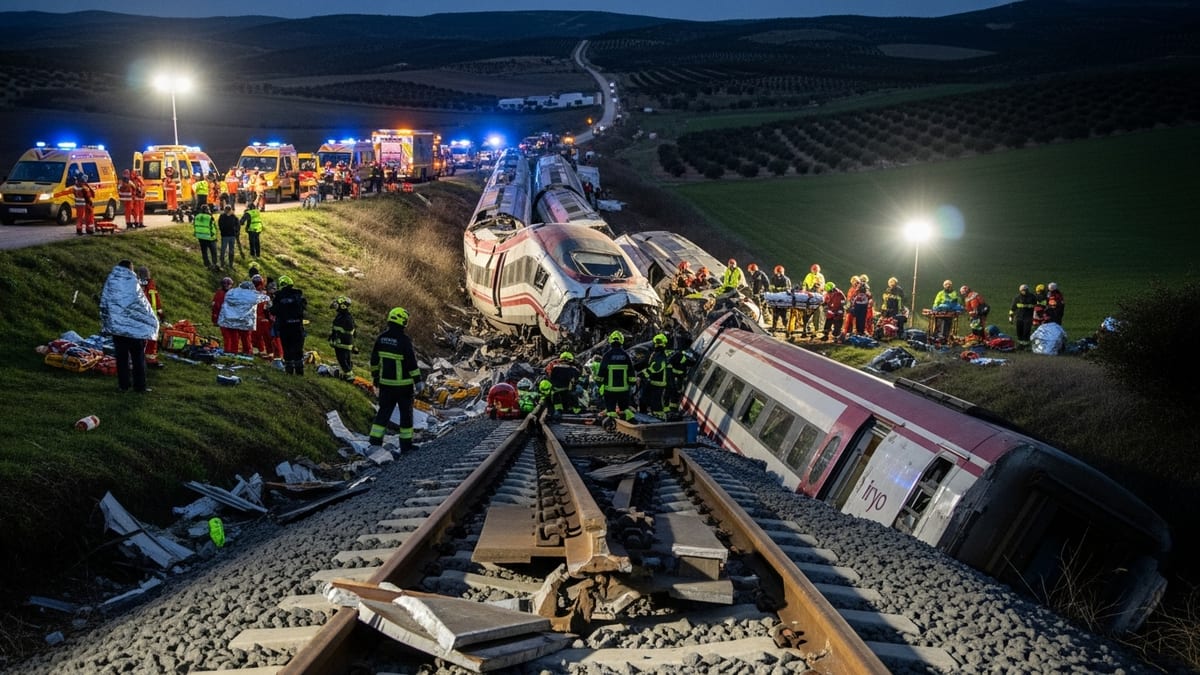
Collision near Bedford at peak travel time
Publicly available information indicates that the crash occurred on Friday, June 19, in the early evening near Elstow, just south of Bedford, on the main line linking the Midlands with London St Pancras. Two southbound East Midlands Railway services were involved, with one train running into the rear of another on the same track.
Reports describe a sudden, violent impact that threw passengers from their seats in crowded carriages during the evening peak. Rail tracking data cited in published coverage places the collision shortly after 5:15 p.m. local time, a period when many commuters and leisure travelers use the route to reach the capital or connect to other services.
Images and video from the scene show multiple carriages remaining upright but visibly damaged, with emergency vehicles lined up along a parallel access road. Some travelers were able to walk away from the wreckage, while others were stretchered to waiting ambulances after initial treatment beside the line.
Travelers heading between the East Midlands and London on Friday evening reported seeing long queues, packed platforms and extensive delays as services were halted through the affected area while first responders worked at the site.
Casualties and hospitalisations
Information compiled from national and regional news outlets states that the driver of the trailing train died in the collision. Published reports identify him as a long-serving professional, whose death has prompted expressions of sympathy from rail staff and passenger groups.
Across the two trains, more than 80 people sought medical help in the hours after the crash, according to figures cited by multiple news reports. By Saturday, June 20, updates from British rail and emergency-service briefings, as reported in the press, indicated that 28 people remained in hospital.
Among those still receiving treatment, nine individuals were described in coverage as being in critical condition. Others were being treated for serious but not life-threatening injuries, ranging from fractures and head trauma to cuts and bruises caused by sudden deceleration and secondary impacts inside the carriages.
Accounts shared in published interviews with passengers describe scenes of confusion in the immediate aftermath, with some people dazed or unable to move, while others tried to assist those with visible injuries until paramedics arrived.
Emergency response and disruption for travelers
According to publicly available reports, a significant multi-agency response was deployed to the site within minutes, including local fire and rescue crews, ambulance teams, specialist hazardous incident units and air ambulance support. Temporary triage areas were set up close to the track to prioritise the most severely injured.
Ambulance services cited in news coverage report that dozens of patients were transported to several hospitals in the wider Bedfordshire and East of England region, helping to spread the clinical load. Others with minor injuries or shock were assessed at the scene and later released.
The collision shut a key section of the Midland Main Line, causing widespread cancellations and diversions for passengers travelling between cities such as Sheffield, Nottingham, Derby, Leicester and London. Rail operators warned that disruption would continue for several days while investigators examined the site and damaged rolling stock was removed.
Travel advisories carried by national media encouraged passengers to check revised timetables, allow extra journey time, and consider alternative routes where possible. Replacement bus services and diversions via other main lines were reported, but capacity constraints led to crowded conditions on some alternative trains.
Investigation into how the crash occurred
Specialist teams from Britain’s rail accident investigation bodies are examining how two passenger services came to be on the same stretch of track in such close proximity. Early reporting indicates a rear-end impact, a type of incident that has become rare on the modern UK network.
Investigators are expected to review signalling data, train protection systems, driver actions and any potential technical faults, drawing on on-board recorders and lineside equipment logs. They are also likely to consider staffing patterns, timetable pressure and any reports of unusual conditions in the minutes before the collision.
Media coverage notes that the UK rail system has recorded comparatively few fatal multi-train collisions in recent decades, which has made this incident near Bedford particularly significant for both safety regulators and railway staff. The findings of the inquiry are expected to inform any recommendations for infrastructure, operational or training changes.
For now, rail travelers across the region face ongoing timetable changes, while those regularly using the Bedford corridor await clarity on when full normal services will resume and what measures will be taken to prevent a repeat of such a serious crash.
Impact on passengers and wider rail confidence
For many individual passengers, the crash has turned an ordinary evening journey into a long-term recovery. Reports highlight people with broken limbs and other serious injuries who now face weeks or months of rehabilitation after what was intended to be a routine trip home or to London.
Travel industry observers note that, while rail remains statistically one of the safest ways to travel in the UK, high-profile incidents such as this one can temporarily affect public confidence. Some regular users of the Midland Main Line have described in published accounts feeling anxious about returning to the route so soon after the crash.
At the same time, specialists quoted in coverage have pointed to the overall survival rate and the fact that most carriages remained upright as evidence of improved crashworthiness standards in modern trains. They suggest that design changes introduced over recent decades may have helped limit fatalities in an impact that occurred at line speed on a busy main route.
As services gradually stabilise in the coming days, attention for many travelers will shift from the immediate disruption to the outcome of the official investigation and any measures proposed to enhance safety on one of the country’s most important intercity corridors.