

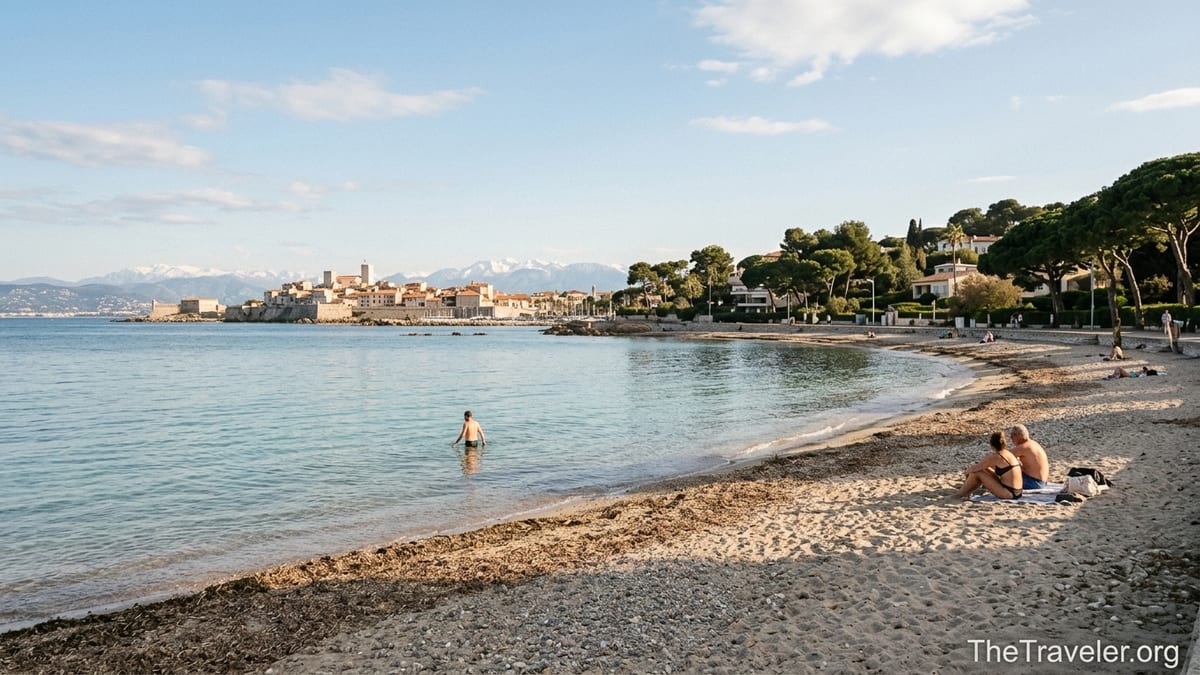
At first glance, Plage de la Salis looks like exactly what most people come to Antibes for: soft sand, calm water and a postcard view of the old town and the Alps beyond. Yet spend more than an afternoon here and you start to notice details that day trippers, cruise passengers and hurried Riviera road trawlers rarely see. From subtle shifts in the light to traces of Antibes’ maritime history and overlooked ways to escape the crowds, this modest crescent of sand rewards travelers who slow down and look closer.
Get the latest updates straight to your inbox!
The Beach That Quietly Connects Old Antibes And Cap d’Antibes
Most visitors arrive at Plage de la Salis, drop their towels near the first free space and never realize they are standing at a natural gateway between two very different worlds. To the east, the ramparts and terracotta roofs of old Antibes rise behind Plage du Ponteil and the harbor. To the west, the wooded peninsula of Cap d’Antibes begins almost immediately after the small Port de la Salis. In practical terms this means you can use the beach as a hinge point: stroll 15 minutes along Boulevard James Wyllie to the covered Provençal market in the morning, then walk the opposite way in the afternoon and find yourself on the coastal path skirting millionaire villas.
Stand roughly mid‑beach and look behind you and you can trace this transition. To the left are apartment buildings, a sailing club and the faint hum of town traffic. To the right, the skyline suddenly drops and turns green as umbrella pines take over. An easy real‑world example is how locals arrange their days: many will swim at Salis before work, pop back up the road toward Antibes for a quick espresso at a café on Avenue de la Libération, then return in the evening with friends to follow the path around the cape for sunset. Visitors often see Salis as the destination instead of the starting point of this daily choreography.
The geography also affects the feel of the water. The beach sits in a broad, shallow bay between the harbor and the tip of the cape, which keeps waves low even on breezier days. Families from inland parts of France routinely choose an apartment a few blocks back from Salis precisely because young children can wade out on the sandy seabed for several meters before it drops. If you compare it with the rounder cove of Plage de la Gravette by the port, which is sheltered by stone walls, Salis feels more open and connected to the wider Mediterranean while remaining surprisingly gentle.
Subtle Viewpoints Most People Never Pause To Frame
On a clear day, everyone points a phone toward the old town skyline. Yet the most rewarding views at Plage de la Salis are not always the obvious ones. Walk toward the southern end of the beach, almost to Port de la Salis, and turn back toward Antibes. From here the curve of the sand acts like a leading line, drawing your eye from the umbrellas in the foreground to the fortifications and the distant ridgeline of the Préalpes d’Azur. Local photographers favor this spot around 8 a.m. in late spring, when the sun is still low enough that the water glows pale turquoise and the mountains are edged with a faint blue haze.
A less noticed angle lies behind the line of tamarisk trees that border the promenade. From the pavement you can step up to a low wall, giving you an elevated perspective that flattens the buildings into layers of color: white boats, yellow façades, red roofs and, on certain winter days, snow on the far peaks. Early in the year this is where Antibois come to check the weather before deciding whether to detour to the Garoupe lighthouse viewpoint or continue a jog toward Juan‑les‑Pins. Travelers rushing straight to the sand rarely realize how different the scene looks from just two meters higher.
There is also a time‑of‑day trick that regulars know. Midday, when many visitors arrive, the light can be harsh and the landscape almost bleached. If you come back in the hour before sunset, the old town fortifications and Fort Carré across the harbor catch a warm golden tone, and the breakwater stones at the edge of Salis cast long shadows into the shallows. This is when you are most likely to see local paddleboarders silhouetted against the horizon, cutting across the bay from Salis toward the next headland. You will share the sand with fewer people, and your memory of the place will feel entirely different from those who only experienced it under midday glare.
Little Traces Of Maritime Life Hiding In Plain Sight
Plage de la Salis sits so close to the yacht harbor and the Antibes sailing club that it is easy to forget people have worked these waters long before today’s leisure craft. One of the most overlooked details is the steady movement of small sailing dinghies launched from the club at the eastern edge of the beach. On weekday afternoons outside of high summer, you might see clusters of schoolchildren learning to tack and jibe just off shore. Their white sails, marked with numbers rather than brand logos, hint at a very local relationship with the sea that predates luxury yachting.
If you walk to the boundary with Port de la Salis, peer between the moored boats and you may spot older wooden fishing vessels among the modern fiberglass hulls. Some are lovingly maintained by retirees who grew up in Antibes when fishing was still a significant trade here. You might see nets spread to dry or small crates that once held the morning’s catch. These modest details tell a quieter story than the polished decks of the superyachts in nearby Port Vauban, but they are just as much a part of the Riviera’s maritime identity.
Even the beach infrastructure has layers. The concrete slipways and ramps near the sailing club are not simply functional paths for boat trailers. Watch on a windy autumn day and you will see windsurfers and foil boarders using them as launching points, slipping into the water on gear that would have looked futuristic a generation ago. In summer those same ramps turn into informal benches where grandparents sit under parasols while younger family members swim. Visitors who treat Salis solely as a place to sunbathe often miss how it doubles as a living classroom and meeting point for people who actually use the sea.
Nature Underfoot: Posidonia, Pebbles And Seasonal Changes
Many newcomers are surprised, or even put off, by the dark ribbons of organic material that sometimes collect along the shoreline at Plage de la Salis. It is easy to assume this is seaweed that should be cleared away. In fact, much of it is Posidonia oceanica, a protected Mediterranean seagrass that plays an important environmental role. Its leaves and fibrous balls accumulate on the sand, cushioning the impact of winter storms on the beach and providing habitat for small marine creatures. Local signage along parts of the coast explains that removing too much Posidonia can accelerate erosion, but many beachgoers never notice, let alone read, these panels.
If you pay attention over a few days, you can watch how the band of washed‑up seagrass shifts with wind and swell. After a calm spell, workers may rake it into lower, tidier mounds near the water’s edge, leaving the upper beach sand clear. After a mistral, it can build into ankle‑high ridges that children use as makeshift fortifications for sandcastle games. Travelers in July or August may barely register these formations because municipal teams typically keep the beach looking “clean,” but visit in May or late September and you will see a more natural pattern, with Posidonia clearly marking the last reach of recent waves.
Move your feet just a little and you also feel subtle transitions beneath the surface. The upper half of Salis is covered by relatively fine sand, which can become scorching in peak summer. Closer to the water, you will notice occasional patches of small pebbles underfoot as you wade in. These pockets often sit where tiny freshwater runoffs meet the sea or where older, coarser sediments collect in slight hollows. Locals adjust automatically, knowing which stretches are kinder to bare feet. Repeat swimmers often head toward the Cap side of the beach, where the entry is usually smoother, while children equipped with inexpensive plastic water shoes from supermarkets in Antibes can explore rockier edges without complaint.
Quiet Corners, Offbeat Times And How Locals Actually Use The Beach
In high season Plage de la Salis can feel thoroughly discovered, yet there are still ways to experience it more like a local. One overlooked tactic is timing. People tend to arrive from mid‑morning until late afternoon, particularly those walking down from the train station or driving to the paid parking behind the beach. By contrast, many residents come early, between 7 and 9 a.m., for a quick swim before work or errands. The beach has a very different rhythm then: joggers use the promenade, an elderly couple might fold up their metal chairs after a short dip, and the snack kiosks are still shuttered. The sun is low enough that you can comfortably sit without a parasol for an hour, and the water is often at its clearest.
Another underused moment is lunchtime, especially on slightly overcast days. Around 12:30 the sand often empties as families retreat to apartments or restaurants in town. If you pick up a simple takeaway pan bagnat or slice of socca from a bakery closer to the center and carry it down, you can claim a near‑front‑row spot by the water even in late July. Just be prepared to respect local norms: people expect you to pack out your trash, and glass bottles on the sand are frowned upon. Observing how residents behave, from using reusable water bottles to staking out modest towel‑sized patches instead of sprawling, can help you blend in.
Spatially, there are also pockets of relative calm. The section closest to the bus stop and main pedestrian crossing is usually busiest. If you keep walking toward the Port de la Salis end, the crowd thins a little, especially near the rocks where families with older children snorkel. On the opposite side, near the sailing club, you may find fewer tourists and more locals who know the daily routine of boats. Simple decisions like spreading your towel a few meters closer to the Cap side can change your experience from cramped to relaxed, without needing to discover a “secret” cove.
Hidden Gateways: From Salis To Coastal Trails And Viewpoints
For many people, Plage de la Salis is a place to spend an afternoon and then leave. Yet a short walk in either direction reveals that it actually anchors some of the Riviera’s most scenic low‑effort walks. At the western end near Port de la Salis, a paved path climbs gently and soon links with the famous coastal trail that loops around Cap d’Antibes. Visitors often read about the dramatic sections near Plage de la Garoupe, with waves crashing against rocks below villas, but they may not realize how easy it is to start that adventure from their beach towel at Salis. In less than 20 minutes you can be rounding the first curves of the cape, looking back to see the entire arc of the bay you were swimming in.
In the other direction, a simple stroll along Boulevard James Wyllie takes you past low‑rise residences and another beach, Plage du Ponteil, toward the old town. The route is entirely flat and lined with occasional benches, making it accessible even for travelers with limited mobility or families pushing strollers. From the promenade you can detour up a side street to reach the ramparts and viewpoints above Port Vauban, where the contrast between the working harbor and the leisure scene at Salis becomes clear. Many guidebooks describe these areas separately, so day visitors do not always connect that they can effortlessly “thread the beads” between them.
There are also vertical links that go almost unnoticed. A set of steps behind the beach leads up toward a residential area that eventually connects, via longer paths, to the road that climbs to the Garoupe lighthouse. While most people would not walk the full distance in midday heat, early in the morning or outside high season this is an achievable climb that repays you with wide views across the Baie des Anges, including the same curve of sand at Salis now seen from hundreds of meters above. Spotting these stairways and paths requires a little curiosity, but they transform the beach from a dead‑end strip of sand into the first rung of a ladder of viewpoints.
Simple Practical Details That Shape Your Experience
Because it is technically a city beach rather than a remote cove, Plage de la Salis comes with amenities that are easy to take for granted but can make or break a day in the sun. There are seasonal lifeguards on duty in summer, for example, something not guaranteed at smaller nearby coves. This is one reason families and more cautious swimmers choose Salis over wilder stretches on the cape. Likewise, having public showers and toilets, even if basic, makes it possible to swim here before catching a regional train without needing to return to your accommodation. Practical travelers plan their day so they use these facilities just before they leave, sparing them a sticky walk back through town.
Transport is another detail visitors often underappreciate. From central Antibes, you can reach Salis on foot in roughly 15 to 20 minutes, depending on where you start, and the route doubles as sightseeing along the ramparts and waterfront. There are also local buses that stop close to the beach, though services can be less frequent in the evening. Some travelers instinctively look for parking right next to the sand, then become frustrated by summer congestion or fees. Locals, by contrast, will often leave their cars a bit further back in residential streets, accepting a slightly longer walk in return for less stress and the chance to stop at a bakery or small supermarket on the way.
Prices along the waterfront also reward those who pay attention. Kiosks and cafés near the beach tend to charge more for cold drinks and ice cream than shops a few blocks inland. A simple strategy is to buy picnic supplies in town, where you will find everything from budget supermarkets to independent delis, then use Salis as your dining room with a sea view. Private beach clubs in the wider Antibes area can charge significant sums for a sunbed and umbrella in high season, while Salis, as a public beach, costs nothing beyond what you bring. Recognizing this contrast helps explain why so many locals continue to favor it even when fashionable clubs are a short drive away.
FAQ
Q1: Is Plage de la Salis a fully public beach or are there private sections?
Plage de la Salis is largely a public beach, so you can lay your towel on the sand without paying for access. There may be small areas with paid loungers or nearby private establishments, but the core stretch of beach remains free to use.
Q2: How far is Plage de la Salis from Antibes old town on foot?
Walking from the heart of the old town, near the covered market, to Plage de la Salis typically takes around 15 to 20 minutes at a relaxed pace along relatively flat waterfront promenades.
Q3: Is the water at Plage de la Salis suitable for children and less confident swimmers?
The bay in front of Plage de la Salis is quite shallow for several meters, with mostly sandy seabed and generally calm conditions, so it is popular with families and cautious swimmers, especially in settled summer weather.
Q4: When is the beach least crowded?
The quietest times are usually early mornings before 9 a.m. and around lunchtime outside peak weekends. Visiting in late May, June or September instead of August also tends to mean fewer crowds.
Q5: Are there showers and toilets at Plage de la Salis?
There are basic public showers and toilets available near the beach in season. They are not luxurious, but they are practical for rinsing off salt water and changing before you walk back into town or catch a train.
Q6: Can I walk from Plage de la Salis to the Cap d’Antibes coastal path?
Yes. From the western end of the beach near Port de la Salis you can continue on foot toward the coastal trail that loops around Cap d’Antibes, reaching more rugged viewpoints in a short walk.
Q7: Is there natural shade on the beach?
There is limited natural shade from trees along the promenade, but most of the sand is exposed. Many locals bring their own compact umbrellas or sun tents, especially for midday hours.
Q8: What should I know about the dark seaweed‑like material on the shore?
The dark material is often Posidonia seagrass, a protected species that helps stabilize the beach and support marine life. It can look messy but is a natural and important part of the coastal ecosystem.
Q9: How easy is it to find food and drinks near Plage de la Salis?
There are snack bars and cafés close to the beach, especially in high season, but prices are often higher than in town. Many visitors buy sandwiches or picnic supplies in Antibes and bring them down to the sand.
Q10: Do I need a car to enjoy Plage de la Salis?
No car is necessary. The beach is within walking distance of central Antibes and can also be reached by local bus. A car can be convenient for exploring other beaches on the cape, but parking near Salis fills quickly in summer.