


More news on this day
A commuter rail driver has died and dozens of passengers have been injured after two southbound trains collided near Bedford in central England, severely disrupting services on one of the main routes into London.
Get the latest news straight to your inbox!
Crash on busy London commuter corridor
According to published coverage, the collision occurred on Friday 19 June 2026 in the late afternoon, on the busy Midland Main Line north of London. Two passenger services heading toward London St Pancras, including trains operated by East Midlands Railway, were traveling in the same direction when one struck the rear of the other close to Bedford.
Initial reports indicate that the driver of the rear train was killed in the impact. Rail tracking data cited in news reports places the incident around 5:15 p.m. local time, at the height of the commuter period, when carriages were relatively full with travelers heading into or returning from the capital.
Images shared from the scene show damaged rolling stock standing on the tracks amid a large emergency response. Passengers can be seen standing alongside the line and near a parallel road, some wrapped in foil blankets, while fire and ambulance crews work around the carriages.
Publicly available information indicates that the crash is one of the most serious incidents on Britain’s rail network in recent years, on a route that carries thousands of daily travelers between London and key Midlands and northern cities.
Casualties and hospitalisations
Reports from national and international outlets state that the driver of one train died at the scene and that many passengers suffered injuries ranging from minor to critical. Figures published on Saturday 20 June indicate that more than 80 people were treated in hospitals, with close to 30 remaining under medical care and several in critical condition.
Accounts from passengers describe a sudden, violent jolt as the rear train slammed into the one ahead, sending travelers crashing into seats and down aisles. Witnesses quoted in media coverage speak of broken limbs, head wounds and people struggling to move in the immediate aftermath.
Onboard staff and fellow passengers are reported to have assisted the injured before paramedics reached each carriage, with some people guided carefully onto trackside embankments and nearby roads to await transport to hospital. Emergency responders deployed road and air ambulances, along with specialist hazardous area teams, to manage the volume and severity of casualties.
Hospitals in the wider Bedfordshire and north London area were placed on heightened alert following the crash, with patients redistributed between facilities to balance capacity as injured passengers arrived.
Investigation into cause under way
Rail accident investigators and police specialists have begun a detailed examination of the circumstances leading up to the collision. Published information indicates that work is focusing on the signalling sequence, the spacing between the two trains and any technical or human factors that may have contributed.
Analysts are expected to review data from the trains’ onboard recorders, signalling logs and communications between drivers and control centers, as well as weather and track conditions at the time. Investigators will also take statements from crew and passengers and conduct a close inspection of braking systems, trackside equipment and the integrity of the rolling stock involved.
Commentary from rail safety experts in British media notes that the United Kingdom has maintained a strong rail safety record in recent decades, with fatal multi-train collisions relatively rare. Any findings from this inquiry are therefore likely to attract close scrutiny and could lead to operational changes or technical upgrades across the wider network.
Publicly available guidance suggests that the investigation process may take many months, with an interim update possible before a final report sets out causes and recommendations aimed at preventing similar incidents in future.
Severe disruption for rail passengers
The crash has led to widespread disruption on one of the principal rail arteries serving London. Travel information services report that all lines between Luton and Bedford were closed for an extended period on Friday evening to allow emergency access, casualty evacuation and initial recovery operations.
According to information from rail operators and network managers, services run by East Midlands Railway and Thameslink were either cancelled, heavily delayed or diverted onto alternative routes. Trains between London St Pancras, Bedford, Leicester and destinations further north experienced substantial knock-on delays well into Saturday, with timetables repeatedly adjusted as the recovery progressed.
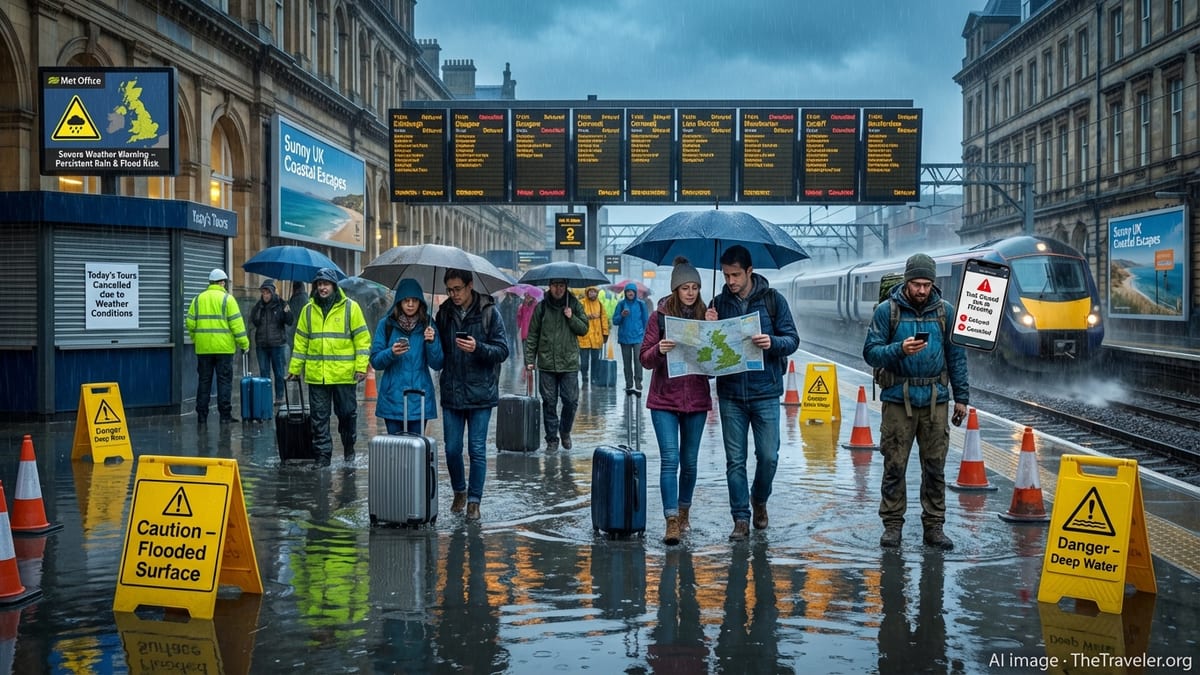
Passengers described crowded concourses at key interchange stations, with departure boards showing widespread cancellations and extended journey times. Travelers heading to and from airports, summer events and weekend breaks faced uncertainty as rolling updates advised against nonessential rail travel on the affected corridor.
For many international visitors and domestic holidaymakers using the line as a gateway to the Midlands, northern England and beyond, the incident served as a stark reminder of how a single infrastructure emergency can ripple across wider travel plans, hotel bookings and onward transport connections.
Safety record and implications for travelers
Context from transport analysts highlights that serious train collisions in the United Kingdom remain uncommon, particularly on electrified main lines equipped with modern protection systems. Recent decades have seen significant investment in signalling, track maintenance and driver training, contributing to a strong comparative safety record for rail travel.
Nonetheless, the Bedford crash follows other high-profile investigations into rail and tram incidents in Britain and elsewhere in Europe, keeping safety culture, fatigue management and equipment reliability in the public eye. Travel industry observers suggest that operators may now face renewed pressure to demonstrate robust risk controls, especially on intensively used commuter routes.
For travelers planning journeys in the coming days, rail companies are advising through public channels that tickets can often be used on alternative routes or at different times, subject to confirmation from the relevant operator. Trip planners and booking platforms are also flagging the disruption on the Midland Main Line, encouraging passengers to check the latest status of services before setting out.
Tourism bodies and travel advisors note that, despite the severity of the Bedford collision, rail remains one of the safest and most efficient ways to move around the United Kingdom. Even so, visitors are being urged to allow extra time, stay alert to timetable changes and follow guidance issued through official passenger information systems while recovery and repair work continues at the crash site.