


Landing at Palma de Mallorca Airport and figuring out how to reach the city centre does not need to be stressful. Whether you are a budget backpacker, a family with strollers and suitcases, or arriving on a late flight, there is a straightforward option that fits your needs. This guide walks you through the main ways to travel between Palma Airport and central Palma, comparing the A1 airport bus, taxis, private transfers, and car rental so you can make a confident choice before you land.
Get the latest updates straight to your inbox!
Understanding the Journey from Palma Airport to Palma
Palma de Mallorca Airport (PMI) sits roughly 8 kilometres from the heart of Palma, so the trip into town is short by European city standards. In normal daytime traffic, most journeys from the terminal to central areas like Plaça d'Espanya, La Seu Cathedral, or Santa Catalina take around 15 to 25 minutes, depending on the route and time of day. This compact distance means that even the slower, cheaper options are still quite practical.
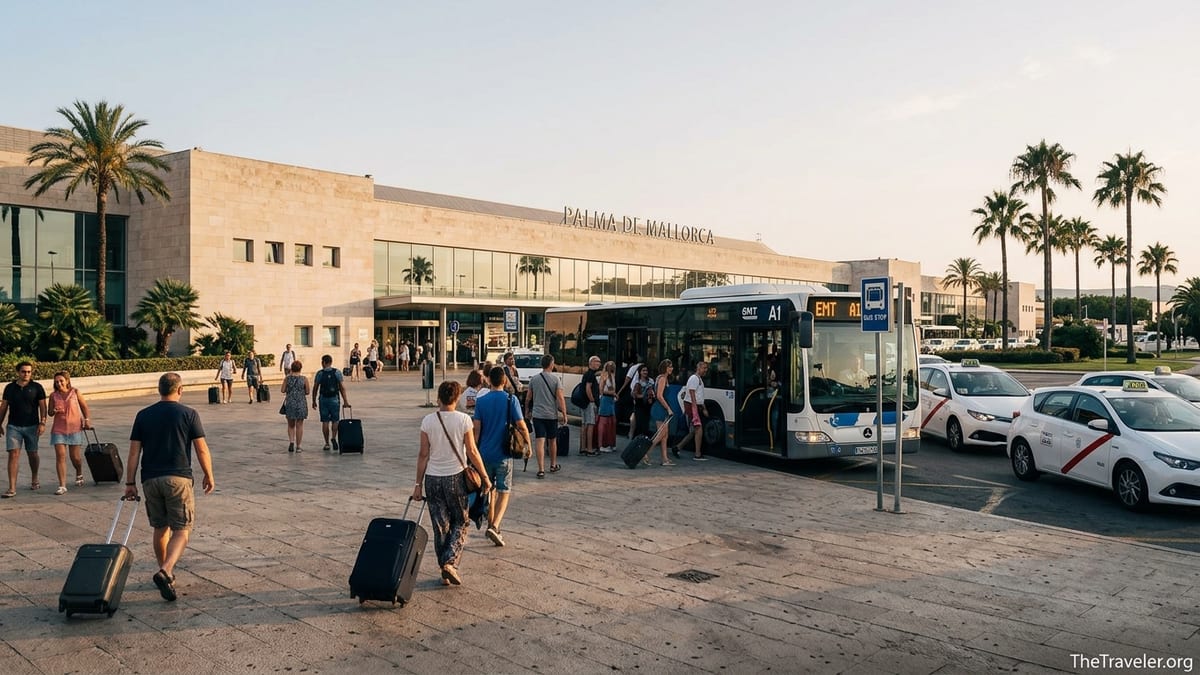
The airport has a single main terminal building. All public transport, taxis and most private transfer pick ups are concentrated just outside arrivals, so you do not need to navigate multiple terminals or long internal transfers. Once you pass customs and baggage claim, you simply follow the signs for “Bus” or “Taxi” and you will be outside in a couple of minutes.
When travellers talk about getting to “Palma city centre” they usually mean either Plaça d'Espanya, which is the main transport hub with the intermodal station, or the historic centre around the cathedral and the Passeig des Born. The A1 airport bus stops at Plaça d'Espanya and other central points, while taxis and private transfers will take you directly to a specific hotel or apartment anywhere in town.
Because the airport is so close to town, the main differences between transport options are not about journey time, but about cost, comfort, luggage handling and how well each one works late at night or with children and large suitcases. The next sections break each of these down in detail with real examples.
A1 Airport Bus: Cheapest and Very Practical
For most budget conscious travellers, the A1 airport bus operated by EMT Palma is the go to choice. It links the airport directly with Palma city centre and key downtown stops. As of mid 2026, the special airport fare is generally around the mid single digits in euros when you pay cash on board, and slightly cheaper if you tap your contactless bank card instead of buying a paper ticket. This makes it one of the least expensive airport to city routes in the western Mediterranean.
The bus stop towards Palma is located just outside the arrivals level. You exit the terminal, follow the signs for “Bus EMT” and look for the clearly marked A1 stop. The buses are modern, low floor city buses with space for suitcases and pushchairs. In normal daytime traffic the ride to Plaça d'Espanya usually takes around 20 minutes, with a few extra minutes if you stay on to the last stops around Passeig Mallorca and Es Baluard, which are handy for the old town and Santa Catalina.
Frequency varies slightly by season and time of day, but during the main daytime hours the A1 typically runs every 12 to 20 minutes. In July and August at midday, you can often step out of the terminal and see a bus already waiting or arriving within a couple of minutes. Early mornings and late evenings are less frequent, so if you land close to midnight you may need to check the latest timetable and be prepared to fall back on a taxi if you just miss the last departure.
The A1 is suitable for most kinds of luggage, but it is still a regular city bus. If you are a solo traveller or couple with standard checked suitcases and a backpack, it works very well. A family of four each rolling a full size suitcase and carrying beach gear might find the bus crowded, especially in high season when flights from all over Europe land within minutes of each other. Seats can fill quickly and you may end up standing for part of the journey.
Using the A1 Bus: Tickets, Stops and When It Makes Sense
Buying a ticket for the A1 is straightforward. You can usually pay the driver in cash with small notes or coins, or tap a contactless debit or credit card on the reader when you board and again when you get off. The contactless system often gives a lower fare than paying cash, and you do not need to buy a separate card beforehand. If you are staying in Palma and plan to use city buses during your visit, tapping the same card on other EMT routes can also keep costs down because of daily spending caps.
The key stops in Palma for most visitors are Plaça d'Espanya, which connects you to almost every other local and intercity bus, and Passeig Mallorca or Jaume III, which are convenient for hotels in the old town, around La Llotja and in Santa Catalina. Many travellers heading to boutique hotels near the cathedral ride the bus to Es Baluard at the end of the line and then walk 10 minutes through the historic streets to their accommodation.
As a practical example, a solo backpacker landing at 15:00 with a hostel near Plaça d'Espanya might be in their dorm by 16:00 using the A1, having paid only a few euros for the ride. Similarly, a couple staying in Santa Catalina can take the bus, get off near Passeig Mallorca and roll their carry ons the last few hundred metres, reaching their Airbnb without the expense of a taxi.
The A1 is less ideal if you have mobility issues, very young children who are already tired from the flight, or a lot of bulky luggage such as golf clubs or dive gear. In those cases the savings on the bus fare can quickly be outweighed by the hassle of managing everything on a potentially busy city bus, and a taxi or private transfer becomes more attractive.
Taxi from Palma Airport: Fast, Flexible and Simple
Official taxis are the most straightforward door to door option from Palma Airport to the city centre. The taxi rank is directly outside the arrivals hall, clearly signposted, and is operated by licensed white taxis with a green light and meter. In normal traffic the journey to central Palma takes around 15 minutes.
Fares are based on a meter with supplements for the airport and for journeys at night, on Sundays and public holidays. For a typical daytime trip from the airport to a central hotel near Plaça d'Espanya or the cathedral, many travellers currently report paying in the mid teens in euros, including the airport surcharge. Late at night or in heavy traffic the total can rise into the high teens or low twenties. Drivers are used to short city trips and should not hesitate to take you even if your hotel is close.
For small groups, a taxi can actually be quite good value. For example, a family of four landing at 21:00 with two large suitcases and two cabin bags might pay around the high teens in euros to reach a central hotel. Divided between four people, this works out at only a little more per person than the bus, while saving them from managing tired children and bags in a crowded vehicle. Taxis also handle luggage better, with space in the boot for several suitcases.
The main drawback is that in peak summer, especially on Saturday afternoons and evenings, queues at the taxi rank can form when multiple full flights arrive close together. You might wait 20 to 30 minutes in extreme cases. In shoulder and low seasons, or at times when there are fewer arrivals, you can often step straight into a cab. If you are landing very late at night and miss the last A1 bus, taxis are usually still available and are the simplest option to reach the city.
Private Transfers and Ride Services: Comfort and Certainty
Private transfer companies have grown in popularity in Palma, particularly with families, groups and travellers arriving very late at night or very early in the morning. These services work on a pre booked, fixed price basis. A driver meets you in the arrivals hall or at a clearly signposted meeting point inside the terminal, helps with luggage, and takes you directly to your accommodation in a private vehicle.
Specialist local companies, as well as larger international platforms, offer these transfers. Prices depend on the size of vehicle and exact location in Palma, but for a standard car or small van from the airport to an address in central Palma you can often expect a fixed rate somewhere in the low to mid twenties in euros for the whole vehicle. For a group of four to six people sharing one transfer, the per person cost sometimes matches or undercuts taking separate taxis, with the added benefit of a meet and greet service.
Private transfers are especially useful in late night and early morning scenarios. Imagine landing at 00:30 with two young children and several suitcases. By the time you clear passport control and baggage claim, the last A1 bus may have departed and the taxi rank could be busy with other delayed arrivals. With a pre arranged transfer, your driver tracks the flight, adjusts the pickup time if there are delays, and waits for you with a name sign. You walk straight to the car and are at your hotel in around 15 minutes without queuing.
Some services also offer extras like child seats on request, assistance for people with reduced mobility, or larger vans for groups with sports equipment. For travellers staying in residential neighbourhoods a little outside the most central tourist areas, the fixed price and direct route can be reassuring, especially late at night when you might feel less confident about public transport.
Renting a Car at Palma Airport: When It Does and Does Not Make Sense
Palma de Mallorca Airport is one of Spain's busiest holiday airports, and car rental desks are prominently located in the arrivals hall and in the nearby parking structures. Major international brands and local companies all operate here, and in high season you will see long lines at popular counters when multiple flights land at once.
For travellers whose plans focus mainly on Palma city itself, renting a car immediately on arrival is often unnecessary and sometimes inconvenient. The city centre has one way streets, bus lanes and limited parking, especially around the old town. Many hotels do not have their own garages, and public car parks in central areas charge hourly rates that can quickly add up. After factoring in rental costs, fuel, insurance and parking, using a car just to shuttle between the airport and a city hotel rarely makes financial sense.
On the other hand, if your itinerary includes exploring different parts of the island from day one, renting a car at the airport can be efficient. A couple arriving in the morning and planning to spend the afternoon in Palma might still pick up a car, drive into town, park in an underground garage near the cathedral, and then continue the next day to places like Valldemossa, Sóller or the eastern beaches. In this case, the car is part of a wider plan and not just a replacement for the airport bus or taxi.
If you decide to rent, it is worth booking in advance for the summer months, checking clearly what is included in the quoted rate, and reading the conditions on fuel, insurance excess and damage deposits. At the airport you will then follow clear signs to the car hire area, complete any final paperwork, and drive out on the main road that links directly to Palma in about 10 or 15 minutes.
Costs, Luggage and Late Night Considerations
When comparing options, it helps to think in terms of both total cost and per person cost. The A1 bus has by far the lowest individual ticket price, particularly if you pay with contactless and benefit from the reduced fare. For solo travellers and couples arriving during bus operating hours, it is difficult to beat the combination of price and convenience that the A1 provides.
Taxis and private transfers are more expensive in absolute terms, but the difference shrinks once you split the fare between three or four people. For example, if you pay around the high teens in euros for a taxi carrying four adults to the old town, the per person cost comes close to that of the bus, while gaining the comfort of a private ride, a guaranteed seat, no need to handle luggage on and off a bus, and a drop off at the door of your accommodation.
Luggage is a key factor in practice. The A1 bus can handle standard suitcases and backpacks, but boarding with very large or numerous bags at a busy time can be stressful. Taxis and private transfers place luggage in the boot or dedicated storage, so you do not need to keep an eye on it during the ride. Travellers arriving with items like collapsible wheelchairs, sports equipment or baby strollers often find the extra space and assistance from a driver worthwhile.
Late night arrivals are where your choices narrow. The A1 bus runs into the evening, but not 24 hours. If your scheduled landing time is after about 23:00, it is wise to check the latest timetable just before you travel and to plan a fallback. Many visitors aim for the last A1 and, if they miss it due to a delayed flight or slow baggage claim, simply walk outside and join the taxi queue. For flights landing shortly after midnight, booking a private transfer in advance removes uncertainty and can be particularly reassuring for solo travellers or those unfamiliar with the city.
The Takeaway
Getting from Palma de Mallorca Airport to Palma city centre is relatively quick and straightforward, with options to fit almost every kind of traveller. The short distance keeps journey times modest, and the choice between bus, taxi, private transfer and car rental mostly comes down to budget, comfort and your arrival time.
For most visitors arriving during the day with light to moderate luggage, the A1 airport bus is the best value choice, combining a low fare with a direct, reliable route into the heart of Palma. If you are in a group, carrying a lot of luggage or simply prefer a direct door to door ride, taxis and pre booked private transfers offer good comfort at a reasonable per person cost. Car rental is best reserved for trips where you genuinely need a vehicle to explore the island, rather than purely for the airport to city transfer.
By considering your group size, budget, luggage and flight schedule before you travel, you can decide confidently which option suits you best. That way, when you step off the plane in Mallorca, your journey into Palma will feel like the smooth start to your island stay rather than an unwelcome logistical puzzle.
FAQ
Q1. How long does it take to get from Palma Airport to Palma city centre?
The trip is relatively short. In normal daytime traffic, both the A1 airport bus and taxis typically take around 15 to 25 minutes to reach central areas such as Plaça d'Espanya or the old town.
Q2. What is the cheapest way to travel from Palma Airport to the city?
The cheapest option is usually the A1 airport bus operated by EMT Palma. The special airport fare is in the low single digits in euros when tapping a contactless bank card, and slightly higher if paying cash.
Q3. Where do I catch the A1 bus at Palma Airport?
After collecting your luggage and exiting customs, follow the signs for buses. The A1 stop towards Palma city centre is just outside the arrivals area, clearly marked with the route number and destination.
Q4. How late does the A1 airport bus run?
The A1 operates from early morning into the late evening, but it is not a 24 hour service. Exact first and last departure times can vary by season, so if you arrive late at night you should check the current timetable in advance and be prepared to use a taxi or transfer if you miss the last bus.
Q5. How much should I expect to pay for a taxi into central Palma?
Official airport taxis use a meter with supplements. For a typical daytime ride to a central hotel, many visitors report paying somewhere in the mid teens in euros, with higher fares at night, on Sundays and public holidays, or in heavy traffic.
Q6. Are private transfers from Palma Airport worth it?
Private transfers can be good value for families, groups, or anyone arriving very late or with lots of luggage. You pay a fixed price per vehicle, are met in the arrivals hall, and driven directly to your accommodation without queuing or managing bags on public transport.
Q7. Is it a good idea to rent a car just to go from the airport to Palma?
For travellers staying only in the city, renting a car purely for the airport transfer is rarely worthwhile. Central Palma has limited and often expensive parking, and the short journey is easily covered by bus, taxi or transfer. Renting becomes more sensible if you plan to drive around the island from the start of your trip.
Q8. Which option is best if I have a lot of luggage or sports equipment?
While the A1 bus can handle ordinary suitcases, taxis and private transfers are generally more comfortable if you have multiple large bags, golf clubs, dive gear or similar items. These services offer dedicated luggage space and help from the driver.
Q9. What should I do if my flight lands after the last A1 bus?
If you land after the A1 has stopped running, your practical choices are a taxi from the official rank or a pre booked private transfer. Both operate late at night, and a pre arranged transfer can be particularly reassuring if you are arriving alone or with children.
Q10. Does the A1 bus stop near the old town and Santa Catalina?
Yes. In addition to Plaça d'Espanya, the A1 serves central stops such as Passeig Mallorca and areas close to Es Baluard, which are within a short walk of the old town and the Santa Catalina district.